 by Tom Gurney
Tom Gurney BSc (Hons) is an art history expert with over 20 years experience
Published on June 19, 2020 / Updated on October 15, 2026
Email: tomgurney1@gmail.com / Phone: +44 7429 011000
Titian's Christ Carrying the Cross in the Prado: Introduction
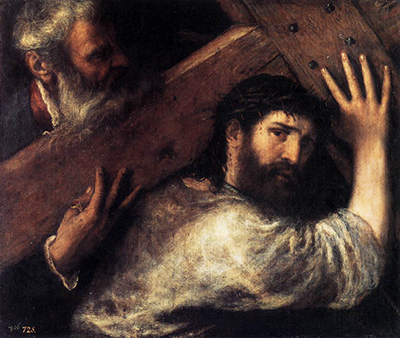
Christ looks out from beneath the heavy wooden cross. Simon of Cyrene leans in behind him, one hand pressed to the beam. Their heads are close, and there is almost no room left for road, crowd or landscape. Titian turns the journey to Calvary into a direct encounter with suffering and assistance. This painting is in the Museo Nacional del Prado, Madrid, inventory P000438. The museum dates it about 1565 and records it as oil on canvas, 67 × 77 centimetres.[1][2]
The exact inventory is essential here. The Prado holds another Titian picture of Christ and Simon, P000439, painted about five years earlier. The later P000438 is the compact scene with Christ in the near foreground addressing the viewer; the earlier P000439 gives more room to the journey and shows Christ fallen on his knees. Their similar subjects make it easy to transfer details, patronage or technical findings from one canvas to the other. The focus here is the later, smaller painting.[1][3]
At a Glance
- WorkChrist Carrying the Cross
- Research recordMuseo Nacional del Prado
Contents
- A close encounter under the beam
- Was Simon painted as Francesco Zuccato?
- Two Prado treatments of the same journey
- From private devotion to the royal collection
A close encounter under the beam
The cross moves diagonally through the image, cutting between Simon's darker figure at the upper left and Christ's illuminated body at the lower right. Christ's raised hand reaches across the wood; his other hand remains near its lower edge. The timber is not a distant sign of a future event. It is a large physical burden in the same narrow space as the two people who bear it. Titian makes the viewer feel its breadth by allowing it to interrupt the figures' bodies and the picture's edges.[1]
Christ turns his face outward rather than exchanging a gaze only with Simon. The Prado describes bloodshot, tearful eyes and a rope around his neck. These details ask the viewer to respond to a person under strain. Simon looks down from behind the cross, his hand indicating the practical act of support. The two figures do not occupy equal light or equal space, but their proximity is the painting's central relationship. The Gospel accounts name Simon as the man made to bear the cross on the way to Golgotha; Titian concentrates that brief narrative action into the meeting of faces, hands and wood.[1][3]
Christ's pale garment is built from shifting light and shadow, rather than outlined as a single smooth form. The warm, dark tones behind Simon press the figures forward. A few bright accents on hand, face and sleeve make the small canvas legible even when the viewer stands back. Up close, the varying strokes keep skin, cloth and rough timber distinct. The painting invites intimate inspection, but its diagonal structure remains forceful from a distance.[2]
The ring displayed on Simon's hand is conspicuous. The Prado suggests that someone who commissioned the painting may have wanted to see himself, or a figure associated with him, in the role of the Cyrenian. Such a choice would transform the helper from a small biblical participant into a model for devotional identification: the patron imagines sharing Christ's weight. The ring is visible evidence of emphasis; the patron's exact intention remains an interpretation.[1][2]
Was Simon painted as Francesco Zuccato?
The seventeenth-century writer Carlo Ridolfi described a Titian picture of this subject in which Simon resembled Francesco Zuccato, a friend of the painter. The Prado explains that Ridolfi's testimony appears to refer to a related version now in the Hermitage. Because Simon's facial features are similar in the Hermitage and Madrid paintings, the museum considers it plausible that Zuccato provided the model for the Prado figure as well. That is a reasoned connection between later testimony and surviving images, not a surviving contract for P000438.[1]
The Prado goes further and proposes that the Madrid canvas was made for Zuccato, while the Hermitage replica came through the Barbarigo collection after acquisition from Titian's heirs. This argument would account for both the prominent ring and the version histories. Its evidential limit is equally important: the museum's account does not produce an original Zuccato receipt or a continuous early provenance for P000438. The picture's devotional force does not depend on treating the proposed patron as settled fact.[1][2]
A related drawing in Budapest, attributed to Pietro Malombra, has been connected with this design. The Prado says either the Madrid picture or the Hermitage replica could have served as its point of departure. Repetition thus extends beyond Titian's canvases into later drawing, but the direction cannot be fixed securely from the present evidence. The Hermitage image, the Madrid original and the Budapest sheet each need their own attribution and object history.[2]
Two Prado treatments of the same journey
The earlier Prado picture, Christ on the Way to Calvary P000439, is larger at 98 × 116 centimetres and dates to about 1560. There Christ has fallen to his knees and braces a hand against a signed stone. The museum identifies several planes stretching toward a faint Golgotha and evening light. Christ and Simon face one another while the viewer watches the scene unfold. P000438 shortens that narrative distance: the background recedes, the heads fill more of the surface and Christ's gaze crosses the boundary between painting and spectator.[3]
This is more than a change of size. The Prado notes a difference in the painted red clothing. In the earlier canvas a thin, translucent red layer required darker lines to strengthen its volume; in the later one the tunic is built by strokes of differing tones laid over one another. Both works belong to Titian's continuing exploration of the subject, yet their visual effects are distinct. Reading one painting's colour or composition as a description of the other would erase the very development the museum asks viewers to notice.[2]
The earlier P000439 has its own X-ray history. The Prado reports that Simon initially wore a turban and that the cross may first have been held aloft by both figures, with their hands arranged differently. Those findings explain revisions to P000439; they are not findings about P000438. For the later P000438, the Spanish Prado record reports a different technical story: Titian reused a canvas that had already carried an Ecce Homo with a reed. The record also observes changes in the positions of both figures' fingers, visible at the surface. One canvas reveals revisions to the Calvary scene; the other contains an earlier subject beneath its current image.[2][3]
A painting of Christ carrying the cross from about 1526 by Lorenzo Lotto, now in the Louvre, is among the Venetian precedents named by the Prado. Lotto's diagonal cross and tearful Christ provide a comparison in how a devotional subject can come close to the viewer. The Prado also names works by Bartolomeo Montagna and Altobello Melone. These precedents place Titian within a regional visual tradition without reducing the Madrid canvas to a copy of any one model. Its own balance of Simon's aid, Christ's direct look and the massive beam is what gives it a particular force.[1][3]
The National Gallery's account of Altobello Melone's c.1515 Christ Carrying the Cross clarifies the contrast. Melone also crops the story close, but soldiers grasp the rope and threaten Christ. In Titian's later Prado canvas, Simon occupies the supporting position at the other side of the beam. The two images share a powerful near view while assigning different roles to the person beside Christ. The Louvre identifies Lotto's Portement de croix as a separate 1526 Venetian oil painting. The Prado's comparison to Lotto concerns the diagonal structure and tearful proximity, not the identity of painter, patron or surviving object.[3][4][5]
This difference in the accompanying figure changes the work a viewer is invited to do. With an aggressor beside Christ, attention falls on violence inflicted. With Simon beside him, attention can also fall on the difficult act of sharing a burden. P000438 retains the rope and wounded face, so help does not erase suffering. Titian compresses both into the same unstable space. The drama is heightened by what is omitted: a procession, distant destination and crowd would provide more story but also allow more distance from the two faces.[1][3]
From private devotion to the royal collection
The small landscape canvas could have suited close viewing, and the Prado's proposed Zuccato connection suggests a personal devotional setting. Its first location, however, is not documented in the museum's public account. The later route is firmer. The Marquis of Leganés acquired P000438 in Italy between 1637 and 1642, then gave it to Isidoro Aliaga, Archbishop of Valencia. By 1666 it was recorded in the Spanish Royal Collection.[1]
The Spanish Prado account traces it through royal spaces: the Alcázar in Madrid until the fire of 1734, the Buen Retiro in 1746 and the New Royal Palace in 1794, before its transfer to the Prado. These stops concern the physical P000438 canvas. They must not be exchanged with the history of P000439, which entered the Escorial in 1574 and hung in Philip II's private oratory before arriving at the Prado in 1845. The two works eventually shared a museum, but for centuries they served different owners and places.[2][3]
The Prado's detailed inventory trail places P000438 in a bedroom off the Alcázar's south gallery in 1666 and again in later seventeenth-century listings. After the 1734 palace fire it appears among works moved toward the Retiro, and eighteenth-century records locate it in rooms used by members of the royal household. By 1826–27 it is listed in a palace chapel sacristy. Those changing spaces do not prove how each viewer used the painting, but they show why “a royal devotional picture” is a broader category than a fixed chapel commission. The canvas survived movements and changes in display before becoming a museum object.[2]
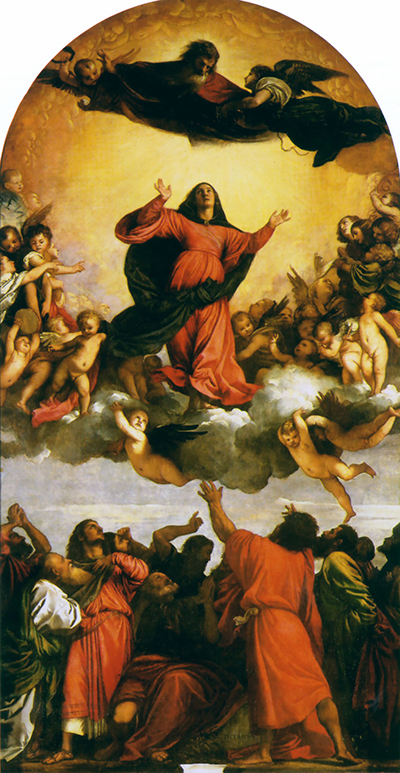
The paintings guide places the late Calvary canvas among Titian's many treatments of sacred stories. The Assumption of the Virgin in Venice shows how differently he could address worshippers through scale and setting. In P000438 the spectator is brought almost against the cross, with little chance to remain a distant witness. The closeness of Christ and Simon gives assistance a visual form that survives the uncertainties about the patron's name.[1]
Researched Titian and related works
Frequently Asked Questions
It is Titian's P000438, Christ Carrying the Cross, about 1565, oil on canvas, 67 × 77 centimetres. Prado P000439 is an earlier, larger treatment called Christ on the Way to Calvary.[1][3]
Simon of Cyrene. The Prado considers a resemblance to Titian's friend Francesco Zuccato plausible, based on Ridolfi's later testimony and comparison with the Hermitage version, but no original commission document identifies him as the patron.[1]
The Prado's Spanish record says P000438 was painted over an earlier Ecce Homo with a reed. This is a finding about the material canvas, not another visible scene in the finished composition.[2]
Discussion
What do you notice when you look closely at Titian's Christ Carrying the Cross in the Prado?
Share a specific observation or a source that adds context.
Reader Insights
Which detail changes your reading?
How does its original setting affect what we see?
Which part of the evidence remains uncertain?
Join the Conversation
Add your observation below.
References
- Museo Nacional del Prado, “Christ carrying the Cross,” collection record P000438, English. View source.
- Museo Nacional del Prado, “Cristo con la cruz a cuestas,” collection record P000438, Spanish. View source.
- Museo Nacional del Prado, “Christ on the Way to Calvary,” separate collection record P000439. View source.
- National Gallery, London, “Altobello Melone, Christ carrying the Cross,” collection record NG6546. View source.
- Musée du Louvre, “Lorenzo Lotto, Le Portement de croix,” collection record RF 1982 50. View source.