 Buy Art Prints Now
from Amazon
* As an Amazon Associate I earn from qualifying purchases.
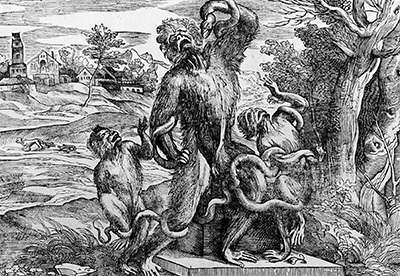
Caricature of the Laocoön Group, woodcut attributed to Niccolò Boldrini after Titian. National Gallery of Art, public-domain image. Image source.
 by Tom Gurney
Tom Gurney BSc (Hons) is an art history expert with over 20 years experience
Published on June 19, 2020 / Updated on October 15, 2026
Email: tomgurney1@gmail.com / Phone: +44 7429 011000
Titian's prints: designs, cutters and impressions: Introduction
Titian's paintings were made for churches, civic spaces and named patrons. Prints could carry related images to readers who would never see the canvases. Yet a print connected with Titian is rarely a small painting transferred mechanically onto paper. One person might invent a composition, another cut its woodblock or engrave its plate, and a publisher might issue it years later. The individual sheet now in a museum is an impression with its own paper, condition and history. Keeping those roles separate prevents “by Titian” from becoming an unsupported claim.[1][2][3]
His print connections include monumental woodcuts, an expressive landscape, a learned parody of ancient sculpture and engravings after paintings. Some images were probably conceived for the printed medium; others translate an image first made in paint. Several survive as incomplete sections or in later editions. These distinctions shape what we can learn about Titian's invention, his collaborators and the wider life of his compositions.[1][3]
At a Glance
- SubjectTitian Prints
- ScopeVenetian Renaissance art
- Source approachCollection records and primary documents
Contents
- What “after Titian” means
- Woodcut, engraving and chiaroscuro
- Titian and Venetian publishing
- Saint Jerome: an unresolved cutter
- The Red Sea: twelve blocks and a 1549 edition
- The Triumph of Christ: one block, two dates
- The Laocoön caricature: an image made to change its source
- Martino Rota and a lost altarpiece
- Cornelis Cort and Diana and Callisto
- Reading a print record step by step
What “after Titian” means
A museum label reading “Martino Rota, after Titian” names Rota as printmaker and identifies a Titian composition as its source. It does not say Titian held the engraving tool. “Attributed to Niccolò Boldrini, after Titian” adds uncertainty about the proposed cutter. A question mark before “after Titian” qualifies even the design relationship. The Met uses these different forms of wording in records for prints associated with him. A responsible caption preserves their exact degree of certainty.[2][3][4]
“After” also covers more than one sequence of work. A print might follow a finished painting, a drawing, a workshop version or another print. A woodcut might be designed to exploit the rhythm of carved line; an engraving might reorganise a painted scene for black ink. The surviving sheet proves a relationship to an image, but it does not alone establish Titian's degree of oversight, the source's date or every colour and surface of a painted original. Each question needs evidence for the particular object.[1][2][5]
Woodcut, engraving and chiaroscuro
In a woodcut, a specialist removes parts of a block so the raised surface receives ink. Paper pressed against that surface takes the image. Broad light areas may be unprinted paper; dense dark passages come from ink and closely spaced strokes. A woodcut that resembles Titian's drawing still depends on a cutter's decisions. The cutter has to make lively turns, irregular textures and deep shadows survive the limits of wood. This collaboration is especially visible in Saint Jerome in the Wilderness.[2]
An engraving starts from a metal plate into which lines are incised. Ink held by the grooves prints fine contours and hatching. Martino Rota's Martyrdom of Saint Peter is catalogued as an engraving, so its lines should not be described as marks cut in a woodblock. Nor can those marks reproduce the literal colours, paint thickness or reflected light of Titian's lost painting. They are a skilled translation in another material.[4]
A chiaroscuro woodcut uses multiple blocks to print broad tone and line. Each block needs a separate pass and careful alignment. The National Gallery of Art describes a distinctive Venetian practice of elaborate linework with large areas of one tone. Its account of Boldrini's Hercules and the Nemean Lion provides a clear technical comparison: black and tan ink from two blocks, whose registration affects the result. That work bears an inscription naming Raphael, so it explains the process but must not be presented as a Titian design.[6]
Titian and Venetian publishing
Sixteenth-century Venice was a major centre of printing, and Titian's relations with writers and publishers opened paths beyond individual commissions. The Met describes Francesco Marcolini as a publisher close to Pietro Aretino and connected with Titian. Marcolini published Aretino's Stanze in 1537 with an unusual chiaroscuro frontispiece usually attributed to Titian. That careful phrase is more informative than declaring the attribution settled. It also does not imply Titian cut the blocks.[1]
Publishing joined writers, designers, cutters, printers and sellers. A frontispiece could make an image part of a book's identity; a large standalone sheet could circulate beyond one reading community. Publishers and issue dates belong to the work's history. This network also makes “Titian's print style” a risky shortcut. The Met identifies Jan Steven van Calcar's illustrations for Vesalius's anatomy book and Giovanni Maria Verdizotti's images for moral fables as designs by artists close to Titian. Their accomplished figures and landscapes have tempted later attributions to him. Studio association and visual resemblance cannot transfer their labour to Titian.[1]
The National Gallery of Art's exhibition Titian and the Venetian Woodcut assembled 114 woodcuts by Titian and other Venetian artists. That is the scale of an exhibition field, not a count of prints personally carved, or even invented, by Titian. The number is useful only with its full description.[7]
Saint Jerome: an unresolved cutter
The Met's St. Jerome in the Wilderness is a mid-sixteenth-century woodcut after Titian on a sheet measuring 38.8 by 54.1 centimetres. The penitent saint appears small within a landscape of moving trees, rocks, water and sky. Carved strokes swell and change direction in a way the museum compares with Titian's pen. Packed marks make shadow, while open paper lets light interrupt the terrain. The surrounding world has an active role in the image, rather than serving as a neutral backdrop to the saint.[2]
But those strokes are not a direct record of Titian's hand. A cutter turned a design into a printable block. The Met considers Niccolò Boldrini and Giovanni Britto possible makers and says the evidence cannot securely choose between them. The National Gallery of Art labels its own impression Boldrini after Titian. These are not interchangeable catalogue statements. One can describe a design after Titian and report the cutter debate, while recognising that the two museums also hold different physical impressions.[2][8]
This image is useful beside the drawings guide: drawn motion could become a repeatable image through another maker's work. Its stark black and white also makes landscape's directional energy visible without the colour and brushwork of a canvas. Calling the woodcut expressive describes what can be seen; naming one cutter with certainty would outrun the Met's evidence.[2]
The Red Sea: twelve blocks and a 1549 edition
The Submersion of Pharaoh's Army in the Red Sea goes beyond the dimensions of an ordinary single-block print. The Met describes a design made from twelve separate blocks, its largest woodcut design associated with Titian. Object 22.73.3-136 is only one surviving section, made of two joined sheets and measuring 80.6 by 55.3 centimetres. It shows part of the drowning army. The museum's object is neither the whole assembled composition nor the blocks from which it was printed.[3]
The Met dates the design to about 1515, partly through an early petition listing the subject. It identifies Domenico dalle Greche as publisher of this 1549 edition. Thus “made in 1515” would be ambiguous for the particular sheet. A later publication can carry an earlier design into a different moment and audience. The Met also marks the design relationship “? After Titian.” That question mark belongs in any careful summary, even though the print's scale makes it a compelling part of the Titian story.[3]
At this size, physical construction becomes visible as part of the work. Land, water and fleeing figures must form a coherent story across block boundaries and paper joins. Repeated marks can unite its turbulent areas, while the seams record planning by designers, cutters, printers and publishers. An image of one section cannot show precisely how every full set was displayed. It can document the ambition of the composition and the material nature of one impression.[3][9]
The Triumph of Christ: one block, two dates
The National Gallery of Art's record for block 8 of The Triumph of Christ dates it around 1510–11 but says it was published after 1545. The title marks the object as one numbered part of a larger composition. Calling that one section a complete print would erase its structure; assigning its later publication date to the invention would erase a chronological distinction. The NGA credits Titian in its artist field, but that does not identify the hand of every cutter involved.[10]
The Red Sea and Triumph records show why a list of “Titian prints” ordered by impression dates cannot serve as a simple timeline of his designs. An edition may transmit an invention from decades earlier. A surviving section may offer only a fraction of a narrative. The composition and the actual sheet in a collection are related subjects of study, yet they answer different questions.[3][10]
The Laocoön caricature: an image made to change its source
The Caricature of the Laocoön Group remakes a celebrated sculptural subject as monkeys struggling with snakes. The National Gallery of Art dates the woodcut to about 1540–45 and attributes it to Niccolò Boldrini after Titian. Central and flanking bodies keep the idea of an entangled group, while the substitution of animals makes the reference witty and unsettling. It is a good example of print invention rather than a straightforward distribution of a Titian painting.[11]
“Attributed” still matters in the maker line. The visible parody also does not, by itself, prove its intended target. We can describe the relationship to the ancient group and the comic substitution without claiming it attacked a particular opponent or artistic doctrine. Prints took part in artists' arguments and conversations, but a plausible account of this image's wit remains interpretation until supported by more specific evidence.[11]
Martino Rota and a lost altarpiece
Martino Rota's Martyrdom of Saint Peter engraving documents a different type of relationship. The Met names Rota as artist, Titian as the source identified by “after,” and Luca Guarinoni as publisher. It dates the engraving around 1560. Its impression, object 17.50.16-155, has a trimmed arched top and measures 40.1 by 27.2 centimetres. These are details of a particular sheet, not measurements of Titian's altarpiece.[4]
The source composition is especially significant because the painting for the Dominican church of Santi Giovanni e Paolo was later destroyed. Rota's engraving preserves evidence about figures and arrangement, but it is not a colour photograph of the lost work. The engraver selected marks fit for a plate, and the Met sheet was subsequently trimmed. Other copies and descriptions also matter when reconstructing the painting. The print is strongest evidence when its difference from the original remains explicit.[4][12]
The National Gallery of Art dates Titian's altarpiece to 1529 and its destruction to 1867; it notes a full-sized copy in the church. Rota's print therefore predates the fire by centuries. That timing makes it an independent early witness to the composition, even though it is a translation. A later copy may preserve scale and some colour relationships that the engraving cannot, while the engraving may keep details that subsequent copying altered. Neither source should automatically control the other. For a lost painting, comparison among these witnesses is more revealing than treating any one of them as an exact surrogate.[4][12]
“After Titian” here acknowledges both an underlying invention and a second artist's skill. The publisher supplies another role in the print's circulation. The accession number allows a reader to locate the exact Met impression instead of relying on an online image that might show a different state, edition or engraving.[4]
Cornelis Cort and Diana and Callisto
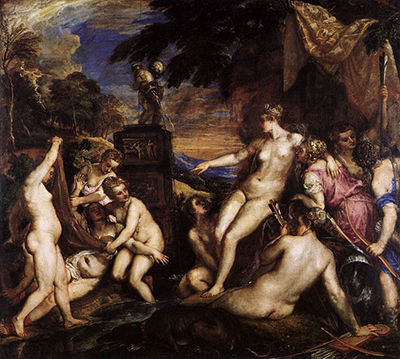
Print circulation was not limited to early religious works. The National Gallery's account of Diana and Callisto says Titian had its composition engraved by Cornelis Cort in 1566. He made the painting for Philip II in 1556–59, and a full-sized workshop variant also followed. The royal canvas, the variant and the engraved image are three kinds of object. Their existence demonstrates continued interest in the composition, without making them identical.[5]
The Gallery interprets Titian's decision to have Cort engrave the image as a sign that he considered it suitable for broad circulation. That reading rests on the documented print relationship. The print's black and white articulation nevertheless offers a different encounter from the canvas's colour, brushwork and scale. A reader of the poesie guide can use this engraving to consider which poses and gestures remained legible when the material qualities of paint were removed.[5]
Reading a print record step by step
Start with the title and accession number. A title might designate a whole composition or one section, as in the Met's Red Sea record. The accession number anchors the description to a physical museum object. Read every part of the maker line: “by,” “after,” “attributed to” and a question mark carry different claims. Then check the medium. Woodcut, engraving and multiblock chiaroscuro require distinct tools and leave distinct printed effects.[2][3][4][6]
Read each date with its noun. Design, cutting or engraving, first issue, later edition and the printing of a particular impression need not coincide. The Red Sea record explicitly separates a c.1515 design from a 1549 publication. The Triumph block likewise combines an early design with an issue after 1545. A bare date conceals more than it explains. Check publisher, size, trimming, joins and condition as well: they tell you why a digital image may differ from another sheet and how much of a multipart design it preserves.[3][4][10]
Finally, compare museums' catalogues without forcing false agreement. The Boldrini/Britto question for Saint Jerome is a real research problem, not an error to hide. Where one record is firm and another qualified, report that distinction when it affects the reader's understanding. The technique guide follows related choices in paint, and the paintings guide leads to works that prints circulated or recalled. Prints are designed and manufactured works in their own right as well as evidence of how far Titian's images travelled.[2][8]
The same care helps when looking at reproductions online. A cropped digital file may suppress an inscription, the edge of a joined sheet or evidence that an impression has been trimmed. The Met's Red Sea object is specifically a two-sheet section; Rota's print has a trimmed arched top. Before comparing two images as if they were separate designs, check whether they are different impressions, different states, parts of one composition or simply differently cropped photographs. The collection record gives a stable point of return when an image circulates without its full caption.[3][4]
Researched Titian and related works
Frequently Asked Questions
The records here do not establish that he did. They name makers such as Rota and propose Boldrini or Britto for a major woodcut, while linking designs or painted compositions to Titian. Give him a specific craft role only when an object record supports it.[2][4]
An impression is one sheet printed from a block or plate. It has its own accession number, paper size and condition. It is neither the matrix nor every other sheet printed from it.[2][3][4]
One date may refer to the design, another to the edition. The Met's Red Sea section gives c.1515 for the design and 1549 for publication; the NGA's Triumph block also records an early design and later issue.[3][10]
Discussion
What do you notice when you look closely at Titian's prints: designs, cutters and impressions?
Share a specific observation or a source that adds context.
Reader Insights
Which detail changes your reading?
How does its original setting affect what we see?
Which part of the evidence remains uncertain?
Join the Conversation
Add your observation below.
References
- Wendy Thompson, Metropolitan Museum of Art, “Woodcut Book Illustration in Renaissance Italy: Venice in the Sixteenth Century” (2004). View source.
- Metropolitan Museum of Art, “St. Jerome in the Wilderness,” object 22.73.3-119. View source.
- Metropolitan Museum of Art, “The Pharaoh's army drowning,” section from The Submersion of Pharaoh's Army in the Red Sea, object 22.73.3-136. View source.
- Metropolitan Museum of Art, “The Martyrdom of Saint Peter,” Martino Rota after Titian, object 17.50.16-155. View source.
- National Gallery, London, “Titian, Diana and Callisto.” View source.
- National Gallery of Art, “Hercules and the Nemean Lion,” technical account of Venetian chiaroscuro. View source.
- National Gallery of Art, “Titian and the Venetian Woodcut,” exhibition overview. View source.
- National Gallery of Art, “Saint Jerome in the Wilderness,” Niccolò Boldrini after Titian. View source.
- National Gallery of Art, “The Submersion of Pharaoh's Army in the Red Sea.” View source.
- National Gallery of Art, “The Triumph of Christ [block 8].” View source.
- National Gallery of Art, “Caricature of the Laocoon Group,” object 1972.49.4. View source.
- National Gallery of Art, “Titian,” artist biography, with the date and fate of the Death of Saint Peter Martyr altarpiece. View source.