by Tom Gurney
Tom Gurney BSc (Hons) is an art history expert with over 20 years experience
Published on June 19, 2020 / Updated on October 15, 2026
Email: tomgurney1@gmail.com / Phone: +44 7429 011000
Titian’s Portrait of Clarissa Strozzi: Introduction
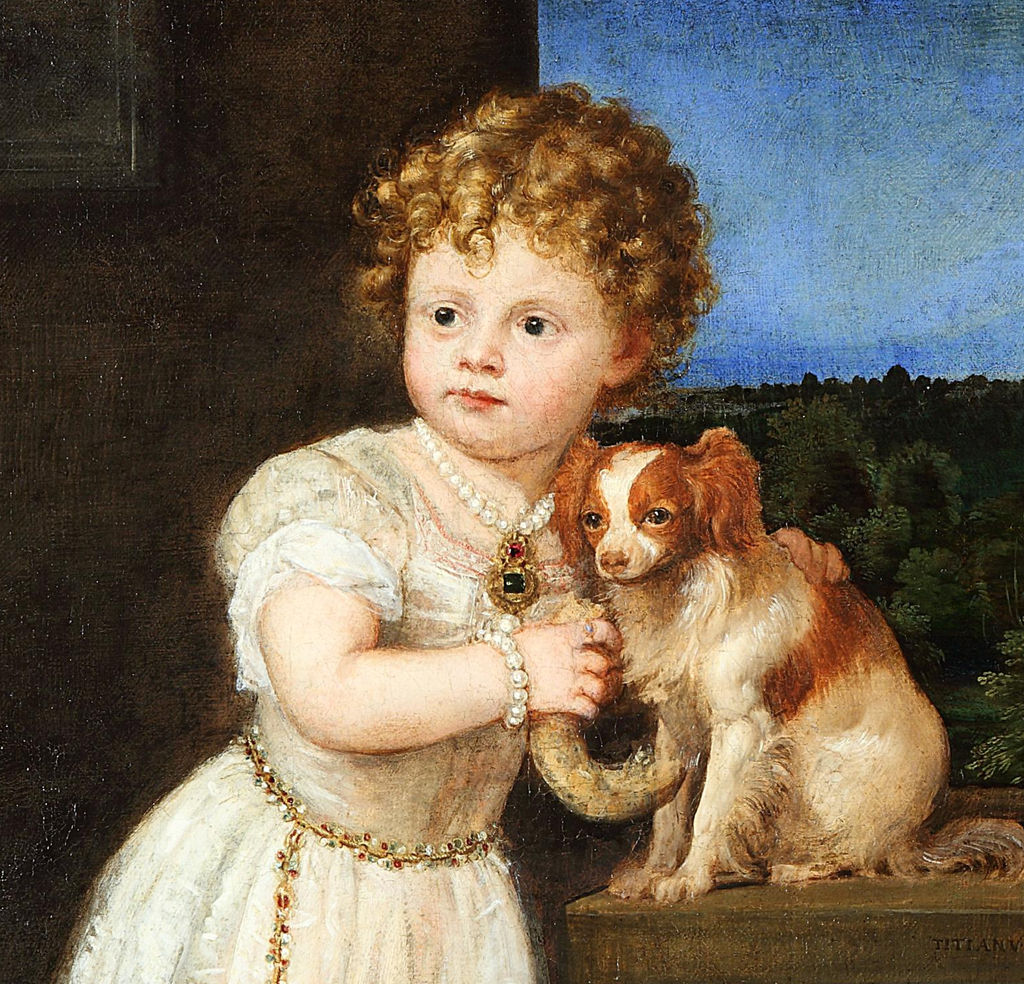
A little girl offers a ring-shaped biscuit to a small dog on a stone table. She wears a long pale silk dress and a string of jewels nearly as long as she is tall. Her head turns away from the animal, while the dog looks out at us. Titian makes the gesture lively without letting the picture become a casual snapshot: an inscribed plaque, a carved relief, a costly costume and a carefully opened landscape surround the child. The painting tells us who she is and how old she was, yet it also asks what a family wanted such a portrait to say about her future.[1][2]
The sitter is Clarissa Strozzi, aged two, daughter of Roberto (Ruberto) Strozzi and Magdalena de’ Medici. Titian made the painting in Venice in 1542. Its current owner, Berlin’s Gemäldegalerie, records it as inventory 160A, an oil painting on canvas measuring 121.7 × 104.6 centimetres. The alternative name Clarice Strozzi, found in scholarship and museum exhibitions, refers to the same child.[1][2]
At a Glance
- WorkClarissa Strozzi
- Research recordsearch.smb.museum
Annotated details from Clarissa Strozzi
Select a numbered area to find its detail below. Open a detail image to view it larger.
Details from CLARISSA STROZZI
Clarissa Strozzi Child and Dog
Clarissa Strozzi Dated Plaque
Clarissa Strozzi Putti Relief
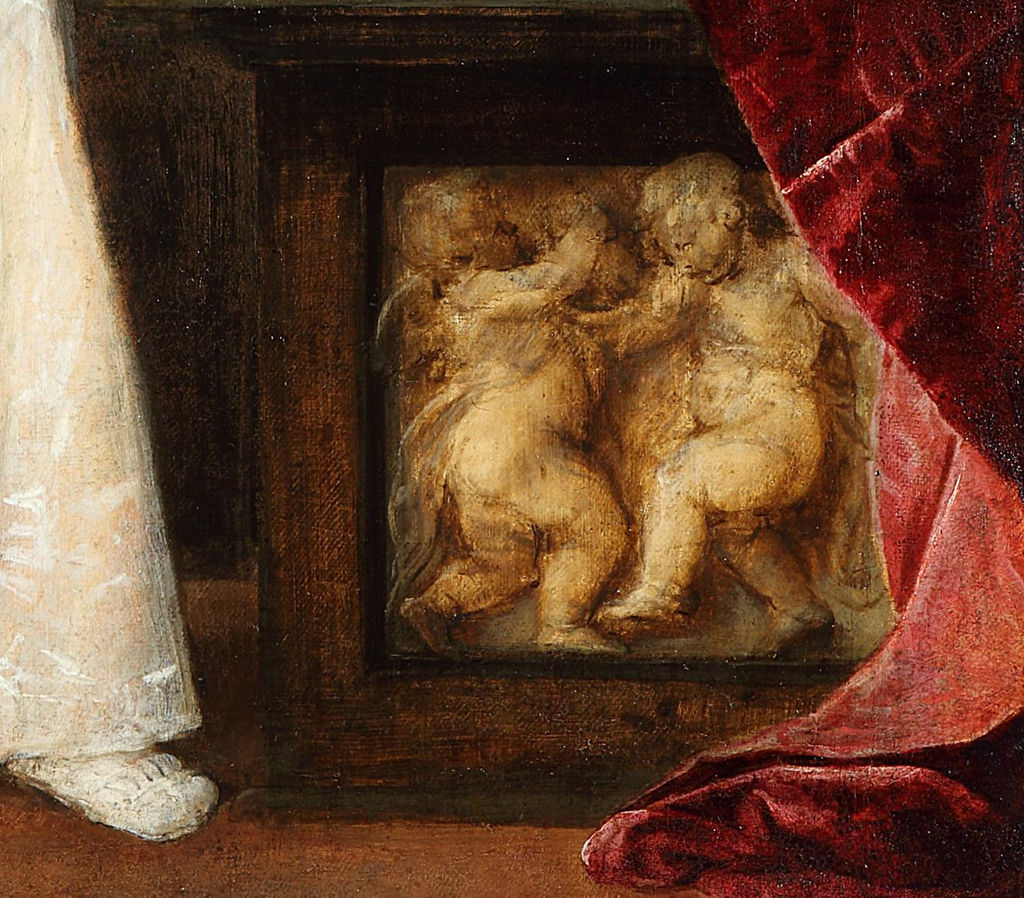
Photo: Staatliche Museen zu Berlin, Gemäldegalerie / Christoph Schmidt. Public Domain Mark 1.0. Cropped and resized. Image source · Reuse licence
Contents
- The child, the dog and the ring of bread
- Inscription, signature and landscape
- An individual child in a prominent family
- Childhood or an imagined adult future?
- Four centuries in the Strozzi story
The child, the dog and the ring of bread
Clarissa stands next to the dog rather than sitting formally before the viewer. She holds a ring-shaped piece of bread near its mouth. The animal is small enough to fit on the table beside her, its brown-and-white coat standing out against the stone. Her hands are engaged with it, but her eyes drift elsewhere. This slight mismatch between action and gaze makes the moment more plausible: a two-year-old can perform a familiar game while her attention moves to something outside the painting.
Berlin’s catalogue calls the food a pretzel; a National Gallery of Art lecture describes it as a ring-shaped biscuit, and art historian Beverly Louise Brown uses the Italian ciambella in a symbolic reading. These labels point to the same prominent ring in Clarissa’s hand but place different weight on its meaning. The visible exchange with a pet is secure. A connection between that bread shape and future motherhood is an interpretation to examine, not a fact written on the canvas.[1][2][3]
Her clothing is unusually grand for a scene of play. The long ivory dress falls nearly to her shoes; its pale surface carries delicate changes of light across sleeves and skirt. Pearls and other jewels surround her neck and wrists. A slender chain drops from her belt almost to the floor, ending in an ornament that Berlin identifies as a pomander, or scent container. The long chain makes her smallness apparent even as the objects mark family resources and rank.[1]
The body of the dress creates a broad, luminous shape in the foreground. Behind her, the left wall remains dark. This contrast keeps the child legible from a distance, while the jewel at her waist and the dog provide points for closer inspection. Titian’s design holds together two speeds of looking: first the bright figure, then the individual signs of wealth and the small domestic gesture. The face is carefully observed without requiring the child to pose like an adult in a state portrait.
Inscription, signature and landscape
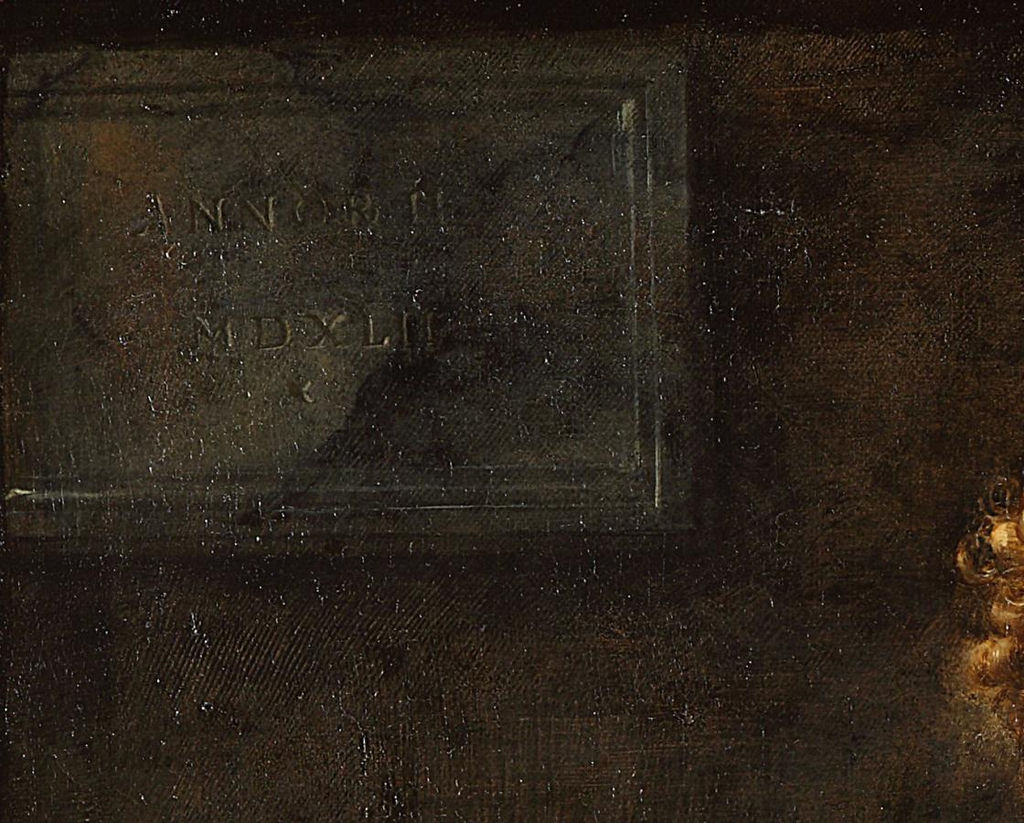
The picture names its own moment. A plaque at upper left bears the age and year, transcribed by Berlin as “ANNOR. II. MDXLII”: two years old, 1542. The front edge of the stone table carries “TITIANVS. F”, recording Titian’s authorship. Those markings are unusually direct anchors for a portrait whose sitter also appears in a contemporary letter. They do not, however, tell us exactly where in the family house it was first hung or what private hopes accompanied its making.[1]
The table is more than a prop on which to perch the dog. Its base contains an antique-style relief of two small putti in energetic movement. Berlin describes them as dancing. Brown reads their bodies as wrestling or play-fighting and uses them in a larger argument about future marriage and children. The relief is visible, but its precise symbolic programme is not supplied by an inscription. It can bring another pair of children into the image without forcing one interpretation of every gesture.[1][3]
At upper right, a window opens towards trees, water and two swans. The green distance offers release from the near figure and dark room. Berlin notes that Titian apparently painted over a mountain range beyond the park, expanding the blue sky. That is a recorded alteration within this painting, not evidence that the setting represents a named villa or that the swans were added in the same campaign. The visible landscape helps balance the plaque’s dark corner and the bright child below.[1]
A rich red fabric drapes over the far right edge of the table and falls into the lower corner. Its colour makes the pale dress and dog seem brighter. The arrangement has strong visual anchors at each side: shadow and writing at left, landscape and red drapery at right, Clarissa between them. The portrait feels open because of the child’s motion and the outdoor view, but its elements have been deliberately placed.
An individual child in a prominent family
Berlin dates Clarissa’s life 1540–1581 and calls her the eldest daughter of Roberto Strozzi and Magdalena de’ Medici. Both parents were Florentine, living in exile in Venice during the years around her birth and portrait. The museum says she was presumably named for her grandmother, Clarissa de’ Medici. “Presumably” matters here: it is a plausible family connection, not a surviving baptismal explanation quoted in the museum record.[1]
The family’s situation gives the portrait more context than its domestic action alone. Music historian Martha Feldman reconstructs Roberto Strozzi’s Venetian household as part of a wealthy network of Florentine exiles. His father Filippo had been an exceptionally prominent banker; conflict with Medici rule pushed the family and its allies away from Florence. Feldman also documents Roberto’s musical patronage and a Venetian household described by contemporaries in terms of high status. None of that turns the painting into an illustration of a specific musical event, but it helps explain why the portrait of a small daughter could be made with unusual splendour.[4]
Portraits devoted entirely to children were still unusual in Italian painting of this period. Berlin places this work beside Bronzino’s portraits of Medici children as an early autonomous child portrait. A family that had left Florence could use an image of its daughter to preserve her likeness and express continuity of status. That social reading is an inference from the family and the costly picture, not a recorded instruction from Roberto Strozzi to Titian.[1][4]
The child’s identity is documented more firmly than any symbolic programme. Pietro Aretino, Titian’s friend, wrote to the artist on 6 July 1542 admiring the recently completed portrait. Berlin points to his praise of its beauty and truth to nature. Brown’s research likewise stresses that the letter referred to the little daughter of Ruberto Strozzi. The inscription fixes her age and year, while the letter places the painting before an informed contemporary audience almost immediately after it was made.[1][3]
Childhood or an imagined adult future?
The simplest reading begins with a child feeding a dog. The ring of bread is sized for her hand, the pet joins her at eye level, and her attention does not stay perfectly fixed. These details give the portrait warmth. Yet the dress, jewels, relief and family inscription make it a carefully designed record of lineage as well. The picture can celebrate a child’s present vitality while also expressing what adults expected of a daughter in a patrician household.[1][3]
Brown’s 2019 study develops that second possibility. She argues that the white gown, pomander, dog, ring-shaped biscuit and putti can refer to marriage, fidelity and fertility. In her reading, Titian paints not only the child Clarissa but virtues and prospects imagined for her adult life. This is a substantial scholarly interpretation, supported by comparisons with Renaissance wedding and birth imagery. It should remain identified as Brown’s argument. Neither Berlin’s descriptive catalogue nor the painted plaque declares that each object has one fixed symbolic meaning.[3]
The difference matters for how we look at the dog. It is unquestionably part of Clarissa’s action and a lively contrast to her pale dress. Dogs could carry associations of faithfulness in period imagery, and Brown applies that association here. But a dog in a child portrait can also be a companion, a source of play and a device that animates a formal pose. The interpretive layers can coexist without reducing the animal to a single emblem.[1][3]
Clarissa later married Cristofano Savelli in 1557, according to the Berlin record. That later fact does not prove the 1542 portrait predicted her actual marriage or that Titian knew its circumstances. It does remind us that the living child had a longer biography than the frozen age named on the plaque. The picture held her at two while the family continued through exile, settlement and marriage.[1]
Four centuries in the Strozzi story
Berlin traces the painting through Strozzi ownership long after the family left Venice. They had settled in Rome by 1544. After Clarissa’s death, the canvas remained in the family palace there. It was shown in a 1641 exhibition at San Giovanni Decollato and engraved by Domenico Cunego in 1770. Early in the nineteenth century it moved to Palazzo Strozzi in Florence. Wilhelm Bode bought it there from Prince Ferdinando Strozzi for the Berlin gallery in 1878.[1]
That path is unusually meaningful for a child portrait. An image of a named daughter stayed within her wider family’s orbit for centuries before becoming a public museum work. The later engraving and display show that viewers beyond the household also encountered it. Its modern museum setting makes the inscription, dog and putti subjects of art-historical study, while the long family ownership recalls its earlier role as a personal likeness.[1]
Titian’s achievement lies in making those roles visible at once. Clarissa is a particular child, identified by inscription and a contemporary letter. She is also presented through costume, setting and objects that can carry family ambition. The Titian paintings guide places this childhood portrait beside his images of adult patrons and rulers. The dog and biscuit make her active; the plaque and jewels place her in history. A careful reading need not choose between a spontaneous moment and a designed portrait, because the painting’s energy comes from their combination.
Researched Titian and related works
Frequently Asked Questions
Both forms refer to the same sitter. Berlin’s current collection title uses Clarissa; the form Clarice is used in other scholarly and exhibition contexts.[1][2]
She was two. The painted plaque records her age and the year 1542.[1]
Berlin calls it a pretzel. Other researchers describe the ring-shaped food as a biscuit or ciambella. Its possible symbolic meaning is debated.[1][2][3]
A long chain ends in a pomander, an ornamental container for fragrance, according to the Berlin museum.[1]
It belongs to the Gemäldegalerie, Staatliche Museen zu Berlin, inventory 160A.[1]
Discussion
What do you notice when you look closely at Titian’s Portrait of Clarissa Strozzi?
Share a specific observation or a source that adds context.
Reader Insights
Which detail changes your reading?
How does its original setting affect what we see?
Which part of the evidence remains uncertain?
Join the Conversation
Add your observation below.
References
- Staatliche Museen zu Berlin, Gemäldegalerie, bilingual object record for Clarissa Strozzi at the Age of Two, inventory 160A, including inscriptions, family history and provenance. View source.
- National Gallery of Art, Washington, introduction to Beverly Louise Brown’s 2017 Freedberg Lecture on Portrait of Clarice Strozzi. View source.
- Beverly Louise Brown, “Sugar and Spice and All Things Nice? Titian’s Portrait of Clarice Strozzi,” Artibus et Historiae 80 (2019), published abstract of the article’s argument. View source.
- Martha Feldman, City Culture and the Madrigal at Venice (University of California Press), discussion of Ruberto Strozzi’s Venetian exile, household and musical patronage. View source.