 by Tom Gurney
Tom Gurney BSc (Hons) is an art history expert with over 20 years experience
Published on June 19, 2020 / Updated on October 15, 2026
Email: tomgurney1@gmail.com / Phone: +44 7429 011000
Titian’s Portrait of Empress Isabella of Portugal: Introduction
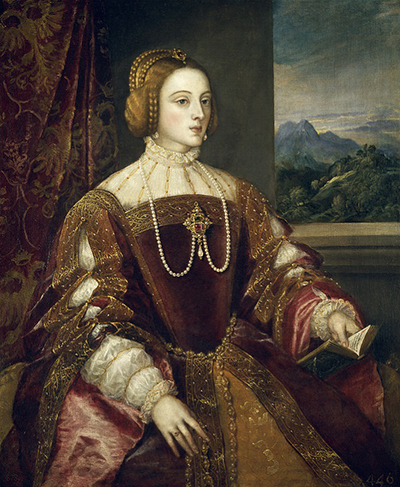
A seated woman in a richly worked dress holds a small open book, with mountains visible through a window beside her. The Museo Nacional del Prado identifies her as Empress Isabella of Portugal and the painter as Titian. Its canvas, P000415, measures 117 × 98 centimetres and was completed in 1548. Isabella had died in 1539. The portrait therefore seems to place a living person before us while recording the emperor’s attempt to preserve a memory of someone Titian could no longer meet.[1]
The picture belongs to a series of related images, including an earlier Titian portrait now lost, but its physical identity is clear. It is the seated, red-dressed version in Madrid, made in Augsburg and finished by 1 September 1548, according to a letter Titian sent to Antoine Perrenot de Granvelle. The Prado’s own account of the commission shows how carefully Charles V sought a satisfactory likeness of his late wife. The painting’s visual choices, X-ray evidence and subsequent royal history tell us what this particular surviving object is, beyond the sequence that led to its making.[1]
At a Glance
- WorkIsabella of Portugal
- Research recordMuseo Nacional del Prado
Contents
- The empress within the picture
- A portrait after the sitter’s death
- A courtly design with earlier models
- What the X-ray shows
- With Charles V, then in the royal collection
The empress within the picture
Isabella sits upright, her upper body turned slightly across the canvas. Her face is still and pale against an elaborate arrangement of hair, jewels and fabric. A deep red garment is crossed by gold patterning, pale sleeves swell around the arms, and strings of pearls descend over the bodice. One hand rests on her lap; the other supports a little Book of Hours. At left, a patterned curtain encloses her. At right, the wall opens to a distant mountain landscape. Titian balances the dense fabrics and close interior against the cool breadth of the view outside.[1]
The window does more than supply a background. It lets the head and shoulders stand against two different fields: dark interior at one side, airy distance at the other. The curtain and window also give the seated figure a frame within the frame. Rather than showing her in conversation with anyone, Titian isolates her in a composed courtly space. The hand holding the book suggests devotion, but the Prado observes that her gaze falls neither on the pages nor on the viewer. It is this withheld attention, in the museum’s reading, that lends the image gravity and remoteness.[1]
The book need not be treated as proof of a specific prayer or occasion. It belongs to a vocabulary of pious royal portraiture. Likewise, pearls, brocade and a carefully bound hairstyle make rank visible without telling us exactly which garment Isabella would have chosen on a particular day. She is presented with the refinement expected of an empress, but the portrait is not a documentary inventory of a sitting. No such sitting was possible for the 1548 painting.[1]
The Prado identifies an imperial eagle embroidered on the curtain as the only direct imperial emblem in the image. The motif may be difficult to resolve in small reproductions, yet the owner’s identification matters: it locates political status in the setting rather than placing a crown on Isabella’s head in this version. Much of the picture’s authority comes instead from scale, posture, sumptuous materials and the distance of her gaze. Titian gives her a presence that is public and ceremonial even though the commission grew out of Charles’s intensely personal loss.[1]
A portrait after the sitter’s death
Isabella was born in 1503, the daughter of Manuel I of Portugal. She married Charles V in 1526 and died in 1539. When Charles wanted a portrait, Titian could not study her face directly. The Prado recounts a search through existing likenesses, beginning with a picture Isabella had once sent to Margaret of Austria. Charles received it from his sister Mary in November 1539 but was dissatisfied with the resemblance. In 1543 he sent Titian a small portrait, probably by William Scrots, as a more usable model.[1]
This sequence makes the surviving canvas different from a portrait drawn from life, but it does not make it a mere mechanical copy. Titian had to translate earlier images into a convincing imperial presence. He completed a first version in 1545, showing Isabella in black with flowers in her lap and a crown behind her. That picture later burned in the 1604 fire at El Pardo and is known through copies and prints. Charles had the painting brought to Augsburg in 1547 so Titian could adjust the nose. The Prado says the lost version then served as a model for the painting now in Madrid.[1]
The nose correction has an unusual bearing on likeness. The Prado notes that portraits made during Isabella’s lifetime, and contemporary descriptions, give her an aquiline nose. In the surviving Titian portrait it appears straighter and more classically regular. The museum interprets Charles’s request as an effort to align the painted image with the face he preferred to remember, rather than an attempt to make it more anatomically exact. That is the Prado’s historical reading of the evidence, not something we can verify from the finished surface alone. It warns against treating a persuasive court portrait as an unfiltered record of appearance.[1]
For the fuller sequence of returned models, the lost 1545 painting and Titian’s subsequent double portrait of the imperial couple, see the commission history. That account concerns the same surviving Prado canvas at its endpoint. The lost first portrait, the double image and P000415 must remain three distinct works despite their shared subject.[1]
A courtly design with earlier models
The Prado traces the seated figure, adjacent window and landscape to a portrait design associated with Raphael and Giulio Romano’s Isabel de Requesens in the Louvre. Titian had also drawn on that type in his 1536 portrait of Eleonora Gonzaga, Duchess of Urbino. Isabella’s pose thus belongs to an established language of high-status female portraiture. It is not evidence that Raphael met Isabella or that this painting copied another sitter’s face. The relationship concerns the image’s structure: a seated woman, a window and a landscape that opens beyond a controlled interior.[1]
The museum also compares the portrait’s conventions with a sonnet by Pietro Aretino on the portrait of Eleonora Gonzaga. Aretino praised the seated pose and covered breast and hair as signs of modesty and purity. Those are codes a sixteenth-century viewer could recognise, and Titian uses related features for Isabella. Yet the Prado finds this portrait distinctly more hieratic than Eleonora’s. That quality is not explained simply by the fact that Isabella was absent. It is an artistic choice suited to an imperial image: the face turns away from direct exchange, and the body settles into a reserved, durable pose.[1]
The comparison helps make sense of two apparently opposite effects. Jewels, patterned cloth and the open landscape attract close visual attention; the sitter’s distant gaze keeps an emotional interval. The emperor could carry the painting near him, while the image itself preserved a formal distance appropriate to her rank. The Prado describes its personal role, but the public formula remains visible in every part of its design.[1]
What the X-ray shows
The Prado reports that an X-radiograph revealed no alterations in the final portrait’s composition. It also revealed that Titian reused a canvas on which a female figure had previously been painted. These findings refer to this Madrid painting, not to the lost 1545 version. The record does not identify the earlier figure or explain why that painted canvas was reused. Her identity should not be guessed from Isabella’s story or turned into a hidden symbolic message.[1]
The absence of reported compositional revisions is equally specific. It tells us what the X-ray did not reveal in the visible portrait, not that Titian made no preparatory choices or corrections of any kind. The material result is useful because it keeps the object from becoming only a tale of remembered likeness: beneath the court image is evidence of a working painter’s reused support. How that earlier image looked, and how much of it was covered before the present design began, are not established in the public record.[1]
The Prado describes the work’s condition as good. That statement applies to the museum’s present assessment; it should not be expanded into an invented account of every restoration or layer of paint. The X-ray gives one unusually direct glimpse of process, while most of the picture’s making remains inaccessible from the catalogue alone.[1]
With Charles V, then in the royal collection
The Prado says the painting was one of the few Charles kept with him. It is documented in Brussels in 1556 and at Yuste in 1558. These locations support the museum’s account of its personal importance more securely than a claim about exactly what Charles felt whenever he looked at it. The portrait could function as a memorial, a dynastic image and an object carried through the last years of his life at once.[1]
Its later itinerary is also unusually legible. Philip II lent it to his sister Empress Mary for the Descalzas Reales convent, where Carducho mentioned it in 1633. By 1636 it hung in the Madrid Alcázar, remaining there until the palace fire of 1734. It then moved to the new Royal Palace and entered the Prado in 1821. The survival of the 1548 canvas through this sequence should be distinguished from the destruction of the earlier Isabella portrait at El Pardo in 1604. The two fires affected different buildings and different pictures.[1]
The portrait’s later influence extended beyond its own possession history. A Prado study of Antonio Moro’s portrait of Mary Tudor says that Moro adapted the composition of Titian’s idealised Isabella image as a model for another queen. That is a claim about the reuse of a portrait formula, not about Mary Tudor resembling Isabella or owning this canvas. It helps show why the arrangement of a seated ruler, controlled setting and dignified distance remained useful to later court painters.[2]
The Titian paintings guide places Isabella among Titian’s religious, mythological and portrait subjects. The Munich seated portrait of Charles V offers a related imperial image; the Prado says Titian later combined that seated Charles with the first Isabella likeness in a double portrait now lost. The Madrid canvas described here remains the surviving 1548 portrait of Isabella, independently catalogued as P000415.[1]
Researched Titian and related works
Frequently Asked Questions
No. She died in 1539; Titian completed the surviving portrait in 1548 using earlier likenesses and his own previous image of her.[1]
The Prado identifies it as a Book of Hours, a devotional object within the courtly portrait. Her eyes are directed neither at the pages nor at the viewer.[1]
Yes. The Prado says X-radiography showed a previous female figure on the reused canvas. The museum does not identify her.[1]
The 1545 version, with Isabella in black, was destroyed in the 1604 El Pardo fire. The seated painting now in the Prado is a separate 1548 canvas.[1]
It belongs to the Museo Nacional del Prado, Madrid, inventory P000415; the museum lists it in Room 056.[1]
Discussion
What do you notice when you look closely at Titian’s Portrait of Empress Isabella of Portugal?
Share a specific observation or a source that adds context.
Reader Insights
Which detail changes your reading?
How does its original setting affect what we see?
Which part of the evidence remains uncertain?
Join the Conversation
Add your observation below.
References
- Museo Nacional del Prado, “Empress Isabella of Portugal,” P000415, collection essay by Miguel Falomir Faus and technical data. View source.
- Museo Nacional del Prado, “Mary Tudor, Queen of England,” Antonio Moro, collection encyclopedia essay. View source.