 Buy Art Prints Now
from Amazon
* As an Amazon Associate I earn from qualifying purchases.
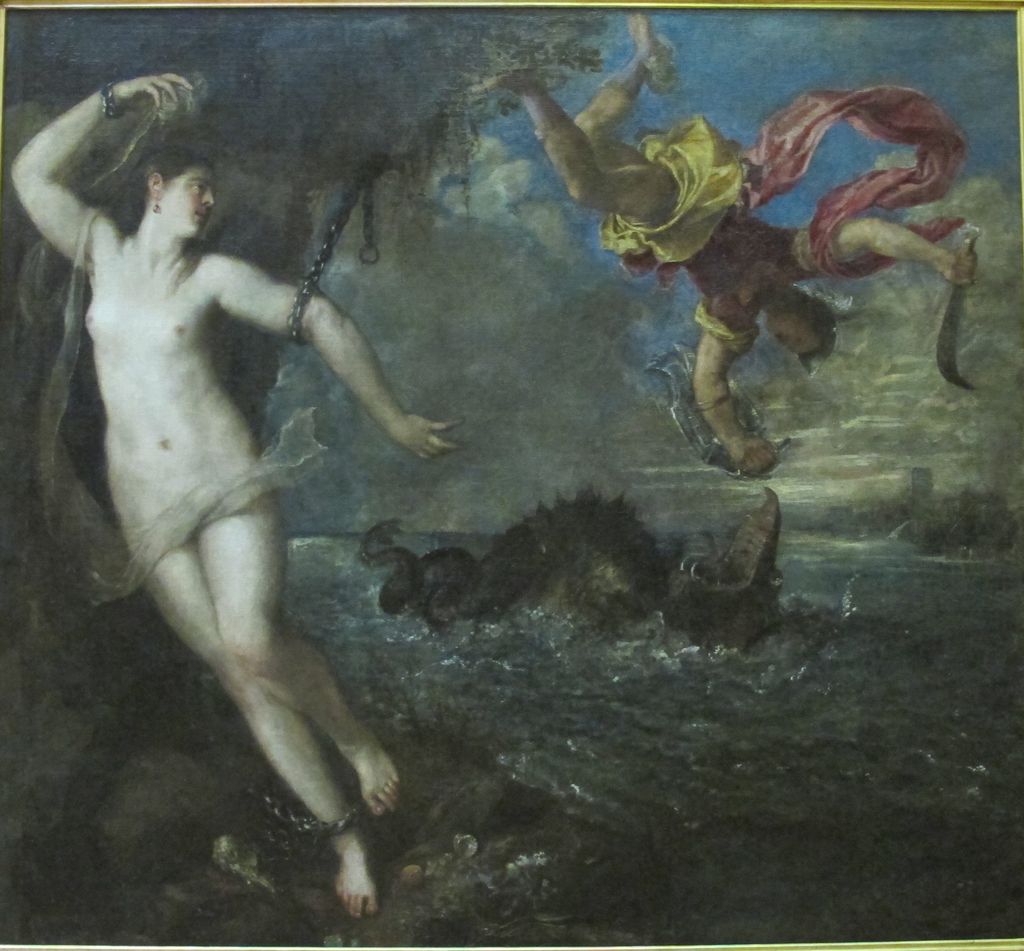
Photo: Sailko, CC BY-SA 3.0; cropped and resized from the original photograph. Painting: Titian, Perseus and Andromeda, Wallace Collection P11. Image source · Reuse licence
 by Tom Gurney
Tom Gurney BSc (Hons) is an art history expert with over 20 years experience
Published on October 13, 2026 / Updated on October 15, 2026
Email: tomgurney1@gmail.com / Phone: +44 7429 011000
Titian's Perseus and Andromeda: Introduction
In Titian's Perseus and Andromeda, a woman is chained to a coastal rock while a sea monster rises below her. A second figure drops headfirst out of the sky. The space between the two people is the painting's suspense: Perseus has come to save Andromeda, but the danger is still present. This large oil painting belongs to the Wallace Collection in London, where it is catalogued as P11. The museum dates it to 1554–56 and gives the painted image, excluding its frame, as 183.3 × 199.3 centimetres.[1]
Titian made the canvas for Philip II of Spain as one of the six mythological works he called his poesie, or poems in paint. The story comes from Ovid's Metamorphoses, yet the painting does more than illustrate a passage. It sets a restrained body, a plunging rescuer and an approaching creature against one another in a scene whose outcome must be imagined. Its present appearance also records a history of substantial revision and damage. Those two facts are essential to understanding what we can see.[1][2][3]
At a Glance
- WorkPerseus and Andromeda
- Research recordwallacelive.wallacecollection.org
Annotated details from Perseus and Andromeda
Select a numbered area to find its detail below. Open a detail image to view it larger.
Details from PERSEUS AND ANDROMEDA
Perseus and Andromeda Figure
Perseus and Andromeda Rescue and Sea Monster
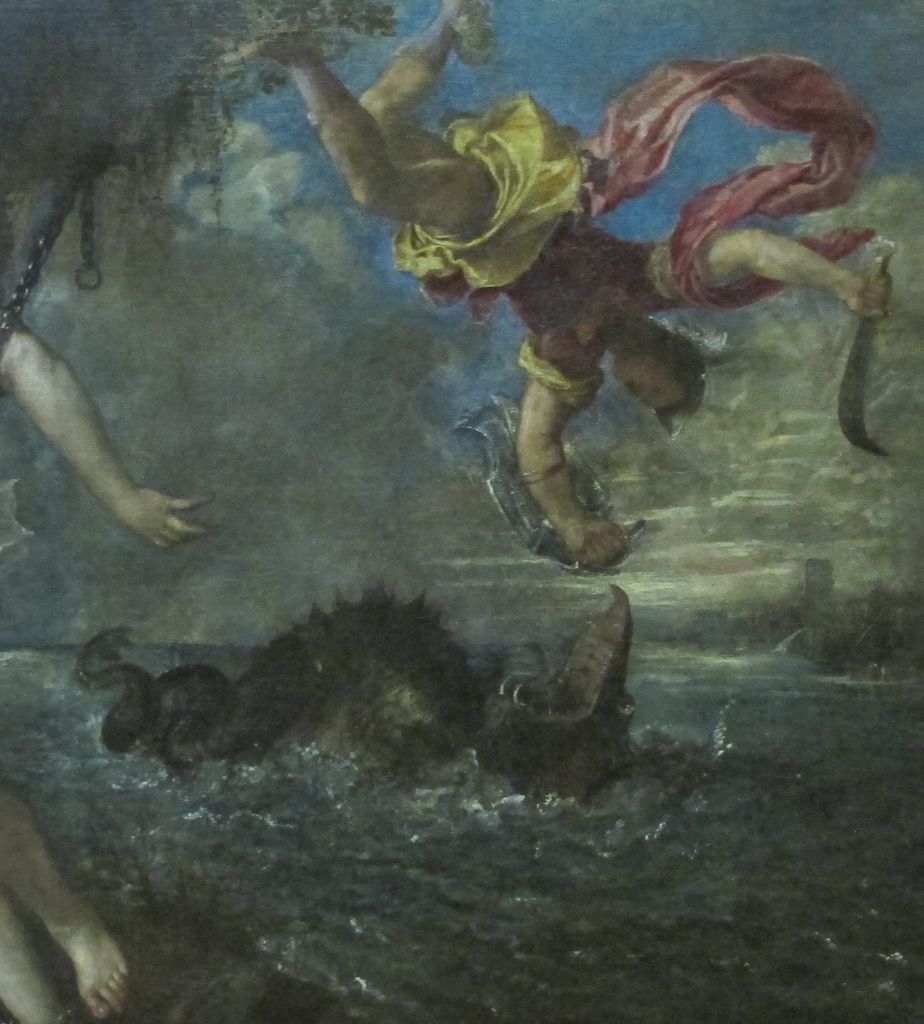
Photo: Sailko, CC BY-SA 3.0; cropped and resized from the original photograph. Painting: Titian, Perseus and Andromeda, Wallace Collection P11. Image source · Reuse licence
Contents
- What is happening in the painting?
- How does Titian create the drama?
- A composition changed during painting
- Why was it painted for Philip II?
- From a Spanish commission to London
- Why does this painting matter within the poesie?
What is happening in the painting?
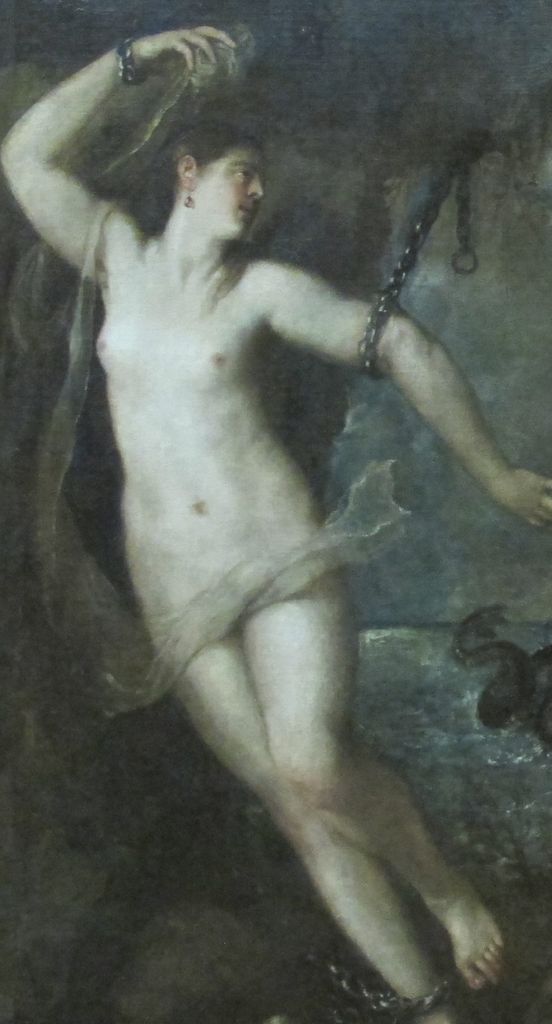
Andromeda occupies the left of the canvas. One arm is raised towards the chain that secures her to the rock. Her pale body and slight drapery stand out against a dark coastal setting. On the right, Perseus comes down at a steep angle, his limbs spread through the air and his red and yellow drapery blown behind him. Below, the monster's dark head and back break the water. Titian has kept all three agents in view. Andromeda cannot leave; Perseus is still in motion; the creature has not yet been defeated.[1]
The narrative begins before the instant shown. Andromeda's mother, Cassiopeia, boasted that she and her daughter surpassed the sea nymphs, the Nereids, in beauty. Neptune sent a monster to punish the offence, and Andromeda was bound to a rock as a sacrifice. The National Gallery's account names her parents as King Cepheus and Queen Cassiopeia. Perseus discovers her, fights the monster and eventually marries her. The painting holds the rescue at its most uncertain point rather than depicting the later release or wedding.[1][2]
Ovid tells the episode in a sequence of encounters. Perseus first sees the captive, learns why she has been exposed, and speaks with her parents. When the monster appears, he attacks it from the air with a curved sword. The fight continues through several changes of position before he kills it and Andromeda's chains are removed. Titian compresses that unfolding story into a field of simultaneous pressures. The parents, bargaining and celebration belong to the poem; they do not need to appear in the painting for its peril to make sense. Nor is the monster slain with Medusa's head in Ovid's account of this fight.[3]
How does Titian create the drama?
The woman and rescuer are built from opposing kinds of movement. Andromeda stands nearly upright, but her pose is constrained by the chain and rock. Perseus cuts diagonally through open space. The viewer's eye crosses from her exposed figure to his falling body and down to the water between them. The creature occupies the point towards which both their situations are directed. The painting therefore makes distance matter: there is still sea and air to cross before help reaches her.
Andromeda is comparatively large and close to the viewer. The light across her skin makes her immediately visible, while the sea and rock are darker and harder to disentangle. The Wallace Collection describes an opposition between her frontal nude and Perseus's lightly armoured body. That formal contrast is also a contrast in power. He arrives equipped and able to act; she has been fixed in place by others. Titian makes her the picture's brightest visual centre, but she is the person with the least freedom in the depicted moment.[1]
The painting can be read as a rescue image without flattening Andromeda into a prize. Ovid's story includes Perseus's demand for her hand in marriage and later calls her the reward for his victory. Titian concentrates instead on the bodily danger of a woman offered to a monster and the effort of an airborne attacker. Her nudity serves the mythological display expected of a court painting, but it also intensifies her exposure. The tension between beauty, vulnerability and spectacle is part of this object's meaning, not an issue resolved by the happy ending in the poem.[1][3]
Even the apparent direction of travel is complicated. Perseus descends from the upper right, but the monster sits nearer the middle of the lower edge and Andromeda remains off to one side. The hero is not simply flying into her arms. He is entering a fight that separates them. The flaring cloth behind him helps register speed, while her lifted arm repeats a different kind of diagonal: an action checked by the visible restraint. These are readings of the finished composition, grounded in its visible arrangement rather than claims about Titian's stated intention.
A composition changed during painting
The current left-hand placement of Andromeda was not Titian's first idea. The Wallace Collection says he made several major changes during the painting process and originally put her on the right. A National Gallery technical publication reports that X-radiography revealed extensive alterations, including that relocation. This is direct evidence of how the design developed within this particular canvas. It is more specific than a general description of Titian as an improviser.[1][4]
Moving the captive across the canvas would change the relation among the rock, flying hero and monster. In the visible version, Andromeda anchors the left while Perseus enters from the upper right. Their separation gives the rescue a wide visual span. We cannot reconstruct every earlier arrangement from the summary of the X-ray findings, so any precise account of how the first design would have worked would go beyond the published evidence cited here. The secure point is the scale of Titian's rethink: the principal figure did not merely receive a small correction to an outline.[1][4]
The work's condition needs a separate caution. The Wallace Collection says it has suffered considerably since the sixteenth century. Areas that look uneven in a photograph may reflect ageing, earlier treatment or loss as well as original handling. The bold positions of the figures and the picture's overall rhythm remain legible, but a modern reproduction cannot give uncomplicated access to the exact colour and surface seen by Philip II. Revision tells us about the making of the design; later condition tells us about the survival of the object. Our guide to Titian's technique explains why those kinds of evidence should be kept distinct.[1]
Why was it painted for Philip II?
Philip II commissioned six large mythologies from Titian. The Wallace Collection says the patron left the choice of subjects to the painter, who called the resulting works poesie because he wanted painting to act as a visual equivalent of poetry. The group includes the Apsley House Danaë, the Prado Venus and Adonis, the two Diana paintings and the Rape of Europa. The subjects are linked by classical narratives and courtly display, although each canvas invents a different relation between figures, setting and action.[1][5]
The project did not unfold as an unchanging list of six subjects. According to a National Gallery technical study, Titian wrote in 1554 of following Danaë and Venus and Adonis with Perseus and Andromeda and Jason and Medea. The Jason picture appears to have been abandoned. The study says Perseus was eventually paired with Rape of Europa, completed years later. Such documentary traces reveal an evolving commission; they should not be turned into a claim that the two surviving paintings were conceived and delivered together.[4]
The Wallace Collection dates Perseus and Andromeda to 1554–56 and says it may have been sent to Philip in 1556. That cautious wording matters. The work is securely associated with his commission, while the exact date of dispatch is less firmly established. Nor is its original position within a royal room certain. The Prado's study of the series identifies the six works and discusses the uncertainty surrounding their first display, so a particular hanging arrangement should not be treated as fact.[1][5]
From a Spanish commission to London
The painting's later history is unusually revealing, but it has a gap. The Wallace Collection says it is unclear how the canvas left the Spanish royal collection. The Prado's Spanish account places the departure in the last years of Philip II's reign. The Prado also owns an anonymous, roughly full-size copy, dated around 1580–1600, which it says could have been commissioned to replace the original after a reported gift to the royal secretary Antonio Pérez. The proposed purpose of that copy and the gift story require the Prado's conditional language; neither establishes an uninterrupted chain for the Wallace original.[1][5][6]
The Wallace record names later owners: the sculptor Pompeo Leoni, Anthony van Dyck, a succession of French collections and the third Marquess of Hertford, who purchased it in 1815. Van Dyck brought it to London. The painting entered the Wallace Collection through the Hertford collecting legacy and is listed today in its Great Gallery. The chain explains the broad movement from a Habsburg patron to a London museum while leaving the precise circumstances of its first transfer out of royal hands open.[1]
In 2020 the Wallace lent Perseus and Andromeda to the National Gallery for the exhibition Titian: Love, Desire, Death. That loan helped reunite the six poesie for display. It did not change the painting's ownership or its present collection. The related Death of Actaeon appeared in discussion of the cycle, but the National Gallery explains that this later work was never delivered to Philip as one of the six core paintings.[7]
Why does this painting matter within the poesie?
The series is often described through love and desire, yet this canvas puts sacrifice and rescue at the centre of its action. Its erotic charge is inseparable from a scene of imposed danger. Its heroic action is inseparable from the immobility of the person being saved. The sharp contrast helps distinguish the Wallace painting from the first pair, where Venus and Adonis turns on a lover's imminent departure and Danaë on a divine arrival. It also differs from the Diana pictures, where discovery and exposure happen within crowded groups rather than across open sea and sky.[1][5]
The painting is valuable evidence of Titian's process as well as his storytelling. Its altered design shows a major decision made on the canvas; its later damage limits easy judgments about finish. Holding both truths together produces a better view of P11: a surviving, historically changed painting that still conveys an extraordinary interval between peril and rescue.
Researched Titian and related works
Frequently Asked Questions
It is in the Wallace Collection, London, inventory P11. The museum lists it in the Great Gallery.[1]
The Wallace Collection dates it to 1554–56 and says it may have been sent to Philip II in 1556.[1]
He substantially revised the composition. X-radiography showed that Andromeda was first placed on the right and later moved to the left.[1][4]
Discussion
What do you notice when you look closely at Titian's Perseus and Andromeda?
Share a specific observation or a source that adds context.
Reader Insights
Which detail changes your reading?
How does its original setting affect what we see?
Which part of the evidence remains uncertain?
Join the Conversation
Add your observation below.
References
- Wallace Collection, “Perseus and Andromeda,” object record P11. View source.
- National Gallery, London, “Titian’s ‘poesie’: The commission.” View source.
- Ovid, Metamorphoses, Book IV, via the Perseus Digital Library. View source.
- National Gallery Technical Bulletin, vol. 36, catalogue entry 4, Diana and Actaeon, pp. 64–65. View source.
- Museo Nacional del Prado, “Venus y Adonis,” collection entry and essay on Philip II’s poesie and the departure of Perseo y Andrómeda. View source.
- Museo Nacional del Prado, “Andrómeda y el dragón,” anonymous copy. View source.
- National Gallery, London, “Remarkable Titian loan.” View source.