by Tom Gurney
Tom Gurney BSc (Hons) is an art history expert with over 20 years experience
Published on June 19, 2020 / Updated on October 15, 2026
Email: tomgurney1@gmail.com / Phone: +44 7429 011000
Titian's Allegory of Prudence: Introduction
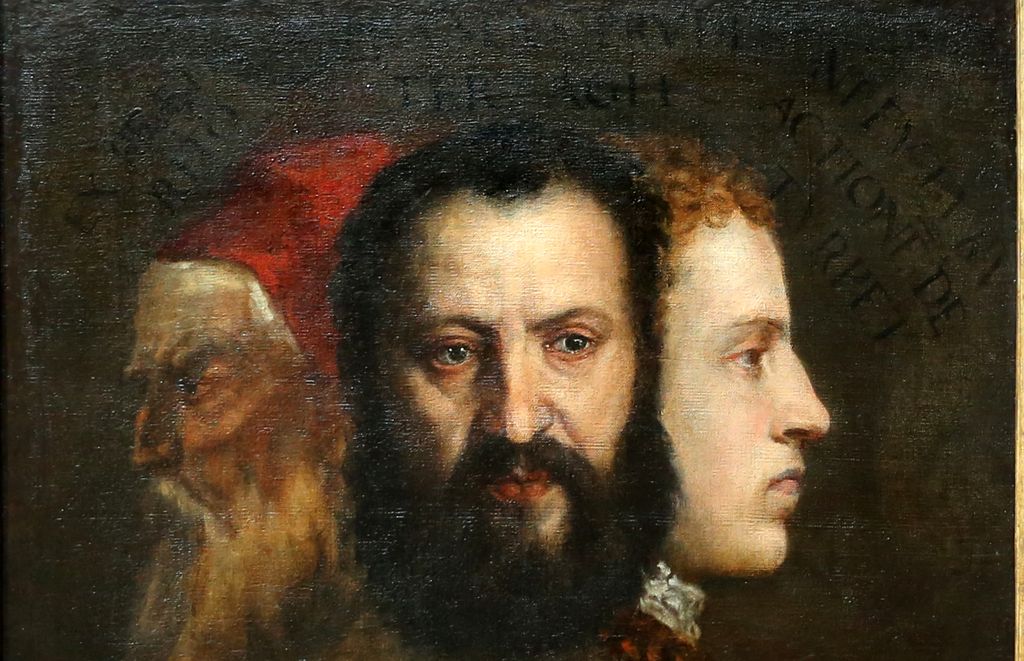
An old man in a red cap looks left, a bearded man looks outward, and a youth turns right. Beneath them sit the heads of a wolf, lion and dog. A Latin inscription runs across the dark upper edge, divided above the three human ages. Titian's An Allegory of Prudence turns a short thought about past, present and future into an image whose original use is still unknown. The National Gallery, London, owns the oil painting as NG6376 and dates it about 1550.[1]
The Gallery's current title is cautious. The alternative name Allegory of Time Governed by Prudence expresses an influential interpretation but makes the relationship between Time and Prudence sound more settled than the object's history allows. The visible inscription gives strong support to prudent action informed by experience; the animal emblem has a longer and less singular history. Technical imaging has also shown that Titian changed the design. Those facts make the painting more interesting than a simple diagram with one fixed key.[1][2][3]
At a Glance
- WorkAn Allegory of Prudence
- Research recordNational Gallery, London
Annotated details from An Allegory of Prudence
Select a numbered area to find its detail below. Open a detail image to view it larger.
Details from AN ALLEGORY OF PRUDENCE
Three Ages and the Inscription
Wolf Lion and Dog
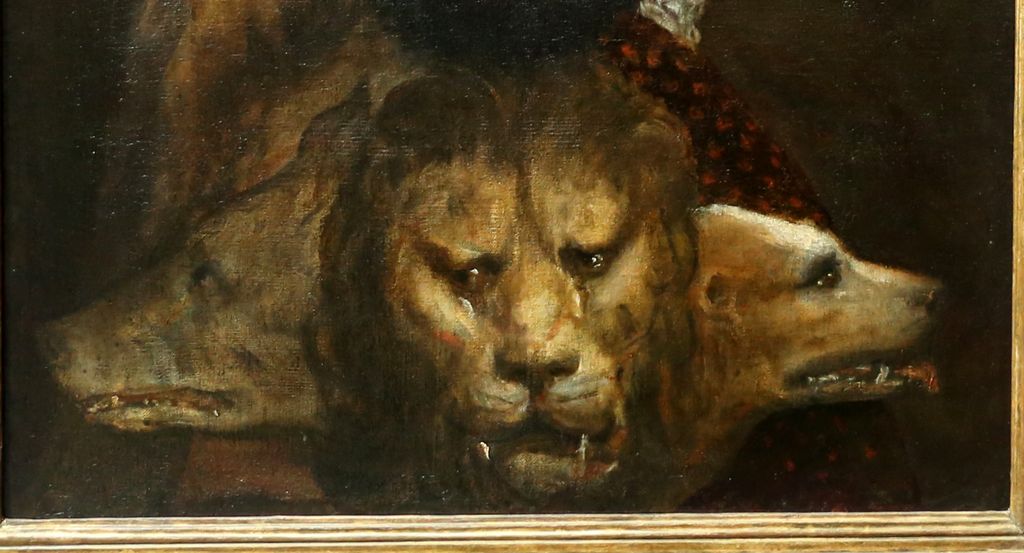
Photo: Sailko, 2017, CC BY 3.0. Cropped to the painting and resized; details are cropped from the same photograph. Image source · Reuse licence
Contents
- Reading the three ages
- Why a wolf, lion and dog?
- Is this Titian with his relatives?
- What lies beneath the present picture?
- Who painted it, and when?
- Collecting history and what remains open
Reading the three ages
The faces form a compressed progression. The elder's white beard and turned profile place him at the left, under the first part of the text. The dark-haired man in the middle meets the viewer almost directly, while the youth on the right looks toward the edge. They are closely packed, with little landscape or room around them. The direction of each gaze makes the passage from memory through present attention toward what lies ahead physically visible.
The inscription, as translated by the National Gallery, urges the present to draw on what has happened and act carefully so that future action is not spoiled. Its words are distributed above the old, middle-aged and young heads. The central figure is thus more than an age between two others: he is the person who must decide now. The old and young faces make past and future present to that decision. This reading comes directly from the combination of words and placement, even if the original patron's purpose remains uncertain.[1][2]
The three animal heads repeat the left-to-right order below: wolf, lion, dog. The wolf's pointed muzzle reaches across the lower left, the lion faces us, and the dog looks right with its mouth parted. Their expressions and directions are not identical to those of the men, but the pairing invites the viewer to compare human and animal forms. The lower row makes the idea stranger and more memorable. It also means that the painting cannot be understood through the inscription alone; an older tradition of composite beasts contributes to its meaning.[1][2]
For a viewer standing close, the dark ground and interlocking heads can initially make it hard to separate one form from another. From farther away, the white beard, the central face and the youth's pale profile emerge as a clear sequence above the animal masks. This observed effect accords with the Gallery's technical authors' suggestion that the picture may have been made to be seen at some distance, perhaps high on a wall. It does not by itself prove that particular original setting.[3]
Why a wolf, lion and dog?
The triple animal has a history older than Titian. Macrobius, writing in late antiquity, described a composite creature associated with Serapis and explained its parts as aspects of Time: a wolf for the past, a lion for the vigorous present and a dog for the future. The National Gallery's catalogue traces how such associations remained available in Renaissance emblem culture. The painting's own inscription directs them toward the practical question of what a person should do with experience and expectation.[2]
In 1556, the Venetian author Pierio Valeriano published a wolf-lion-dog emblem of Prudence in his Hieroglyphica. That is an illuminating comparison, but its date creates a limit. If the National Gallery's date of about 1550 is right, Titian could not have copied this printed 1556 passage. He and Valeriano could have drawn from older material, or the picture could be later than the public label suggests. The source parallel makes a prudence interpretation plausible without establishing direct borrowing or a commission year.[1][2]
The Gallery's catalogue also discusses the illustrated Hypnerotomachia Poliphili of 1499, which presents triple human and animal heads, as a possible visual resource. The forms and age distinctions are not identical. It is better treated as another example of material circulating in Venice than as Titian's demonstrated model. Renaissance viewers could combine classical texts, prints, sculpture and household emblems without leaving a document that says exactly which one the painter saw.[2]
Earlier histories of the picture moved between titles and meanings. It was understood as Three Ages of Man before Erwin Panofsky and Fritz Saxl brought attention to the inscription in 1926. Later readings proposed political meanings for the heads or made them members of Titian's family. These interpretations tell us how suggestive the compressed design has been. They should not displace the text painted across the top, nor should the modern title suppress the painting's unresolved original function.[2][3]
Is this Titian with his relatives?
An autobiographical theory identifies the elder as Titian, the central man as his son Orazio, and the youth as his nephew Marco Vecellio. It makes the three ages a family sequence and would put the painting near the late 1560s. The idea has appeal because Titian did work alongside relatives and because the central face is unusually vivid. Yet the Gallery notes that the supposed likenesses are not close matches to secure portraits. No surviving inscription names the three as Titian's family, and the painting's technical style does not require a date that late.[1][2][3]
Even if the heads were based on real people, an allegory can use observed faces without becoming a triple portrait. The three roles—one remembering, one acting and one inheriting the consequences—are legible without names. Conversely, the existence of a general moral does not prove that Titian never referred to his own family. The evidence supports a qualified statement: the family identification is a proposal, not the painting's documented subject.[2]
The elder's face is especially tricky evidence for likeness because it changed while being painted. Infrared study found an earlier head in profile beneath the version now visible, which turns somewhat more toward us. What looks like a particular physiognomy in the final image was the result of revision. It should therefore not be treated as a fixed portrait clue dating the entire work to the artist's final decade.[3]
What lies beneath the present picture?
The National Gallery's scientific examination used X-radiography, infrared reflectography and small paint samples. It confirmed that the old man's head was moved and reoriented. The central and young faces do not show the same clear change. In particular, the younger head's paint blends into the central figure and is partly overlapped by the central curls. The technical authors consider it unlikely that this head was attached as a much later workshop contribution. This corrects a tempting explanation for its relatively plain appearance.[3]
Other hidden marks are harder to read. An X-ray shows forms that may belong to a previous single figure seen from behind and turning left, perhaps with a large collar or drapery. Curves in the upper part could indicate a banner or decorative cartouche. A red shape under the youth's clothing is visible both in imaging and through ageing paint. These findings demonstrate a design history, but the researchers explicitly caution that an X-ray does not reproduce a lost finished painting. Some marks may belong to intermediate stages of the present arrangement.[3]
The animal heads were painted quickly in thin, wet layers. Their present softness is partly connected to abrasion and increasing transparency as the paint aged. The lion's short orange-red touches and the dog's rapidly indicated tongue show that economy can be deliberate. The youth's garment also originally had a darker green made with verdigris, which has changed in appearance. Technical evidence therefore separates visible roughness from an easy claim that an assistant must have painted everything less detailed.[3]
The support is a coarse plain-weave canvas over a gesso ground. The technical study counted twelve warp and eight weft threads per centimetre. The painting was cleaned and restored in 1966. Such facts matter because its texture, losses and treatment affect how viewers judge finish and authorship. They also help keep claims about hidden forms attached to actual examination rather than to guesses made from a web image.[3]
Who painted it, and when?
The National Gallery's brief object record lists Titian and a date of about 1550. Nicholas Penny's fuller catalogue uses Titian and Workshop and allows a broad date of about 1550–65, possibly with a later completion. The 2015 technical authors compare its strong light and shadow, abbreviated handling and possible viewing distance with works of the late 1540s and around 1550. They do not assign every animal or face to a named hand. The records are best read together as different levels of attribution and dating judgment.[1][2][3]
Some connoisseurs have thought the central head more subtle than the youth or the animals, and that distinction is visible. But a difference in finish is not the same as proof of different painters. The technical study points to the rapid animal painting, integration of the youthful head and the effects of condition. A room decoration designed for a high position could be executed differently from an intimate portrait meant for close inspection. These considerations complicate, rather than eliminate, the workshop question.[1][3]
The painting is lit from the right, unusual enough in Titian's output to suggest a planned position relative to a light source. The technical authors raise the possibility of a decorative frieze in the camerino of the Venetian collector Gabriel Vendramin. A 1567 inventory records symbolic canvases by Titian in that room, and triple-headed decoration survives on the Vendramin palace facade. Neither record specifically identifies NG6376. The related Vendramin family portrait demonstrates the family's connection with Titian but cannot prove that this smaller allegory hung beside it or belonged to the same commission.[2][3]
Another suggestion is that the canvas was a painted cover for a portrait, a type used in Venetian collections, or perhaps a cupboard door. No securely matching companion survives. In particular, the Technical Bulletin rejects the proposed pairing with Titian's Prado self-portrait: surviving edge evidence shows the allegory never had enough height to cover that larger canvas. A general cover function remains possible, but this specific match is physically ruled out.[2][3]
Collecting history and what remains open
The first owner is unknown. The documented trail begins in France with Pierre Crozat before his death in 1740, then the Duc de Tallard. The painting later passed through the collection of Lucien Bonaparte and British owners including the Earls of Aberdeen and Alfred de Rothschild. David and Betty Koetser presented it to the National Gallery in 1966. This history explains its route to London but does not close the gap between Titian's workshop and the eighteenth-century French collection.[1][2]
The painting gives a clear moral pressure without providing a complete historical answer. The words ask the present to take responsibility for the future in light of the past; the heads and animals make that relation visible. The identities of individual faces, the exact date, first room and division of labour remain debated. Looking at the inscription, the lower emblem and the revised paint in that order lets the supported meaning emerge without turning a persuasive interpretation into a documented original programme.[1][2][3]
Researched Titian and related works
Frequently Asked Questions
It is in the National Gallery, London, inventory NG6376. The Gallery's object page lists its current display location.[1]
The human heads show youth, middle age and old age. With the inscription, they connect future, present and past to the exercise of prudent judgment.[1][2]
The wolf, lion and dog belong to an older emblematic tradition linking past, present and future. Valeriano's 1556 book associates the group with Prudence, but direct dependence cannot be assumed for a painting dated about 1550.[2]
That has been proposed alongside identifications of the other heads as Orazio and Marco Vecellio. The likenesses and date do not establish the theory; it remains an interpretation.[1][3]
Imaging shows earlier forms and revision of the old man's head. A prior single figure is a possible reading of the X-ray, not a fully recoverable earlier painting.[3]
Discussion
What do you notice when you look closely at Titian's Allegory of Prudence?
Share a specific observation or a source that adds context.
Reader Insights
Which detail changes your reading?
How does its original setting affect what we see?
Which part of the evidence remains uncertain?
Join the Conversation
Add your observation below.
References
- The National Gallery, London, “An Allegory of Prudence,” current collection record NG6376. View source.
- Nicholas Penny, National Gallery, “An Allegory of Prudence,” The Sixteenth Century Italian Paintings, volume II, 2008. View source.
- Jill Dunkerton and colleagues, National Gallery, “Titian's Painting Technique from 1540,” National Gallery Technical Bulletin 36, catalogue 2, 2015, pp. 52–57. View source.