 by Tom Gurney
Tom Gurney BSc (Hons) is an art history expert with over 20 years experience
Published on June 19, 2020 / Updated on October 15, 2026
Email: tomgurney1@gmail.com / Phone: +44 7429 011000
Titian’s Copy of Raphael’s Portrait of Pope Julius II: Introduction
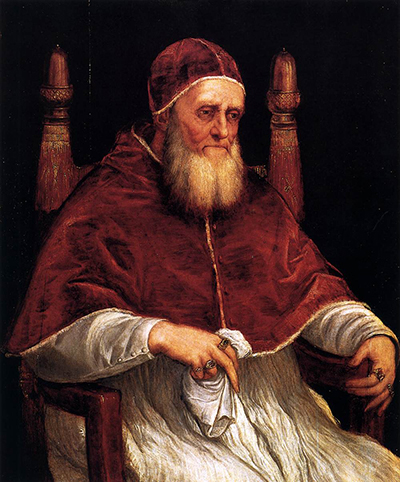
A white-bearded pope sits close to the viewer, wrapped in red and white. His eyes are lowered; one hand holds a white cloth, while the other rests at the arm of his chair. The pose is famous because Raphael devised it for Pope Julius II around 1511. The panel in Florence is a later version attributed to Titian, painted about 1545 as a copy after Raphael. It is held in the Galleria Palatina at Palazzo Pitti, inventory Palatina 79, and measures 100 × 82.5 centimetres. The Italian national catalogue specifies oil on wood panel and identifies the object’s role as a copy.[1][2]
That identification changes how the portrait should be read. Julius died in 1513; he could not have sat for Titian three decades later. Titian’s achievement, if the accepted attribution is followed, was to make his own painted version of an already influential papal image. Raphael supplied the seated composition and the original encounter with the sitter. The Pitti panel has a separate material, collecting and attribution history that makes it more than a generic reproduction.[1][2]
At a Glance
- WorkPortrait of Pope Julius II
- Research recordcatalogo.beniculturali.it
Contents
- The seated pope and the power of restraint
- Why Raphael’s model is in London
- Why there are several Julius portraits in Florence
- A della Rovere object with its own journey
- A copied image can still be an important painting
The seated pope and the power of restraint
Julius appears in three-quarter length, brought forward against a dark ground. The chair’s uprights rise on either side of his head, enclosing the figure without a grand throne room. The red cap and cape announce the papal office, while the beard and lowered gaze bring attention back to a particular aging man. His hands occupy the lower part of the picture: one gathers a pale handkerchief, the other seems to pause on the armrest. The combination gives an official portrait an unusually inward mood.[1][2]
The small objects matter. The rings and cloth help make the hands feel specific rather than merely ceremonial. The gold acorns on the chair refer to the della Rovere family name, rovere meaning oak in Italian. The national record for the Pitti panel notes the acorn devices; London’s National Gallery explains their family meaning in Raphael’s image. These details link individual, family and office without an inscription naming the pope across the front of the painting.[1][2]
Because this is a copy, not every compelling feature can be credited to Titian as an invention. The close seated format, papal red, beard, lowered head and chair emblems derive from Raphael’s prototype. Titian’s participation lies in translating that established design into another panel through his own paint. A close visual comparison might assess differences in colour, edge and surface, but the available catalogue sources do not provide a specific technical account of his brushwork here. The secure first step is to distinguish the shared design from the later object that carries it.[1][2]
Raphael’s invention was striking in its own time. Instead of placing the pope at a ceremonial distance, he made an image of a powerful patron apparently absorbed in thought. The National Gallery calls it a model for later ecclesiastical portraits over the next two centuries. Titian’s Pitti picture belongs to that history of reuse, while also showing one leading painter studying the portrait formula of another.[2]
Why Raphael’s model is in London
The National Gallery, London, holds NG27, catalogued as Raphael’s Pope Julius II, dated 1511. It is oil on poplar, 108.7 × 81 centimetres—larger and materially distinct from Titian’s Pitti panel. The Italian national catalogue for Palatina 79 cites Cecil Gould’s 1970 study for the conclusion that Titian copied the London Raphael, rather than another Julius portrait historically held in the Uffizi. This identification is a scholarly argument about the precise model in a crowded family of versions; the current records adopt it.[1][2]
The London panel’s date can be narrowed by Julius’s beard. According to the National Gallery, he grew it in late 1510 during illness and political losses, and shaved it after conditions improved in March 1512. The Gallery thinks Raphael’s portrait was probably made after Julius returned from a campaign in June 1511. Those details explain the beard and the careworn expression in Raphael’s original. They also explain why copying the picture later meant copying a likeness tied to a particular episode of Julius’s life rather than observing the pope anew.[2]
Raphael’s portrait was displayed after Julius’s death on 12 December 1513 in the Roman church of Santa Maria del Popolo. The National Gallery traces it through later Roman collections before its acquisition in London in 1824. That is the history of NG27, not the travel history of Titian’s copy. Confusing the two would attach the original’s exhibition in Rome and its London purchase to the wrong physical object.[2]
The Gallery also reports that Raphael covered an earlier, busier heraldic background with the plain green field visible today. That is an important technical finding about the London original. It should not be transferred to the Pitti copy: no corresponding imaging or paint investigation of Palatina 79 has been found in the records used here. The two panels may share a design while preserving different evidence of how each was made.[2]
Why there are several Julius portraits in Florence
The Pitti picture sits within a web of copies, versions and changing labels. The Italian national catalogue records a Julius portrait formerly in the Uffizi, inventory 1890 no. 1450, and another, considered later and from Raphael’s school, in Pitti storage, inventory 477. It also mentions a related cartoon in the Galleria Corsini. These works should not be collapsed into one “Florence Raphael” or substituted for Titian’s Palatina 79. The catalogue’s view is specifically that the London Raphael was Titian’s model.[1]
An Uffizi guide to the Room of Saturn says a portrait of Julius associated with Raphael can be seen there and compared with Titian’s copy in the Room of Venus. The opportunity to compare works in one palace is valuable; it does not override the national catalogue’s separate argument about which earlier version Titian followed. A display label and a proposal about a direct painted model answer different questions. Gallery arrangements can also change, so inventory numbers are more dependable than a room name when identifying a picture over time.[1][3]
The Pitti panel itself has carried names other than Titian’s. The full national record lists old paper labels on its back that assign it to Raphael. Those labels are evidence of past cataloguing, not a signature on the painted front. The same record says Adolfo Venturi began the move toward recognizing Titian’s hand in 1891, and that later scholarship accepted the attribution. The story is therefore not simply Raphael “versus” Titian; it is a history of distinguishing an image invented by Raphael from a later panel now attributed to Titian.[1][4]
A della Rovere object with its own journey
The national catalogue places the copy in the della Rovere collections at Urbino before the middle of the sixteenth century, then records it in Vittoria della Rovere’s Florentine collection from 1631. That family connection is fitting but should not be turned into an undocumented commission story. Julius II himself was born Giuliano della Rovere, and the oak emblems make the lineage visible in the image. The collection record supports later family ownership; it does not name the person who first ordered Titian’s copy or the circumstances under which it left his workshop.[1][2][4]
The object’s recorded route became unusually mobile after reaching Florence. The catalogue lists it at Villa di Poggio Imperiale in Vittoria’s collection, and in Palazzo Pitti by 1723. It names successive Pitti rooms: a private audience room in 1723, Mars in 1793, Jupiter in 1798, Saturn in 1819, and Mars again in 1888. It has been assigned to Venus since the early twentieth century in the catalogue’s history. The change of rooms shows how a painting’s setting could change its neighbours and the comparisons available to viewers.[1][4]
There was also a major interruption. The full record says the panel was taken to Paris in 1799 during the Napoleonic requisitions and remained there until 1816. Its later presence in the Pitti rooms belongs to the history after that return. The catalogue’s chronological entries do not fully explain every interval between family collection and later palace placement, so they should not be smoothed into an invented continuous itinerary. What is clear is that Palatina 79 has a documented journey different from Raphael’s London NG27.[2][4]
The catalogue records a 1976 restoration by personnel of the Opificio delle Pietre Dure, with photographs taken before, during and after the work. That is evidence that the Pitti panel was treated and documented. The accessible entry does not give a pigment analysis or a detailed account of what the conservators found or changed. A technical interpretation of Titian’s copying method would need the treatment file itself, not just the date and names in the inventory.[4]
A copied image can still be an important painting
Calling the Pitti work a copy describes its relationship to Raphael’s composition. It does not make the panel historically empty. Titian’s version was valued in the della Rovere and later Florentine collections; its attribution shifted as scholars distinguished hands within a famous group of papal portraits; it even crossed to Paris and back. Its back labels, room records and conservation file belong to this object alone.[1][4]
The picture also exposes a useful distinction in portraiture. Raphael may have observed Julius and invented the intimate seated formula. Titian could study the finished image without ever meeting its subject. The likeness of Julius endured because artists, patrons and collectors wanted the formula to survive in more than one painting. At the same time, each version has its own support, size, handling and provenance. Respecting those differences is the way to understand both Raphael’s invention and Titian’s participation in its afterlife.[1][2]
The Titian paintings guide places the Pitti panel among his works while retaining its “after Raphael” relationship. The portrait of Francesco Maria della Rovere offers another Titian image tied to the family, but it is a separate commission and sitter. The shared surname and oak emblems make a meaningful connection, not proof that the two portraits were designed as a pair.[1][2]
Researched Titian and related works
Frequently Asked Questions
No. Palatina 79 is catalogued by the Italian national collection as a Titian copy after Raphael, painted about 1545. Raphael’s NG27 in London is dated 1511.[1][2]
No. Julius died in 1513, decades before the Pitti panel’s estimated date. Titian worked from Raphael’s established image.[1][2]
The famous composition generated versions and copies. The national catalogue identifies separate Uffizi, Pitti and Corsini-related objects, while the Uffizi guide discusses works displayed for comparison at Pitti.[1][3]
The full national catalogue records its transfer to the Louvre during the Napoleonic requisitions in 1799 and its return in 1816.[4]
Discussion
What do you notice when you look closely at Titian’s Copy of Raphael’s Portrait of Pope Julius II?
Share a specific observation or a source that adds context.
Reader Insights
Which detail changes your reading?
How does its original setting affect what we see?
Which part of the evidence remains uncertain?
Join the Conversation
Add your observation below.
References
- Catalogo Generale dei Beni Culturali, “Ritratto di papa Giulio II,” Titian after Raphael, national record 0900294762, Palatina 79. View source.
- National Gallery, London, Raphael, Pope Julius II, NG27, object essay and catalogue data. View source.
- Uffizi Galleries, “The Room of Saturn in Pitti Palace,” display history and comparison with Titian’s copy in the Room of Venus. View source.
- Catalogo Generale dei Beni Culturali, full 15-page inventory record for Palatina 79, including provenance, historic labels and 1976 restoration entry. View source.