 by Tom Gurney
Tom Gurney BSc (Hons) is an art history expert with over 20 years experience
Published on June 19, 2020 / Updated on October 15, 2026
Email: tomgurney1@gmail.com / Phone: +44 7429 011000
Titian and Marco Vecellio's Doge Antonio Grimani before Faith: Introduction
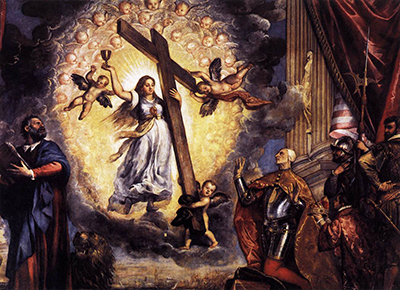
A kneeling doge raises his face toward a luminous figure of Faith. Saint Mark stands at the other side, with Venice stretched low beneath the vision. This immense votive painting in the Doge's Palace was begun by Titian and completed after his death by his nephew Marco Vecellio. It is known as La Fede and hangs in the Four Doors Room (Sala delle Quattro Porte). Save Venice records the completed oil canvas as 375 × 814 centimetres, with a history running from its commission in 1555 to Marco's final payment in 1593.[1][2]
The image shown here is a central-section view. It allows close study of Grimani, Faith, Saint Mark and the low Venetian skyline, but it does not include the entire eight-metre-wide work. A prophet and standard bearer at the outer sides, along with framing curtains associated with Marco's completion, lie beyond this photograph. Reading the pictured centre as the whole finished canvas would hide an important part of both its composition and its authorship.[1]
At a Glance
- WorkDoge Antonio Grimani Kneeling before the Faith
- Research recordsavevenice.org
Contents
- A ruler praying for the Republic
- A work begun in one lifetime and finished in another
- What the photograph shows—and omits
- The Four Doors Room
A ruler praying for the Republic
Antonio Grimani served as doge from 1521 to 1523. He is shown kneeling in his robes, turning toward Faith rather than sitting in a portrait chair or standing at the head of a military action. Faith descends through clouds and light with a cross and Eucharistic chalice, signs that make the allegorical figure legible. Putti accompany her above the city. The doge's lowered position gives his public office a devotional posture, while the breadth of the canvas makes the act of prayer visible in a palace devoted to government.[1]
Saint Mark, patron of Venice, stands as an intercessor. Save Venice identifies him by the lion and the book of his Gospel. He gives the political community a sacred representative beside its remembered human ruler. The small city view along the horizon, centred on the bell tower of Piazza San Marco, fixes the scene to Venice. The painting is therefore not simply a private statement that Grimani believed. It stages the Republic, embodied by its doge, under the protection and mediation of Faith and its patron saint.[1]
The diagonal cross and Faith's movement downward connect heaven to the kneeling man below. Grimani's upturned face provides the other direction of attention. Between them, the city seems tiny against the bright apparition. This difference in scale is central to the work's rhetoric: a powerful state is shown as dependent on a higher order. Yet the doge is large enough to remain a particular historical person. Titian's design joins a named ruler, an identifiable place and a virtue that can stand for collective belief.[1]
The canvas belongs to a Venetian tradition of dogal votive imagery. Save Venice explains that a new doge's election usually led to a portrait and a votive picture for the palace. Grimani's case was strikingly late. The commission was recorded on 12 March 1555, more than thirty years after his death. He could not have sat for a picture commissioned then. The image represents his memory and office, not a direct encounter between Titian and the living doge in the 1550s.[1]
The delay changes how the word “portrait” should be understood. Grimani is individually named and shown in dogal dress, yet the image is not primarily concerned with recording an appearance observed at a sitting. A remembered officeholder can act as a stand-in for the Republic itself. Save Venice explicitly describes the kneeling doge as personifying Venice. That civic role helps explain why the city's skyline and Saint Mark are present: they specify the community on whose behalf he kneels. The painting uses a historical person to make a continuing claim about the state's relationship to Faith.[1]
A work begun in one lifetime and finished in another
Titian produced the main composition but had not finished the canvas when he died in 1576. Save Venice reports that it remained in his workshop. That delay had an accidental consequence: the work escaped the palace fires of 1574 and 1577 because it had not yet been installed there. The circumstances matter as much as the long date range. A picture meant for public commemoration survived precisely because its completion and arrival were deferred.[1]
Marco Vecellio, Titian's nephew and assistant, took up the work. X-ray examination, pigment analysis and cleaning trials led conservators to assign him the side curtains and the added figures of a Prophet on the left and Standard Bearer on the right. Those outer passages enlarge and frame Titian's core. Technical evidence can identify a coherent later campaign, but it does not make every individual brushstroke on the vast surface attributable with certainty. The finished painting records a family workshop's continuation across two generations.[1]
An archival document found at the Biblioteca del Museo Correr provides a firm end point. Dated 6 March 1593, it records Marco's completion and a final payment of 20 ducats. This is why the full object is appropriately dated 1555–1593, from recorded commission to documented finish. A shorter label such as “1575–76” can indicate Titian's late stage, but cannot describe the complete physical painting now in the palace.[1]
The document also corrects a historical explanation of how the picture entered the room's decorative cycle. It cannot have been the decision of Doge Marino Grimani, whose term began only in 1595. Save Venice mentions Marino's brother Almorò, a palace building superintendent in 1593, as a more plausible candidate, while stopping short of proving he ordered the installation. A dated payment can disprove one proposed patronal sequence without automatically establishing another.[1]
Conservation has its own place in the work's history. Save Venice records treatment in 1978 by Serafino and Ferruccio Volpin under Giovanna Nepi Scirè. The public account gives the kinds of technical study used for the authorship question, but it does not publish a complete pigment list or a map of every treatment step. The value of that research is its combined archival and material argument: Marco's documented payment and the visible later side additions support each other.[1]
What the photograph shows—and omits
The central-section photograph concentrates on the part associated chiefly with Titian's design. Grimani kneels near the right, clothed in gleaming armour beneath a richly coloured robe; Faith descends from a bright opening in the clouds, and Saint Mark occupies the left. The lower edge holds a thin ribbon of land and buildings. At this scale the dramatic contrast between celestial light and darker human figures is easy to grasp. The photograph also leaves out the surrounding room and the outer completion.[1]
The archival Fondazione Zeri record lists a painting of the subject at 365 × 500 centimetres, dated approximately 1555–76, and acknowledges Titian with a Titian-and-workshop alternative. Save Venice gives 375 × 814 centimetres for the full Titian-and-Marco object completed by 1593. The two records describe different scopes and traditions of measurement: the former aligns with the central image, while the latter explicitly includes the completed span. They should be reported as such, not silently treated as two interchangeable sizes for an identical photographed field.[1][3]
This is why the missing figures matter. A prophet and standard bearer would extend the picture's argument at either side and make the full canvas much wider than its central scene. The curtains would help present the sacred vision as a staged public revelation. A central crop can support detailed discussion of Grimani's posture and Faith's apparition, but it cannot demonstrate precisely how Marco's outer figures work from one edge to the other. The full painting must be kept in mind when discussing authorship, scale and architectural placement.[1]
The Four Doors Room
The palace's own guide locates La Fede in the Four Doors Room, a formal antechamber leading toward major chambers of government. Its four marble-framed doorways bear allegorical sculpture referring to virtues expected of those who governed. The room's decorative setting makes the painting's Faith more than an isolated figure in a religious canvas. A visitor entering state rooms saw a ruler kneeling before a virtue while architecture and other images also presented ideals of public authority.[2]
The fire of 1574 damaged this area, and the later ceiling programme celebrated Venice's foundation, independence and aristocratic mission. The palace guide describes designs by Andrea Palladio and Antonio Rusconi, work overseen by Antonio da Ponte, stucco by Giovanni Cambi and frescoes by Jacopo Tintoretto from 1578 onward. Grimani's canvas belongs to the late-century wall decoration of this rebuilt space. Its completion in 1593 places it in the room's renewed civic programme, even though its commission preceded the fire by almost twenty years.[2]
The visitor's route matters to the image's meaning. This was an antechamber, so the painting would be encountered while moving or waiting before entry to other rooms of power. Its enormous horizontal span could address a group in motion rather than one viewer standing close in private devotion. The room's doors and ceiling gathered distinct images of virtues, territories and Venice's history around them. In that environment, Faith and a kneeling doge contributed to a larger argument about legitimate government. The painting's religious language and the palace's political function were meant to be seen together.[1][2]
The guide treats the Antechamber to the Hall of the Full Council as the next, separate room. That distinction matters in a palace where adjacent spaces have similar ceremonial roles and much post-fire decoration. Locating this canvas correctly links its large votive subject to the Four Doors Room's architecture, rather than borrowing the history or paintings of its neighbour. The Saint Christopher fresco elsewhere in the palace offers an earlier example of Titian's work for a civic setting, with a different patron, medium and position.[2]
The Titian paintings guide situates La Fede among images made for Venice as well as works for courts abroad. Its unusual maker history makes it especially revealing. Titian devised a powerful central vision long after Grimani's reign; Marco finished and widened it after Titian's death; the rebuilt palace gave the work its public setting. The final image cannot be explained by any one date, hand or photograph alone.[1][2]
Researched Titian and related works
Frequently Asked Questions
In the Four Doors Room of the Doge's Palace, Venice. The palace guide locates it there, and Save Venice records the whole oil canvas as 375 × 814 centimetres.[1][2]
No. Grimani died in 1523; the commission was not recorded until 1555. The picture is a later votive commemoration of the doge.[1]
No. Titian left the main composition unfinished at his death in 1576. Technical study and a 1593 payment record document Marco Vecellio's completion, including outer additions.[1]
Discussion
What do you notice when you look closely at Titian and Marco Vecellio's Doge Antonio Grimani before Faith?
Share a specific observation or a source that adds context.
Reader Insights
Which detail changes your reading?
How does its original setting affect what we see?
Which part of the evidence remains uncertain?
Join the Conversation
Add your observation below.
References
- Save Venice, “Titian and Marco Vecellio's Votive Picture of Doge Antonio Grimani at the Palazzo Ducale,” conservation and archival account. View source.
- Palazzo Ducale / Fondazione Musei Civici di Venezia, English palace guide, Four Doors Room, page 11. View source.
- Fondazione Federico Zeri, “Doge Antonio Grimani inginocchiato davanti alla Fede,” archival work record 42099. View source.