 by Tom Gurney
Tom Gurney BSc (Hons) is an art history expert with over 20 years experience
Published on June 19, 2020 / Updated on October 15, 2026
Email: tomgurney1@gmail.com / Phone: +44 7429 011000
Titian's Saint Mark Enthroned: Introduction
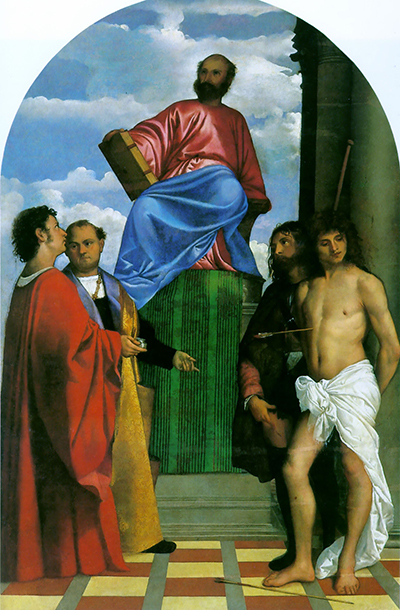
Titian's Saint Mark Enthroned with Saints Cosmas, Damian, Roch and Sebastian is an early Venetian altarpiece made for Santo Spirito in Isola and now kept in the sacristy of Santa Maria della Salute. Five saints share a tall oil-painted panel. Mark, Venice's patron, sits above two pairs of standing figures: the physician saints Cosmas and Damian on the left, and Roch and Sebastian, closely associated with protection from plague, on the right. The subject joins the city's civic identity to an appeal for health and intercession.[1][2][3]
The painting is 230 centimetres high and 149 wide according to Save Venice, which helped conserve it. Its date is less settled. Save Venice proposes around 1508–09; the Italian national catalogue displays about 1511; the owning basilica gives 1510 or 1511–12. These are different proposed dates for the same panel, rather than evidence for several Titian pictures with this title. “Around 1510” conveys their shared early-sixteenth-century setting without pretending a securely dated commission survives.[1][2][3]
At a Glance
- WorkSaint Mark Enthroned
- Research recordsavevenice.org
Contents
- A Venetian saint above four protectors
- Was it painted because of a plague?
- Santo Spirito in Isola and the move to the Salute
- How early is this Titian?
- What the material evidence tells us
- Looking at the painting today
A Venetian saint above four protectors
Mark sits high on a pedestal, holding his Gospel against his knee. His red upper garment and blue drapery form a large coloured shape against the sky. The throne lifts him above the pavement occupied by the four other saints, yet the whole group shares one space. The patterned floor reaches to their feet, so the lower figures seem available to a viewer approaching an altar while Mark remains an elevated focus. The scene is an assembled sacred company, often called a sacra conversazione, rather than a story in which the saints perform one historical action.[1][3]
On the viewer's left, Cosmas and Damian appear as mature, fully clothed men. On the right, Roch is robed while Sebastian is shown with much of his body uncovered, recalling the saint's martyrdom by arrows. Their contrast gives Titian an opportunity to distinguish fabric, flesh and different ages within one symmetrical scheme. The two pairs also carry different but connected associations: Cosmas and Damian were doctors, while Roch and Sebastian were invoked during outbreaks of plague. Save Venice identifies those roles explicitly, and the Salute calls the group “saints of the plague.”[1][3]
The figures face and respond to one another in varying ways, so the panel is not merely a rigid row of five names. Mark's height makes a central axis; the pairs below give the eye lateral movement. The left saints stand close to the picture plane, while Sebastian's exposed body and the darker figure beside him create a different balance on the right. There is a tension between the ordering supplied by architecture and the individuality of the bodies. The basilica points to the thoughtful expressions of the right-hand saints as one feature of its early Venetian style.[3]
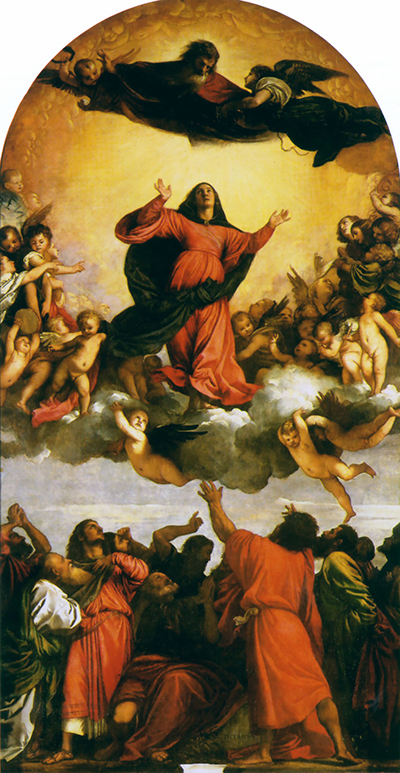
The Titian paintings guide places the panel among his early religious works. Later altarpieces, such as the Frari Assumption, use far larger crowds and more sweeping movement. That comparison can sharpen one's sense of the five-figure order here, although it does not prove that this work was conceived as a preliminary version of a later composition. It had a particular altar and local devotional purpose of its own.[1]
Was it painted because of a plague?
The selection of four protective saints is the strongest reason for connecting this altarpiece with Venice's plague years. Save Venice proposes that it may have been commissioned during an outbreak that ended in 1510. The Italian national catalogue describes the subject as votive and says its dating has commonly been linked to that epidemic. These institutional readings make the connection substantially more than a casual modern guess. They still do not name a contract that says the panel was ordered in response to a particular day or event.[1][2]
The difference matters. A patron could choose Roch and Sebastian because an epidemic was immediate, because memories of disease remained powerful, or because protective devotion had continuing importance. The picture itself names no outbreak. Nor does it show an infected citizen, a healing scene or an inscription recording thanks for deliverance. Its response to danger is expressed through the company of saints. Mark makes that company specifically Venetian, while Cosmas, Damian, Roch and Sebastian bring protective prayer into the assembly.[1][2][3]
Save Venice offers another possible plague reading in the dramatic darkness over Mark's face, left arm and shoulder, describing a shadow cast from the structure at the right. It suggests that the obscured city patron might evoke Venice's crisis and hope for salvation. This is an interpretation supplied by the conservation organisation, not a documented statement by Titian. In the existing small reproduction, Mark's face is still partly legible; variations in photography and lighting also limit how confidently a remote viewer can judge the exact darkness. The panel's choice of saints is firmer evidence for its health-related meaning than one symbolic reading of a shadow.[1]
The Salute's present setting adds another layer of association. A modern viewer enters a Venetian church deeply tied to the city's plague memory and sees these protective figures there. Yet the painting was created for Santo Spirito in Isola, not for the Salute. Its later location can intensify a visitor's response without becoming proof about the first patron's motives.[1][2][3]
Santo Spirito in Isola and the move to the Salute
Save Venice identifies the original destination as the church of Santo Spirito in Isola, used by Augustinian Canons. The owning basilica is more specific, assigning the panel to Santo Spirito's chapel of Saint Mark. The national catalogue also traces it to the island church. Thus, although the panel is now one of the notable works in the Salute sacristy, it originally belonged to a different religious interior and a differently organised ensemble.[1][2][3]
The transfer has a documented political starting point. The national catalogue says that on 29 December 1656 the Venetian Senate ordered the furnishings of the suppressed Santo Spirito church to be conserved at the Salute, in accordance with a papal brief. It points to an inventory of those objects in the State Archives of Venice. Save Venice similarly says that the altarpiece, Titian ceiling paintings and organ shutters by Giuseppe Porta Salviati were transferred after the Augustinian community's suppression in 1656.[1][2]
The basilica's own guide, however, says the Saint Mark panel arrived “after 1674.” That statement may describe the object's later arrival or installation rather than the date of the 1656 order; the available pages do not reconstruct every step. The safest account keeps both pieces of evidence visible: the Senate's 1656 directive and the basilica's later arrival date. Saying simply that the altarpiece “moved in 1656” would collapse an order and an arrival into one event.[2][3]
Displacement also changed the panel's neighbours. At Santo Spirito it was part of a programme that included other works by Titian. In the Salute sacristy it belongs to a collection of art relocated from elsewhere, as well as to a new architectural and devotional setting. The painting's origin and its current viewing place are both necessary to its history. Neither should be treated as a minor location footnote.[1][3]
How early is this Titian?
Save Venice dates the painting about 1508–09 and describes it as thought to be Titian's first independent commission. The phrase “thought to be” is important: it is a scholarly assessment of the work's place in his developing career. The Galleria Borghese, in its Titian biography, gives the panel a 1510 date but calls his Saint Anthony frescoes at Padua in 1511 his first documented commission. Those statements can coexist, because a painting may be proposed as an early independent undertaking without a surviving contemporary document that establishes the commission date.[1][4]
The national catalogue opts for about 1511. The owning basilica places it in 1510 or 1511–12 and relates its style to Giovanni Bellini and Giorgione. In the basilica's account, the enthroned saint and Sebastian's hair carry motifs associated with those earlier Venetian painters, while the picture shows Titian developing a more autonomous manner. These are curatorial observations about visual lineage, not proof that he copied a specific Bellini or Giorgione picture for each figure.[2][3]
The panel's size and multi-figure design do show ambition. Its combination of civic patron and health-related saints asks Titian to make an ordered, public devotional image. The Gospel, throne, floor and pairs of figures are enough to make the subject clear at altar distance. At closer range, differences of clothing, bodily exposure and expression give viewers more to examine. The claim of an emerging individual manner can therefore be discussed in relation to visible decisions rather than to a rigid first-work ranking.[1][3]
What the material evidence tells us
Save Venice and the Italian national catalogue both specify oil on panel. This matters because some widely circulated image metadata describe the work as oil on canvas. The primary object sources agree on the wooden support, so this page follows them. The exact dimensions stated here are Save Venice's 230 by 149 centimetres. Readers comparing photographs should also remember that a frame or crop can change an image's apparent proportions without changing the recorded panel size.[1][2]
A National Gallery technical bibliography reports an analysis of samples from this altarpiece. Above the gesso it identifies one or two pale grey layers, which the researchers say were probably a priming rather than separate underlayers. That is useful object-specific information about preparation of the support before the visible painting. It does not, by itself, establish a full sequence of underdrawing, alterations or pigments for each saint. Those stronger claims would require a published treatment or imaging report devoted to this panel.[5]
Save Venice records conservation maintenance completed in September 2015. It names Valentina Piovan as conservator and Valeria Poletto as project director. The public project page does not spell out every treatment step or provide a complete technical dossier; it says some dossiers can be consulted by appointment. The date and personnel are therefore documented, while detailed claims about cleaning, repainting or discoveries should not be inferred from the presence of before-and-after photographs alone.[1]
Looking at the painting today
The short title Saint Mark Enthroned correctly identifies the centre, but it leaves out what gives the altarpiece its particular devotional force. Four saints traditionally approached in times of illness stand close to a Venetian patron whose authority sits above them. That structure makes the city and its vulnerable inhabitants part of the same imagined sacred community. The plague interpretation rests on the named figures and institutional scholarship; the exact patron and date remain unsettled.[1][2][3]
The object also shows how easily a compact label can hide a complicated history. It has an original island-church destination, a 1656 order concerning displaced furnishings, a basilica account of arrival after 1674, several plausible early dates, and a modern conservation record. Holding these facts apart makes the painting more intelligible. It allows the panel to be read as a specific object made for a particular altar, rather than as a timeless gathering of saints detached from its first audience and later movements.[1][2][3]
Researched Titian and related works
Frequently Asked Questions
It is in the sacristy of Santa Maria della Salute in Venice. It was originally painted for Santo Spirito in Isola.[1][2][3]
Cosmas and Damian stand to the viewer's left of Mark; Roch and Sebastian are to the right. The first pair were physician saints, and the latter two were invoked during plague outbreaks.[1][3]
Institutional dates vary: Save Venice suggests c.1508–09, the Italian national catalogue c.1511, and the owning basilica 1510 or 1511–12. “Around 1510” communicates the broad agreement without choosing one proposal as a documented year.[1][2][3]
That is a well-supported interpretation of the four saints, proposed by Save Venice and strongly linked to the outbreak in the national catalogue. The available public sources do not give a contract naming the precise motive or patron.[1][2]
The Senate ordered Santo Spirito's furnishings to be conserved there in December 1656. The basilica says this panel arrived after 1674. The sources do not explain each stage between order and arrival.[1][2][3]
Discussion
What do you notice when you look closely at Titian's Saint Mark Enthroned?
Share a specific observation or a source that adds context.
Reader Insights
Which detail changes your reading?
How does its original setting affect what we see?
Which part of the evidence remains uncertain?
Join the Conversation
Add your observation below.
References
- Save Venice, “Titian's Saint Mark Enthroned with Saints Cosmas and Damian, Roch and Sebastian at Santa Maria della Salute,” object and conservation project. View source.
- Italian Ministry of Culture / Regione Veneto, “San Marco evangelista in trono con i santi Cosma, Damiano, Rocco e Sebastiano,” national catalogue 0500138581. View source.
- Basilica della Salute, Venice, “Sezione San Marco,” bilingual owner guide. View source.
- Galleria Borghese, “Breve biografia: Tiziano,” artist chronology. View source.
- Jill Dunkerton, Marika Spring et al., “Titian's Painting Technique to c.1540,” notes and bibliography, National Gallery Technical Bulletin 34 (2013), note 43. View source.