by Tom Gurney
Tom Gurney BSc (Hons) is an art history expert with over 20 years experience
Published on October 13, 2026 / Updated on October 15, 2026
Email: tomgurney1@gmail.com / Phone: +44 7429 011000
How Titian painted: drawing, colour, revision and the workshop: Introduction
A Titian painting can appear astonishingly immediate. A sleeve catches light in a few broken strokes; a body seems to turn beneath a transparent colour; a distant hill balances figures at the front. Technical examination shows that such effects were seldom the product of a single unplanned session. Beneath the visible image are prepared supports, drawn outlines, coloured underlayers and changes made during painting. Some pictures were repeated with help from the workshop, while others have been altered by ageing or restoration. To understand Titian's technique, we need to distinguish those different histories.[1][4]
This guide follows evidence from the National Gallery's studies of early and later paintings, alongside object research from the Prado, the Kunsthistorisches Museum and the Wallace Collection. It treats a technical finding as a claim about a particular physical picture. Titian did not use one unchanging recipe for more than sixty years, and a dramatic X-ray does not tell us what he was thinking. It can, however, reveal what he tried before arriving at the image now visible.[1][4]
At a Glance
- SubjectTitian’s Technique
- ScopeVenetian Renaissance art
- Source approachCollection records and primary documents
Contents
- What an examination can tell us
- Canvas, panel and preparation
- Titian began with drawing
- A change is not always what it first appears to be
- Colour is built in layers
- Why a colour may look different today
- The two Diana paintings: related, different histories
- Repetition, transfer and the workshop
- Incomplete, deliberately open and damaged
- Looking at a Titian after the technical study
What an examination can tell us
Infrared reflectography records light outside the visible range. It can reveal dark drawing or paint beneath some upper layers, but a thick or infrared-absorbing layer may conceal what lies below. X-radiography records differences in how materials absorb X-rays: paint rich in lead white often appears light, while other materials register differently. Neither method is a transparent photograph of every stage. Conservators compare the images with close surface examination, the painting's documented history and small samples when sampling is justified.[1][4]
A cross-section is a tiny slice through paint taken at one point, often from an existing loss or edge. Under a microscope it can show a sequence of ground, underpaint, glazes and later coatings. Analysis can identify some pigment particles or dye components. A sample from one purple fold does not establish the recipe for every purple in the canvas. The National Gallery's later study combined infrared, X-rays, microscopy, pigment analysis and study of paint media precisely because each method leaves questions the others can address.[4]
Technical discoveries also require interpretation. A mark in an X-ray may be a discarded figure, a test stroke, a tool mark or a later repair. Condition can complicate the reading: old varnish, relining and cleaning change the appearance of a surface, and a pigment can lose its original colour. The methods provide evidence of material and sequence; an explanation of artistic purpose must still fit the visible picture and its history.[2][4]
Canvas, panel and preparation
Titian worked on both wood panel and canvas early in his career. Later, canvas predominated, including in many paintings intended to stay in Venetian churches. The National Gallery's survey says panel supports became uncommon after approximately the first twenty years, while noting exceptions. Canvas offered practical possibilities for large works and for transport, but the fabric was not painted raw. It was prepared with layers that isolated its fibres and gave the artist a surface on which to draw and paint.[1][4]
In Noli me Tangere, painted about 1514, the National Gallery found a fine-weave canvas prepared with gesso and an off-white imprimitura: a thin preparatory layer above the ground. The precise materials and appearance matter because they influence the colour and handling above them. In the later Vendramin Family, a large picture on a distinctive point-twill canvas, the study found a creamy white gesso ground. Its weave has become more visible through the picture's subsequent history of relining. A texture apparent today can thus be both an original material and an effect magnified by later treatment.[2][4][5]
The point-twill support also helps make a practical connection among objects. The National Gallery notes a related weave in Pope Paul III and his Grandsons. A broad roll of fabric could carry a large picture without the seam that a narrower linen would need. That finding tells us about material choice; it does not prove that every picture on a similar weave was painted at one moment or by one hand.[4][5]
Titian began with drawing
The popular image of Titian as an artist who invented directly with colour and never drew beneath it is contradicted by technical study. Infrared examination has found underdrawing in paintings from different stages of his career. The National Gallery describes fluid, often black brush lines used to place figures and folds. Some lines are rapid and approximate; others specify a hand or arm more carefully. Titian might then follow, modify or abandon them while painting.[1][4]
The late Tribute Money is a useful counterexample to the claim that the older painter ceased planning. Infrared shows an accurately outlined hand and arm of the Pharisee holding the coin in a higher position than they occupy in the final picture. Other drapery lines are freer. The painting thus contains both precise preparation and subsequent revision. A missing drawing in one photographed area would not prove an absence of planning elsewhere: overlying paint can block the infrared signal.[4][8]
Paper studies are another form of evidence, but only a small and debated group survives. A surviving drawing can connect a figure to a commission without supplying every intervening stage. Conversely, underdrawing can establish that the artist prepared a figure on the canvas even when no paper sheet is known. The drawings guide addresses the works on paper; here the central question is how a planned design became a painted one.[1][4]
A change is not always what it first appears to be
The National Gallery's examination of Noli me Tangere shows why technical images need careful reading. A forked white shape in its X-ray had been interpreted as a discarded version of Christ's legs, turned away from Mary Magdalene. The conservators argue instead that it is more likely a trace of a knife wiped on the canvas during preparation or painting. Infrared shows Christ drawn in essentially the pose visible now, and no corresponding earlier torso appears. The revised interpretation does not deny that Titian changed the painting; it prevents one mark from becoming a dramatic but unsupported story about a different Christ.[2]
Other revisions in the same canvas are better supported. Titian altered parts of the landscape and tree, and the picture's edges and parapet were worked as he brought figure and setting together. A technical record therefore contains different degrees of certainty: some forms clearly belong to an earlier composition, while another bright mark may have a workaday explanation. Readers should be told which is which.[2]
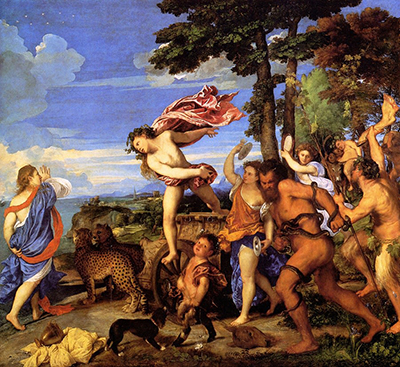
Bacchus and Ariadne supplies a different kind of evidence. Infrared reveals broad, rapid brush drawing for the pair of cheetahs pulling the god's chariot. Titian shifted Ariadne's profile to the left and adjusted her raised hand during painting. He also changed details of the chariot and draperies. X-rays and paint samples show overlapping colours where forms were revised. The energetic leap of Bacchus and Ariadne's response were therefore shaped through decisions on the canvas, rather than transferred unchanged from a fixed first design.[3]
These cases qualify the word pentimento, an alteration from an earlier state. It can mean a moved contour, a covered limb, a changed colour or a reordered landscape. Some changes are obvious in imaging; others remain ambiguous. A pentimento is evidence that painting developed, not automatic proof of authorship or of Titian's motive.[1][2][3]
Colour is built in layers
Titian's colour depended on material as well as placement. The National Gallery's early study identifies ultramarine, azurite, red lakes and other pigments in examined works. These substances do not behave alike: some make opaque mixtures, while translucent lakes can deepen a colour laid beneath them. Titian could place pale modelling below a red glaze, or bring a bright blue forward against a warmer underlayer. Calling him a master of “colour rather than drawing” obscures how drawn lines, underpaint and coloured strokes could work together.[1][3]
In Bacchus and Ariadne, a paint section from the bacchante's blue skirt contains red-lake layers below the blue. The catalogue weighs whether these layers were intended to affect the final blue or record a change from an earlier pink design; in this particular passage the later blue largely suppresses the red. The finding illustrates a crucial limit: a coloured layer is not always a deliberately visible optical effect. Its position and the overlying paint must be read together.[3]
The palette also changed as materials became available. National Gallery analysis found kermes-based red lake in earlier pictures and still in some later samples. Cochineal appears in the sampled later works, consistent with the arrival of American cochineal in Venetian dyeing during the 1540s and 1550s. The researchers qualify the origin of some early occurrences and analyse only selected passages. It would be wrong to say Titian replaced every red with one new pigment at a fixed date. The more useful conclusion is that a long career connected pictorial choices to changing supplies and trade.[1][4]
Why a colour may look different today
Smalt, a cobalt-containing blue glass pigment, is important to the appearance of several later paintings. The National Gallery's study of the Diana and Actaeon sky finds smalt beneath ultramarine. Much of that smalt has lost colour, helping account for a grey, patchy appearance in places that once carried a different balance of blue. Some purples in Diana and Callisto also contain degraded smalt with red lake, white and ultramarine. The cross-sections reveal complex adjacent strokes and layers, not one simple mixture spread across the entire cloth.[4][6][7]
A darkened passage should not automatically be interpreted as Titian's wish for a sombre late style. The National Gallery's Virgin suckling the Infant Christ has lost part of the colour in smalt-containing drapery, while other areas retain their force. Old varnish and conservation history can further change an impression of overall tone. The gallery also shows that some transparent and broken handling in this picture was intentional. Both facts must be held together: altered colour does not cancel deliberate brushwork, and expressive brushwork does not mean the colour has remained unchanged.[4][9]
These findings are especially helpful when comparing a reproduction with a painting. A digital image may exaggerate or suppress a subtle difference, and it cannot reveal which hue comes from original paint or a later coating. Source photographs and conservation reports are evidence about the present object, not a direct view into the sixteenth-century room where it first hung.[4][9]
The two Diana paintings: related, different histories
Titian sent Diana and Actaeon and Diana and Callisto to Philip II as a linked pair. They invite comparison, but their working histories differ. Technical study finds more extensive change in Diana and Actaeon. Actaeon's pose was altered; paint sections and imaging distinguish earlier positions from the finished figure. The architecture and some accompanying figures also shifted. These changes affect how the intruder meets the bathing goddess and how the viewer reads the surprise.[4][6]
Diana and Callisto appears to have been more fully arranged before Titian began painting, though it too changed significantly. Imaging shows that one nymph who now grips Callisto's arm was introduced after another position had been painted. A standing nymph later shown nude was initially partly wrapped in swirling drapery. These are object-specific revisions to a figure group; they do not make the entire pair one design worked out twice. The two canvases also differ in condition. The more thinly painted passages of Callisto have been especially vulnerable to past treatment, according to the technical catalogue.[6][7]
A reader can now ask more precise questions of the pair. Which lines belonged to the first layout? Which figures were moved after paint had been applied? Does a subdued colour reflect Titian's choice or an ageing pigment? This is more informative than describing both canvases simply as “late and loose.”[4][6][7]
Repetition, transfer and the workshop
Titian's workshop produced variants of successful subjects. Technical study finds evidence compatible with tracing or other mechanical transfer in series of reclining Venus pictures, Danaë and Venus and Adonis. The basic position of a main figure could be carried from one canvas to another and then altered during painting. A transferred outline is not a sign that Titian had no part in the new version. The National Gallery notes transferred elements even in the Prado Venus and Adonis and Apsley House Danaë sent to Philip II; their execution and patronage must be assessed separately from a workshop replica.[4]
The Prado's Spanish-language study of three Saint John the Baptist paintings makes this process unusually concrete. The early Venice composition appears beneath the Prado version; the Prado composition in turn appears beneath the later Escorial picture. The institution interprets this as a sequence in which a design was retained and adapted for a new painting over roughly thirty-five years. The three canvases are separate objects at Venice, Madrid and the Escorial. An X-ray of one cannot be cited as if it belonged to another.[10]
The question of authorship remains object-specific. A studio painting may contain revision because its maker was adapting the design, while an important commission may start from a traced figure and still receive substantial work from Titian. Neither the presence of a pentimento nor the use of transfer alone divides his hand from an assistant's. Collection attribution, provenance, close examination and comparison of materials all contribute to the judgment.[4][10]
Incomplete, deliberately open and damaged
The word “unfinished” is often attached to Titian's late paintings as if every visible brushstroke proved it. Technical evidence demands a finer distinction. In Pope Paul III with His Grandsons, the National Gallery finds that the red glazing of the pope's cap and garment had barely begun. This is a materially incomplete passage. In other works, a less polished surface can be intentional even if some strokes remain visible. Their condition after centuries must also be examined.[4]
The Death of Actaeon is a case where a long working history, changes of design and later condition meet. The National Gallery catalogue finds revisions to Diana's pose and a complex layer structure in parts sometimes called unfinished. Yellowed varnish, retouching and damage further complicate what the present eye sees. The painting was not sent to Philip II, and its current state cannot be converted into a simple story that Titian stopped work at one uniform stage.[4][11] The Pietà has a more explicit posthumous history: Palma Giovane completed it after Titian's death.[14]
A change can even remain visible because ageing made upper paint more transparent. Conversely, a later restorer may have hidden an alteration. Technical research is valuable because it stops us from treating the present surface as an untouched record of the painter's last working day.[2][4][11]
Looking at a Titian after the technical study
The most useful habit is to begin with the identified object. Note its owner and inventory, support and present condition. Then separate what can be seen in normal light from what imaging and samples establish. In Vienna, X-rays of Girl in a Fur reveal an earlier La Bella-like dressed figure beneath the present woman; at the Wallace Collection, Perseus and Andromeda preserves evidence that Andromeda was originally placed on the right. These are strong examples of revision, but each belongs to its own painting and source record.[12][13]
Titian's technique emerges from the accumulated distinctions: planning and improvisation, stable designs and changed ones, vivid original layers and colours affected by age, the artist's work and that of a workshop. A painting's force in ordinary light remains the starting point. Technical study gives us a more accurate account of how that force was made and what centuries have done to it.[1][4]
Researched Titian and related works
Frequently Asked Questions
No. Infrared study shows preparatory lines in works from different decades, including late Tribute Money. He often changed a design after drawing it.[1][4][8]
It is a change from an earlier state of a painting. Imaging, surface examination or a paint sample may reveal a moved figure, altered contour or changed colour; the evidence needs interpretation.[1][2]
Not always. An X-ray records how materials absorb radiation. The forked white mark in Noli me Tangere was once read as earlier legs, but the National Gallery now considers a wiped knife mark more likely.[2]
Pigments and coatings can age. Smalt in parts of the Diana pictures has lost blue colour, and varnish or past treatment can also alter a painting's appearance.[4][6][7]
No. Transferred outlines appear in important pictures made for Philip II as well as workshop variants. The extent of Titian's participation must be judged for the individual canvas.[4]
Discussion
What do you notice when you look closely at How Titian painted: drawing, colour, revision and the workshop?
Share a specific observation or a source that adds context.
Reader Insights
Which detail changes your reading?
How does its original setting affect what we see?
Which part of the evidence remains uncertain?
Join the Conversation
Add your observation below.
References
- Jill Dunkerton and Marika Spring, “Titian's Painting Technique to c.1540,” National Gallery Technical Bulletin 34 (2013), pp. 4–31. View source.
- Dunkerton and Spring, “Noli me Tangere,” National Gallery Technical Bulletin 34 (2013), catalogue 7, pp. 60–67. View source.
- Dunkerton and Spring, “Bacchus and Ariadne,” National Gallery Technical Bulletin 34 (2013), catalogue 8, pp. 68–75. View source.
- Jill Dunkerton and Marika Spring, “Titian after 1540: Technique and Style in his Later Works,” National Gallery Technical Bulletin 36 (2015), pp. 6–39. View source.
- Dunkerton and Spring, “The Vendramin Family, venerating a Relic of the True Cross,” National Gallery Technical Bulletin 36 (2015), catalogue 1. View source.
- Dunkerton and Spring, “Diana and Actaeon,” National Gallery Technical Bulletin 36 (2015), catalogue 4. View source.
- Dunkerton and Spring, “Diana and Callisto,” National Gallery Technical Bulletin 36 (2015), catalogue 5. View source.
- Dunkerton and Spring, “The Tribute Money,” National Gallery Technical Bulletin 36 (2015), catalogue 6. View source.
- Dunkerton and Spring, “The Virgin suckling the Infant Christ,” National Gallery Technical Bulletin 36 (2015), catalogue 7. View source.
- Museo Nacional del Prado, “Tiziano: San Juan Bautista,” exhibition research, Spanish. View source.
- Dunkerton and Spring, “The Death of Actaeon,” National Gallery Technical Bulletin 36 (2015), catalogue 8. View source.
- Kunsthistorisches Museum Vienna, “Titian's Vision of Women,” exhibition research on X-rays of Young Woman in a Fur. View source.
- The Wallace Collection, “Perseus and Andromeda,” object P11 and painting history. View source.
- Gallerie dell'Accademia di Venezia, “Pietà,” collection record; Ministero della Cultura, account of the intended Frari setting and Palma Giovane's completion. View source; View source.