 by Tom Gurney
Tom Gurney BSc (Hons) is an art history expert with over 20 years experience
Published on June 19, 2020 / Updated on October 15, 2026
Email: tomgurney1@gmail.com / Phone: +44 7429 011000
Titian's Emperor Charles V with a Dog: Introduction
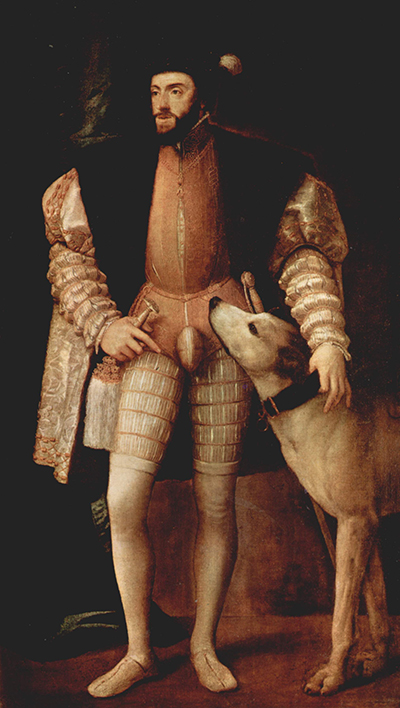
Charles V stands almost the full height of a narrow canvas. A large dog presses close at his side and turns its head up toward him; Charles lets one hand descend to the animal while the other rests near his weapon. The arrangement is formal but unusually direct. Titian's Emperor Charles V with a Dog is a portrait of a ruler whose authority is conveyed through dress, bearing and a companion, without a throne or battlefield. Painted in 1533, it is now in the Museo Nacional del Prado, Madrid, as P000409.[1]
The oil painting measures 194 × 112.7 centimetres. It is distinct from Titian's later mounted Charles V at Mühlberg, Prado P000410, and the Munich Charles V portrait. The Prado also owns a later anonymous copy titled Charles V with a Dog, P000454, so title alone is not enough to identify the original painting. The 1533 full-length Titian canvas is P000409.[1][2][3]
At a Glance
- WorkPortrait of Emperor Charles V with Dog
- Research recordMuseo Nacional del Prado
Contents
- Charles V and Titian in Bologna
- Looking at the emperor and the dog
- What Titian changed from Seisenegger
- Which portrait came first?
- Reward, status and later ownership
Charles V and Titian in Bologna
The early 1530s were decisive for how the emperor was represented. Charles was king of Spain as Charles I and Holy Roman Emperor as Charles V; his image had to work across courts and territories. Titian had first painted him in 1530, but that portrait is lost. A woodcut by Giovanni Britto and a later copy by Rubens offer indirect clues to its appearance. They differ in format, and neither should be mistaken for the Prado dog portrait. The surviving painting belongs to a renewed meeting in Bologna in January 1533.[1][4]
By then a full-length type was already available. The court painter Jakob Seisenegger had painted Charles several times from head to foot between 1530 and 1532. Patrimonio Nacional identifies his 1530 portrait, made at Augsburg, as an early life-size, full-length representation of the emperor. Seisenegger then worked for Charles's brother Ferdinand of Austria, including a portrait with an English water dog painted in Bologna in 1532. That work, signed and dated, is now in the Kunsthistorisches Museum, Vienna.[4][5][6]
The Prado counts five full-length portraits of Charles by Seisenegger in those three years. The Augsburg portrait was made during the imperial diet in the summer of 1530 at Charles's request. Ferdinand then commissioned two portraits in Prague in 1531; another followed in Regensburg in 1532 before the Bologna dog portrait. The series shows a court testing and repeating a new format for this particular ruler. Full-length princely portraits already had precedents in German painting, and fewer in Italian painting, but Seisenegger's repeated use of the format made it an established way to present Charles by the time Titian took it up.[4]
The Prado's Spanish catalogue treats Titian's painting as a transformation of this established court image. The likeness between the two dog portraits is too close to ignore: a standing ruler, fur-lined outer garment, a dog close to one side, and a partly enclosed setting. Titian's contribution is not simply the invention of a new pose. It is the alteration of proportion, space, light and expression within a formula Charles and his family had already accepted.[1][4]
That sequence matters because an artist borrowing another painter's design was not necessarily doing something discreditable in the sixteenth century. A court portrait needed to satisfy a patron's expectations and circulate a recognizable ruler. Titian could take a sanctioned image and test how much more persuasive it became when the figure's silhouette, face and surrounding space were reconsidered. The Prado regards the result as a real reinterpretation rather than a mechanical copy.[4]
The earlier paintings also explain what Titian was competing with. Seisenegger's full-length type had already met with Charles's approval; the Prado contrasts that acceptance with the uncertainty surrounding Titian's lost first likeness. Titian did not have to persuade the court to accept a standing emperor. His opportunity was to make a familiar official scheme work differently as a painting. That distinction keeps the comparison grounded in the court's portrait history rather than a simple contest over which artist had the first idea.[4]
Looking at the emperor and the dog
Charles wears a dark hat with a pale feather, a silvery, fur-lined outer garment and a brown garment beneath. Light catches the broad sleeves and the pale hose below the doublet. The dark upper part of the canvas concentrates attention on his face; the brighter clothing then carries the eye down the standing body to the white footwear and the dog. The Order of the Golden Fleece hangs at his chest, marking a Burgundian dynastic and chivalric identity.[1][4]
The animal rises from the lower right. Its head turns toward Charles's hand, creating the painting's clearest exchange of attention. It is not given a name in the Prado's record. Nor does the picture require a single literal reading such as “the dog means loyalty.” Dogs had a long history beside rulers in Burgundian court portraits, as the museum notes. Here the living creature also gives scale, animates the low part of the picture and softens the stillness of the official pose without diminishing the sitter's position.[1][4]
Charles's other hand remains near the sword or dagger. The weapon signals readiness but is not drawn or brandished. This is a different form of military presence from the armour and lance of the Mühlberg portrait fifteen years later. In 1533, the courtly garment and the animal frame a figure who can suggest command without being shown in action. The portrait's directness comes from its full-length format and proximity to the viewer, not from a narrative event.[1][2]
The Prado identifies the clothing more precisely: a silver-toned, fur-lined outer garment over a brown doublet with silver brocade, white boots and hose related to the dress of Landsknecht soldiers. It connects the ensemble to a documented appearance by Charles at Bassano on 1 November 1532. This combination of refined court material and soldierly elements gave the portrait a public meaning. It was an image of a ruler who could appear elegant and martial at once, particularly relevant to Charles's authority in Italy.[4]
The painting's space is restrained but carefully planned. A dark curtain recedes on one side, and the floor extends under the feet and paws. The figure stands near the front rather than deep within an architectural setting. He looks beyond the dog and the edge of the canvas, while the animal looks back to him. These differing directions hold the composition between an official likeness meant for others and a small encounter inside the picture.
What Titian changed from Seisenegger
The two painters do not present Charles's body in quite the same way. The Prado says Titian made the torso look more slender by giving more apparent area to the fur-lined outer garment and less to the doublet. He also opened the eyes by raising the lids and straightened the nose. These are painterly adjustments to a public likeness; they should not be treated as proof that Charles's physical features changed between 1532 and 1533.[1][4]
Titian changed the room as well. In Seisenegger's portrait, the patterned floor meets the wall relatively high behind the sitter, and a curtain closes the space. Titian lowered the point where floor and wall meet, moved the curtain to one side and placed Charles closer to the front. The area between the legs feels more open. According to the Prado, the smaller Titian canvas consequently offers a greater sensation of breadth and depth. Colour contributes too: its warmer gradations bind the figure, dog and setting into one atmosphere.[4]
These differences are useful to notice rather than merely to rank. Seisenegger's portrait had a documentary role and was evidently satisfactory to the Habsburg court. Titian made the figure look less confined, more vertical and more immediately present. The same dog-and-ruler formula could thus produce different impressions of proximity and command. Seeing the works together, even in careful reproductions, makes visible a decision about how imperial dignity should feel to a viewer.[4][5]
The two portraits also differ in scale. The Vienna Seisenegger canvas measures 203.5 × 123 centimetres, whereas the Prado Titian is 194 × 112.7 centimetres. Yet the emperor in Titian's narrower, somewhat shorter field does not seem crowded. The low viewpoint and sparse setting allow the figure's long silhouette to carry more weight than the room. Physical dimensions help explain the visual problem Titian solved; they do not establish that one painting was a direct tracing of the other.[1][5]
Which portrait came first?
The signed date 1532 on Seisenegger's Vienna portrait and Titian's documented encounter with Charles in January 1533 favour Seisenegger first. Some scholars have argued for the opposite order because an X-ray of Titian's painting shows that he changed the dog's pose. A revision proves that Titian reconsidered that element while painting. It does not show that he invented the whole dog-and-ruler scheme before Seisenegger made his signed portrait.[1][4][5]
The Prado adds a telling document: in a 1535 letter to Ferdinand, Seisenegger described the dog as an English breed and said he had taken care to show that it was female. That characteristic is visible in his image but not discernible in Titian's. The letter supports the view that Seisenegger studied the animal directly. It is not a complete record of Titian's working process, but it makes the proposed reversal of the portraits' order harder to sustain.[4]
There is also a longer sequence behind the Vienna painting. Seisenegger had been making full-length images of Charles since 1530; the dog portrait did not appear out of nowhere in 1532. Titian's lost first portrait appears to have used a different, shorter format, as far as the surviving woodcut and Rubens copy allow us to infer. The Prado therefore favours the documentary chronology while acknowledging the debate. The safest conclusion is that Titian adapted a court type associated with Seisenegger and made consequential changes to it.[4][6]
Reward, status and later ownership
The Prado says Charles rewarded Titian with 500 ducats and subsequently ennobled him and granted him an exclusive privilege to portray the emperor. These honours belong to the developing relationship between the painter and the Habsburg court. They should not be read as an inscription on this particular canvas specifying a per-picture fee or as evidence that Charles chose every adjustment to the dog or background.[4]
The picture later had a remarkable collecting journey. According to the Prado's Spanish provenance, Philip IV of Spain gave it to Charles I of England. This Charles I was a seventeenth-century collector, not the sixteenth-century sitter who also bore the Spanish regnal name Charles I. After the English king's death, the portrait appeared in the 1651 Commonwealth sale. It was acquired back for Philip IV and returned to the Spanish Royal Collection.[1][4]
The Prado records it in the New Royal Palace in Madrid in 1747. The English-language collection record begins its provenance summary with the Commonwealth sale, while the Spanish entry supplies the earlier royal gift and return. Read together, they explain why a portrait of the Habsburg ruler passed through an English royal collection and then came back to Spain. The later anonymous Prado copy and reproductions show the image continued to circulate, but they are separate objects from P000409.[1][3][4]
The portrait is now at the Prado. The paintings guide places it beside Titian's other court works; the Mühlberg painting shows what changed when Charles was portrayed as a victorious mounted commander in 1548. This earlier canvas makes its political claim through a recognized face, selected dress, court emblem, open pictorial space and a dog whose presence connects the emperor to established Burgundian portrait practice.[1][2]
Researched Titian and related works
Frequently Asked Questions
It is in the Museo Nacional del Prado, Madrid, as P000409. The museum also holds a later anonymous copy with the same subject, P000454.[1][3]
Seisenegger had painted full-length portraits of Charles from 1530 and signed a closely related dog portrait in 1532. Titian transformed that court type in 1533 through changes to proportion, space, expression and colour.[4][5][6]
Seisenegger described the animal in his Vienna portrait as an English breed in a 1535 letter. The Prado cannot establish every detail of Titian's dog from its image alone; its name is not recorded there.[4][5]
Discussion
What do you notice when you look closely at Titian's Emperor Charles V with a Dog?
Share a specific observation or a source that adds context.
Reader Insights
Which detail changes your reading?
How does its original setting affect what we see?
Which part of the evidence remains uncertain?
Join the Conversation
Add your observation below.
References
- Museo Nacional del Prado, “Emperor Charles V with a Dog,” collection record P000409. View source.
- Museo Nacional del Prado, “Emperor Charles V at Mühlberg,” collection record P000410. View source.
- Museo Nacional del Prado, anonymous later copy “El emperador Carlos V con un perro,” P000454. View source.
- Museo Nacional del Prado, “El emperador Carlos V con un perro,” detailed Spanish object essay and provenance. View source.
- Kunsthistorisches Museum Wien, Jakob Seisenegger, “Kaiser Karl V. mit seinem Englischen Wasserhund,” signed 1532. View source.
- Patrimonio Nacional, “El Retrato en las Colecciones Reales,” Seisenegger's 1530 full-length portrait of Charles V. View source.