by Tom Gurney
Tom Gurney BSc (Hons) is an art history expert with over 20 years experience
Published on June 19, 2020 / Updated on October 15, 2026
Email: tomgurney1@gmail.com / Phone: +44 7429 011000
Titian's The Worship of Venus: Introduction
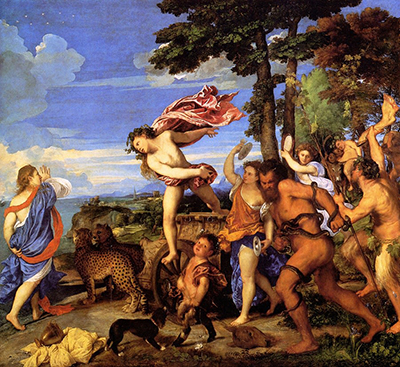
Titian's The Worship of Venus turns an orchard into a crowded realm of desire. Winged children gather apples, compete, play and rush between the trees, while nymphs attend a statue of Venus on the right. Alfonso I d'Este commissioned the painting for his Camerino d'Alabastro in Ferrara, a room devoted to mythological scenes by leading artists. Today the oil on canvas belongs to the Museo Nacional del Prado in Madrid, inventory P000419. The Prado gives its dimensions as 172 by 175 centimetres and catalogues it under the year 1518, although Titian's delivery to Ferrara is recorded in October 1519.[1]
The painting takes its subject from Imagines I.6 by Philostratus the Elder, an ancient prose description of a picture filled with Erotes, or personifications of love. That claimed ancient picture does not survive for us to compare directly with Titian's work. What Alfonso supplied was a text and a subject; what Titian made was a new painted space for a specific Renaissance room. The garden's variety is the point. Venus is present, but the many changing actions below her keep a viewer looking and moving from group to group.[1][2]
At a Glance
- WorkThe Worship of Venus
- Research recordMuseo Nacional del Prado
Contents
- A first look across the orchard
- Philostratus's picture in words
- Alfonso's room and the handoff to Titian
- Titian's answer to Fra Bartolommeo
- Antiquity translated into Venetian painting
- From Ferrara to Rome and Madrid
- Seeing the picture today
A first look across the orchard
The goddess is easy to miss if the eye begins where activity is thickest. Most of the foreground is occupied by children with wings, bare limbs and small gestures that overlap. The dark trees at left and a lighter opening toward the distance make a route into the garden, but that route is repeatedly interrupted by figures. Some are close to the painted surface; others become smaller along the paths. The picture gives a sense of breadth without requiring a single central character to anchor every incident.[1][2]
Venus rises as a statue at the far right, high above the nymphs below. This is not a scene of a goddess walking among the children. The rocky setting and elevated image give her a place of honour while the living figures do the work of gathering, offering and celebrating. A contrast develops between the fixed statue and the restless movement around it. The right-hand group brings the goddess into the story, but the orchard continues to claim most of the pictorial space.[1]
The title has appeared in English as The Worship of Venus and in Spanish as Ofrenda a Venus, or Offering to Venus. “Worship” here describes a mythological act within a classical literary subject. The offerings of the nymphs and children are part of a fiction painted for a ducal room, not evidence that a Renaissance court used the canvas as a working pagan shrine. The Spanish title usefully directs attention toward the gifts at the right; the English title suggests the larger festive honour paid to the goddess.[1][2]
Philostratus's picture in words
Philostratus asks a listener to imagine an orchard with rows of trees, walkable paths and soft grass. Apples in several colours hang overhead. Crowds of Erotes move among them, and their numbers are explained by the many objects of human love. The writer then shifts attention through small episodes: children tossing fruit, archers testing one another, wrestlers surrounded by spectators, and a comic pursuit of a hare. Finally the description reaches Venus and the gifts presented to her. The Prado reproduces this passage in Spanish in its teaching dossier, allowing readers to compare the story's sequence with Titian's painting.[2]
That comparison is rewarding precisely because a verbal description and a painting work differently. Philostratus can address one group after another, explain an animal's supposed properties, and ask the listener to imagine fragrance. Titian has to present many actions at once on a fixed surface. He separates clusters by depth, greenery and gaps of ground; he varies the direction of little bodies and wings; and he lets the viewer choose a path through them. The painting can suggest abundance and motion, but it cannot literally emit the apples' scent or deliver the ancient writer's explanations without a reader bringing the text to it.[1][2]
The apples are central to both works. Philostratus describes colours, baskets and fruit handled by the Erotes, with some playful exchanges standing for the beginning or continuation of affection. In Titian's orchard, fruit gives the children a shared task and a reason to gather beneath the branches. It also links the many small incidents to one environment. The children are not merely pasted across a generic landscape; they belong to a garden that offers things to pick, carry and present. Looking closely at how hands, arms and bodies are directed toward fruit makes the swarm more legible.[1][2]
Philostratus's episode of a hare may seem a surprising addition to a garden of love. His account connects the animal to Venus through ancient beliefs about its fertility and describes children trying to catch it alive as a gift. The hunt turns the desire to possess into comedy, with pursuers missing their agile quarry. It is useful to know that story when searching the dense foreground, but a small reproduction cannot prove the identity of every tiny animal or gesture. The interpretive point is secure in the source: play, courtship and pursuit are different forms of movement within the same garden.[1][2]
The nymphs offer a mirror and other precious objects to Venus in Philostratus's description. The mirror held aloft in Titian's right-hand group is more than a bright accessory. It directs a gaze upward and participates in the act of offering. At the same time, it is a device for steering the viewer toward the statue at the edge of the canvas. The literary source tells us why the gift belongs to Venus; the painted arrangement makes it a visual link between attendants and goddess.[1][2]
Alfonso's room and the handoff to Titian
Alfonso I d'Este wanted a coordinated sequence for the Camerino rather than an isolated canvas. The National Gallery in London describes the wider scheme as works by Giovanni Bellini, Titian and the Ferrarese painter Dosso Dossi. Bellini's Feast of the Gods was made for the room before Titian's contributions; Titian later reworked its landscape. Titian's other two major Ferrara canvases were Bacchus and Ariadne and the Bacchanal of the Andrians. Their subjects bring drinking, love, music and myth into dialogue without making all three scenes copies of the same literary passage.[3]
The Worship did not begin as Titian's assignment. Alfonso had asked the Florentine painter Fra Bartolommeo for the subject around 1516, and that artist sent a design. His death in October 1517 led the duke to pass the project to Titian. In April 1518 Titian received instructions on its theme and dimensions together with a drawing, probably Fra Bartolommeo's. The Prado says the finished canvas was carried to Ferrara by Titian himself in October 1519. These dates mark successive stages: proposed subject, change of artist, instructions and delivery. They should not be flattened into the statement that every part of the painting was finished in 1518.[1]
The Prado's teaching dossier also names the humanist Mario Equicola as an adviser to Alfonso's programme. A courtly reader could value Philostratus's account for its display of ancient learning, but the resulting picture had to work in a real room of limited dimensions. According to the National Gallery, the duke sent correctly sized canvases to Titian. The record suggests how seriously format and placement were taken, even though the precise location of the Camerino in the palace and the original order of the paintings remain uncertain.[2][3]
Titian's answer to Fra Bartolommeo
The drawing associated with Fra Bartolommeo put Venus at the centre of a symmetrical, pyramid-like design. Titian retained the idea of a statue and attendants but moved the goddess to one side. The garden and its inhabitants took over the centre. This was a significant compositional decision, not simply a change in minor ornament. A centrally placed Venus would have given every activity an obvious axial destination; Titian instead makes the eye discover her after following a succession of children through the orchard.[1]
The Prado proposes that the shift may have suited the painting to a particular wall. It notes the rightward pull of the composition, the landscape's recession and nymphs' glances toward the right, including a direction mediated by the raised mirror. A reconstruction made for the 2003 Titian exhibition placed this work alone on the room's right wall. That is a reasoned proposal, not a surviving plan signed by Alfonso. The National Gallery expressly says that the paintings' exact arrangement is unknown. We can therefore appreciate the picture's rightward energy without claiming certainty about the wall on which a sixteenth-century visitor saw it.[1][3]
This distinction matters because room-based explanations are tempting. A painting can be carefully composed with its neighbours in mind even when those neighbours have moved and the wall records are incomplete. The Worship now hangs in a museum, and the Camerino works are dispersed. Reconstructing their original conversation requires documents, surviving paintings and qualified inference. It should not turn every gaze in the picture into proof of a lost object beyond the frame.[1][3]
Antiquity translated into Venetian painting
The commission was unusual in asking Titian to recreate a painting known through ancient writing. The Prado calls the Worship his first attempt at such a task. It was a form of ekphrasis: words describing an image and provoking a new one in the reader's mind. Titian did not have the alleged ancient original before him. He could select, arrange and colour the text's details, making something that satisfied Alfonso's learned subject while displaying his own skill with figures and landscape.[1][2]
Other antique models entered the painting through sculpture. The Prado connects several Erotes to classical works known in Venice, and its teaching dossier compares the statue of Venus to a type called the Venus Celeste. A version associated with Giovanni Grimani's collection may have been available in the city early in the sixteenth century. The fall of the goddess's drapery and the way she gathers it below the waist are the specific features invoked in this comparison. It is more precise to describe such visual affinities than to say that the entire canvas copies a particular Roman marble.[1][2]
Titian had also explored the image of the winged child in earlier work, including The Three Ages of Man, as the Prado points out. The Erotes here are simultaneously types inherited from antiquity and bodies with differing positions, tasks and degrees of attention. Their repeated forms create a rhythm; their individual actions prevent the rhythm from becoming a uniform pattern. The dark leafy canopy, bright flesh, fruit, fabrics and opening distance give the busy assembly a shared atmosphere.[1]
The literary source is frank about desire. Some of Philostratus's games represent attraction between pairs; the hare's ancient associations are sexual; Venus is the goddess whose domain includes love and fertility. Titian's children can look exuberant or humorous, but reducing them to harmless decoration would miss that adult classical subject. Equally, it would be misleading to assign one fixed allegorical label to every child. The picture's richness lies in how many distinct acts occupy a common garden.[1][2]
From Ferrara to Rome and Madrid
The painting's later history changes the meaning of “its setting.” The Prado's encyclopedia places the Ferrara mythologies in the Aldobrandini and Ludovisi collections in Rome after the Este period. Its account of the Bacchanal of the Andrians says that Niccolò Ludovisi offered the two Prado canvases to Philip IV of Spain in 1637, with the count of Monterrey involved in the transfer. That narrative connects The Worship of Venus with its companion. The Prado's own object inventory supplies a later secure point: the canvas was in the Buen Retiro Palace in Madrid by 1747, with subsequent entries for rooms in the New Royal Palace.[1][4]
While the original was still in Rome, Giovanni Andrea Podestà made a print after it in 1636 and dedicated the plate to Cassiano dal Pozzo. The Prado explains that the etching reverses Titian's composition and alters part of the distant landscape. The sheet held by the Prado is a later impression of that plate, dated approximately 1782–1817 from its paper watermark. “1636 print” thus describes the engraving's original date, not the age of that particular surviving sheet. The reversed image helped the design circulate, but it cannot be substituted uncritically for the canvas when discussing Titian's left-to-right arrangement.[5]
Copies multiplied the image in another medium. The Prado names Padovanino's version in Bergamo and a copy by Peter Paul Rubens. Stockholm's Nationalmuseum identifies its Offering to Venus, inventory NM 599, as a free copy by Rubens after Titian, painted in the 1630s. This is evidence of sustained interest in Titian's Ferrara invention, not evidence of a second Titian original in Sweden. The distinction between original, free copy and reproductive print is especially important for a composition crowded with small figures: each later maker could change emphasis, scale or orientation.[1][5][6]
Seeing the picture today
At the Prado, the canvas can be examined as a self-contained work, yet its first audience encountered a larger mythological programme. Looking back toward the Camerino clarifies three choices: why the format was specified, why an ancient literary description was given to the painter, and why a composition might pull attention across a wall. Looking at the painting itself clarifies something the documents alone cannot show: Titian turned a list of garden incidents into an environment where attention keeps shifting between close play and distant space.[1][2][3]
The record also has limits. The Prado's catalogue year is 1518, while the documented handover is 1519. The proposed right-wall position is still a reconstruction. The ancient image described by Philostratus is not available to prove literal fidelity. Accepting those limits does not weaken the painting's achievement. It makes clear what Titian actually controlled: the way a text, an inherited drawing, antique models and the needs of Alfonso's room could become a new visual order.[1][2][3]
Researched Titian and related works
Frequently Asked Questions
The Museo Nacional del Prado in Madrid holds it as P000419. The museum records it as oil on canvas, 172 × 175 centimetres.[1]
Alfonso I d'Este ordered the subject for his Camerino d'Alabastro at Ferrara. Fra Bartolommeo supplied a design before his death, after which Titian took up the painting.[1][3]
The Prado catalogues the painting as 1518 and separately records Titian bringing it to Ferrara in October 1519. The first is the museum's assigned work date; the second is a delivery event.[1]
Philostratus the Elder's Imagines I.6 describes an orchard of Erotes collecting apples, playing, chasing a hare and making offerings to Venus. Titian translated that verbal scene into a new composition.[1][2]
Discussion
What do you notice when you look closely at Titian's The Worship of Venus?
Share a specific observation or a source that adds context.
Reader Insights
Which detail changes your reading?
How does its original setting affect what we see?
Which part of the evidence remains uncertain?
Join the Conversation
Add your observation below.
References
- Museo Nacional del Prado, “The Worship of Venus” / “Ofrenda a Venus,” collection record P000419. View source.
- Museo Nacional del Prado, Mitología en el Prado, teaching dossier, especially pp. 34, 40–41 (Spanish discussion and Philostratus passage). View source.
- National Gallery, London, “Titian, Bacchus and Ariadne,” collection essay on Alfonso's Camerino, associated painters and uncertain original installation. View source.
- Museo Nacional del Prado, “Bacanal de los andrios, La [Tiziano],” encyclopedia account of the shared Ferrara, Roman and Spanish collecting history. View source.
- Museo Nacional del Prado, “Ofrenda a Venus,” record for Giovanni Andrea Podestà's 1636 plate and later impression. View source.
- Nationalmuseum, Stockholm, “Offer till Venus,” collection presentation of Rubens's free copy after Titian, NM 599. View source.