by Tom Gurney
Tom Gurney BSc (Hons) is an art history expert with over 20 years experience
Published on June 19, 2020 / Updated on October 15, 2026
Email: tomgurney1@gmail.com / Phone: +44 7429 011000
The Martyrdom of Saint Peter: Martino Rota after Titian: Introduction
The surviving image is an engraving by Martino Rota after Titian, rather than Titian’s painted altarpiece. The Metropolitan Museum of Art identifies Rota as the printmaker and Luca Guarinoni as publisher of its impression, The Martyrdom of Saint Peter, accession 17.50.16-155. This distinction matters unusually much here: Titian’s original Death of Saint Peter Martyr was destroyed in 1867. What can be studied today is a network of prints and painted copies, each preserving and interpreting parts of a lost work. The Met sheet is one such witness, and also a work with its own maker, material and history.[1][2][3]
At a Glance
- WorkThe Martyrdom of Saint Peter
- Research recordMetropolitan Museum of Art
Annotated details from The Martyrdom of Saint Peter
Select a numbered area to find its detail below. Open a detail image to view it larger.
Details from THE MARTYRDOM OF SAINT PETER
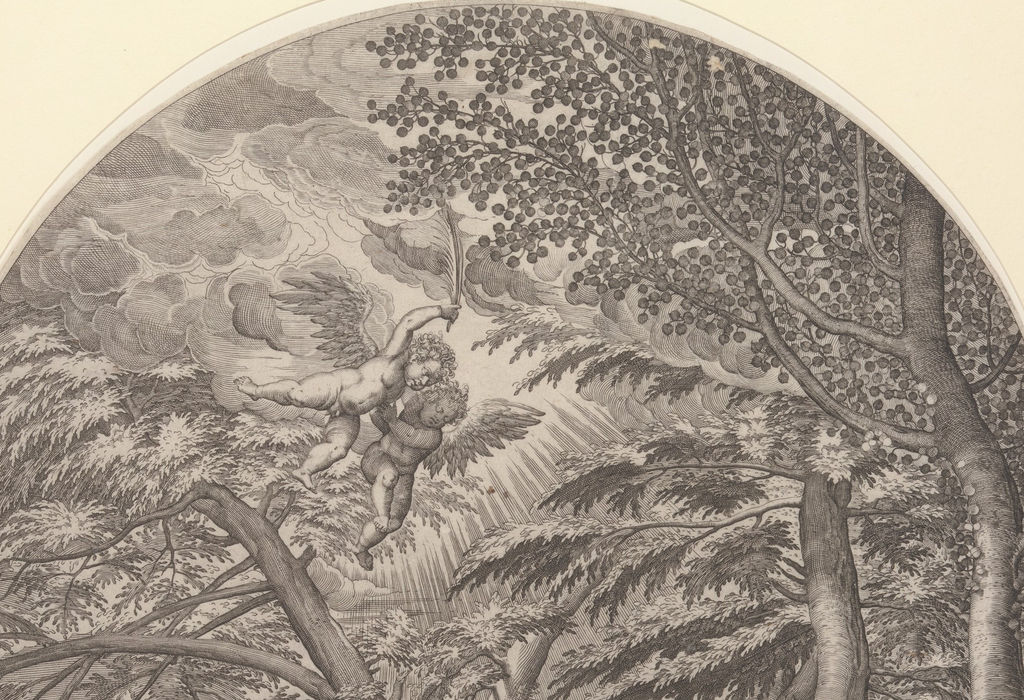
Martyrdom of Saint Peter Angel and Trees
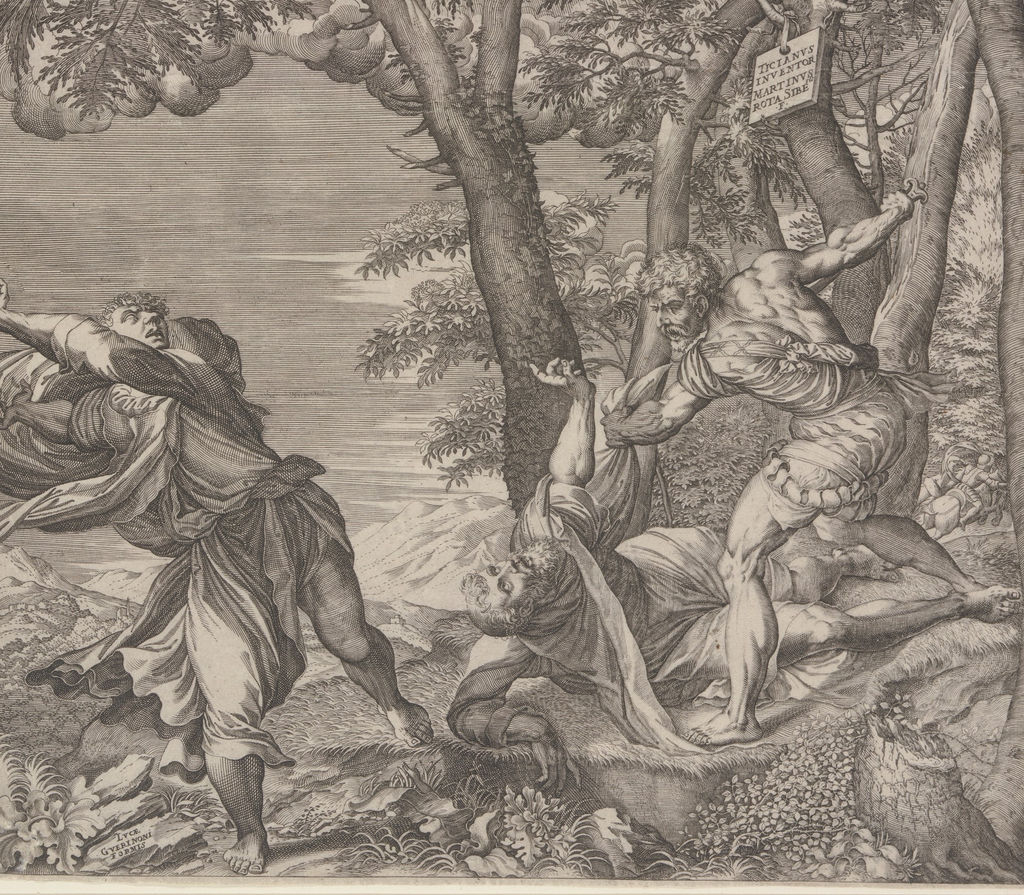
Martyrdom of Saint Peter Figures and Inscription
Purchase, Joseph Pulitzer Bequest, 1917 Public domain. Image source · Reuse licence
Contents
- Which Saint Peter is shown?
- Titian’s altarpiece and its church setting
- How Rota organizes the violence
- What the surviving copies can tell us
- Why the dates require care
- Looking at the print today
Which Saint Peter is shown?
The subject is Peter of Verona, usually called Saint Peter Martyr, a Dominican friar. He is not the apostle Peter. The Dominican Order records that Peter of Verona was killed on 6 April 1252 while travelling from Como to Milan; he was canonised the following year. The print shows the violent moment of the attack, not an episode from the apostle’s life. This identity is easy to miss because the Met’s shorter English title says only “Saint Peter,” while accounts of Titian’s altarpiece commonly add “Martyr.”[1][4]
At the bottom of the arched image, the fallen friar occupies the centre of a wooded path. A sword-bearing attacker presses in from the right. The other robed figure at the left moves away and raises an arm. Their opposed movements make the crisis readable before the eye reaches the upper part of the sheet. Above the trees, a heavenly figure brings a palm, a familiar sign of martyrdom. The visual story therefore unfolds in two registers: bodily danger below and an assurance of sanctity above. These observations concern Rota’s surviving print; the precise appearance of Titian’s lost surface cannot be checked against it.[1]
Titian’s altarpiece and its church setting
Titian made the original oil altarpiece for the Basilica dei Santi Giovanni e Paolo in Venice in 1527–29. The Walters Art Museum records its imposing dimensions as approximately 500 × 306 centimetres, and the National Gallery of Art says it was completed in 1529. This was a nearly five-metre-high church painting, designed to confront a viewer within a religious setting. Rota’s sheet, at 40.1 × 27.2 centimetres in its present trimmed state, asks for close inspection at a completely different scale.[1][2][3]
The National Gallery of Art places the commission among Titian’s major Venetian altarpieces, after the Assumption for the Frari and the Pesaro family’s altarpiece there. Its account also confirms the decisive later event: Titian’s painting was destroyed by fire in 1867, and a full-size copy occupies the original location. The image now seen in that church should therefore not be mistaken for Titian’s surviving hand. The Rota engraving, unlike the replacement, belongs to the centuries when the original still existed. Yet a print made after a painting is never identical to the painting, even when it preserves the broad organization of a famous composition.[2][3]
That difference begins with the materials. Titian’s large canvas could use colour, oil, light and changes of brushwork to separate the living figures from the forest. An engraver works through lines cut into a metal plate and transferred in ink to paper. Rota builds the dark masses of foliage and the folds of clothing through patterned marks. The spaces left as bare paper can make figures and sky seem illuminated. Those effects are worth examining as engraving, but they do not tell us exactly which greens, browns or reds Titian used, or how thickly he laid his paint.[1][3]
How Rota organizes the violence
The trees do more than supply a location. Their trunks divide the long image into passages, while their foliage closes much of the distance beyond the actors. At the bottom, the attack is compressed into a small, crowded area; above it, branches and openings draw the gaze upward. The saint’s fall and the companion’s flight pull in different directions. The attacker’s raised weapon turns the viewer back toward the victim. Rota uses the continuous network of engraved lines to hold the landscape and the sudden human movement together.[1]
That movement gives the scene its force without requiring the viewer to know every detail of Peter of Verona’s biography. The threatened body, the retreating companion and the apparition overhead establish the event and its religious interpretation. At the same time, the forest is not merely a neutral backdrop. A narrative encountered in a chapel would have surrounded the worshipper with a large painted landscape; the paper print condenses that encounter into a portable image. Its narrow, arched top also recalls a shape suitable for an altarpiece, although the Met describes this particular sheet as trimmed. We should not assume its present edges show the entire original plate or the exact outline of the church painting.[1][2]
The print’s title and visual emphasis can be discussed separately. The title identifies the martyrdom. The arrangement makes the viewer work through the instant of injury, the witness’s reaction and the promise signalled above. This is an interpretive reading of what the Met impression visibly presents, not proof of Titian’s intended sequence of attention. Rota’s decisions about line density, contrast and scale mediate the design at every point.[1]
What the surviving copies can tell us
The painting was famous enough to be repeated in several media. The Walters Art Museum owns a small grisaille—a painting largely in tones of grey—catalogued as Venetian, The Death of St. Peter Martyr (after Titian), dating from the sixteenth century or later. Its canvas measures 43.1 × 29.5 centimetres, close to the Met sheet’s present size. Because the grisaille resembles a monochrome print, it might be tempting to treat it simply as a painted copy of Rota. The Walters cautions against that shortcut: the companion’s windswept drapery in its work differs from Rota’s engraving and is, in the museum’s judgment, closer to the lost original. The museum leaves open the possibility that its painter used another reproductive print.[2]
This comparison shows both the value and the limit of reproduction. A copied detail may preserve something omitted or changed in another version; it may equally reflect a later maker’s choices. The Walters’s broad date, “sixteenth century or later,” also prevents a firm claim that its painter stood before Titian’s canvas. No single print or grisaille can restore the original’s colour, surface and full composition with certainty. Comparing independent witnesses is more informative than treating one as a transparent substitute.[2]
Another surviving engraving belongs to Cornelis Cort, not Rota. The National Gallery of Art dates Cort’s Assassination of Saint Peter Martyr to 1567 and identifies Luca Bertelli as publisher, with Titian named as the artist after whom it was made. That is a different object and a different publishing arrangement from the Met’s Rota–Guarinoni impression. The existence of both helps explain how the Venetian painting travelled as an image: viewers could know its dramatic design through paper without seeing the church original. It also warns us to check the named engraver and publisher before using a reproduction as evidence.[1][5]
Why the dates require care
The Met gives its Rota engraving an approximate date of about 1560, but the same record describes Guarinoni as active in Venice in 1568–69. The Walters calls Rota’s engraving published in 1568–69. These catalogue statements are not easily collapsed into one precise year. They may refer to different stages of making or publishing a print, but the cited records do not establish a complete sequence. For this impression, the soundest practice is to retain the Met’s approximate object date, record the Walters’s later publication dating, and avoid assigning a single certain printing date.[1][2]
The Met lists the impression as a trimmed sheet with an arched top and records its purchase in 1917 with funds from the Joseph Pulitzer Bequest. That accession history describes this particular surviving paper object; it is separate from the history of Titian’s altarpiece and from the history of Rota’s engraved plate. The museum makes a public-domain photograph available for close study, but the object credit still needs to distinguish the engraver, Titian as source artist, the publisher and the holding museum.[1]
Looking at the print today
Rota’s engraving is most useful when it is allowed to be both evidence and art. It offers a concrete view of how a sixteenth-century maker translated the lost altarpiece’s attack in a wooded landscape into linear contrasts. It also demonstrates how Titian’s composition could circulate beyond Venice before the painting was lost. What it cannot offer is direct access to Titian’s painted colour or touch. The surviving print, the Walters grisaille and Cort’s separate engraving invite comparison precisely because their differences remain visible.[1][2][5]
For related works and techniques, see the Titian prints guide and the Titian paintings guide. The Met’s Rota impression remains the object under discussion: “after Titian” does not make Titian the printmaker.[1]
Researched Titian and related works
Frequently Asked Questions
No. The Met identifies Martino Rota as the engraver, Titian as the artist after whose work it was made, and Luca Guarinoni as publisher.[1]
Titian’s original was destroyed by fire in 1867. The National Gallery of Art says a full-size copy stands in its former location in Santi Giovanni e Paolo.[3]
No. This is Saint Peter Martyr of Verona, the Dominican friar killed in 1252.[4]
Discussion
What do you notice when you look closely at The Martyrdom of Saint Peter: Martino Rota after Titian?
Share a specific observation or a source that adds context.
Reader Insights
Which detail changes your reading?
How does its original setting affect what we see?
Which part of the evidence remains uncertain?
Join the Conversation
Add your observation below.
References
- Metropolitan Museum of Art, “The Martyrdom of Saint Peter,” Martino Rota after Titian, accession 17.50.16-155. View source.
- Walters Art Museum, “The Death of St. Peter Martyr (after Titian),” accession 37.990. View source.
- National Gallery of Art, “Titian,” artist biography. View source.
- Order of Preachers, “S. Petri de Verona.” View source.
- National Gallery of Art, “The Assassination of Saint Peter Martyr,” Cornelis Cort, accession 2012.147.1. View source.