 by Tom Gurney
Tom Gurney BSc (Hons) is an art history expert with over 20 years experience
Published on June 19, 2020 / Updated on October 15, 2026
Email: tomgurney1@gmail.com / Phone: +44 7429 011000
A Self-Portrait Drawing Attributed to Titian: Introduction
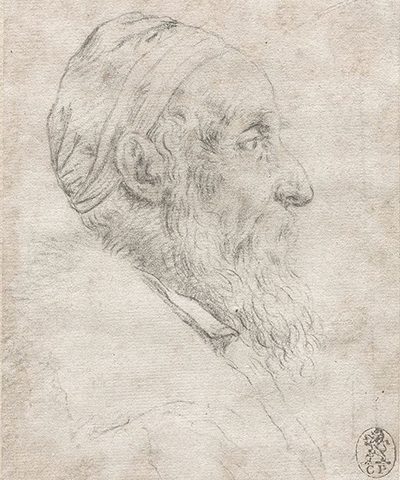
An old man’s head faces right in a small chalk drawing. Its near eye, long nose, cheek, ear and beard are closely studied; the cap and the upper body receive much less attention. This imbalance gives the image its force. The face seems to emerge from lines still in motion, while the clothing is little more than a setting for it. Venice’s Museo Correr exhibited the sheet in 2014 as a self-portrait drawing attributed to Titian. It was a loan from a private collection, not a drawing owned by the museum.[1]
The two parts of that description carry different degrees of certainty. The man looks like the elderly Titian familiar from painted self-portraits. Whether Titian himself made the marks is a scholarly argument. The Correr explicitly called its exhibition Questions of Attribution in Titian’s Drawings and presented it as an opportunity to investigate the problem, even as it named David Rosand and Luba Freedman among scholars supporting the attribution.[1] This page follows that distinction: it describes the proposed self-image and the evidence for the drawing, while keeping the artist’s hand qualified.
At a Glance
- WorkSelf Portrait Drawing
- Research recordarchivio-correr.visitmuve.it
Contents
- What is visible on the sheet?
- Is the man Titian?
- A comparison with the painted self-portraits
- Why attribution is especially difficult here
- From rediscovery to exhibition
- What the drawing contributes
What is visible on the sheet?
The profile gives nearly all its attention to the head. A chalk contour moves down from the cap to the brow, nose and mouth; smaller changes of pressure and direction model the folds around eye and ear. The beard is made from quick, irregular strokes, rather than from a single enclosed silhouette. Below the head, shoulders and the fur collar are only lightly set out. The Correr described the medium as black chalk and singled out the rapidly drawn head against the briefly indicated cap and collar.[1]
The dark details of the face make the areas left open more noticeable. This is not the finish of a painted portrait translated into monochrome. A drawing can establish likeness by selecting which features need emphasis and which can remain provisional. The ear, eyelid and nose bridge carry much of the identification; the abbreviated body gives no comparable description of rank, setting or profession. Looking at this economy is worthwhile whether or not the attribution is ultimately accepted.[1][2]
The lower right of the reproduced sheet includes a small circular mark. The published sources cited here do not identify it as a named collector’s mark or establish an early ownership history. Similarly, a pale digital image cannot establish the exact tone of the paper or a complete list of drawing materials. The Correr’s black-chalk description is the appropriate material statement.[1]
Is the man Titian?
Rosand’s 2009 study calls the figure a profile portrait of Titian and links it visually to the painted self-portrait in Madrid. He notes that the drawing faces right, whereas the Prado painting’s profile faces the other way.[2] That reversal is a useful comparison, but it is not a mechanism of authorship by itself. A painter, assistant, admirer or later copyist could have used a known likeness. The question “who is shown?” must be kept apart from “who held the chalk?”
The Correr’s exhibition account takes the sitter’s identity with considerable confidence, describing a familiar elderly profile. It frames the maker as an attribution supported by named scholars and open to wider critical judgement.[1] The distinction matters because the accepted body of Titian drawings is comparatively small. As Rosand himself acknowledged, there is no plentiful group of securely assigned late sheets against which this one can be matched mechanically. His case therefore rests on his reading of quality and the intimate way the marks construct the likeness.[2] Readers should understand that as an original art-historical argument, not as a signed document.
Rosand also records an earlier tentative attribution to Giuseppe Porta, which he did not find convincing.[2] That history shows why the sheet deserves more than a caption that simply says “Titian” or, conversely, “anonymous.” Different scholars have tested its visible qualities against different makers. The Correr’s title invited precisely this discussion. A defensible current label is “self-portrait drawing attributed to Titian”; a claim of secure autograph status goes beyond the institution’s wording.[1][2]
Luba Freedman devoted a substantial chapter to the work in the 2014 Correr catalogue, titled “Titian’s self-portrait drawing as demonstration of his art.”[3] Its publication establishes that the attribution received extended scholarly treatment alongside the exhibition; the chapter’s bibliographic record does not itself reveal each step of her argument. It would be misleading to attribute a specific technical finding or provenance discovery to that chapter without consulting its full text. The Correr account and Rosand’s published abstract provide the checked basis for the claims made here.[1][2][3]
A comparison with the painted self-portraits
The drawing is often placed beside the self-portraits in the Prado and Berlin. Those are separate oil paintings, with their own collection records and technical histories. Berlin calls its canvas one of only two authenticated painted self-portraits by Titian, the other in Madrid.[4] That statement concerns paintings; it does not automatically admit or exclude a drawing in private hands.
In Madrid, the profile turns the other way from this sheet, the relationship Rosand singled out.[2] In Berlin, the painter appears as an older man with a more frontal turn, a fur-trimmed cloak and a gold chain associated with his imperial ennoblement. The Berlin record also notes that the picture is partly unfinished and has no brush, palette or canvas identifying Titian’s profession.[4] The chalk sheet shares the emphasis on age, but its lightly sketched collar does not have the painted canvas’s material presence. It records a face in line; Berlin stages a person in paint and costume.
The date of the Berlin canvas itself illustrates the danger of assigning a year from apparent age. Berlin’s catalogue metadata gives roughly 1550–55, while its detailed essay argues on stylistic grounds that the painting is unlikely to predate the early 1560s.[4] That internal difference belongs to the Berlin painting, not to the private drawing. It warns against treating all older likenesses of Titian as moments in a perfectly settled chronological sequence. The drawing lacks a publicly checked dated inscription or comparable fixed point; “late-life” is more responsible than a confident single year.[1][2][4]
Nor should the sheet be described as a proven preparatory study for either canvas. A reversed profile can support a discussion of shared image-making, and a broadly similar sitter can prompt comparison. It does not document the drawing’s exact place in a painting’s production, especially where the sheet’s early provenance is not known.[1][2] The strongest comparison is of choices: which parts of the face receive attention, how a familiar profile is constructed, and how chalk differs from oil paint in making the artist visible.
Why attribution is especially difficult here
Titian’s paintings frequently survived in known collections, commissions or written accounts. Drawings can be more fragile and less thoroughly documented. A small sheet may pass through private hands, be mounted or copied, and appear publicly long after its making. In this case, the Correr called the work recently rediscovered but did not publish a continuous provenance back to the sixteenth century in its exhibition announcement.[1] The absence of such a chain does not disprove authorship; it limits one potential line of confirmation.
The challenge is also visual. A right-facing profile that resembles Titian is a subject a later artist could copy. Rapid, persuasive chalk handling might favor a skilled hand, but quality is a judgement that must be argued rather than read off a signature. Rosand was unusually explicit about this problem: the small corpus of accepted Titian drawings offers no simple comparison, so he focused on the quality and mechanics of the drawing itself.[2] The Correr described the museum’s role as creating space for debate and investigation, especially for mature Titian drawings.[1] That is a more accurate account of the evidence than either complete dismissal or automatic acceptance.
There is no reason to collapse attribution, material and sitter into one yes-or-no test. The Correr identifies black chalk, the image presents an elderly profile and Rosand argues for Titian as both sitter and draughtsman.[1][2] Each proposition has different support. A conservator’s material study, a secure historical document or a better reconstruction of the sheet’s early movements could change the assessment. None was identified in the public sources checked for this page.
From rediscovery to exhibition
The Correr says the drawing was first presented publicly in the 2007 Belluno exhibition Tiziano ultimo atto, curated by Lionello Puppi. It was then displayed at Fondazione Cosso in San Secondo di Pinerolo before the Venice exhibition from 29 March to 15 June 2014. The 2014 loan came from a private collection.[1] This is a useful modern exhibition record. It is not a provenance for the preceding centuries.
The Correr’s project included a catalogue and a public study day devoted to questions around Titian’s drawn work.[1] Freedman’s chapter in the catalogue runs across pages 11–67, and a Rijksmuseum Research Library record confirms the bilingual publication and its 2014 date.[3][5] These facts show the scale of scholarly attention generated by one small sheet. They do not make the 2014 exhibition a final vote on authorship.
The drawing was in a private collection when lent in 2014. The public exhibition account does not give an inventory number or establish its present owner.[1] Any later sale or transfer needs a verifiable object record before it can be written into the page as fact. Readers looking for the object should therefore not expect to find it in the Correr’s permanent collection. The museum displayed it temporarily and published a framework for studying it.
What the drawing contributes
Even with the attribution open, the sheet makes a distinct contribution to the history of Titian’s image. The painter’s face was represented in several media and settings; here it is reduced to a profile, a few lines of clothing and focused attention to aged features. The image can be discussed alongside the painted portraits without being made into their documented source.[1][2][4] That relationship is more interesting than a forced conclusion about where it sits in a precise sequence.
The drawings guide places the sheet among works for which object identity and attribution need separate evaluation. A small black-chalk profile of the elderly Titian was publicly exhibited after 2007, Rosand and Freedman argued for its place in his drawn oeuvre, and the Correr displayed it as a serious question of attribution. The facial marks and the abbreviated collar remain available to look at and judge; the historic hand behind them is still the part that needs to be argued.[1][2][3]
Researched Titian and related works
Frequently Asked Questions
The sitter has been read as Titian, and Rosand argued that the artist drew it himself. The Correr described the maker as an attribution and made the question of authorship central to its exhibition.[1][2]
It came from a private collection for the Correr exhibition in 2014. The checked museum announcement does not establish a current public location or accession number.[1]
The Correr describes black chalk on paper. The digitally reproduced appearance should not be used to infer additional materials or a definitive paper colour.[1]
No. Those are separate oil paintings. Rosand compared the drawing with the Prado canvas in reverse orientation, and Berlin identifies its own painting as one of two authenticated painted self-portraits.[2][4]
The Correr says it was first presented publicly at Belluno in 2007, then shown at Fondazione Cosso and in Venice in 2014. That exhibition sequence does not establish when it was made.[1]
Discussion
What do you notice when you look closely at A Self-Portrait Drawing Attributed to Titian?
Share a specific observation or a source that adds context.
Reader Insights
Which detail changes your reading?
How does its original setting affect what we see?
Which part of the evidence remains uncertain?
Join the Conversation
Add your observation below.
References
- Museo Correr, Venice, “A Self-Portrait by Titian: Questions of Attribution in Titian’s Drawings,” 2014 exhibition account. View source.
- David Rosand, “Titian Draws Himself,” Artibus et Historiae 59 (2009), publisher abstract. View source.
- Luba Freedman, “Titian’s self-portrait drawing as demonstration of his art,” in Tiziano: un autoritratto, MUVE, 2014, bibliographic record, Hebrew University of Jerusalem. View source.
- Staatliche Museen zu Berlin, Gemäldegalerie, “Selbstbildnis,” inventory 163, collection record and essay. View source.
- Rijksmuseum Research Library, catalogue record for Tiziano: un autoritratto; problemi di autografia nella grafica tizianesca, 2014. View source.