 by Tom Gurney
Tom Gurney BSc (Hons) is an art history expert with over 20 years experience
Published on June 19, 2020 / Updated on October 15, 2026
Email: tomgurney1@gmail.com / Phone: +44 7429 011000
Titian’s Religion Assisted by Spain: Introduction
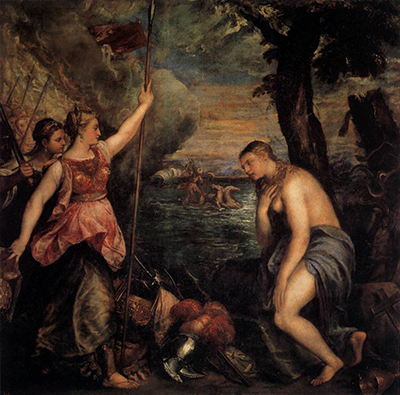
A richly armed woman advances from the left of this painting toward a nearly unprotected figure at the right. A second woman stands just behind her, while the sea in the distance carries a threat of war. Titian made the scene as an allegory: Spain, Justice and Religion appear as people, so that a political claim can become an encounter between bodies. The Museo Nacional del Prado calls the picture Religion assisted by Spain, P000430, and dates it 1572–75. Its oil-painted canvas measures 168 × 168 centimetres. It is also known as Spain Succouring Religion and was made in Titian’s last years for the world of Philip II.[1]
The painting commemorates the Spanish monarchy’s part in the Christian naval victory at Lepanto on 7 October 1571. It does not illustrate the battle as a report from the ships. Instead, it asks viewers to see Spain as a defender of Catholic Religion against enemies on land and sea. Its present meaning emerged through a remarkable sequence: Titian reused a composition first devised for Alfonso I d’Este, then recast for Emperor Maximilian II, and finally adapted for Philip. The Prado’s painting and its related Giulio Fontana print allow those changes to be traced more precisely than the picture alone would permit.[1][2][3]
At a Glance
- WorkSpain Succouring Religion
- Research recordMuseo Nacional del Prado
Contents
- The figures in the final picture
- A design that began in mythology
- What the X-rays reveal
- Lepanto, delivery and the lost relatives
- Why this late allegory matters
The figures in the final picture
Spain dominates the left side. She wears a cuirass, raises a lance and bears a shield marked with Philip II’s arms. The equipment turns a female personification into a military actor. She is not a portrait of a Spanish woman; her costume and heraldry name a realm and its king. Beside and slightly behind her is Justice, identified by the sword. The Prado describes Spain as holding the hand of this companion. That is an important detail: Religion is the vulnerable figure she approaches, not the woman whose hand Spain holds.[1]
Religion is at the right, bowed and partly exposed, set apart from the armed figures. The contrast between protection and vulnerability is immediate. Spain and Justice are upright, equipped and active; Religion appears in need of defence. A cross and the surrounding hostile signs belong to a visual vocabulary that makes the faith recognizable as a person in danger. This is the picture’s argument, not a neutral portrait of sixteenth-century Europe. It presents a particular Habsburg Catholic interpretation of conflict.[1][2]
The sea opens behind the figures. The Prado describes an armed, turbaned marine adversary and threatening Ottoman ships replacing the peaceful sea figure in an earlier form of the design. The foreground also contains the remains of conflict. Together, those details connect the allegory to naval war without reducing it to a literal view of Lepanto. The standing figures carry the message; the fleet and trophies give it contemporary urgency.[1][2]
The Prado reads the snakes near Religion as symbols of Protestant heresy within the painting’s political language. That means the threat imagined by the commission extends beyond the Ottoman fleet. A present-day description should keep the symbol attributed to its historical programme: it records how Philip’s court and Titian’s image represented religious opponents, not an independent judgment about those opponents.[1]
A male figure in the scene has been tentatively identified as Don Juan of Austria, Philip’s half brother and commander of the allied fleet at Lepanto. The Prado uses “probably” rather than stating a documented likeness. The identification would connect the general allegory to a named military leader, but the central reading—Spain, Justice and Religion after Lepanto—does not depend on certainty about that figure’s face.[1]
A design that began in mythology
The final Prado painting did not begin as a wholly new arrangement of bodies. The museum traces its underlying composition to a mythological commission for Alfonso I d’Este, Duke of Ferrara. That work was unfinished when Alfonso died in 1534. Giorgio Vasari later reported seeing a canvas in Titian’s workshop with a young nude figure bowing toward Minerva, another figure nearby, and Neptune in a marine chariot in the distance. The figures and sea already provided a framework that could be given another subject through changes in attributes.[1][2]
The Prado’s accounts differ over when Vasari saw the canvas: its painting entry says 1568, while the essay attached to Fontana’s print says spring 1566. Either date places the unfinished design before the known imperial allegory. Neither authorises an exact day or an unbroken physical history for every related canvas. The secure point for interpreting the Prado picture is the compositional transformation from a mythological encounter into a political and religious one.[1][2]
Titian reworked the earlier painting for Maximilian II as an allegory of Religion assisted by the Empire. A Venetian imperial agent, Veit von Dornberg, mentioned the painting as Religion in a letter of November 1568. The picture sent to Maximilian is now lost. The Prado holds Fontana’s engraved interpretation, G005813, which preserves its principal arrangement and many of its symbols. This is a distinct object: a print on paper after the imperial composition, not the oil canvas now in the Prado.[1][2]
The Fontana print shows how different the imperial message was. Empire wears a tunic and carries a banner with the double-headed Habsburg eagle, not Spain’s cuirass, lance and shield. Its companion holds a laurel branch and represents Peace, where the final painting has armed Justice with a sword. In the distance the calm-sea goddess Amphitrite travels by chariot, where the later Spanish allegory introduces a hostile Ottoman presence. The Prado relates this conciliatory imagery to a 1567 peace treaty between Maximilian and the Ottoman sultan. The print’s inscription refers broadly to the enemies of religion and to the emperor’s protective and peaceful virtues.[1][2]
These differences make the revision legible even without the lost imperial canvas. The same basic positions can ask viewers to admire peace in one commission and martial defence in another. A raised weapon, a coat of arms, a laurel branch or a changed figure at sea can redirect the entire story. Titian’s reused design was therefore not mere economy. It demonstrates how allegorical meaning can be carried by attributes and patronage context as much as by the arrangement of bodies.[1][2]
What the X-rays reveal
The Prado reports that X-rays of its surviving painting reveal elements closer to the imperial version recorded in Fontana’s print. Spain first appeared with a flared tunic rather than the finished cuirass. The accompanying woman initially lacked her sword. Titian did not simply make a clean copy of the imperial image and add Spanish arms at the end; he revised key figures on the Spanish canvas itself. The hidden stages help explain how Peace could become Justice and Empire could become an armed Spain.[1]
This evidence has a clear limit. The X-ray shows earlier paint stages beneath the present surface of P000430. It does not turn the Prado work into the very canvas once sent to Maximilian. The Prado identifies the imperial original as lost. Its account instead describes a new Spanish painting derived from, and worked through against, the earlier design. Keeping the material distinction clear prevents a fascinating technical discovery from becoming a false provenance claim.[1][2]
The X-rays also focus interpretation on deliberate choices. A tunic became a cuirass; a woman without a sword became Justice. These are not tiny corrections invisible to the allegory. They alter how authority is represented. Philip’s Spain is more heavily armed than Maximilian’s Empire, and a woman marked by a weapon stands where a branch once signalled peace. Titian retained the composition’s basic framework while changing the political force of its details.[1][2]
Lepanto, delivery and the lost relatives
The Prado dates the surviving canvas 1572–75 and says it belonged to a final group of paintings sent to Philip II around the end of Titian’s life. Its painting essay places the shipment in 1576; the print essay refers to a work sent to Philip in 1575. Those descriptions agree that the picture followed Lepanto and was intended for Philip, while the exact dispatch year is not consistent across the museum’s related entries. The painting was assigned to the Alcázar in Madrid, remained in the Spanish Royal Collection, and entered the Prado in 1839.[1][2]
An unfinished related version survives in the Galleria Doria Pamphilj, Rome. The Prado’s fuller Spanish record notes that earlier writers identified that canvas with the unfinished Ferrara painting seen by Vasari. Its curator instead associates it with a later work reported by Carlo Ridolfi in 1648 among the heirs of Cardinal Aldobrandini. These are arguments about another surviving object. Neither the Doria picture nor the lost Maximilian allegory should be counted as the Prado’s P000430, even though all belong to the same chain of designs.[3]
Fontana’s print has its own chronological caution. The Prado’s technical header dates the impression or print about 1566, but its explanatory essay says Fontana probably engraved the imperial painting after its arrival at court around the end of 1568. The museum has not reconciled those statements in the pages used here. It is therefore safest to describe the print as recording the imperial design and to leave its precise production date open. That uncertainty does not weaken the visible comparison between laurel and sword, tunic and armour, peaceful and hostile sea.[2]
Why this late allegory matters
In one square painting, Titian made a claim about the Spanish monarchy’s role after Lepanto. The picture was meant to be read politically: heraldry identifies Philip’s realm, Justice accompanies its action, Religion requires its help, and naval conflict occupies the background. Its symbolism extends the victory into a general defence of Catholicism. The claims are the painting’s historical point of view, and describing them accurately is different from endorsing them.[1]
The work also shows a late Titian still altering inherited designs for new patrons. The sequence from Alfonso’s mythology to Maximilian’s Empire and Philip’s Spain is unusually well documented by Vasari’s report, the imperial agent’s letter, Fontana’s print and the Prado’s X-rays. Yet each source answers a different question: a description of an unfinished picture, notice of an imperial painting, a printed composition, and hidden stages in a surviving Spanish canvas. Together they explain change; none makes all the related objects physically the same.[1][2][3]
The Titian paintings guide places the allegory among his late works. The poesie guide concerns the mythological paintings Titian made for Philip II, a different series from this political image. Both show his long relationship with the king, but Religion assisted by Spain speaks especially to the religious and military rhetoric of the 1570s.[1]
Researched Titian and related works
Frequently Asked Questions
The museum calls it Religion assisted by Spain, inventory P000430. Spain Succouring Religion is another English title for the same oil canvas.[1]
Religion is the vulnerable figure at the right. Armoured Spain stands at the left with Justice, who bears a sword. The Prado describes Spain as linked by hand to Justice.[1]
It commemorates the victory through personification and symbols. The fleet appears in the distance, but the main scene is an allegory rather than a literal battle view.[1]
No. The imperial painting is lost. Fontana’s print records its design, and X-rays show related earlier stages beneath the Prado painting, which was made for Philip II.[1][2]
At the Museo Nacional del Prado, Madrid, in its Titian collection, P000430.[1]
Discussion
What do you notice when you look closely at Titian’s Religion Assisted by Spain?
Share a specific observation or a source that adds context.
Reader Insights
Which detail changes your reading?
How does its original setting affect what we see?
Which part of the evidence remains uncertain?
Join the Conversation
Add your observation below.
References
- Museo Nacional del Prado, Miguel Falomir Faus, “Religion assisted by Spain,” Titian, P000430, object and curatorial essay. View source.
- Museo Nacional del Prado, Miguel Falomir Faus, “Religion Rescued by the Empire,” Giulio Fontana print G005813, catalogue and essay. View source.
- Museo Nacional del Prado, “La Religión socorrida por España,” Spanish object record with fuller Doria Pamphilj and Ridolfi discussion. View source.