 by Tom Gurney
Tom Gurney BSc (Hons) is an art history expert with over 20 years experience
Published on June 19, 2020 / Updated on October 15, 2026
Email: tomgurney1@gmail.com / Phone: +44 7429 011000
Titian’s Holy Family with a Shepherd: Introduction
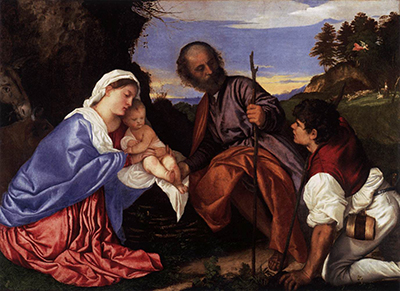
Mary kneels beside the newborn Christ, Joseph stands at the centre, and a single young shepherd approaches from the right. The figures fill much of an open landscape, yet the moment is quiet: Joseph seems to introduce the child, and the visitor lowers himself in reverence. The National Gallery, London, catalogues Titian’s The Holy Family with a Shepherd as NG4, an oil painting on canvas dated about 1510. Its current collection record gives the size as 99.1 × 139.1 centimetres. Technical study has made this early picture unusually revealing about how Titian assembled and revised a sacred encounter.[1][2]
At a Glance
- WorkThe Holy Family with a Shepherd
- Research recordNational Gallery, London
Contents
- One shepherd at the manger
- A group made to fit together
- Early Titian, Bellini and Giorgione
- Paint layers and altered colours
- The canvas and the route into the Gallery
One shepherd at the manger
The painting represents the Adoration of the Shepherds. In Luke’s account, an angel announces Christ’s birth to shepherds, who find Mary, Joseph and the infant lying in a manger. Titian includes a small flying angel in the distance and places the child near a manger woven from sticks. An ox and donkey accompany the family in the foreground. Those animals belong to the familiar visual tradition of the Nativity, although Luke’s passage does not specify them. The story’s many visitors become just one kneeling shepherd in this version.[1][3]
That reduction gives Joseph a distinctive role. He stands between mother and visitor and appears to present the child. The National Gallery proposes that Titian may have chosen the single shepherd to make Joseph important in both position and action. It notes that devotion to Joseph was growing in northern Italy and suggests a possible patron with particular devotion to him. No patron is named in a surviving commission for NG4. The same museum thinks the picture was probably intended for a domestic space rather than an altar. Those possibilities help explain the intimate grouping; they remain interpretations, not a documented original address.[1][2]
Mary supports the baby on white linen, turning her head toward him. The child’s light body lies across the centre, between her hands and Joseph’s gesture. The shepherd’s white shirt and leggings answer the linen across the canvas, while his red upper garment echoes warm colours near Joseph. The National Gallery draws attention to this balancing of white cloth even in so early a Titian. It also notes that the shepherd’s clothing is oddly fine for outdoor labour. He is not a portrait of a historically identifiable worker; he participates in a devotional image shaped for visual clarity.[1]
The animals at left and angel at right extend the event beyond the cluster of people. The ox and donkey locate the birth in a humble shelter; the angel refers to the announcement that brought the shepherds. The surrounding hills and trees open the picture to a dawn sky. Titian thus lets a viewer move between the immediate presentation of the child and the larger narrative of his birth without crowding the foreground with more worshippers.[1][3]
A group made to fit together
The figures seem to meet naturally, but infrared reflectography and X-radiography show how extensively Titian adjusted them. The Gallery’s 2013 technical study describes Mary as an apparent starting point for the underdrawing. Her head was first tilted at another angle; the drawn eyes lie in the area of her present cheek. Titian changed the veil at the side and top of her head and later extended it across the child’s head, painting over rocks already present behind. The revision gave mother and child a closer visual connection in the finished image.[2]
The underdrawing around the child is complex. It includes lines associated with Mary’s shoulder, possible different arrangements of the white cloth, and hands or drapery that were moved or not painted. The study cautiously identifies what may be a smaller initial head closer to Mary, but the child’s painted body was otherwise altered relatively little. The technical images are therefore evidence of experimentation, not a complete diagram of every abandoned pose.[2]
Joseph changed too. His eyes were first lower, and the drawn figure appeared younger, with curls on a balding head. His final head and shoulders were adjusted during painting; his left sleeve extended over the landscape, and his orange cloak was reworked to cover a knee that was previously exposed. The Gallery’s public account still finds the size and attachment of Joseph’s head awkward. The imaging makes that observation more specific: the figure was not simply placed incorrectly in a finished outline, but revised as Titian worked to coordinate the group.[1][2]
The shepherd was initially sketched farther to the right. Titian moved him closer to the Holy Family, and his face covers parts of the already painted landscape. His barrel and clothing details were added over broader colour. Bringing him inward narrows the gap across which Joseph presents the child. This is a plausible reading of the visual effect of the documented change; the imaging itself does not record Titian’s private reason for making it.[2]
The technical study says the whole figure group dominates the landscape more than in an earlier Titian Flight into Egypt. It also notes suggestions that more geometrically ordered central Italian designs, including work associated with Fra Bartolommeo and perhaps Raphael, informed the composition. These are comparisons, not evidence that Titian copied a particular lost drawing. NG4 retains its own balance between an ordered group and figures adjusted in paint until their interaction became convincing.[2]
Early Titian, Bellini and Giorgione
The National Gallery treats this as one of Titian’s earliest surviving works and dates it about 1510. It points to uneven figure drawing, especially Joseph’s head and neck, as a sign of youth. Yet the broad colour relationships and bolder, more monumental figures anticipate strengths of the mature painter. Early does not mean unconsidered. Titian was already testing how colour, movement and a natural setting could work together.[1]
The image relates to the world of Giovanni Bellini and Giorgione. The Gallery sees Bellini’s influence in the religious subject and a closer affinity to Giorgione in the meditative atmosphere and landscape: dark rocks, shrubs and weeds stand against the dawn sky. Titian had worked with Giorgione in the years before Giorgione’s death in 1510. The Gallery nonetheless distinguishes NG4’s substantial figures and drapery from Giorgione’s known works. A shared Venetian visual language need not imply common authorship.[1]
The relationship between people and landscape is especially important. The figures are part of the same outdoor space rather than cutouts placed before a view. The Gallery sees that union developing further in Titian’s later Noli me tangere, where setting contributes to the action. It also warns that the exact sequence of Titian’s very early pictures is hard to settle because his figure drawing and confidence vary from work to work. NG4’s approximate date is more secure as a broad placement in the period than as a precise position in a year-by-year list.[1]
Paint layers and altered colours
The technical bulletin provides a close look at Titian’s materials. The canvas was prepared with gesso and a pale lead-white ground layer in oil, with a little fine black pigment. Infrared and X-ray images register broad brushwork in this preparation, while some underdrawing lies above it. This construction helps explain why parts of the design appear in imaging and others remain concealed beneath thicker or less transparent paint.[2]
Mary’s blue mantle was painted with high-quality ultramarine over an indigo underlayer adjusted with a little red lake. The Gallery reports that its blue shadows now look blanched, so the cloak appears flatter than originally intended. Her red dress contains different red lake colourants, including madder and kermes, placed in different layers. Titian was building effects through underpaint and translucent colour, not merely filling shapes with single pigments.[1][2]
Joseph’s robe originally had a layered purple made from azurite, red lake and lead white. Its present duller appearance may reflect darkened oil and perhaps faded lake. His orange cloak used yellow earth and other bright pigments; the bulletin compares the colour practice with work by Cima da Conegliano. The shepherd’s red waistcoat relies chiefly on vermilion layers and a thin lake glaze. Across the group, material analysis supports the visual impression that Titian used clothing colours to connect figures and make them distinct.[2]
Not every brown or muted green is damage. Samples from parts of the background foliage show that some autumnal tones were intended, and brown glazes near foreground earth include a softwood pitch or tar mixed in oil. One such surviving passage even bears a fingerprint, perhaps made while adjusting or testing the glaze. Elsewhere, damage is real: the Gallery reports rubbing in much of the landscape, especially at left, and loss of a purple glaze on Joseph’s robe. A present-day photograph combines original colour, intentional brown passages and later loss. Reading all three as one untouched palette would flatten the painting’s material history.[1][2]
The study found heat-bodied linseed oil in several coloured areas but heat-bodied walnut oil in the shepherd’s thick white breeches, perhaps chosen for its paler hue. This distinction shows deliberate handling of different paint passages at an early stage of Titian’s career. It should not be turned into a claim that every white in the canvas used walnut oil; the technical statement concerns sampled areas and a broader practice suggested by comparison.[2]
The canvas and the route into the Gallery
A seventeenth-century sketched copy once led to a suggestion that NG4 had been cut down. The technical bulletin says X-radiography instead shows weave cusping around all edges and old tack holes, evidence that the image field has not been shortened in the proposed way. The support is still not untouched. Most original tacking margins are lost, old putty and restoration cover damaged edges, and the bottom was extended by about three centimetres. The painting was cleaned and restored in 1953. An intact broad composition and a materially altered edge can both be true.[2]
The Gallery’s current public record gives 99.1 × 139.1 centimetres, while the 2013 technical catalogue prints 106.4 × 143 centimetres. Both belong to National Gallery publications for NG4; they differ substantially. The current public record supplies the size stated above. The discrepancy cannot be attributed to a remeasurement, frame convention or restoration without further evidence. The lower-edge extension discussed in the bulletin does not by itself explain every difference between the two published pairs.[1][2]
The earliest securely linked collection record is a 1693 Borghese inventory. The Gallery correlates its description with this picture using a seventeenth-century sketched copy. William Young Ottley bought it in Italy in 1797–99; it appeared in London sales connected with him in 1801. In a 1810 sale of the W. Champion collection, the Reverend William Holwell Carr bought it. His 1831 bequest brought the painting to the National Gallery. This trail is specific from the Borghese record onward, but it does not establish where Titian first displayed the painting or who commissioned it.[1]
The Titian paintings guide places NG4 among the early religious works. Seen beside later pictures, it shows a painter already working through a central problem: how to make holy figures present in a believable shared world. The imaging reveals revisions behind that result, while the paint samples and provenance remind us that the image visible today is both an early Titian invention and an object altered by centuries of use.[1][2]
Researched Titian and related works
Frequently Asked Questions
The National Gallery suggests that a single visitor allowed Joseph a central role and may reflect special devotion to him. Neither an original patron nor that patron’s preference is documented.[1]
Yes. Infrared and X-ray study show revisions to Mary’s head and veil, Joseph’s face and clothing, and the shepherd’s position. The shepherd was brought closer to the family.[2]
The National Gallery’s technical study rejects an older cut-down theory on the evidence of weave cusping around the edges, while documenting lost tacking margins and a later extension at the bottom.[2]
No. The Gallery reports rubbed landscape paint, flatter blue shadows in Mary’s cloak and loss of colour from Joseph’s robe. Some brown landscape passages, however, were deliberately painted that way.[1][2]
It belongs to the National Gallery, London, inventory NG4, acquired through Holwell Carr’s 1831 bequest.[1]
Discussion
What do you notice when you look closely at Titian’s Holy Family with a Shepherd?
Share a specific observation or a source that adds context.
Reader Insights
Which detail changes your reading?
How does its original setting affect what we see?
Which part of the evidence remains uncertain?
Join the Conversation
Add your observation below.
References
- National Gallery, London, “Titian, The Holy Family with a Shepherd,” NG4, collection essay and provenance. View source.
- Jill Dunkerton and Marika Spring, with contributors, “Titian’s Painting Technique before 1540,” National Gallery Technical Bulletin 34 (2013), catalogue 4, pp. 46–51. View source.
- United States Conference of Catholic Bishops, Luke 2:8–20. View source.