 by Tom Gurney
Tom Gurney BSc (Hons) is an art history expert with over 20 years experience
Published on June 19, 2020 / Updated on October 15, 2026
Email: tomgurney1@gmail.com / Phone: +44 7429 011000
Titian and workshop: Venus and Cupid at the Uffizi: Introduction
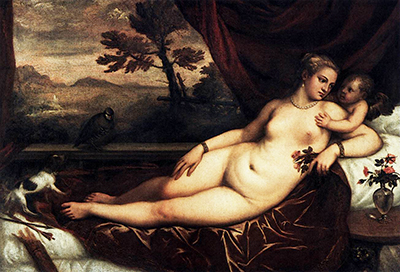
A reclining woman turns toward a child who embraces her shoulder. The child is Cupid, so the woman is understood as Venus. Yet the scene also contains a small quarrel at the left: a spotted dog barks toward a partridge. Between the tender encounter and that restless animal pair, Venus and Cupid asks how love may be seen and interpreted. The painting belongs to the Gallerie degli Uffizi in Florence, inventory 1890 no. 1431, and is dated 1550–60 in Italy's national cultural-heritage catalogue. It is an oil painting on canvas measuring 139.2 × 195.5 cm.[1]
The attribution needs more care than the short title “Titian” allows. The national record formally lists Tiziano Vecellio, but it also records older assignments to Titian and workshop or the workshop of Titian. Its critical account says many scholars retain Titian's design and perhaps selected passages, especially Cupid's face, while seeing substantial workshop execution. The arrangement can therefore be discussed as a Titian invention without claiming that he painted every part of this particular canvas himself.[1]
At a Glance
- WorkVenus and Cupid
- Research recordcatalogo.beniculturali.it
Contents
- The scene and its visual contrasts
- Titian's design and the problem of versions
- Who first owned it?
- How to look at this Venus
The scene and its visual contrasts
Venus reclines on dark fabric, with one arm resting along her body and the other meeting Cupid's embrace. The two faces turn toward one another. Her necklace and earrings, the flowers in a vase at the right and the curtain above make the setting sumptuous. Behind the bed, an architectural edge gives way to an open landscape with trees and hills. The goddess is both near to the viewer and set within a world that extends beyond the room. Her long body establishes the picture's horizontal rhythm; Cupid's close approach concentrates the action at the right.[1]
The dog and bird interrupt that calm. The catalogue identifies the bird as a partridge and calls attention to a small lion carved on the table at the right. These details may be hard to make out in a small reproduction, but they are part of the recorded composition. The dog is alert rather than asleep; the partridge draws its attention away from Venus and Cupid. The effect is to place two kinds of movement in one image: an affectionate embrace among the figures and a sharper response among the animals.[1]
None of those objects comes with a label explaining its intended meaning. The national catalogue reports the suggestion that the dog's fidelity is opposed to the partridge's associations with fecundity and lust. It also records a reading in which Cupid's embrace and the carved lion recall the classical theme of love overcoming natural force. On that account, the painting might caution fidelity against temptation. These are interpretations proposed by scholars, not a documented message from Titian or a known patron. The pearls have likewise been read in the catalogue as signs of a married woman's social standing; that reading should not turn Venus into an identified portrait.[1]
Titian's design and the problem of versions
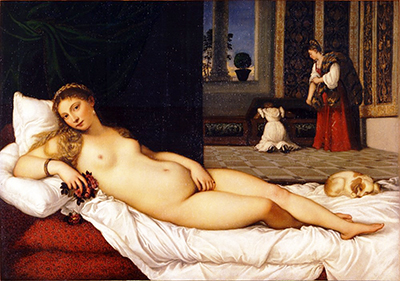
Titian repeatedly developed reclining nudes and Venus subjects, sometimes with a dog, Cupid or a musician. The Uffizi Venus and Cupid has no organist. It should not be merged with the Prado's Venus with an Organist and Cupid, which is a different canvas, or with the Uffizi's earlier Venus of Urbino of 1538. The latter is inventory 1890 no. 1437, shows a woman looking toward the viewer in a domestic interior, and has a sleeping dog. The Uffizi Venus and Cupid has an active Cupid and a barking dog. Similarities belong to Titian's developing pictorial vocabulary; they do not erase the separate identities of the paintings.[1][2][3]
The exact sequence of the later Venus pictures remains debated. The Italian national catalogue presents the Florence canvas as a workshop variation after the Prado's Venus with an organist and Cupid. A Prado account, however, proposes that the Uffizi Venus and Cupid was the immediate precedent of the Venus-and-musician compositions. The Prado also discusses a possible lost Venus made for Charles V in 1545. Those accounts cannot both establish a simple, certain order for this canvas and the musician pictures. They do agree that repetition and alteration are essential to the group. The Prado specifically warns that its Venus-and-music paintings were made for different clients, not as one ensemble with a single fixed meaning.[1][2][4]
The workshop question becomes clearer against that background. Reusing a reclining figure was not necessarily copying a finished masterpiece mechanically. Artists could adjust Cupid, musician, dog, curtain, landscape or expression for another painting. The Prado identifies changes between its two organist versions and says technical analysis supports the primacy of one within that pair. Those findings concern the Prado paintings; they do not by themselves settle which hands painted the Uffizi canvas. The Uffizi record's qualified attribution remains the relevant description for the Florence object.[1][2][4]
Who first owned it?
The most concrete early clue cited by the national catalogue is a court diary. Cesare Tinghi recorded Paolo Giordano Orsini's visit in January 1618/19 and shortly afterward noted his gift to Grand Duke Cosimo II de' Medici of a Titian painting of a nude woman with Cupid. The words fit this picture, but they do not give an inventory number or all its distinctive details. The identification is plausible, rather than an unbroken documented chain back to a commission.[1]
The record also describes competing proposals for the earlier history. Erwin Panofsky connected the picture to a letter Titian sent in 1545 and argued for Charles V as patron. The catalogue points out that no clear route is known from the emperor's collection to the Orsini family. Harold Wethey instead favoured early Orsini ownership, noting that Titian had ties to that family. Neither proposal establishes a secure original patron for the actual Uffizi canvas. This uncertainty matters especially when the painting's workshop contribution and relationship to other versions are themselves disputed.[1]
Past viewers tried to make Venus into a particular woman. The national record mentions an eighteenth-century description of her as Titian's wife and another identification with a lover of the Duke of Urbino. These tell us about the painting's reception, but the source does not verify either sitter. Cupid secures the mythological subject; it does not supply the historical woman's name. The pearls and rich room can invite a marital reading without making the scene a literal portrait.[1]
How to look at this Venus
Begin with the exchange of glances and touch between Venus and Cupid. Then follow the line of her body leftward to the dog and the partridge, and return to the jewellery, flowers and carved table. The painting balances immediate physical presence with signs that have prompted several readings. Its subject is plain enough to name, while its moral point and first ownership remain open.[1]
The picture is also a good test of how a famous artist's name works on a museum label. Titian's design shaped the composition, according to the national catalogue, yet the same record asks viewers to recognize the workshop's probable share in its making. The most faithful account keeps both facts in view: this is a distinct Uffizi Venus and Cupid, connected to a wider family of Venetian Venus pictures, with a documented history of changing attribution and interpretation.[1][2][4]
The Titian paintings guide places the canvas within his wider work. The separate Venus of Urbino study treats the 1538 Uffizi painting. Comparing their dogs, settings and ways of addressing the viewer is more useful than treating the two Florentine paintings as interchangeable.[1][3]
Researched Titian and related works
Frequently Asked Questions
At the Gallerie degli Uffizi, Florence, inventory 1890 no. 1431.[1]
The national catalogue lists Titian but also records substantial proposed workshop participation. It retains Titian's invention and possibly individual passages while qualifying execution of the canvas.[1]
That is one scholarly proposal. The link between this Uffizi canvas, a 1545 letter and the later Orsini gift is not securely documented.[1]
Discussion
What do you notice when you look closely at Titian and workshop: Venus and Cupid at the Uffizi?
Share a specific observation or a source that adds context.
Reader Insights
Which detail changes your reading?
How does its original setting affect what we see?
Which part of the evidence remains uncertain?
Join the Conversation
Add your observation below.
References
- Italian national cultural-heritage catalogue / Gallerie degli Uffizi, “Venere e Cupido,” record 0900287381, including attribution, object data and historical-critical essay. View source.
- Museo Nacional del Prado, “Venus with an Organist and Cupid,” P421, collection account of the related composition and variants. View source.
- Gallerie degli Uffizi, “Venus of Urbino,” object page for the distinct 1538 painting. View source.
- Museo Nacional del Prado, “Venus with an Organist and a Dog,” P420, collection account of the Venus sequence and technical comparison of its own musician pictures. View source.