by Tom Gurney
Tom Gurney BSc (Hons) is an art history expert with over 20 years experience
Published on June 19, 2020 / Updated on October 15, 2026
Email: tomgurney1@gmail.com / Phone: +44 7429 011000
Titian's Draped Figure Called Saint Peter: A British Museum Drawing: Introduction
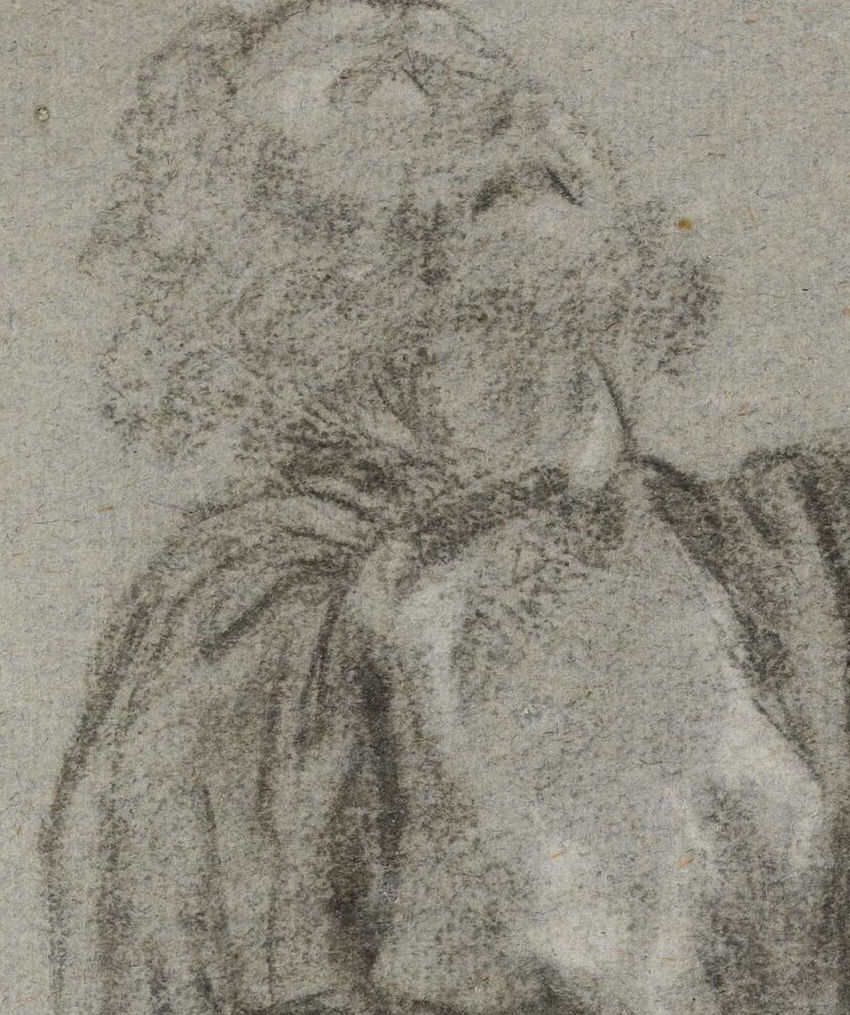
A man's head bends beneath a mass of hair and beard. His right arm rises through a broad sleeve, while a cloak folds around his shoulders and chest. The British Museum drawing commonly called Saint Peter concentrates on this upper body rather than constructing a whole narrative scene. It is a sheet to study slowly: dark chalk gathers in the folds and around the head, lighter passages leave the coloured paper visible, and the lower figure fades before it is fully described.[1][3]
The object is British Museum registration 1895,0915.823. The museum's indexed collection listing assigns it to Titian and dates it to 1515–18. Its conventional title proposes the apostle Peter, but the figure has no obvious keys or other unmistakable identifying attribute on the visible side of the sheet. Calling it a study of a draped male figure therefore describes what can be seen; calling it Saint Peter reports the identification by which it is known. The drawing is distinct from the lost Titian altarpiece of the Martyrdom of Saint Peter Martyr, whose Dominican subject was a different saint.[1][3]
At a Glance
- WorkSt Peter
- Research recordBritish Museum
Annotated details from St Peter
Select a numbered area to find its detail below. Open a detail image to view it larger.
Details from ST PETER
St Peter Face and Shoulder
St Peter Raised Arm and Drapery
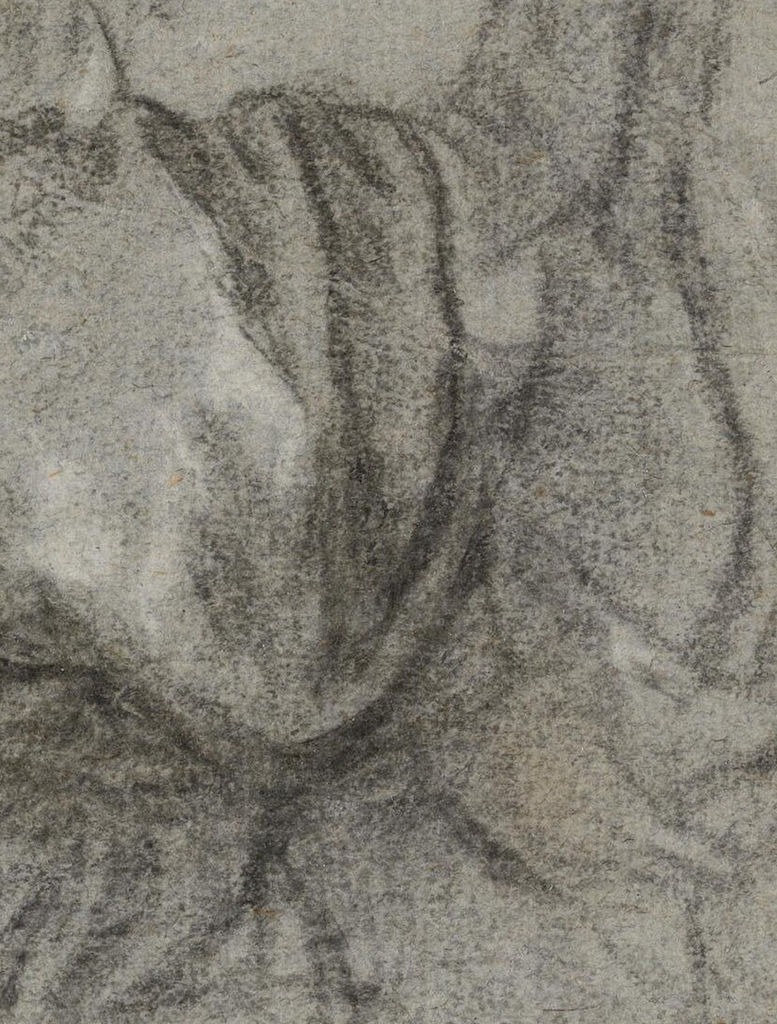
British Museum drawing 1895,0915.823; public-domain scan via Wikimedia Commons. Cropped and resized. Public domain. Image source · Reuse licence
Contents
- The drawing as a physical object
- Gesture, drapery and the name Saint Peter
- A second side to the sheet
- Why attribution requires comparison
- What can the drawing tell us about Titian's practice?
The drawing as a physical object
The recto reproduced from the museum photograph shows a grey-blue field of paper with the figure set close to its centre. He turns his face downward and slightly to the viewer's right. At the left, a wide fall of cloth defines the shoulder and arm. Across the middle, darker strokes tighten the garment around the torso. The arm rising along the right edge gives the composition a vertical counterweight to the lowered head. These relations can be traced directly in the scan without deciding exactly which painted figure, if any, was intended.[3]
The marks are far from uniform. Fine work around the face and hair differs from broad, dark handling in the clothing. Some passages seem pressed firmly into a dense shadow, while others merely suggest where cloth or body will continue. The nearly vacant lower part of the sheet does not mean the figure was carelessly abandoned. A study can pursue one problem, such as the movement of drapery around a raised arm, without giving equal finish to every part. Here the concentrated upper body is the informative portion.[3]
The support matters as well. A UK government report on a different Titian drawing identifies the British Museum St Peter as one of a group of Titian sheets made in black chalk on blue paper. The report places it beside examples in the Fitzwilliam and Ashmolean collections and a fourth drawing that was then the subject of an export case. That comparison supplies useful evidence about material practice, but the export case's measurements and ownership details belong to its separate Study of a Kneeling Man, not to the British Museum sheet.[4]
Paper that was once blue may look muted or grey after centuries of handling, light and photographic reproduction. The present image should therefore not be treated as a colour standard for the sheet's first appearance. The dark and light of the drawing are still legible: the toned ground sits between chalk shadow and the brighter untouched or lightly worked areas. This gives the body a sense of volume with fewer marks than a fully outlined figure would need.[3][4]
Near the lower corners of the photographed sheet are small marks and a stamp. They are part of the surviving object's visible surface, though they should not be mistaken for a signature by Titian or a date of making. The museum registration number, rather than a mark read from the photograph, is the secure way to identify this particular drawing among many sheets formerly or currently associated with the artist.[1][3]
Gesture, drapery and the name Saint Peter
The pose sets three directions against each other: the inclination of the head, the spread of the cloak and the rising right arm. Those directions could give a figure a place in a larger group composition, particularly one in which someone looks and gestures upward. On this page the surrounding people and event are absent. That absence is an advantage for close looking, because the sheet exposes the decisions about a single body's movement and clothing rather than concealing them within a finished painting.[3]
It is tempting to see the raised arm and religious title as proof of an exact commission. The indexed museum record gives a date in the period of Titian's major early Venetian projects, and the title Saint Peter may reflect a traditional connection to a painted apostle. But the sources available for this specific recto do not establish a one-to-one transfer to a particular figure in the Frari Assumption of the Virgin or any other altarpiece. A comparison of poses can be illuminating; it should remain a comparison unless the object's curatorial documentation verifies the relationship.[1][3]
Another small work often called Study for St Peter is described as a head study and published with dimensions of 157 × 134 millimetres. That is not a reliable dimensional description of the present full upper-body sheet identified by the British Museum registration 1895,0915.823. Similar names can attach to different studies, reproductions or crops. Starting with the accession number and visible composition prevents such details from drifting between them.[1][3]
The name Peter also needs a second distinction. The apostle identified in the traditional title is not Peter Martyr of Verona, the friar commemorated in Titian's later, now-lost altarpiece. A surviving engraving after the martyrdom painting concerns the friar's violent death. The British Museum sheet shows one draped man without that event or its attributes. Their shared first name does not link their objects or dates.[1][3]
A second side to the sheet
A photographic file catalogued under the same museum number identifies the reverse as containing two caricature heads. That is a useful reminder that a drawing sheet has two surfaces and that its front-facing subject need not exhaust what an artist or later user placed on it. The recto image used here and the separately labelled verso file bear the same registration number, so they can be read as two documented views of one museum object. The reverse is not a second Saint Peter picture.[3][5]
The verso description should be kept modest. Without the British Museum's full object record in view, the file title alone does not settle when the heads were drawn, whether both are accepted as Titian's own work, or how they relate to the large draped figure. Drawing on the back of a sheet can occur at another stage of work. The important point for a reader is that the photographic evidence exposes a different kind of study on the other side, not that we can reconstruct a complete sequence of use from it.[1][5]
Why attribution requires comparison
Titian's works on paper are a much smaller and less straightforward body of evidence than his paintings. A drawing may be assigned by comparing line, pressure, chalk handling and the construction of forms with better-established sheets. Shared materials alone are insufficient. Other Venetian artists also used chalk and toned papers, and later collectors sometimes applied famous names to drawings that current curators have reassigned.[2][4]
Museum Boijmans Van Beuningen provides a concrete example. Its Half Figure of a Standing Man came to a collector as a Titian, but recent research classifies it as anonymous Venetian and later in date. The museum compares that Rotterdam sheet with Titian drawings in Florence and with British Museum 1895,0915.823. It finds Titian's figures and folds in those comparisons looser and more dynamic, with thicker lines, than the marks on its own sheet. The argument is about a difference of handling, not a claim that the Rotterdam drawing copies the British Museum one.[2]
The government report cited the British Museum St Peter among black-chalk drawings on blue paper accepted as Titian in its 2016 review. Its expert gave a then-current count of 39 autograph Titian drawings. That figure is evidence of the degree of selectivity involved in this attribution field, not an eternal count of every surviving sheet. Lists change as drawings are studied and reassigned. For this object, the decisive public identifier remains the British Museum's own listing of its registration number under Titian.[1][4]
What can the drawing tell us about Titian's practice?
The sheet shows attention to how fabric makes a body legible. The large draped shoulder provides mass, the sleeve lifts the eye towards the arm, and the compressed folds at the middle supply a point of weight. Light and shade arise from the relation between dark chalk and the toned paper. The figure is convincing even where the lower body is only indicated. These features make the drawing valuable as evidence of a pictorial problem under examination, whatever the exact destination of the design.[3][4]
Its incomplete setting also limits what can be inferred. A sketch of one figure does not disclose an entire patron's commission, an installation site, or the final colouring of a painting. Nor does the conventional title prove a saint's identity by itself. Seen with these limits, the page becomes a clear example of why surviving drawings matter: they preserve an artist's choices about pose, gesture and folds at a stage distinct from the polished effect of a finished work. The drawings guide places this sheet among other museum-identified examples and explains the wider attribution problem.[1][2][4]
Researched Titian and related works
Frequently Asked Questions
It is in the British Museum, London, registration number 1895,0915.823. The museum's indexed listing assigns it to Titian and dates it 1515–18.[1]
Saint Peter is the conventional identification. The visible recto is a draped male study without a decisive attribute such as keys; the sitter or subject cannot be established from facial likeness alone.[1][3]
A separately catalogued photograph bearing the same registration number labels the verso “two caricature heads.” That file does not by itself establish the heads' precise date or their relation to the recto.[5]
Discussion
What do you notice when you look closely at Titian's Draped Figure Called Saint Peter: A British Museum Drawing?
Share a specific observation or a source that adds context.
Reader Insights
Which detail changes your reading?
How does its original setting affect what we see?
Which part of the evidence remains uncertain?
Join the Conversation
Add your observation below.
References
- British Museum, indexed collection listing for drawing 1895,0915.823, attributed to Titian and dated 1515–18. View source.
- Museum Boijmans Van Beuningen, “Half Figure of a Standing Man,” research note comparing its former Titian attribution with British Museum 1895,0915.823. View source.
- Wikimedia Commons, British Museum photographic reproduction, “Titian – Study of a draped male figure (St Peter), 1895,0915.823,” recto. View source.
- UK Department for Digital, Culture, Media and Sport, Export of Objects of Cultural Interest 2016–17, case 5, comparative discussion of Titian's chalk drawings. View source.
- Wikimedia Commons, British Museum photographic reproduction, “Titian – Verso Two caricature heads, 1895,0915.823.” View source.