 by Tom Gurney
Tom Gurney BSc (Hons) is an art history expert with over 20 years experience
Published on June 19, 2020 / Updated on October 15, 2026
Email: tomgurney1@gmail.com / Phone: +44 7429 011000
Titian’s Penitent Magdalene in the Pitti Palace: Introduction
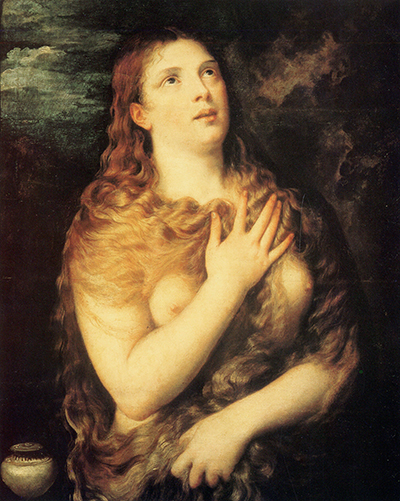
Titian’s Penitent Magdalene fills a small, dark picture with a figure who is at once physically present and emotionally elsewhere. Her copper-coloured hair falls over bare shoulders and breasts; tears catch the light in her upturned eyes. One hand rises to her chest. At the lower left sits a small ointment jar, its rim signed “TITIANUS.” Those few elements made a memorable image that Titian and his workshop would revisit, and that other artists would carry into later centuries. This particular painting belongs to the Palatine Gallery in Florence’s Pitti Palace, inventory 1912 no. 67. The Uffizi Galleries date it 1531–35 and measure it at 85.8 × 69.5 centimetres.[1]
The name Mary Magdalene Repentant identifies a devotional subject rather than an illustrated moment from a single Gospel episode. The jar, flowing hair and tears came together through a long tradition of interpreting different women in the New Testament as one person. Looking closely at Titian’s picture, and separating that tradition from the biblical text, makes the painting richer. It also helps distinguish the Pitti work from the several other Magdalene paintings associated with Titian.[1][2][3]
At a Glance
- WorkMary Magdalene Repentant
- Research recordUffizi Galleries
Contents
- A figure brought close to the viewer
- What the jar says, and what it does not
- Beauty and contrition in the same painting
- Which Titian Magdalene is this?
- Looking at the object carefully
A figure brought close to the viewer
There is little narrative distance in the composition. Magdalene occupies most of the surface, pressed toward the front of a dim setting. A patch of rock and deep shadow gives her a place to stand, but it does not describe a particular landscape. The sky to which she looks is beyond the upper edge of the picture. The viewer therefore follows the turn of her face rather than scanning a story unfolding behind her. This format belongs to the half-length devotional image: it presents a saint as someone to contemplate at close range, without requiring a crowd of supporting figures.[1][4]
Titian sets the movement of her eyes against the movement of her hands. Her gaze rises out of the painting, while the hand at her chest keeps attention on the body in front of us. The second hand descends through the hair toward the lower edge. Neither gesture fully explains what has happened; together they suggest an inward response made visible. The small tears are crucial. They make feeling legible in a face otherwise turned away from direct contact with the viewer. Warm flesh, bright hair and wet eyes stand against the subdued ground, concentrating the picture’s light on the figure rather than on an external event.[1]
The hair has more than one visual job. It spreads around the face like a bright mantle, gives the composition its broad, fluid rhythm and covers parts of the naked body while allowing other parts to remain visible. The Uffizi calls attention to this simultaneous display and concealment, and to Titian’s thick, warm handling of paint. In the traditional story of Magdalene, hair recalled the woman who dried Christ’s feet; in paintings of a penitent in retreat it could also stand in place of clothing. Here it lets Titian make an image of renunciation that still insists on beauty. The viewer encounters both qualities in the same passage of paint.[1][4]
What the jar says, and what it does not
The ointment jar at the lower left is easy to overlook beside the figure’s face and hair. Its position and inscription make it unusually important. The Uffizi records Titian’s name, TITIANUS, on the rim of its opening. That mark ties the artist to a material object within the scene. The jar also gives viewers the familiar attribute by which many Renaissance Magdalene images were recognized. It brings a story of anointing into a solitary picture, even though Christ and the meal at Simon’s house are absent.[1]
In Luke 7:36–50, an unnamed woman enters the house of Simon the Pharisee, washes Jesus’s feet with tears, dries them with her hair and anoints them. The passage does not call her Mary Magdalene or say that she was a prostitute. Luke names Mary called Magdalene in the following chapter, among women who accompanied Jesus. John’s Gospel separately describes Mary of Bethany anointing Jesus. Later Western Christian tradition combined these figures, and artists inherited the composite identity. The Uffizi’s description of Titian’s Magdalene follows that traditional interpretation when it links the jar, hair and tears to Luke 7. The Vatican’s own account now explains that the popular identification of Magdalene as the unnamed “sinner” has no secure textual basis.[1][2][3]
This distinction need not diminish the painting’s religious meaning. Titian painted for viewers who knew the composite story and its recognizable signs. The jar and the tears show how that historical belief shaped the image. They do not establish a biographical fact about the woman named in the Gospels. In the New Testament, Magdalene’s clearly named role includes following Jesus and witnessing the events around his death and resurrection. In this painting, however, the subject is the penitent imagined by later devotional tradition. The title records that tradition; it is not a claim that the pictured incident appears as such in scripture.[2][3]
Beauty and contrition in the same painting
The Pitti Magdalene has often invited a choice between two readings: an alluring female figure or a sincerely devotional one. The painting gives reasons for both responses, but the choice may be too narrow. Tears, raised eyes and clasping movement make penitence visible. At the same time, Titian gives exceptional attention to skin, hair and the movement of light across them. The saint’s beauty was part of the image’s power for its first viewers, not an accidental distraction from it.[1][4]
Art historian Maya Corry places Titian’s Magdalenes within Renaissance discussions of how a pleasing religious image might move a viewer’s emotions. She points to an illuminating request from Federico Gonzaga, Duke of Mantua, who asked Titian in 1531 for a Magdalene as beautiful and as tearful as possible. The paired wishes are revealing: beauty and grief were expected to work together. That letter documents a commission and a taste for this type of image. It does not, by itself, prove that the painting now at the Pitti Palace is the very work sent in response.[4]
Corry also discusses the poet Vittoria Colonna, whose devotional writing engaged the Magdalene as a model of loving repentance. Her case complicates a simple assumption that an exposed saint could only have been made for a male owner’s pleasure. Different viewers could respond to the same painting through prayer, admiration, desire or unease, and those responses need not be neatly separable. We cannot recover each historical viewer’s experience from the painted surface. We can see, however, that Titian made tears and physical beauty equally hard to ignore.[4]
Titian did not invent every element of the type. Corry traces close predecessors in half-length Magdalenes by the Lombard painter Giampietrino and his circle. Such figures appear in rocky retreats, with abundant hair, exposed bodies, prayerful gestures or upward gazes. Titian intensified their emotional focus: the Pitti figure’s visibly wet eyes and urgent turn give her beauty an immediate sense of remorse. The comparison is about a visual tradition, not evidence that a particular Giampietrino painting served as Titian’s direct model.[4]
Which Titian Magdalene is this?
The Uffizi describes the Florence painting as possibly one of the earliest prototypes for Titian’s successful Magdalene type. That careful wording matters. The painter returned to the subject, and his workshop made versions too. Similar hair, tears and a jar can therefore identify the kind of picture without identifying a specific surviving object. For the Pitti painting, the collection, inventory number, dimensions and signed jar provide firmer anchors than the familiar title alone.[1]
Its early ownership is closely connected with the della Rovere family, although the beginning of that history remains qualified. The Uffizi considers it probable that Francesco Maria della Rovere, Duke of Urbino, commissioned this version from Titian in Venice around 1533–35. The museum then connects the painting to a Magdalene seen by Giorgio Vasari in 1548 in the Urbino collection of Francesco Maria’s son Guidubaldo. Vasari admired it as an exceptional thing. These are meaningful pieces of evidence for the picture’s early reception; the owner’s language still leaves room for uncertainty about its first commission and the identification of every recorded Magdalene with the canvas or panel before us.[1]
Another documented 1531 request, from Federico Gonzaga, belongs in this wider history of demand, but should not be silently merged with the proposed della Rovere commission. In the same decade, elite patrons could ask for related images, and Titian could produce more than one. Later copies and repetitions make the surviving family of works harder to sort. The Uffizi’s “probably” and “may” are therefore useful guides to the strength of the record, not mere cautionary flourishes.[1][4]
The painting’s later journey is clearer in the museum account. It came to Florence through the inheritance of Vittoria della Rovere in 1631 and is now part of the Pitti Palace collection. That route helps explain why an image associated with an Urbino family can be seen in a Florentine palace. A later Magdalene by Titian in the Hermitage is a separate painting; neither its appearance nor its collection history should be substituted for those of the Pitti work. The distinction is particularly important where digital images and repeated titles circulate without inventory numbers.[1][5]
Looking at the object carefully
The Uffizi’s records themselves raise one unresolved material question. The English object page lists oil on canvas; the Italian page, for the same inventory number and measurements, says oil on panel (olio su tavola). Because the owner gives conflicting descriptions, it is safer to identify the work by its stable inventory number than to state one support as certain. A conservation report or clarification from the collection would be needed to settle the discrepancy. It does not change what the viewer can see in the image, but it matters for any technical account of how Titian built the painting.[1][6]
What can be said visually is more secure. The figure’s lighted face, hair and chest carry the emotional argument of the picture. The jar introduces an inherited sign of anointing and bears Titian’s name. The sparse setting offers no precise location or episode; it gives the saint room for an inward act. Titian leaves the viewer with a tension that the picture does not resolve: someone represented through bodily beauty appears to direct her attention away from the world. That tension, and the instantly recognizable arrangement of hair, tears and upward gaze, help explain why this Magdalene became so influential. The Rijksmuseum’s catalogue of a much later Van Dyck Magdalene describes the Pitti Titian as the starting point of a long line of weeping penitents.[1][7]
The Titian paintings guide places the Pitti work among his devotional subjects. Titian’s Christ and Mary Magdalene treats the saint in an encounter with the risen Christ, offering a useful contrast with the Pitti painting’s solitary figure. Both depend on a recognizable Magdalene, but they ask viewers to attend to very different moments and gestures.[3]
Researched Titian and related works
Frequently Asked Questions
It is in the Palatine Gallery, Pitti Palace, Florence, held by the Uffizi Galleries as inventory 1912 no. 67. The museum dates it 1531–35.[1]
Yes. The Uffizi says Titian repeatedly treated the subject and that his workshop also produced versions. The Pitti painting is one specific work within that wider group.[1]
No. Luke’s woman who anoints Jesus in chapter 7 is unnamed. The identification with Magdalene arose through later interpretation; the Vatican’s account explicitly distinguishes the women.[2][3]
The Uffizi considers Francesco Maria della Rovere a probable patron for the Pitti work, but does not present its original commission as definitively established. Federico Gonzaga’s separate 1531 request for a beautiful, tearful Magdalene shows contemporary demand for the subject; it is not proof that he ordered this particular painting.[1][4]
Discussion
What do you notice when you look closely at Titian’s Penitent Magdalene in the Pitti Palace?
Share a specific observation or a source that adds context.
Reader Insights
Which detail changes your reading?
How does its original setting affect what we see?
Which part of the evidence remains uncertain?
Join the Conversation
Add your observation below.
References
- Uffizi Galleries, “The Penitent Magdalene,” Palatine Gallery, inventory 1912 no. 67. View source.
- United States Conference of Catholic Bishops, Luke 7:36–50 and Luke 8:1–3. View source.
- Vatican News, “St. Mary Magdalene, Disciple of the Lord,” on the distinction between the biblical figure and later composite tradition. View source.
- Maya Corry, “The Sublime Divinity: Erotic Affectivity in Renaissance Religious Art,” Arts 13 (2024), 121, especially pp. 8–12. View source.
- State Hermitage Museum, separate Titian Penitent Magdalene collection record, inv. GE-117. View source.
- Gallerie degli Uffizi, “Santa Maria Maddalena,” Italian collection record, inventory 1912 no. 67. View source.
- Rijksmuseum, Gregory Martin, “Saint Mary Magdalen,” online catalogue of Anthony van Dyck’s painting, 2022, on Titian’s Pitti prototype and the later tradition. View source.