 by Tom Gurney
Tom Gurney BSc (Hons) is an art history expert with over 20 years experience
Published on June 19, 2020 / Updated on October 15, 2026
Email: tomgurney1@gmail.com / Phone: +44 7429 011000
Titian’s Cavalier over a Fallen Adversary in Munich: Introduction
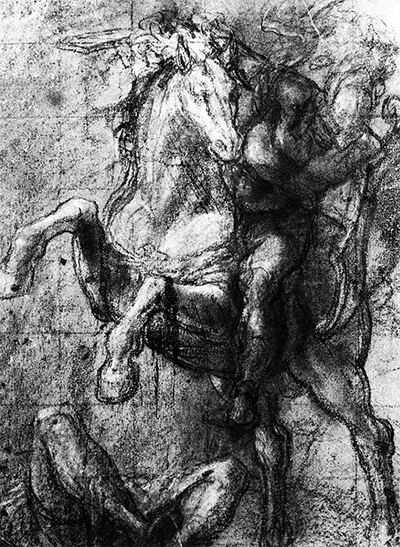
A rearing horse almost fills this drawing. Its head bends toward the viewer as its front legs lift above a man on the ground; a rider, pressed into the dark mass of the horse’s body, prepares to strike. The scene catches a battle at the point when movement could become violence. Held by the Staatliche Graphische Sammlung München as 2981 Z, the sheet is attributed to Titian and described in the University of St Andrews’ Venice in Blue exhibition as black chalk with white heightening on blue paper, 350 × 251 millimetres. It is squared with a grid, suggesting that its design was meant to be transferred to a larger surface.[1]
The Munich drawing is probably connected with Titian’s great battle painting for the Sala del Maggior Consiglio in Venice’s Doge’s Palace. That work was completed in 1538 and destroyed in the 1577 palace fire. The drawing survives where the painting does not, but the relationship remains an informed attribution rather than an exact, fully documented map of preparation. Its broad exhibition date, 1513–37, signals how hard it is to place the sheet precisely within the commission’s long history.[1][3]
At a Glance
- WorkCavalier over a Fallen Adversary
- Research recordveniceinblue2021.wp.st-andrews.ac.uk
Contents
- A fight compressed into one vertical sheet
- What blue paper and white heightening do
- The lost painting in the Doge’s Palace
- Cadore, Spoleto and a disputed subject
- The other horse drawing is in Oxford
- Attribution and artistic ambition
A fight compressed into one vertical sheet
Titian arranged the action so that the horse is both a forceful shape and a difficult body to read. Its head pitches forward, one foreleg thrusts into the left side of the design, and the other crosses the dark cluster beneath it. The rider rises behind that movement. At the bottom, the fallen adversary is partly cut by the edge of the composition; only enough of his body is visible to make the horse’s height and the rider’s advantage clear. The result is a concentrated contest of diagonals and overlaps rather than a complete battlefield narrative.[1]
The drawing’s energy comes partly from its refusal to separate all the forms neatly. A viewer has to follow the horse’s neck, chest, limbs and the rider’s silhouette through a web of dark marks. The exhibition points to foreshortening, the way bodies are represented at sharp angles to the picture plane, as a central challenge. The plunging head makes the horse seem to push outward. Its lifted limbs then take the eye down toward the opponent. Titian was testing how an action could remain legible even when horse, rider and victim occupy nearly the same space.[1]
There is no need to invent the complete battle from this fragment. It gives us a mounted attacker and a defeated figure; it does not give a secure location, date or army. Its dramatic force comes from the immediate encounter. A wider compositional study in the Louvre and later prints offer other evidence for the lost palace painting, but the Munich sheet’s special achievement lies in this single knot of movement.[1][3][4]
What blue paper and white heightening do
The original support was blue paper, although the familiar reproduced crop can look nearly monochrome. The paper supplied a middle value before the artist added a mark. Black chalk could push passages into shadow, while white heightening could pull a form toward the light. The St Andrews exhibition describes illumination from the upper left, catching the horse more strongly than the rider. That difference helps separate the animal’s projected body from the dark, compact shape of the mounted man.[1]
This is a practical way to develop a dramatic effect before painting it at a much larger scale. White touches across the horse’s head and chest guide the eye to the moving mass, while darker hatchings give depth behind it. The material does more than colour the page: its middle tone permits quick changes between light and dark without covering the entire surface. The exhibition calls this a display of chiaroscuro, or modelling through contrasts of illumination. In this drawing, the contrasts also help the viewer follow the physical action.[1]
The sheet is squared, a network of lines often used to translate a design into another size or support. A grid can help preserve positions and proportions while enlarging or transferring an image. Its presence is good evidence that the group was more than a casual sketch. It does not establish the exact dimensions of the destination, prove that every contour reached the final painting, or tell us whether Titian changed the figures during execution. A plan for transfer and a surviving final state are different kinds of evidence.[1]
The lost painting in the Doge’s Palace
Titian’s battle painting was made for the public chamber of the Great Council in the Doge’s Palace, where images carried civic as well as artistic weight. The St Andrews exhibition links the Munich horse and rider likely to that commission, completed in 1538. The Louvre’s separate drawing, Battle of Spoleto, INV 21788 recto, is a wider compositional study dated around 1537 and catalogued as preparation for the same lost work. It too is on blue paper and squared, but it is a different object, measuring 38.3 × 44.2 centimetres and using charcoal, black chalk, brown wash and white heightening.[1][3]
The two sheets can be considered together without being made identical. Munich concentrates on a mounted confrontation. The Louvre drawing works at the scale of a battle composition. The St Andrews account sees a group in the Louvre sheet similar to the Munich design, which supports a connection among studies for the large picture. Yet the surviving sheets do not provide a complete sequence of decisions. It is possible for a motif to be tried more than once, altered on the final surface or omitted. Since the palace painting burned, a drawing cannot be checked against the original as it could if the canvas were still hanging.[1][3]
The Louvre dates the loss to the night of 20 December 1577. That detail clarifies why descriptions, copies and prints matter so much here. They are evidence of an absent public work, not a substitute for inspecting its original paint, dimensions or condition. The Munich sheet is especially valuable because its chalk marks preserve the artist’s effort to make one part of the projected action convincing.[3]
Cadore, Spoleto and a disputed subject
The palace painting was long called the Battle of Cadore, a Venetian victory of 1508. The St Andrews exhibition and the Louvre now favor or use Spoleto, referring to a different historical conflict. The Rijksmuseum’s record for a later print after Titian likewise gives Battle of Spoleto as its current title and Battle of Cadore as its former one. The museum connects the Spoleto identification with the 1155 attack by Emperor Frederick Barbarossa’s army on the city.[1][3][4]
This change of name is not something the Munich fragment can settle on its own. A rearing horse above an opponent is a battle motif, not a dated historical inscription. The broader composition, historical commissioning context and later records have to carry the subject argument. The coexistence of both names in scholarship is therefore worth preserving, especially because readers may encounter older reproductions titled Cadore. They may be looking at material related to the same lost palace picture even when the historical event named in the caption differs.[1][3][4]
The print associated with that lost composition is itself another object. The Rijksmuseum identifies Giulio Fontana as the printmaker of an etching after a design by Titian, RP-P-OB-36.120, broadly dated 1553–82. It shows armies fighting near a bridge, a river and a burning city. The museum notes that, if it was made after Titian’s palace painting, the relevant impression or plate design must predate the 1577 fire. A print can transmit features of a lost painting, but it also reflects the printmaker’s decisions and the conditions of reproduction. It cannot certify that every mark in the Munich study remained in Titian’s finished battle.[4]
The other horse drawing is in Oxford
The Munich sheet is often discussed with a drawing at the Ashmolean Museum, Oxford, inventory WA1895.6. Both are associated with blue paper, tonal modelling and horse-and-rider action. Their movements are different. The Munich horse rises in a moment of triumph over an enemy; in the Oxford drawing the horse itself falls. Oxford’s sheet is also smaller, 220 × 230 millimetres, and the exhibition describes black chalk, charcoal and white bodycolour with a red squaring grid. Those Oxford-specific details should not be transferred to Munich simply because both works appear in the same discussion.[1][2]
The St Andrews entry for Oxford notes a further proposed connection with a later battle design involving Titian’s son Orazio. That alternative belongs to the interpretation of the Oxford sheet. It does not automatically change the Munich drawing’s attribution or its likely relation to the earlier Doge’s Palace battle. Comparing the objects is most useful when each retains its own inventory, dimensions, materials and action.[1][2]
There is also a separate Louvre study of the larger battle scene. Taken together, the Munich, Oxford and Paris works show several ways to approach mounted conflict: isolating a victorious group, exploring a fall, and planning a wider field. Their possible relationships are a subject of scholarship, not a complete set of surviving instructions for rebuilding the lost canvas.[1][2][3]
Attribution and artistic ambition
The Munich drawing was once attributed to Jacopo Tintoretto. According to the St Andrews exhibition, it was recognized as a work by Titian in 1924. That attribution history matters because the painting to which the drawing is likely related cannot now provide a direct visual comparison. The current identification rests on study of the sheet and related works, while the older name records how differently earlier scholars saw its energetic handling.[1]
The exhibition proposes that Titian may have used such daring foreshortening to assert his skill against Pordenone, a rival painter. This is a plausible account of artistic ambition, but it remains an interpretation of motive, not a documented statement by Titian about this sheet. The visible achievement can be described without that speculative step: a complicated horse, a rider in shadow, a victim below, and a strong light source made a scene that could attract attention within a vast battle painting.[1]
For the Titian drawings guide, the Munich sheet is a clear example of drawing as design work rather than a finished miniature painting. It tests spatial compression, tonal focus and possible transfer. The Oxford Horse and Rider offers a close comparison with a different movement. Neither drawing restores the vanished palace painting, but together with the Louvre study and later print they show how much can survive of a lost commission in its preparatory and reproductive traces.[1][2][3][4]
Researched Titian and related works
Frequently Asked Questions
It is 2981 Z in the Staatliche Graphische Sammlung München. The St Andrews exhibition records its material, size and current Titian attribution.[1]
No. Munich’s horse rears over a fallen opponent. The Oxford horse falls; that sheet is WA1895.6 and has different dimensions and techniques.[1][2]
Squaring usually helped an artist transfer or enlarge a design. It supports a working purpose for this group but does not prove exactly how it appeared in the finished palace painting.[1]
Both names have been used. The older Cadore identification appears in much literature; the St Andrews exhibition, Louvre and Rijksmuseum records use or favor Spoleto. The Munich fragment alone cannot identify the event.[1][3][4]
Discussion
What do you notice when you look closely at Titian’s Cavalier over a Fallen Adversary in Munich?
Share a specific observation or a source that adds context.
Reader Insights
Which detail changes your reading?
How does its original setting affect what we see?
Which part of the evidence remains uncertain?
Join the Conversation
Add your observation below.
References
- University of St Andrews, Venice in Blue, “Titian, Horse and Rider Falling,” Munich version, 2981 Z, with Staatliche Graphische Sammlung München guidance. View source.
- University of St Andrews, Venice in Blue, “Titian, Horse and Rider Falling,” Oxford version, WA1895.6. View source.
- Musée du Louvre, Titian, Bataille de Spolète, INV 21788 recto, compositional drawing and lost-painting record. View source.
- Rijksmuseum, Giulio Fontana after Titian, De Slag bij Spoleto, RP-P-OB-36.120, print and subject record. View source.