by Tom Gurney
Tom Gurney BSc (Hons) is an art history expert with over 20 years experience
Published on June 19, 2020 / Updated on October 15, 2026
Email: tomgurney1@gmail.com / Phone: +44 7429 011000
Titian's Miracle of the Jealous Husband: Introduction
Titian's Miracle of the Jealous Husband is a wall painting of a man attacking his wife. It belongs to the 1511 cycle of Saint Anthony's miracles in the Scuola del Santo at Padua. The Basilica of Saint Anthony calls the scene A Jealous Husband Stabs His Wife. The familiar “miracle” title describes what happens later in the story, when the husband asks Anthony for help and the wife recovers. Titian gives the assault most of the pictorial space and pushes the appeal to the saint into the background. A viewer has to confront the violence before reaching its religious resolution.[1][2][3]
The name “vicious husband” describes the attack but is imprecise as an artwork title. The actual object is a fixed wall painting in the upper room of a confraternity building, one of three works Titian made there. A separate black-and-white drawing of a similar attack once circulated under Titian's name. The Padua fresco includes both episodes of the story in colour, with the assault and the later appeal to Anthony sharing one painted setting.[1][7]
At a Glance
- WorkMiracle of the Jealous Husband
- Research recordsantantonio.org
Annotated details from Miracle of the Jealous Husband
Select a numbered area to find its detail below. Open a detail image to view it larger.
Details from MIRACLE OF THE JEALOUS HUSBAND
The Attack in the Foreground
Saint Anthony and the Penitent Husband
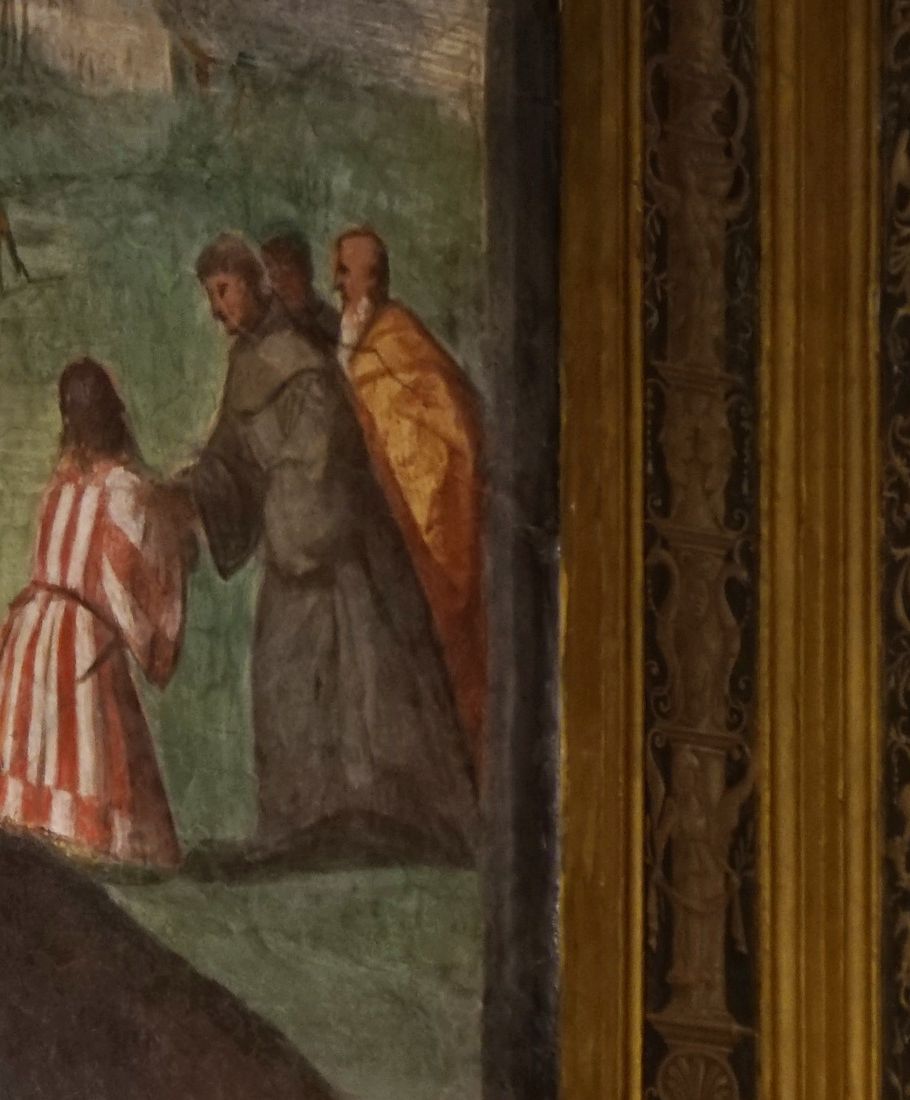
Photo: Armin Kleiner, 2019, CC BY-SA 4.0. Cropped to the fresco and resized; details are cropped from the same photograph. Image source · Reuse licence
Contents
- The attack in the foreground
- Repentance at the right
- An early public commission
- The raised plaster arm
- The story beyond the image
- Restoration, photograph and the separate drawing
- Why the fresco matters
The attack in the foreground
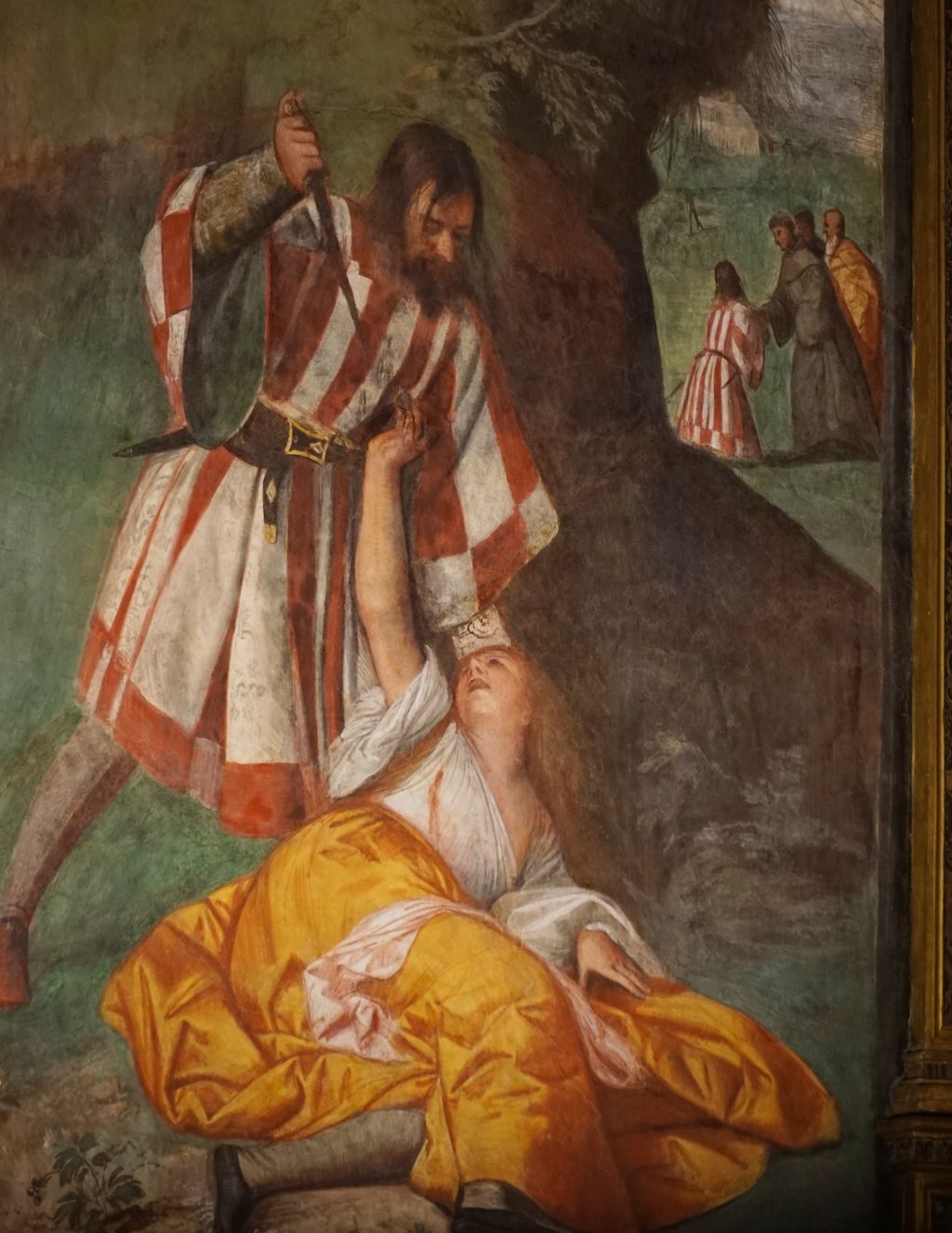
The husband fills the left side of the painted scene. He holds a knife above the woman with one hand and catches her raised arm with the other. The diagonals of those limbs draw attention to the imminent blow. He wears a striking red-and-white garment; the woman lies below him in a white bodice and a broad yellow skirt that spreads across the lower part of the composition. Her head falls back and her face is turned upward. Titian gives her substantial bodily presence even as the larger man looms over her.[1][3]
The landscape rises behind the pair. Green ground and trees separate the large foreground bodies from a small group farther to the right. The woman is not merely an attribute in a saint's legend: the attack is represented as a physical act against a particular person. The scale difference ensures that it dominates at a distance, which mattered for a painting seen on a wall in a shared room. A photograph cropped to the pair could be mistaken for an image with no later episode; a photograph cropped to Anthony would hide the force of the foreground.[1][3]
The knife, grasped wrist and fallen body are not easy details to neutralise by calling the picture only a miracle. Rossetti Morosini's close study of the fresco describes the foreground as a murder of a wrongly accused woman, with the penitence and miracle relegated to the background. The Basilica's narrative says the woman was virtuous and that the husband acted out of anger and violence. Nothing in these accounts establishes that she committed adultery. The title “jealous husband” identifies his suspicion and conduct, not her guilt.[2][4]
Repentance at the right
Beyond the rise of ground, much smaller figures enact the next stage. The husband is shown again, in striped clothing, before the grey-robed Anthony; another figure stands nearby. In the Basilica's account he comes to regret the attack, kneels before the saint and begs him to save the woman. Anthony rebukes him, goes to her and prays for her recovery. The image compresses more than one moment into one landscape: assault in front, supplication behind, with the healing understood through the saint's story.[2][3]
That arrangement is a form of continuous narrative. The viewer reads across space and thereby across time. The slope and tree help separate events without giving them independent frames. The husband's upright, threatening posture in the foreground contrasts with his later posture before Anthony. This does not make the assault vanish. Indeed, the fresco can leave the viewer with the unsettling imbalance that the perpetrator receives a visible scene of repentance while the wife's later experience is carried by the story rather than a similarly large depiction of recovery.[2][4]
The Basilica's modern meditation on the episode explicitly treats it as a prompt to think about violence against women. That is a present-day devotional interpretation of an older miracle narrative, not evidence of Titian's personal views. It does, however, support direct language about the scene. The wife's danger and the husband's responsibility remain central to what the wall painting shows.[2]
An early public commission
The Scuola del Santo, or Scoletta, was the Confraternity of Saint Anthony's headquarters beside the Basilica. According to the Basilica's site, its lower level dates to around 1430 and its upper level to 1504. The upper room contains eighteen early sixteenth-century paintings of Anthony's life and miracles. Three are Titian's 1511 frescoes: the jealous husband, the speaking newborn and the saint reattaching a young man's foot. Together, they placed vivid crises within the confraternity's wider account of Anthony's interventions.[1]
The room gave Titian a public setting and a religious audience. Someone standing inside would encounter the painting beside other miracles, surrounded by the room's architecture. Its meaning was therefore shaped by more than its isolated composition. A visitor could compare cases of injury, accusation and restoration across the cycle. At the same time, the assault scene remains unusually forceful as an image in its own right. The Titian paintings guide sets this work within his early production; the two other Padua subjects belong to the same room, though each tells a distinct story.[1]
The commission is particularly valuable for dating Titian's early career. A National Gallery technical study says he was approached to paint the Saint Anthony miracles on 1 December 1510, the first documentary appearance of his name, and that his brother Francesco assisted him. The frescoes are dated 1511 by the Basilica. The National Gallery of Art also treats this commission as a firm point against which scholars compare early pictures whose dates and attributions are less secure. Documentary evidence for the Padua work is stronger than for many small, Giorgionesque panels associated with the young painter.[1][5][6]
Titian had already worked on the Fondaco dei Tedeschi decoration in Venice. The National Gallery notes that little of his contribution there survives in good enough condition to reveal detailed technique. The Padua murals are therefore especially useful as surviving evidence of his early skill on a wall. Rossetti Morosini calls the Saint Anthony group his earliest surviving fresco work still in its original setting. Those statements are about what survives and can be studied, not proof that these were his first ever attempts at fresco.[4][5]
The raised plaster arm
A close technical examination reveals something a normal photograph can easily conceal. Rossetti Morosini reported that the wife's raised right arm is not simply painted to look rounded. Its plaster finish, the intonaco, rises from the wall by as much as two inches. The built-up surface models the arm and even slight projections around elbow and wrist. In raking light it casts a real shadow on the neighbouring painted surface. The researcher found no visible join between this raised passage and the plaster of the torso, indicating that the forms were made as one continuous application.[4]
This finding changes how to look at the fresco. The painter used actual physical relief within an illusionistic figure, while the surrounding forms use paint to suggest volume. According to Rossetti Morosini, the real and painted volumes blend so closely that the relief may not announce itself from an ordinary viewing position. The account compares this experiment with Titian's interest in three-dimensional form in the contemporary La Schiavona portrait. The physical build-up of plaster is an observed feature; the idea that it formed a deliberate test of painting against sculpture is the researcher's interpretation.[4]
Fresco also demands working in sections of fresh plaster. The National Gallery's study says this scene was divided into only six giornate, or daily working areas, and that the Santo murals were largely executed in true fresco with speed and confidence. This is object-specific evidence about Titian's process, rather than a general claim that every visible mark was finished in a single sitting. It also helps make sense of the image's assertive forms: a complex story was organised into a relatively small number of working passages on a fixed wall.[5]
The National Gallery gives the painted scene as 340 by 184 centimetres. Published dimensions elsewhere differ, possibly because of what is counted at the edges; the figure here follows that study's caption rather than pretending the dimensions have been independently remeasured. The painted surface is large enough for the life-sized impact of the foreground figures and for a readable secondary episode. A full-width image better conveys that relationship than a detail alone.[5]
The story beyond the image
The Basilica's Italian account tells of a wealthy, irascible Tuscan knight who violently beats his wife, drags her and stabs her in the chest. Servants and family carry her to a bed while he seeks Anthony. The saint rebukes the man, then prays beside the woman, who recovers. This modern telling gives detail to the legend beyond what can be read directly in the fresco. We should not infer that all of those actions, such as servants carrying her indoors, are painted somewhere in the background.[2]
Some retellings describe the woman as killed and revived; the Basilica's account describes her as left near death and restored. The picture itself shows an attack and an appeal. It does not function as a medical record of the exact interval between wound and recovery. The religious point of the episode is Anthony's intervention, but Titian's compositional decision makes the violent human action unforgettable. Keeping narrative text, visible image and later interpretation distinct makes the painting easier to understand.[2][3][4]
The same episode appears in another medium at the Basilica: a later marble relief of the jealous husband was made for Anthony's chapel by Giovanni Rubino and Silvio Cosini in 1529. That work belongs to a different site and date. Its existence shows that the story had a larger devotional life at Padua, while it should not be confused with Titian's fresco in the confraternity room.[8]
Restoration, photograph and the separate drawing
The Basilica reports substantial restoration of the paintings and their room completed in 2006. The fresco remains in the Scoletta, so the wall and setting can still inform a visit. A modern photograph records the work after centuries of use and treatment, but its colour, surrounding architecture and distant Anthony group still help identify the Padua object. The wall placement also matters: a viewer can connect the violent first episode to the later appeal within the same room rather than treating them as unrelated pictures.[1]
A monochrome drawing of the attack in the École des Beaux-Arts, Paris, inventory 401, is a different object. A Getty catalogue treats that sheet as Domenico Campagnola after an earlier Titian attribution. The drawing can inform a discussion of related images and uncertain Venetian draftsmanship, but it cannot stand in for the wall painting. It lacks the fresco's yellow skirt, green setting and small scene of supplication. The Titian drawings guide explains why names attached to related sheets must be checked against their individual catalogues.[7]
Why the fresco matters
This work joins an unusually secure early commission to an unusually difficult subject. The documented Padua cycle helps scholars place Titian in 1510–11. The force of the painted figures shows how he could make narrative legible across a public room. The raised plaster arm provides rare material evidence of an experiment with real and depicted volume. None of these facts should make the woman's assault seem merely a vehicle for a technical achievement; the fresco asks the viewer to see both its constructed surface and the harm represented on it.[1][4][5]
The title Miracle of the Jealous Husband directs attention toward repentance and recovery. The Basilica's plainer title, A Jealous Husband Stabs His Wife, directs attention toward the foreground. Both describe parts of the same scene. The full wall painting makes their relationship visible: violence is large and immediate, while the hoped-for healing is smaller, later and mediated by Anthony.[1][2][3]
Researched Titian and related works
Frequently Asked Questions
It remains in the upper room of the Scuola del Santo, beside the Basilica of Saint Anthony in Padua.[1]
The Basilica dates Titian's three Scuola frescoes to 1511. The National Gallery records an approach to him for the commission on 1 December 1510.[1][5]
After the husband attacks his wife, he asks Anthony to help her. In the Basilica's account, Anthony rebukes him and prays for her recovery. The distant group on the right shows the husband's appeal; the foreground shows the assault.[2][3]
Yes. A published close examination found that the plaster of her raised arm projects by up to about two inches, producing a real shadow alongside painted modelling.[4]
Discussion
What do you notice when you look closely at Titian's Miracle of the Jealous Husband?
Share a specific observation or a source that adds context.
Reader Insights
Which detail changes your reading?
How does its original setting affect what we see?
Which part of the evidence remains uncertain?
Join the Conversation
Add your observation below.
References
- Basilica of Saint Anthony of Padua, “The school of the Saint,” owner guide to the Scuola del Santo. View source.
- Basilica of Saint Anthony of Padua, “Il marito violento,” narrative and 2017 meditation. View source.
- Vanderbilt University Special Collections, Contini-Volterra photographic archive, Miracle of the Jealous Husband, spc-mss0088-s21-i0021. View source.
- Sergio Rossetti Morosini, “New Findings in Titian's Fresco Technique at the Scuola del Santo in Padua,” The Art Bulletin 81, no. 1 (1999), 163–64. View source.
- Jill Dunkerton, Marika Spring et al., “Titian's Painting Technique to c.1540,” National Gallery Technical Bulletin 34 (2013). View source.
- National Gallery of Art, Washington, “Titian,” artist biography. View source.
- J. Paul Getty Museum, The J. Paul Getty Museum Journal 15 (1987), “Acquisitions/1986,” p. 204, discussion of the Paris drawing assigned to Domenico Campagnola. View source.
- Basilica of Saint Anthony of Padua, “Cappella di sant'Antonio o Cappella dell'Arca,” list of chapel reliefs and authors. View source.