by Tom Gurney
Tom Gurney BSc (Hons) is an art history expert with over 20 years experience
Published on June 19, 2020 / Updated on October 15, 2026
Email: tomgurney1@gmail.com / Phone: +44 7429 011000
Titian's Berlin self-portrait: the unfinished likeness and its disputed date: Introduction
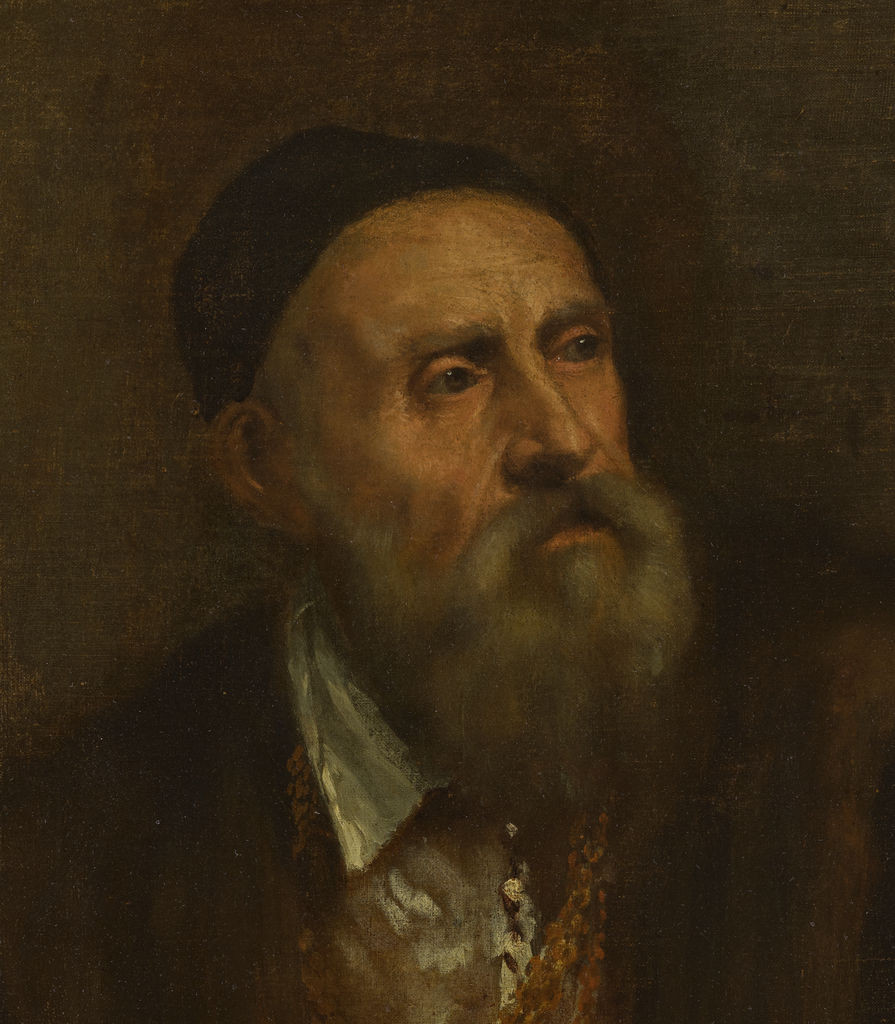
Titian appears as an older man in a dark cap and fur-trimmed sleeveless garment. A white shirt brightens his chest beneath a conspicuous gold chain. One hand rests on a table; the other lies near his thigh. His head turns to the viewer's right, allowing both eyes and more of the face to be seen than in the strict profile of his Prado self-portrait. The Gemäldegalerie in Berlin holds this canvas as inventory 163 and records its dimensions as 100.1 × 77 centimetres. It is partly unfinished.[1]
Berlin regards this and the Prado canvas as the only two securely attributed surviving self-portraits by Titian. That does not make their dates or original purposes secure. Berlin's object metadata gives approximately 1550–55; its extended essay favours the first half of the 1560s on stylistic grounds; a Prado account has proposed around 1546–47. The often-cited 1547 date is therefore a proposal, not a verified year of execution. The painting is best understood through its precise museum identity and the reasons scholars disagree.[1][2]
At a Glance
- WorkSelf Portrait 1547
- Research recordsearch.smb.museum
Annotated details from Self Portrait 1547
Select a numbered area to find its detail below. Open a detail image to view it larger.
Details from SELF PORTRAIT 1547
Berlin Self Portrait Face and Head Covering
Berlin Self Portrait Hands and Chain
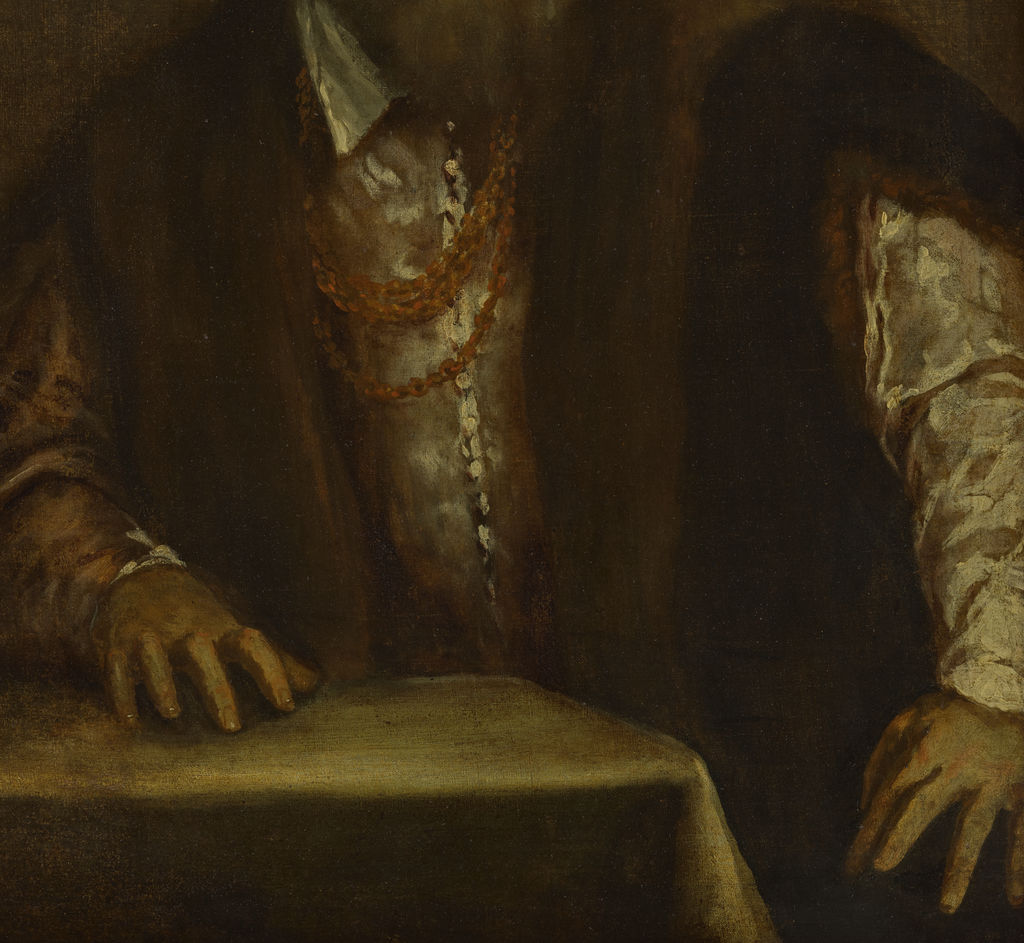
Photo: Staatliche Museen zu Berlin, Gemäldegalerie / Dietmar Gunne. Public Domain Mark 1.0. Cropped and resized. Image source · Reuse licence
Contents
- What the picture shows
- What does unfinished mean here?
- Three different dating arguments
- The chain, intellectual identity and self-presentation
- From Venice to Berlin
- How to compare the two surviving canvases
What the picture shows
The composition includes more of Titian's body and hands than the Madrid self-portrait. His right hand spreads over a pale tabletop at the lower left; the left rests lower at the right side of the image. The light shirt, beard and flesh stand out against a quiet dark ground and brown garment. The chain crosses his chest in several loops. The face appears more resolved than some of the surrounding costume and setting. A visual reading should begin with these relationships instead of assuming the image was meant to represent a single instant of sitting before a mirror.[1]
Berlin describes the outer garment as fur-trimmed and the chain as a sign of Titian's elevation by Charles V in 1533. The chain claims courtly status without showing the emperor. No brush, palette or canvas names the profession visually. That absence differs from the Prado picture, where a brush is held near the lower edge. It does not mean Titian wished to hide his occupation from everyone who saw the Berlin canvas; contemporaries familiar with his likeness could know who he was. It does mean that the picture's visible attributes emphasise dignity, age and rank rather than a demonstration of painting in progress.[1][2]
The museum's prose calls the Berlin likeness a profile, but the reproduced painting visibly shows a turned head with both eyes. The Prado canvas, by contrast, presents the contour of a left-facing face almost edge-on. This distinction is worth preserving because “profile” can otherwise make two different compositions sound interchangeable. The Berlin painting gives a more open view of the sitter's features while still holding him at a measured distance from the viewer. It is a public image of an artist who has achieved high standing, not a casual studio snapshot.[1][2]
What does unfinished mean here?
Berlin explicitly describes the canvas as partly unfinished. Its account finds the face more complete than the surrounding passages. The difference can be seen in the reproduction: the head concentrates the likeness, while some clothing and background areas read more broadly. Yet “unfinished” is a condition judgment, not a surviving statement from Titian about why he stopped. He might have set it aside, retained it as a working model or considered its uneven levels of finish sufficient for a purpose now unknown. Those explanations have different implications and cannot all be declared facts.[1]
One proposal, associated in Berlin's essay with Miguel Falomir, treats the canvas as a ricordo: a retained image related to a self-portrait bought by the humanist Paolo Giovio for his collection at Como in 1549. On that account, the face could preserve a likeness while leaving other areas available for later use or replication. This is an interpretive solution to the painting's condition and the earlier documentary notice. No document attached to inventory 163 states that it served this function. The portrait acquired by Giovio is a recorded historical image; identifying the present Berlin canvas as its remainder requires an additional argument.[1]
The physical painting offers firmer evidence of change. Berlin reports that X-radiography revealed an earlier head covering and sharper facial features beneath the present image. Titian did not simply transfer an unaltered formula onto this canvas. He revised the way he appeared. An X-ray can show a change in material layers, but it cannot name his reason for changing the cap, count the sittings or identify the audience he had in mind. The discovery supports a more active account of the portrait's making without resolving its date.[1]
Berlin's essay also notes the painting's substantial brushwork and light effects when arguing for the early 1560s. Such technical comparisons can be meaningful when tested against secure works. They should not be turned into a rule that broad strokes always mean one decade. A partly unfinished picture may vary considerably across its surface. The museum itself keeps its earlier metadata date alongside the later essay's stylistic view, which is a good signal that the case is still open.[1]
Three different dating arguments
The earliest proposal connects the Berlin portrait to Giovio's self-portrait, acquired in 1549, and therefore places its making around 1546–47. The Prado's discussion presents this view, and Berlin recounts it as a scholarly hypothesis. Its strength is a dated notice of Titian supplying his likeness to a collector. Its weakness is object identity: the notice does not describe the exact surviving Berlin canvas sufficiently to make the match compulsory. An image made for Giovio could have been separate from the one now in Berlin.[1][2]
Berlin's current structured date is about 1550–55. That is the museum catalogue's compact label, and it remains useful when identifying the work in a database. The longer curatorial essay, however, argues that its handling and appearance fit the first half of the 1560s better. A single institutional record thus contains different levels of dating judgment. Reporting only the metadata would hide the museum's own explanation; reporting only the essay would conceal the catalogue label a reader is likely to encounter.[1]
A third historical notice comes from Giorgio Vasari, who saw a self-portrait in Titian's Venice studio in 1566 and later described it as made some years earlier. That could seem to point to the early 1560s, but Berlin cautions against identifying the partly unfinished Berlin work with a picture Vasari called finished. The Prado instead proposes that Vasari may have seen its own canvas. Even this identification remains an argument, since Vasari did not supply a modern accession number, dimensions or an image. Neither painting can acquire a signed date from the anecdote alone.[1][2]
The disagreement matters for interpreting Titian's old age. His precise birth year is itself debated, and the strength of a face in a self-portrait need not correspond to a mechanically calculated age. A proposed date should be attached to the evidence that produces it: a document, a catalogue label or stylistic comparison. The clearest answer to “Was it painted in 1547?” is that this has been proposed but is not settled.[1][2]
The chain, intellectual identity and self-presentation
The chain is visible in both secure self-portraits, but it works differently in each composition. In Berlin it is conspicuous against the shirt, while his hands show no tool. In Madrid the chain is quieter and the brush supplies an explicit reference to the painter's craft. Titian could thus stage himself as a person of rank in more than one way. There is no need to claim that one image repudiates the other. They address different visual questions, and we do not know that they were made for identical recipients.[1][2]
Berlin compares Titian's presentation with portraits of learned men, including Raphael's Tommaso Inghirami and a bronze bust of the humanist Lazzaro Bonamico. This is a curatorial account of visual type and cultural association, not evidence that Titian consciously copied any one object when painting himself. The cap, beard, restrained pose and rich but controlled clothing place him among people whose authority rested on more than hereditary rank. The comparison helps explain why the absence of a brush need not erase his artistic identity: the image could assert a painter's intellectual and social standing through portrait conventions.[1]
The picture's unfinished state complicates the message. A sitter may look commanding even when the paint surrounding him remains visibly exploratory. Berlin's account sees energy in the rapid passages and notes that Titian reworked his images across stages. The coexistence of finished likeness and open painting makes this canvas valuable as a record of process as well as self-presentation. But a psychological claim, such as what he privately thought about ageing, cannot be read directly from looseness, shadow or averted gaze.[1]
From Venice to Berlin
Berlin traces the portrait to the Casa Barbarigo in Venice and says it may have been there from 1581, when Titian's son Pomponio sold the house and its contents to Cristoforo Barbarigo. The museum presents that link as probable rather than certain. It should be kept distinct from a documented, continuous list of owners extending back to the painting's creation. A family or household connection is plausible, but the exact moment the canvas entered that setting is not established by the brief modern record.[1]
The later chain is clearer. Berlin says Leopoldo Cicognara bought the picture in 1815, then sold it almost immediately to Edward Solly. The Gemäldegalerie acquired it from Solly's collection in 1821. These names and dates belong to inventory 163, not to the Madrid portrait, whose route through Rubens and the Spanish royal collection is described on its own page. Separating the objects' provenance is essential when a title as broad as Self-portrait appears in catalogues and exhibition lists.[1][2]
How to compare the two surviving canvases
Place the Prado portrait beside the Berlin reproduction and look first at format and body. Berlin gives Titian a table and both hands, with the face turned toward the right. Madrid narrows the presentation into a strict left-facing profile, with a brush near the bottom. Both include a cap, aged face and chain. The comparison shows a stable public identity reshaped through pose, attributes and degrees of finish. It does not prove which canvas was painted first.[1][2]
Then read each label in full. Berlin's compact date, its essay's alternative, the Prado's proposed early dating for Berlin and Vasari's historical notice represent different kinds of evidence. “Titian, Self-portrait, 1547” is not enough to explain the case. The accession number 163, the painting's dimensions and the museum's discussion identify the real object; the date belongs in a qualified sentence. The paintings guide sets these images beside Titian's portraits of patrons and rulers, while this canvas lets us see how he chose to present his own person.[1][2]
Researched Titian and related works
Frequently Asked Questions
No. About 1546–47 is one proposal linked to Paolo Giovio's portrait. Berlin's metadata gives c.1550–55, while its curatorial essay favours the early 1560s. The picture has no secure date from a surviving commission document.[1][2]
It is in the Gemäldegalerie, Berlin, inventory 163, on canvas measuring 100.1 × 77 centimetres.[1]
Berlin describes the face as more complete than surrounding passages and records changes found through X-radiography. The reason Titian left it in that state is debated.[1]
Discussion
What do you notice when you look closely at Titian's Berlin self-portrait: the unfinished likeness and its disputed date?
Share a specific observation or a source that adds context.
Reader Insights
Which detail changes your reading?
How does its original setting affect what we see?
Which part of the evidence remains uncertain?
Join the Conversation
Add your observation below.
References
- Staatliche Museen zu Berlin, Gemäldegalerie, “Selbstbildnis,” inventory 163, object metadata, bilingual curatorial account and provenance. View source.
- Museo Nacional del Prado, “Self-portrait,” P000407, collection account and comparison with the Berlin picture. View source.