 by Tom Gurney
Tom Gurney BSc (Hons) is an art history expert with over 20 years experience
Published on June 19, 2020 / Updated on October 15, 2026
Email: tomgurney1@gmail.com / Phone: +44 7429 011000
Titian’s Virgin and Child with Saints Dorothy and George: Introduction
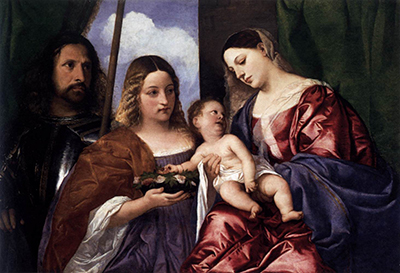
A woman holds out a basket to the Christ Child while an armoured man stands behind her. The child reaches toward the offering from the Virgin’s lap. Rather than sitting in a strict row, the four figures seem to meet across a small but animated space. The Museo Nacional del Prado in Madrid catalogues this painting as Titian’s The Virgin and Child with Saints Dorothy and George, P000434. Painted in oil on panel, it measures 86 × 130 centimetres and is dated 1515–18. The names in that title express the museum’s present judgment; the identities of both saints, the date and the painting’s authorship have all had longer histories of debate.[1]
At a Glance
- WorkMadonna and Child with St Dorothy and George
- Research recordMuseo Nacional del Prado
Contents
- A sacred meeting rather than a fixed lineup
- Why the woman is called Dorothy
- The armoured figure and related works
- Why the Prado dates it to 1515–18
- From Titian to Giorgione and back
- Philip II, El Escorial and the Prado
A sacred meeting rather than a fixed lineup
Mary and the child occupy the foreground at right. She bends her head toward him, holding him close as he twists toward the woman beside them. The woman brings a low basket forward, joining her gesture to the child’s outstretched hand. Beyond her stands the male saint in armour, a long spear rising near the left edge. Dark curtains frame the meeting, but an opening between them reveals a patch of cloudy sky. The shallow setting keeps attention on faces, hands, cloth and the offered gift.[1]
This is a sacra conversazione, a devotional grouping of Mary and the Christ Child with saints who could not all have met them in ordinary historical time. Its purpose is to bring revered figures together for contemplation. Titian gives the conventional grouping a particular sense of arrival. The Prado describes the Virgin and Child in the foreground turning to the right, while the saints approach from behind on the left. The divided curtain supplies a spatial opening and helps make the saints appear to have entered the mother and child’s space. The exact path of a figure’s movement cannot be recovered from a still image, but the unequal depths and crossing gestures make the encounter feel less static than a symmetrical line of holy figures.[1]
The composition is wide for a panel only 86 centimetres high. That horizontal format lets Titian place the armoured saint, the woman with the basket and Mary in a chain across the picture. Yet the exchange is concentrated near the centre, where the offered basket, child’s hand and faces converge. The spear forms a vertical counterweight at the left; Mary’s bowed head and the child’s bent body answer it with softer curves at right. The curtain interrupts a simple reading of the scene as a frieze and creates two darker zones around the brighter figures. Those are visible organising choices, not evidence of a known original room or commission.[1]
Why the woman is called Dorothy
The Prado identifies the offering woman as Saint Dorothy because her basket contains fruit and roses, her customary attribute. The child’s interest in the basket gives that attribute an active role in the painting: it is not merely an emblem held beside her for a viewer to decode. The gift joins the saint to Christ and directs the attention of the Virgin and of the person looking at the panel. The museum nevertheless records Saint Catherine as an alternative historical identification. A basket supports Dorothy strongly, but the figure bears no painted caption that would end the question by itself.[1]
This uncertainty has a tangible paper trail. A later caption on the frame calls the female saint Catherine and the male saint George. An older handwritten label associated with the picture calls the woman Bridget, offering flowers to the child, and identifies the armoured man as her husband Hulfo. The Prado’s nineteenth-century catalogue repeated the Bridget and Hulfo pairing. These records are useful evidence of how viewers and cataloguers once understood the composition. They do not turn either pair into its proven original title. The names must be weighed against the basket, armour, related paintings and modern scholarly study.[1]
The older Bridget/Hulfo reading is more than a random spelling variation. It casts the two figures as a married pair rather than as two separately chosen saints. The Prado’s current account instead prefers Dorothy for the basket bearer and usually George for the armed man. Because the latter’s armour and spear are compatible with a soldier saint but do not name him in letters, the museum also mentions Saint Hulfo as a possible identity. The public title can therefore be used clearly while the supporting evidence and alternative names remain visible.[1]
The armoured figure and related works
The male saint occupies the back of the left side of the group. His dark armour blends into the curtain and shadow, while the spear leads the eye upward. He is less directly involved in the basket exchange than Dorothy, Mary and the child. That difference gives the painting a rhythm: an upright, watchful figure at one edge, a woman carrying the gift in the middle, and mother and child answering her at the other. Calling him George is the Prado’s conventional identification, not a claim that a dragon or a scene from his legend appears here.[1]
Scholars have used the figure as a clue to Titian’s chronology. The Prado notes a resemblance between this armoured saint and Saint Roch in Titian’s Saint Mark Enthroned for Santa Maria della Salute in Venice. An earlier scholar, Georg Gronau, placed the Prado panel as early as about 1505 partly because he believed the Salute work itself to be that early. The Salute altarpiece is now generally dated 1511–12, so the resemblance no longer requires so early a date for this painting. A shared figure type can suggest artistic continuity, but it is not an exact clock or proof that the same drawing was transferred to the panel.[1]
The female saint has prompted another comparison. The Prado sees the same female model in Saint Catherine of Titian’s Virgin and Child with Saints and a Donor in the Fondazione Magnani Rocca, a work it dates 1511–12. This resemblance links the pictures in Titian’s early practice without requiring the Prado saint herself to be Catherine. A model’s appearance and a saint’s iconographic name are separate questions. The Magnani Rocca painting can be compared for its figures and grouping, while each panel keeps its own subject, owner and proposed date.[1]
Why the Prado dates it to 1515–18
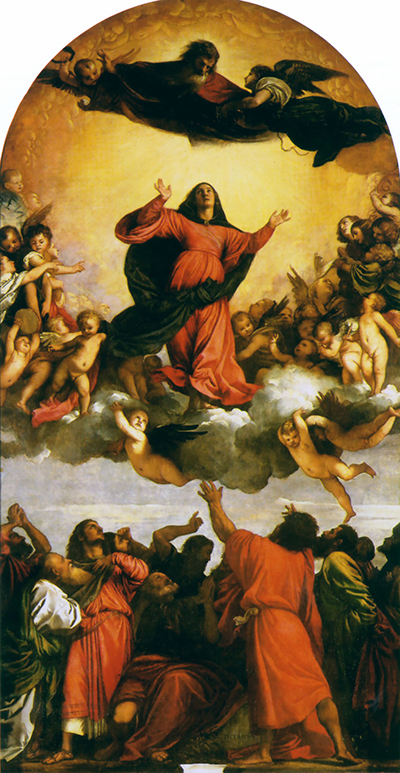
The Prado records proposed dates stretching from about 1505 to 1520. It prefers 1515–18 because the work as a whole looks more developed than its earlier resemblances alone suggest. The figures have a monumental presence; the museum relates its half-length arrangement to a format Titian used from around 1516. It also finds a luminosity of colour that looks ahead to the great Frari Assumption of 1516–18. The dynamic arrangement of saints entering from behind Mary and the child weighs in the same direction.[1]
Those comparisons explain an art-historical date range. They do not identify a documented day, a patron’s payment or a signature dated on the panel. The Salute Saint Roch and Magnani Rocca Saint Catherine provide connections to works placed earlier in the decade; the Frari comparison points toward Titian’s later command of mass and colour. The Prado’s date balances these pieces of evidence rather than treating any one resemblance as decisive. A visitor can therefore read “1515–18” as the museum’s best current estimate and still understand why scholars have argued for other years.[1]
The picture also stands at a useful point in Titian’s development of the sacred conversation. The traditional formula brought Mary and saints into a single devotional field, often in a balanced or axial arrangement. Here the foreground group and the figures emerging from behind it make the field feel activated. That change is not an abandonment of religious meaning. It makes the offered basket and the child’s response into the event through which the viewer encounters the holy figures. The Prado’s comparison with earlier, more rigid groupings is a formal interpretation, grounded in the picture’s arrangement rather than in an unknown commission document.[1]
From Titian to Giorgione and back
The painting was named as Titian’s in the 1593 Libro de entregas recording delivery to El Escorial. The writer José de Sigüenza also accepted that attribution. In 1626, however, Cassiano dal Pozzo attributed it to Giorgione, and it still entered the Prado under Giorgione’s name in 1839. Since the work of Crowe and Cavalcaselle, the Prado says attribution to Titian has been almost unanimous. The shifts belong to the documented reception of a painting from the period when Titian’s art was closely compared with Giorgione’s.[1]
The older attribution should not be turned into evidence that Giorgione painted part of the panel. The Prado’s current catalogue names Titian as the artist, and its essay treats the Giorgione names as historical judgments. The same caution applies to the labels on the frame. A caption can show what a later owner, visitor or cataloguer believed, but it is not automatically a report from the painter’s studio. The painting’s changing attributions and saint names are especially instructive together: the object stayed the same as the explanatory language around it changed.[1]
An 1854–58 Prado catalogue described it as a mystical subject by Giorgione and identified Saint Bridget presenting flowers, with her armoured husband Hulfo nearby. The museum preserves that entry in its online record. Seeing the exact combination matters: the date of the catalogue does not merely show a vague “attribution dispute”; it documents a coherent alternate account of maker and subject. Modern readers can compare that account with the museum’s preferred Dorothy-and-George interpretation and the material signs painted in the panel.[1]
Philip II, El Escorial and the Prado
The Prado says this was the earliest Titian work owned by Philip II of Spain. He had it sent to El Escorial, where the 1593 delivery record documents it. The museum does not know how Philip acquired it. No secure original patron or first destination is supplied either. It would be tempting to infer that the panel was made for the king because it later entered his collection; the nearly eighty years between the Prado’s approximate painting date and the Escorial record leave no basis for that conclusion.[1]
The museum notes that some later sixteenth-century collectors became interested in works from Titian’s youth, mentioning the Marquis of Ayamonte as an example. It suggests that people at the Spanish court may have followed such interests. This helps place Philip’s possession of an early Titian in a historical context, but it remains an interpretation of collecting taste, not a discovered purchase receipt for P000434. The firm sequence is royal ownership, transfer to El Escorial and entry into the Prado in 1839. The Prado’s technical data also records the painting in the Escorial sacristy in 1839.[1]
One unusually specific later record concerns its condition. A paper note on the back of the frame records work between 20 April and 28 May 1943: securing paint, restoration and cleaning. The note says that Mary's mantle had been covered with darkened asphalt and green material and that the treatment returned its lapis-coloured appearance; it also says a grey veil over the armoured figure’s colour was removed. This is evidence that a mid-twentieth-century intervention was documented on the object. The online record does not supply the analyses needed to verify every original pigment or to describe the full treatment outcome independently. The colours visible now are the colours of a painting with a long material history.[1]
The Titian paintings guide sets this panel among the artist’s early religious works. The Virgin and Child between Anthony of Padua and Roch is another Prado sacred grouping that invites comparison, but it has its own support, arrangement and history. Keeping those objects distinct is especially useful in an artist’s career full of repeated holy figures and later copies.[1]
Researched Titian and related works
Frequently Asked Questions
The Prado currently identifies the woman offering fruit and roses as Saint Dorothy and the armoured man as Saint George. Earlier records also named Catherine, Bridget and Hulfo, so the iconography remains a subject of interpretation.[1]
The Prado currently attributes it to Titian. Cassiano dal Pozzo called it Giorgione’s in 1626, and that attribution persisted when it entered the museum in 1839; later scholarship has largely returned it to Titian.[1]
The Prado dates it 1515–18. Scholars have proposed a wider span, from about 1505 to 1520, because comparisons with Titian’s early works pull in different directions.[1]
His ownership and the 1593 transfer to El Escorial are documented, but the Prado says how he acquired the panel is unknown.[1]
It belongs to the Museo Nacional del Prado, Madrid, inventory P000434.[1]
Discussion
What do you notice when you look closely at Titian’s Virgin and Child with Saints Dorothy and George?
Share a specific observation or a source that adds context.
Reader Insights
Which detail changes your reading?
How does its original setting affect what we see?
Which part of the evidence remains uncertain?
Join the Conversation
Add your observation below.
References
- Museo Nacional del Prado, “The Virgin and Child with Saints Dorothy and George,” P000434, collection essay by Miguel Falomir Faus, historical inventories and inscriptions. View source.