 by Tom Gurney
Tom Gurney BSc (Hons) is an art history expert with over 20 years experience
Published on June 19, 2020 / Updated on October 15, 2026
Email: tomgurney1@gmail.com / Phone: +44 7429 011000
A Horse and Rider Falling: Titian’s Oxford Drawing: Introduction
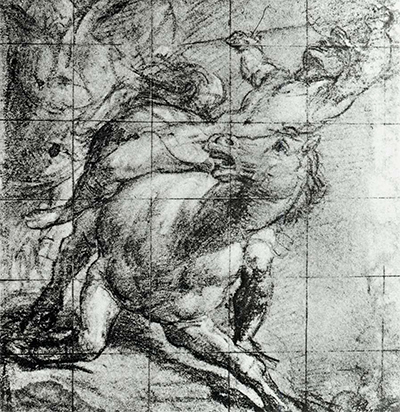
The drawing shown here is Titian’s A Horse and Rider Falling in the Ashmolean Museum, Oxford, inventory WA1895.6. Its force comes from a horse collapsing in a tangle of limbs while the mounted figure twists above it. The work is a small, nearly square sheet rather than a surviving battle painting. The Ashmolean catalogues black chalk, charcoal and white bodycolour on blue laid paper, with a red chalk grid crossing the image; it dates the drawing to 1537. The St Andrews Venice in Blue exhibition gives its dimensions as 220 × 230 millimetres and associates it, with caution, with a lost Doge’s Palace battle.[1][2]
At a Glance
- WorkHorse and Rider
- Research recordveniceinblue2021.wp.st-andrews.ac.uk
Contents
- A fall constructed in chalk
- What the red grid does—and does not—show
- The lost Doge’s Palace battles
- Oxford, Munich and Paris: three different sheets
- Why the distinction matters
A fall constructed in chalk
The horse fills most of the sheet. Its front and hind legs turn across one another near the ground; its neck and head are caught in the same movement. The rider’s body, higher in the image, pulls the eye beyond the horse toward the other combatant suggested near the edge. The action is difficult to parse at a glance, which is part of the challenge Titian was testing. An animal’s heavy body and a person’s urgent movement have to occupy one convincing moment of combat.[2]
Look at how the dark strokes concentrate around the joints, mane and descending limbs. Lighter passages keep the horse’s flank from becoming a single black shape. The blue paper supplies a middle value between dark chalk and added white. According to St Andrews, its textured surface also lets charcoal and chalk produce gradations as pressure changes. The drawing’s light is therefore built from paper, dark marks and white heightening together. It should not be described as a monochrome photograph of a lost painting: the particular contrasts belong to this working sheet.[1][2]
The paper is now described by the exhibition as discoloured. That qualification matters when interpreting “blue paper.” Its present colour may not reproduce the exact midtone Titian first used. The museum’s material description nevertheless establishes that the support was blue laid paper, not a later blue wash over white. Material facts are especially important for a preparatory drawing because the support actively shapes what the artist can see while working.[1][2]
What the red grid does—and does not—show
Red lines divide the Oxford drawing into squares. Such squaring can help transfer or enlarge a design: the artist or an assistant can locate a contour in one cell and recreate it in a corresponding cell of a larger grid. In this context it is evidence that the violent figure group could be carried toward another composition. It is not an invoice, a project label or proof that one particular palace canvas was the final destination. The grid survives on the drawing; the large paintings to which the sheet has been linked do not.[1][2]
The combination of swift black marks and a measured red grid is revealing. Titian was working through both the sensation of a fall and the practical problem of placing that fall elsewhere. The horse’s compressed body could become a component of a wider battle, yet this sheet gives the group room to be tested on its own. Its small dimensions encourage close inspection of the pose rather than a panoramic reading of an army. The distinction helps explain why a figure study and a compositional study can belong to the same inquiry without being the same kind of object.[1][2][3]
The lost Doge’s Palace battles
St Andrews considers the Oxford drawing likely connected to Titian’s Battle of Spoleto, completed for the Doge’s Palace in Venice in 1538. The National Gallery of Art’s biography says Titian had secured the palace battle commission in 1513, although the work was not executed until 1537–38. Those dates describe different stages: obtaining a commission, making possible studies and completing the painting. A 1537 drawing fits the later making of the work; it does not mean Titian began drawing it in 1513.[2][4]
The naming of the lost battle has also changed. The St Andrews exhibition notes that the palace image was often called the Battle of Cadore but is now likely identified with the Battle of Spoleto. The Louvre’s record for a related drawing, Bataille de Spolète, likewise records the older Cadore identification. We cannot settle that historical subject by looking at the Oxford horse alone: the close-up study contains no labelled city, campaign or dated event. It depicts an action that could serve more than one large narrative.[2][3]
St Andrews raises a second possibility: the sheet may relate to the later Battaglia a Porta Sant’Angelo, designed by Titian’s son Orazio Vecellio with help from his father in 1562–64. This is not the exhibition’s preferred association, but it is a reason to avoid stating the Oxford sheet’s purpose as certain. Both relevant palace paintings were destroyed in the 1577 fire. The Louvre specifies that the fire occurred on the night of 20 December 1577. With the paintings gone, relationships between drawings, copies and written records carry more weight, while the missing originals limit what can be proved.[2][3]
Oxford, Munich and Paris: three different sheets
The Cavalier over a Fallen Adversary in Munich is a separate drawing, inventory 2981 Z, measuring 350 × 251 millimetres. St Andrews describes its horse as rearing over a defeated opponent, an image of mounted superiority. Oxford’s horse is falling, so its physical balance and dramatic effect are different. Both drawings use blue paper and develop mounted combat, but they are neither duplicate impressions nor interchangeable views of one sheet. The Munich entry also records an earlier attribution to Tintoretto before recognition as Titian in 1924, a history that belongs to Munich’s object, not automatically to Oxford’s.[2][5]
The Louvre preserves a broader Bataille de Spolète drawing, inventory INV 21788 recto, dated about 1537. Its 38.3 × 44.2 centimetre format is larger and more horizontal than Oxford’s nearly square study. The Louvre lists charcoal and black chalk, brown wash and white heightening on blue paper, with squaring in black rather than Oxford’s red. It connects its sheet with the 1538 palace painting. These different formats and grid colours are practical safeguards against collapsing all the battle drawings into one generic “Horse and Rider.” The Louvre sheet addresses a larger composition; the Oxford image tests a difficult mounted group.[1][3]
A later witness is Andrea Vicentino’s red-chalk Battle of Spoleto in the National Gallery of Art, catalogued about 1575 as after Titian. Its maker and date make it neither a Titian preparatory sheet nor a replacement for the Oxford original. It does show that the battle design could be copied while Titian’s painting still existed. Yet a copy introduces another person’s selection and handling. Placing it beside the Oxford and Louvre drawings can support discussion of circulation; it cannot recover every feature of the destroyed palace canvas.[3][6]
Why the distinction matters
Titian’s Oxford drawing is compelling even without a certain final commission. We can see the draughtsman solving a demanding pose through dark, middle and light tones, then marking a grid that could help move the design onward. The possible Spoleto connection places that work within an ambitious civic painting, but the alternate Porta Sant’Angelo proposal keeps the purpose open. The surviving paper makes the making process more tangible than the lost painting’s finished appearance.[1][2]
The Ashmolean records the sheet as presented by Mrs Josiah Gilbert in 1895. That is a firm collecting point, not a complete history back to Titian’s studio. It does, however, place the drawing in a documented modern collection before the later debate over its connection to the lost palace painting. The Ashmolean record and the St Andrews exhibition offer complementary ways to study the sheet: one identifies the object and its materials, while the other sets its restless mounted group beside the problem of the Battle of Spoleto.[1][2]
For the broader role of preparatory studies, see the Titian drawings guide. The Oxford sheet is best understood first as WA1895.6, with its own materials, scale and unresolved destination.[1]
Researched Titian and related works
Frequently Asked Questions
The Ashmolean Museum, University of Oxford holds the drawing as WA1895.6.[1]
No. St Andrews regards that link as likely, while also proposing the later Battaglia a Porta Sant’Angelo as a possibility. Both paintings were lost in the 1577 fire.[2]
No. Munich 2981 Z is a larger sheet with a rearing horse above a fallen opponent; Oxford WA1895.6 shows a falling horse and measures 220 × 230 millimetres.[2][5]
Discussion
What do you notice when you look closely at A Horse and Rider Falling: Titian’s Oxford Drawing?
Share a specific observation or a source that adds context.
Reader Insights
Which detail changes your reading?
How does its original setting affect what we see?
Which part of the evidence remains uncertain?
Join the Conversation
Add your observation below.
References
- Ashmolean Museum, Italian Drawings Project, “A horse and rider falling (detail), Titian,” WA1895.6. View source.
- University of St Andrews, Venice in Blue, “Titian, Horse and Rider Falling,” Oxford WA1895.6. View source.
- Musée du Louvre, “Bataille de Spolète,” INV 21788 recto. View source.
- National Gallery of Art, “Titian,” artist biography. View source.
- University of St Andrews, Venice in Blue, “Titian, Horse and Rider Falling,” Munich 2981 Z. View source.
- National Gallery of Art, “The Battle of Spoleto,” Andrea Vicentino after Titian, 2002.127.1.b. View source.