by Tom Gurney
Tom Gurney BSc (Hons) is an art history expert with over 20 years experience
Published on October 13, 2026 / Updated on October 15, 2026
Email: tomgurney1@gmail.com / Phone: +44 7429 011000
Titian's poesie for Philip II: six paintings, many stories: Introduction
Titian called the large mythological pictures he made for Philip II his poesie: paintings offered as the visual counterparts of poems. Six canvases were delivered over roughly a decade. They show gods and mortals at moments of pursuit, discovery, danger and change, and they now belong to collections in Britain, Spain and the United States. To read them together, it helps to know both the stories Titian invented in paint and the precise objects that left his workshop for the Spanish prince.[1][2]
The six are the Wellington Collection Danaë, the Prado Venus and Adonis, the Wallace Collection Perseus and Andromeda, the jointly owned Diana and Actaeon and Diana and Callisto, and the Gardner Museum's Rape of Europa. The related Death of Actaeon was not delivered to Philip. A later version of Danaë now in the Prado is another canvas. These distinctions are the foundation of the guide, since a shared subject or title cannot substitute for object identity.[1][2][3]
At a Glance
- SubjectTitian’s Poesie
- ScopeVenetian Renaissance art
- Source approachCollection records and primary documents
Contents
- The six canvases at a glance
- What did Titian mean by poesie?
- A commission developed with the prince
- The first pair: Danaë and Venus and Adonis
- A rescue picture in the Wallace Collection
- Two Diana canvases made to be seen together
- Europa: the final delivered work
- A related sequel outside the six
- One series, many later histories
The six canvases at a glance
| Work sent to Philip II | Approximate date | Present collection |
|---|---|---|
| Danaë | 1551–53; sent 1553 | Wellington Collection, Apsley House, London |
| Venus and Adonis | 1554 | Museo Nacional del Prado, Madrid, P000422 |
| Perseus and Andromeda | 1554–56 | Wallace Collection, London, P11 |
| Diana and Actaeon | 1556–59; sent 1559 | National Gallery and National Galleries of Scotland |
| Diana and Callisto | 1556–59; sent 1559 | National Gallery and National Galleries of Scotland |
| The Rape of Europa | 1559–62 | Isabella Stewart Gardner Museum, Boston, P26e1 |
The dates describe periods of work or documented dispatch, depending on the evidence for each picture; they are not six dates signed on the canvases. Present collections are equally a matter of object history. The Diana pair is displayed together in London or Edinburgh under joint ownership, so a current room number may change while the paintings remain the same two objects. Starting with this list prevents a related version from quietly taking a delivered work's place in the story.[1][2][3][4][5][7][9]
What did Titian mean by poesie?
The term means “poems,” but it was more than a flattering name for expensive pictures. Titian used classical narratives as material for visual invention. A painting can hold one moment before our eyes while making us anticipate what came before and after it. In Venus and Adonis, Venus tries to stop the hunter as he turns away; in Perseus and Andromeda, the descending hero is still in midair as the bound woman waits by the sea. Neither picture is a neutral illustration of a fixed literary sentence. Titian's composition determines the emotional pressure of the scene.[1][4]
Ovid's Metamorphoses was a major source, alongside other ancient writing and possible contemporary retellings. The Prado notes that the particular moment of Adonis wrenching himself from Venus's embrace does not appear as such in Ovid. Titian had made earlier versions of the subject and used a dramatic departure to let the goddess act, even though she cannot change the coming death. A source text can therefore explain the characters without dictating every pose or encounter in the finished canvas.[1]
The group has no continuous plot running from the first painting to the sixth. Danaë and Perseus connect through mythic family history, and the two Diana pictures share the goddess and a landscape design; other relations lie in visual contrast, patronage and themes of unequal power. The six works were not made for Alfonso d'Este's earlier Ferrara Camerino d'Alabastro. Those Bacchanals belong to a different patron, room and phase of Titian's career.[2][5]
A commission developed with the prince
Titian and Philip, still a prince, met through Philip's father Charles V. The National Gallery suggests that discussion of a thematic group may have begun in Milan in 1548 or at Augsburg in the winter of 1550–51. The Prado gives a firmer documentary anchor: in a letter of 23 March 1553 Titian says he is setting the poesie in order, as though the prince already knew of the project. The letter establishes work in progress; it does not preserve a signed contract listing six fixed subjects, dates and wall positions.[1][2]
The Prado describes the pictures as a meeting of patron and artist's interests. Philip wanted ambitious mythological works; Titian was given substantial freedom in choosing and developing the stories. Neither a purely private painter's whim nor a rigid programme imposed in complete detail by Philip fits that account. This matters because the painter could reuse a successful subject, change a narrative moment and consider how one body or composition would answer another across the group.[1]
The works took time. First deliveries came in 1553 and 1554, and Europa followed in the early 1560s. Philip became king of Spain in 1556, partway through the enterprise. The changing status of the patron and his movements between residences caution against assuming that Titian painted six canvases for one already measured room in the Madrid Alcázar. The Prado regards their later shared display there as likely, but the precise original arrangement is not securely known.[1][2]
The first pair: Danaë and Venus and Adonis
The first Danaë sent to Philip is the canvas now in the Wellington Collection at Apsley House, London, made about 1551–53 and delivered in 1553. Jupiter comes to the confined princess in a shower of gold. Titian had painted the subject earlier for Cardinal Alessandro Farnese; that earlier version is now in Naples. English Heritage's account of the Apsley canvas reports that an X-ray revealed an original position of Danaë's drapery closer to the Naples design. Titian changed it while making this new picture. Repetition therefore supplied a starting point, not an obligation to leave the new painting identical.[3]
The Apsley canvas also has a later history that affects what we see. It belonged to the Spanish Royal Collection, left Spain after the Peninsular War, and was presented to the Duke of Wellington in 1816. Conservation at the Prado in 2013 removed discoloured varnish and later overpaint, allowing aspects of Titian's original colour and handling to be reassessed. A photograph taken before that work and a present view do not show quite the same surface.[3]
The Prado's Venus and Adonis, P000422, followed in 1554. Venus is seen from behind as she clings to Adonis; he steps toward the hunt that will kill him. The museum interprets the pair as a demonstration of painting's ability to show a figure from different viewpoints, in a conversation with sculpture. That claim is a historical reading of the two canvases together, not a rule that every viewer must find them symmetrical. Danaë receives the divine visitor; Venus tries to prevent a mortal departure. Both pictures make a woman's body central, yet their narrative positions differ.[1]
The Prado's technical account complicates any claim that Venus and Adonis was invented without a model. Infrared examination indicates transfer from an earlier version now in Moscow, followed by changes to the spear, the embrace and figure contours. Titian reused a design for a highly important royal picture. Transfer alone does not make the work an anonymous workshop replica; the alterations and the painting's execution belong to the assessment of this specific canvas.[1]
There is also a Prado Danaë dated later, around 1560–65. The Prado says Velázquez probably acquired it during his first Italian journey and sold it to Philip IV in 1634. It was not the Danaë sent to Philip II. The name identifies the myth, while the owner, provenance and date distinguish the physical painting. The Naples, Wellington and Prado canvases offer three related but separate histories.[1][6]
A rescue picture in the Wallace Collection
Perseus and Andromeda is held by the Wallace Collection in London as P11. The museum dates it 1554–56 and says it may have been sent to Philip in 1556. Andromeda has been chained as an offering to a sea monster; Perseus descends to rescue her. Titian positions the armed moving hero against the exposed, stationary figure, turning the distance between them into suspense. The story supplies a rescue, but the painted moment leaves the outcome still ahead of us.[4]
Technical evidence shows that this arrangement was not the only one Titian considered. The Wallace Collection says Andromeda originally stood at the right side of the canvas before being moved. The picture's subsequent condition is poor, so a statement about exact original colour or level of finish needs care. It later passed through the collections of Pompeo Leoni and Van Dyck, then French owners before the third Marquess of Hertford bought it in 1815. Its path from Philip's collection is not fully documented. The painting thus carries a history of making and dispersal as well as a mythic narrative.[4]
Two Diana canvases made to be seen together
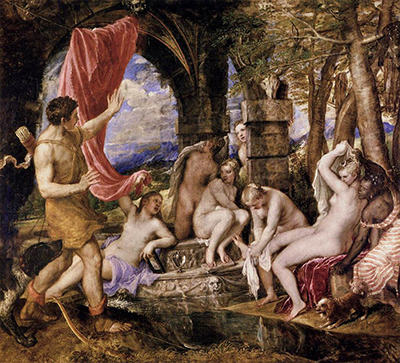
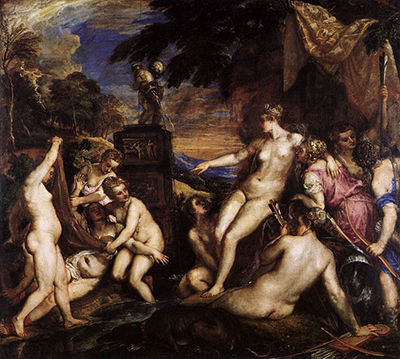
Diana and Actaeon and Diana and Callisto were painted between about 1556 and 1559 and sent together in 1559. The National Gallery says their landscapes and foreground stream appear to continue from one canvas into the other; figures and poses also echo. The light, however, falls from opposite directions. They were designed as companions, but not as two halves of one seamless view. The pair has remained together through its later travels and is now jointly owned by the National Gallery, London, and the National Galleries of Scotland, displayed together in the two cities.[5][7]
Actaeon accidentally enters the bathing place of Diana and her nymphs. The scene holds his shock and the goddess's anger before the punishment to come. In the companion painting Diana orders Callisto exposed after her pregnancy is discovered. Jupiter had raped Callisto while disguised as Diana; her fellow nymphs pin her down and tear away her clothing. Describing the action as an elegant bath scene alone would misstate the story and the distress Titian chose to depict. The paintings share the goddess's authority, but the two people on whom it falls occupy different positions.[2][5]
Technical examination finds distinct working histories behind the visual pair. The Actaeon canvas was revised more extensively during painting. The Callisto design appears to respond to aspects of its companion's developed state, and it too includes changes to figures. Their colour and surfaces have aged differently. A pair can be planned to converse without both canvases being made by exactly the same sequence of steps or surviving in identical condition.[8]
After delivery, the works went first to Toledo, where Philip was residing, and later to the Alcázar in Madrid. A proposed diplomatic gift to the future Charles I of England in 1623 did not take place. Their later circulation together is unusually well documented compared with the more fragmentary paths of some other poesie. Titian also allowed the Callisto design to travel in another way: a version was made with workshop participation, and Cornelis Cort engraved the composition in 1566.[5]
Europa: the final delivered work
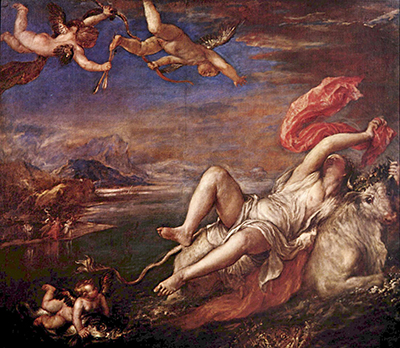
In the Gardner Museum's Rape of Europa, dated 1559–62, Jupiter as a bull carries Europa away across the sea. She twists and reaches while companions remain on the far shore. The bull, water, scattered fabric and sky turn the abduction into a scene of unstable movement. It is tempting to call the picture merely triumphant because the paint is so exhilarating; the figure's fear and separation are part of the action.[2][9]
The Gardner Museum identifies its canvas as P26e1, now in the Titian Room in Boston. Its setting is not the room Philip first imagined, and conservation in 2019–20 changed the present view by addressing later coatings and earlier damage. The museum's collection and conservation accounts let a reader distinguish the painted story from the modern object through which it is seen. A claim about its original sixteenth-century appearance should rest on that research rather than a reproduction alone.[9]
A related sequel outside the six
The National Gallery's Death of Actaeon shows the hunter's punishment after his encounter with Diana. A letter of June 1559 probably refers to a picture of Actaeon torn by his hounds. Titian returned to the subject later, and the picture was never sent to Philip. That makes it a meaningful companion to Diana and Actaeon without making it a seventh delivered poesia.[2][10]
Questions about its final state are harder. The National Gallery says parts may have been painted mostly in the early 1570s and that the work may not be entirely finished. Its technical catalogue warns that the common assumption that it remained in Titian's studio at his death lacks direct surviving documentation. Those qualifications are more useful than a neat story of an unfinished seventh canvas rejected by the king; no such rejection is established.[10]
One series, many later histories
The six delivered paintings were made for a common patron, yet modern ownership divides them. The Wellington Danaë came to Britain after the Peninsular War; the Prado owns Venus and Adonis; the Wallace picture travelled through several private collections; the Diana pair now moves between London and Edinburgh; and Europa reached Boston. Their present locations can be mapped, but the map is not Titian's first hanging plan. Even the likely Alcázar grouping cannot restore an exact order that the evidence does not record.[1][3][4][5][9]
Versions complicate a simple reunion further. The Farnese and Prado Danaë canvases, other Venus and Adonis paintings and the later Vienna Diana and Callisto belong to the wider history of Titian's designs. They can clarify how a composition changed and circulated, yet they are not substitutes for the six commissioned objects. This guide follows the original delivered canvases while the individual pages give versions, present attribution and condition their own space.[1][3][5][6]
The word poesie remains useful because it captures Titian's ambition to make painting do more than repeat a written fable. It should also sharpen how we look. Who has power in the scene? Which moment was chosen or invented? What does the neighbouring picture change? And what is known of the actual canvas before us? Those questions let the colour, narrative and material history of the six works speak together without smoothing away the violence many of their stories contain.[1][2][4][5]
Researched Titian and related works
Frequently Asked Questions
Six: the Wellington Danaë, Prado Venus and Adonis, Wallace Perseus and Andromeda, the two Diana canvases, and the Gardner Rape of Europa.[1][2]
No. The sent painting is at Apsley House in the Wellington Collection. The Prado Danaë is later and entered the Spanish royal collection under Philip IV.[3][6]
No. Ovid supplied many characters and stories, but Titian chose and sometimes invented a dramatic moment. The departing Adonis scene is a Prado example.[1][2]
Yes. Their landscapes, stream and figure echoes connect them, although their lighting and working histories differ. They remain together in joint London and Edinburgh ownership.[5][7][8]
Discussion
What do you notice when you look closely at Titian's poesie for Philip II: six paintings, many stories?
Share a specific observation or a source that adds context.
Reader Insights
Which detail changes your reading?
How does its original setting affect what we see?
Which part of the evidence remains uncertain?
Join the Conversation
Add your observation below.
References
- Museo Nacional del Prado, “Venus y Adonis,” P000422, collection study and documentary account of the poesie. View source.
- National Gallery, London, “Titian's poesie: The Commission,” exhibition research. View source.
- English Heritage, Titian at Apsley House, exhibition and conservation guide, printed p. 10. View source.
- The Wallace Collection, “Perseus and Andromeda,” P11, collection record and painting history. View source.
- National Gallery, London, “Diana and Callisto,” NG6616, account of the paired paintings and later circulation. View source.
- Museo Nacional del Prado, “Dánae recibiendo la lluvia de oro,” collection record; encyclopedia account distinguishing its provenance from Philip II's canvas. View source; View source.
- National Galleries of Scotland, 2012 release on joint ownership and shared display of Diana and Actaeon and Diana and Callisto. View source.
- Jill Dunkerton and Marika Spring, National Gallery Technical Bulletin 36 (2015), catalogue studies of “Diana and Actaeon” and “Diana and Callisto.” View source; View source.
- Isabella Stewart Gardner Museum, “The Rape of Europa,” P26e1, object record and conservation account. View source; View source.
- National Gallery, London, “The Death of Actaeon,” NG6420, object account and technical catalogue. View source; View source.