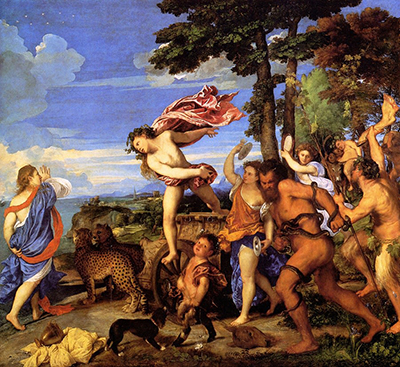
by Tom Gurney
Tom Gurney BSc (Hons) is an art history expert with over 20 years experience
Published on June 19, 2020 / Updated on October 15, 2026
Email: tomgurney1@gmail.com / Phone: +44 7429 011000
Titian's study for Saint Bernardino: Introduction
The image on this page shows a drawing of a draped figure seen from behind, generally called a Study for Saint Bernardino. It belongs to the Uffizi Galleries' Department of Prints and Drawings in Florence, inventory 1713 F. A photograph of the sheet matches the site's image: the figure bends forward, one arm folds in toward the body, and long dark passages give the robe its weight. The saint's name is a traditional interpretation of this figure, not something established by a visible face or identifying attribute in the drawing.[1][2]
The proposed connection is with a lost painting Titian completed for Doge Andrea Gritti in the Venetian Doge's Palace in 1531. The painting was destroyed in a palace fire in 1574. A separate official Gritti portrait by Titian perished in another fire in 1577; the two works and the two fires should not be confused. The Uffizi sheet survives, but because the relevant painted figure is lost, its precise role in that commission cannot be checked by placing it directly beside the original canvas.[3][4]
At a Glance
- WorkDrapery study for Saint Bernardino
- Research recordUffizi Galleries
Annotated details from Drapery study for Saint Bernardino
Select a numbered area to find its detail below. Open a detail image to view it larger.
Details from DRAPERY STUDY FOR SAINT BERNARDINO
Saint Bernadine Sleeve and Shoulder
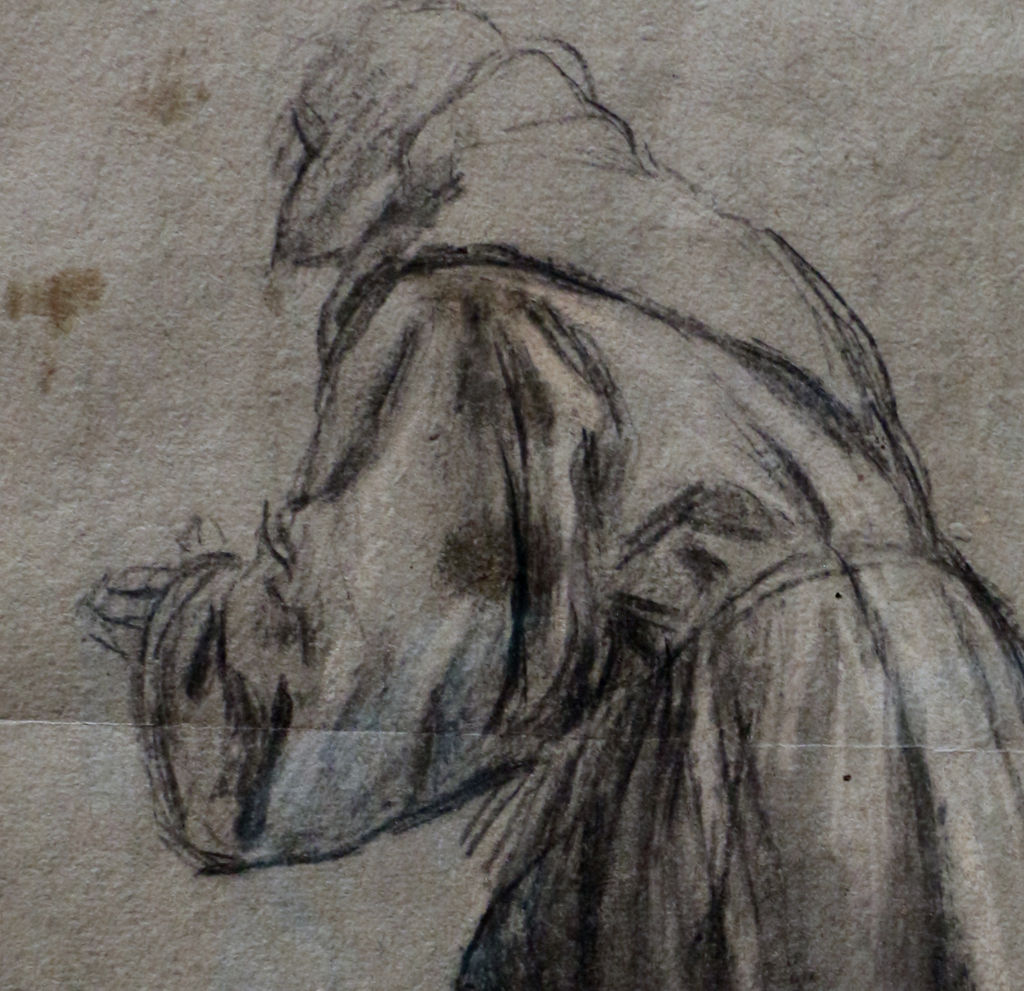
Saint Bernadine Long Robe and Hem
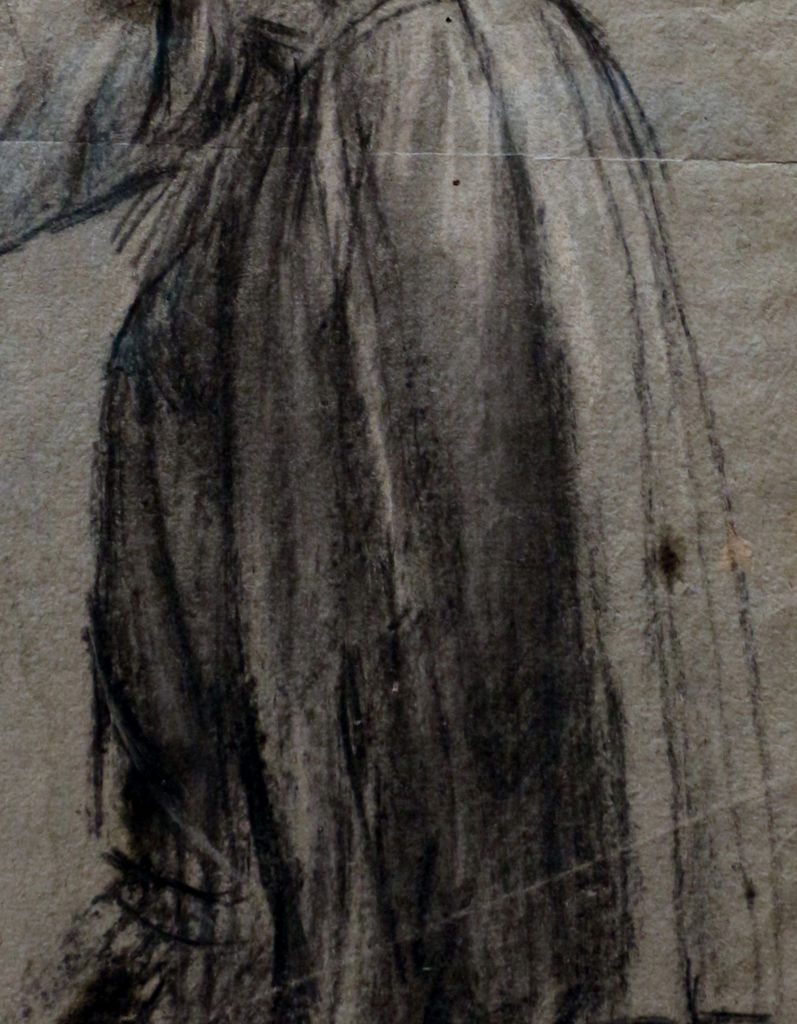
Photo: Francesco Bini (Sailko), CC BY-SA 4.0. Cropped and resized. Image source · Reuse licence
Contents
- Looking at the sheet
- Why call him Saint Bernardino?
- Gritti's lost picture and its records
- What comparisons with Rotterdam tell us
- A study with a useful limit
Looking at the sheet
The figure's face is mostly turned away and hidden by the upper drapery. The upper body bends toward the left of the sheet. One sleeve gathers around a bent arm, and the robe falls in a heavy column below. Stronger dark marks deepen the fold under the arm and along the centre of the garment; lighter passages define the outer edge. The effect is of a body carrying cloth, not an isolated pattern of decorative folds.[2]
At the shoulder, the fabric seems to turn abruptly across the back. The lines around the upper arm are short and compressed, then lengthen into the lower garment. This transition gives the figure a physical hinge: the arm's movement explains why cloth bunches near the torso and flows more freely below. The drawing leaves the hand and the front of the body much less resolved. It concentrates work where Titian needed a convincing shift of direction and weight.[2]
The small line of the head remains indistinct. That is one reason to speak first of a drapery or figure study rather than a devotional portrait of a saint. A finished painting might have provided a halo, setting or neighbouring figures that settled the identity; this sheet by itself does not. Its interest lies partly in what a draughtsman chooses to solve before every aspect of the subject is fixed.[2]
The photographed paper also shows a horizontal crease or join-like line across its middle and a small collection mark near the lower left. Those belong to the visible sheet and its photographic record. They do not tell us which saint is represented or how the drawing was used. The site displays an independently made photograph and details of the same object, with credit to photographer Francesco Bini, known as Sailko. A photograph is useful for close looking, while the physical drawing remains the Uffizi object.[2]
Why call him Saint Bernardino?
The title connects the robe study with Titian's lost votive picture for Gritti. A Fondazione Giorgio Cini archive record identifies Saint Bernardino among the holy figures associated with that work. The National Gallery of Art independently documents the picture's 1531 completion for the Sala del Collegio and its destruction in 1574. Together, these sources make the proposed setting historically intelligible. They do not prove that the specific Uffizi sheet was definitely used for that specific painted saint.[3][4]
The distinction matters because the drawing lacks a surviving final comparison. A draped figure seen from behind could serve many compositions. The conventional identification may be persuasive to scholars who know earlier catalogues and visual traditions, but it is not equivalent to a dated inscription on the paper saying “Bernardino.” The Uffizi inventory number securely locates the sheet; the name and function remain an art-historical proposal.[1][3][4]
This is also a problem of evidence rather than mere caution about wording. The lost painting cannot reveal whether Titian kept the figure's pose, adjusted it, moved it elsewhere or abandoned it. A study can be close to a final work, as the Averoldi Saint Sebastian sheets show, but that relation is easier to assess when the painting survives. For Bernardino, the drawing asks us to infer more from a fragmentary chain.[3][4]
The Uffizi's online Euploos drawing catalogue was undergoing maintenance when this page was reviewed. Consequently this account does not attach an unverified sheet size, medium, date or complete ownership history to 1713 F. Those details should come from a directly accessible owner record rather than from a different drapery study or a photograph caption. The Uffizi's own department page confirms the collection and the interruption to catalogue access.[1]
Gritti's lost picture and its records
Andrea Gritti was doge of Venice from 1523 to 1538. The National Gallery of Art's catalogue explains how he used art and architecture to express Venetian civic renewal. It lists several commissions to Titian in the Doge's Palace, including the 1531 votive picture. Such a work showed a ruler or patron in prayer before holy figures. A study of one robed saint would therefore address a practical part of a much larger composition, if the proposed connection is right.[4]
The Votive Picture of Doge Andrea Gritti hung in the Sala del Collegio until the 1574 fire. The National Gallery of Art says its composition is partly recorded in a woodcut attributed to Nicolò Boldrini. In that print, a later doge, Francesco Donà, replaces Gritti, so the print is evidence for elements of a compositional tradition rather than a photograph of Titian's destroyed canvas. A later Tintoretto votive picture also responds to the lost arrangement. Neither record lets us inspect the painted drapery of Titian's original Bernardino figure directly.[4]
The gallery distinguishes this votive painting from another Titian image of Gritti, the official succession portrait for the Sala del Maggior Consiglio. The portrait was destroyed in 1577, three years after the votive work. That chronology matters because references to “Titian's lost Gritti painting” can collapse two different commissions into one. It also prevents a drawing traditionally linked to a saint in a votive scene from being misdescribed as a study for the doge's solo portrait.[4]
Titian also painted a quite different portrait of Doge Andrea Gritti now in the National Gallery of Art, Washington. The Washington canvas survives and has its own date debate and probable private setting. It can tell us about Titian's representation of Gritti, but it is not a substitute for the lost 1531 votive picture. The Uffizi drawing's proposed connection concerns the holy company of that lost public composition.[4]
What comparisons with Rotterdam tell us
Museum Boijmans Van Beuningen in Rotterdam has a Half Figure of a Standing Man, I 454 (PK), once collected as a Titian drawing. In a recent catalogue entry, the museum compares it with the Uffizi 1713 F and a separate British Museum sheet associated with Titian. The Rotterdam curators find its figure and drapery firmer and less dynamic than those comparison works, and now describe it as by an anonymous Venetian artist. Their conclusion concerns the Rotterdam drawing. It does not create a new date, commission or catalogue measurement for the Uffizi sheet.[5]
A second Boijmans Drapery Study, I 449 (PK), makes the issue clearer. It too was formerly given to Titian and is now classified as anonymous Venetian. It shows drapery from the front and is drawn in black chalk and white on blue paper. The museum notes that this technique and support were widely used by Venetian artists; their presence alone cannot identify one hand. It cites Uffizi 1713 F as a comparison while explaining why the Rotterdam attribution has changed. The blue paper, exact dimensions and old English collector's mount described for I 449 belong to Rotterdam, not Florence.[6]
These comparisons show how a drawing's attribution is argued. Curators ask how lines behave, how folds respond to a body, and whether a sheet belongs in a group of securely studied works. They also examine marks, paper, provenance and earlier labels when available. A confident old mount inscription is not sufficient by itself. In the case of the Uffizi drapery figure, the museum comparisons show its place in discussions of Titian's working manner; they do not independently demonstrate the proposed Bernardino commission.[5][6]
The National Gallery of Art has also mentioned a Titian Study for Saint Bernardino in the Uffizi when discussing later drawings attributed to Annibale Carracci. That is a stylistic comparison across periods, not a claim that Carracci had this very sheet in front of him. The point is how useful a compact drapery study can be to scholars trying to describe the force of line and light on cloth. Its value does not depend wholly on identifying the final lost painting.[7]
A study with a useful limit
The older English title “Saint Bernadine” uses a spelling variant of Bernardino. It names a Uffizi drawing by convention, not a painting of Saint Bernardino by Titian. What the photograph securely presents is one bent, heavily robed figure. The proposed Gritti connection supplies historical context; the loss of the 1531 canvas sets a limit on how fully it can be verified.[2][3][4]
The sheet remains rewarding to examine without filling that gap with invented certainty. Its compressed shoulder and loose lower robe show Titian solving the visual problem of a body under fabric. The drawings guide places it among other surviving studies where a painter's marks can be compared with finished works. Here the finished work may be gone, but the drawing still records an act of looking and planning on paper.[2][5]
Researched Titian and related works
Frequently Asked Questions
No. It is a drawing of a robed figure, seen mainly from behind. “Saint Bernardino” is the traditional identification associated with a proposed link to a lost votive painting.[2][3]
It is associated with the Uffizi Galleries' Department of Prints and Drawings, Florence, inventory 1713 F. The Uffizi Euploos catalogue was under maintenance at the time of this review, so some detailed object fields could not be rechecked directly.[1][5]
Titian completed a votive picture for the Sala del Collegio in 1531. It was destroyed in the Doge's Palace fire of 1574. A different official Titian portrait of Gritti was destroyed in the 1577 fire.[4]
Discussion
What do you notice when you look closely at Titian's study for Saint Bernardino?
Share a specific observation or a source that adds context.
Reader Insights
Which detail changes your reading?
How does its original setting affect what we see?
Which part of the evidence remains uncertain?
Join the Conversation
Add your observation below.
References
- Gallerie degli Uffizi, Department of Prints and Drawings; notice that Euploos is under maintenance. View source.
- Francesco Bini (Sailko), independent photograph of Uffizi 1713 F with traditional title, Wikimedia Commons, CC BY-SA 4.0. View source.
- Fondazione Giorgio Cini, archive record concerning a print of Titian's lost votive painting for Andrea Gritti and its saints. View source.
- National Gallery of Art, Doge Andrea Gritti, Italian Paintings of the Sixteenth Century, on the 1531 votive picture, 1574 fire, 1577 portrait fire and visual records. View source.
- Museum Boijmans Van Beuningen, Esmé van der Krieke, Half Figure of a Standing Man, I 454 (PK), comparison with Florence 1713 F. View source.
- Museum Boijmans Van Beuningen, Esmé van der Krieke, Drapery Study, I 449 (PK), second comparison with Florence 1713 F. View source.
- National Gallery of Art, The Drawings of Annibale Carracci, comparison with the Uffizi Study for Saint Bernardino. View source.