 by Tom Gurney
Tom Gurney BSc (Hons) is an art history expert with over 20 years experience
Published on June 19, 2020 / Updated on October 15, 2026
Email: tomgurney1@gmail.com / Phone: +44 7429 011000
Titian’s Portrait of a Young Woman: the Uffizi Drawing: Introduction
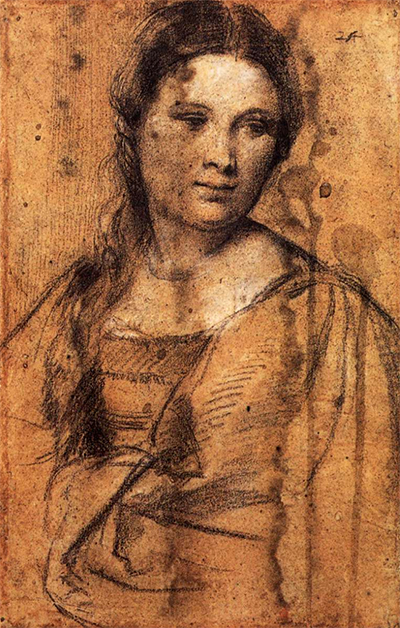
A young woman turns her face across a loosely drawn upper body. The work is a drawing, Ritratto di giovane donna, held in the Uffizi Galleries’ drawing collection in Florence as 718 E. An Ashmolean exhibition record credits Titian and describes black and white chalk on faded blue paper, measuring 418 × 265 millimetres. A scholarly Uffizi caption dates the sheet about 1510–15. Those details identify a particular physical sheet, rather than one of Titian’s many painted images of young women.[1][2]
The woman has no secure name in the cited records. “Portrait of a Young Woman” is a descriptive title: it tells us what the sheet shows, not whom Titian met or whether the image had a patron. Its power lies partly in that open question. The face is considered more closely than the clothing, while the body remains a framework of dark marks and lighter passages. We can study how the image takes shape without converting an unknown sitter into a historical character.[1][2]
At a Glance
- WorkPortrait of a Young Woman
- Research recordcomune.bologna.it
Contents
- What the chalk does
- Was the paper blue or brown?
- An early date, with limits
- A drawing beside a painted woman
- The sheet and its record
What the chalk does
The head is the area of greatest concentration. Dark strokes shape the hair, eyes, nose and cheek; pale highlights lift the face and neck. The clothing, by comparison, is indicated with changing pressure, broad curves and less insistent contours. The drapery below the shoulders gives the body weight without describing every seam. This shift of attention is visible in the image and helps distinguish a working drawing from a painted portrait finished evenly for display.[1][2]
The Ashmolean’s exhibition caption describes black and white chalk, a more exact medium than the broad label “pencil drawing.” Chalk can produce a soft passage through pressure as well as a firm dark edge. White marks, applied over a coloured support, add light rather than merely leaving the sheet untouched. This is why the medium matters to the woman’s face: its modelling depends on a relationship between dark, light and the paper’s middle tone.[1]
The pose is not a rigid profile. Her head turns gently relative to her torso, and her eyes do not confront the viewer directly. The lines of the shoulders and garment remain sufficiently open that one can follow the draughtsman’s search for volume. Such observations do not identify the sitter or prove what the drawing was for. They show what Titian chose to develop most fully on this side of the sheet: a head with presence, supported by a less resolved half figure.[1][2]
Was the paper blue or brown?
The Ashmolean’s exhibition caption calls the support faded blue paper. Some digital images make it appear warm brown, and widely circulated derivative metadata describes brown paper instead. Digital colour can change through lighting, photography, scanning, ageing and screen display; the reproductions alone cannot resolve the present colour or reconstruct the original shade. The institutional description is therefore more dependable than the image on a screen.[1][3]
The same sources differ slightly on size. The Ashmolean caption gives a height of 418 millimetres; a widely shared image file gives 419 millimetres, with both giving 265 millimetres for the width. A one-millimetre difference may arise from measurement or transcription, but the cited evidence does not say which. The institutional exhibition figure is used here. The inventory 718 E is a still firmer way to distinguish the object from another similarly titled portrait.[1][3]
The paper question is more than a cataloguing nuisance. If the ground was blue, it provided a middle value that could make black shadows and white highlights work together with relatively few strokes. A brown-toned reproduction can obscure that relationship and invite an inaccurate account of how the drawing was built. Readers looking at the image should attend to the light and dark marks while keeping the support’s recorded material separate from the colour shown by this particular file.[1]
An early date, with limits
A scholarly essay hosted by Ca’ Foscari University of Venice dates the Uffizi sheet to approximately 1510–15. “Approximately” is essential: the cited source supplies no year of commission or named sitter to pin the drawing to a single moment. The proposed date places it early in Titian’s long career, when a study of a female half figure could have served several possible purposes. It does not prove that the sheet was made for a surviving painting.[2]
The Ca’ Foscari essay reproduces the sheet under its Uffizi inventory. That independent scholarly caption strengthens the identification of the same object; it is not a substitute for an object record that would establish every physical detail and provenance step. A separate university-hosted study of Simone Peterzano later cites the Uffizi Ritratto di giovane donna as an admired example of early Titian drawing while discussing another artist’s black-and-white chalk technique. That comparison tells us something about the sheet’s place in later drawing scholarship. It does not show Peterzano copied this particular woman or identify who sat for Titian.[2][4]
A drawing beside a painted woman
The Uffizi also owns Titian’s Flora, which its own catalogue dates about 1517. That work is an oil painting on canvas, not another view of 718 E. In Flora, the female figure is developed through colour, textile, flesh and a flower-bearing gesture; the museum explains its poetic and classical associations. The drawing, in contrast, uses black and white chalk on a coloured sheet and offers no such attribute to settle a symbolic role. Comparing them makes medium and degree of finish visible, but similarity in age or subject is not evidence that both portray the same woman.[1][5]
The distinction matters because descriptive titles can blur across Titian’s work. A “young woman” may be an unnamed person, a poetic figure, or a conventional title attached later. No cited source names the woman in 718 E, and the portrait itself contains no inscription identifying her. Neither the proximity of the proposed date to Flora nor a resemblance of face licenses a claim of shared identity. The Titian drawings guide places the sheet among graphic studies; the Flora page can be used for a specific painted comparison while keeping each object’s evidence separate.[1][2][5]
The sheet and its record
A reproduction of the verso, or back, of inventory 718 E circulates alongside the portrait on the recto. These are two sides of one physical sheet, not two independent portraits. The inventory suffix “E” and the Uffizi drawing collection identify the sheet more securely than a translated title alone. The Ashmolean exhibition and Uffizi scholarly caption credit Titian directly, while attributions to unsigned historical drawings can still be reassessed.[1][2][3]
The cited sources do not establish an uninterrupted ownership history from Titian’s studio to Florence. They establish the current Uffizi collection and inventory, a published early date and a material description. The verso reproduction also reminds us that a drawing is a handled sheet with more than one face; its back cannot be turned into a second sitter without separate evidence. The lack of a named woman or complete provenance is an evidence limit, not a gap to fill with an appealing guess.[1][2][3]
Look again at the face. The drawing asks the viewer to follow a few pressures of dark chalk and the placement of light rather than the elaborate costume or setting of a state portrait. Inventory 718 E preserves that small but substantial act of looking. The woman remains unidentified, and the sheet remains a drawing with its own material life, even as it invites comparison with Titian’s later painted figures.[1][2]
Researched Titian and related works
Frequently Asked Questions
No. The Ashmolean exhibition caption records black and white chalk on faded blue paper.[1]
The cited institutional and scholarly records do not give her a name. The title is descriptive.[1][2]
The Ca’ Foscari-hosted essay dates it about 1510–15. This is an approximate scholarly date.[2]
Discussion
What do you notice when you look closely at Titian’s Portrait of a Young Woman: the Uffizi Drawing?
Share a specific observation or a source that adds context.
Reader Insights
Which detail changes your reading?
How does its original setting affect what we see?
Which part of the evidence remains uncertain?
Join the Conversation
Add your observation below.
References
- Ashmolean Museum, Titian to Canaletto: Drawing in Venice, 2015–16 exhibition record and Uffizi drawing caption. View source; view exhibition caption.
- Giorgio Marini, essay hosted by Ca’ Foscari University of Venice, reproducing Uffizi inv.718 E. View source.
- Wikimedia Commons, “Tiziano, disegno di fanciulla, uffizi.jpg” and Uffizi 718 E recto/verso files; used only for comparison of circulated reproductions. View source.
- Università di Pavia research repository, Simone Peterzano study citing Titian’s Uffizi Ritratto di giovane donna, 718 E. View source.
- Gallerie degli Uffizi, “Flora,” Titian, inventory 1890 no.1462. View source.