 by
Tom Gurney
Tom Gurney BSc (Hons) is an art history expert with over 20 years experience
Email:
tomgurney1@gmail.com
/ Phone:
+44 7429 011000
Marchesa Elena Grimaldi Cattaneo: Introduction
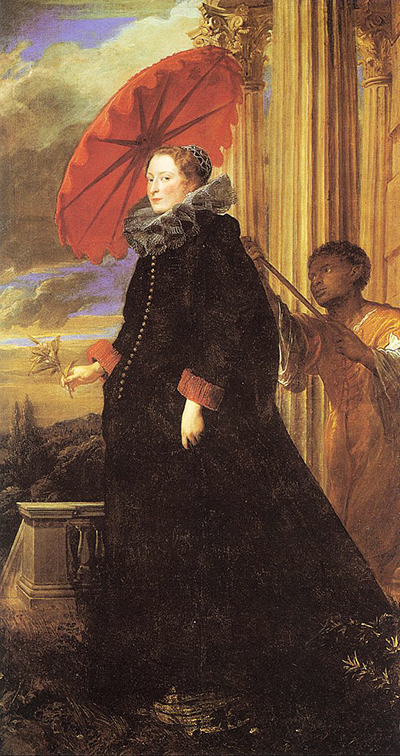
A red parasol spreads above Elena Grimaldi Cattaneo, its slanting ribs opening against the sky. Below it, her black dress fills most of the canvas. Anthony van Dyck makes her presence seem expansive: she occupies the terrace, interrupts the architecture and looks out towards us. Yet a second person sustains this display. At the right, an African attendant holds the parasol above her, his hands and raised arms helping to organise the entire picture.
At a Glance
- Artist Anthony van Dyck
- Date 1623
- Medium Oil on canvas
- Dimensions 242.9 × 138.5 cm
- Collection National Gallery of Art, Washington, Widener Collection
- Accession number 1942.9.92 [1]
This work across Anthony van Dyck’s career
Entry of Christ into Jerusalem
about 1617Frans Snyders
about 1620Rinaldo and Armida
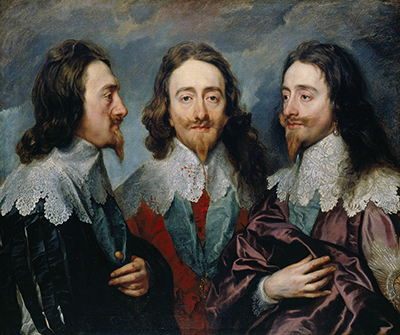
1629–1632; Louvre commentary proposes late1631–spring1632Charles I in Three Positions
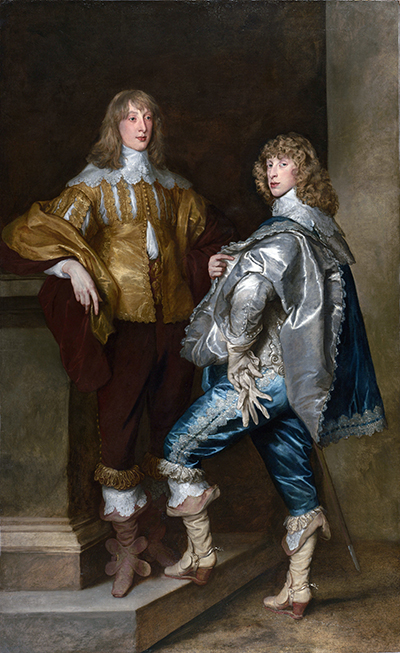
1635–before June 1636Lord John Stuart and his Brother
about 1638Cupid and Psyche
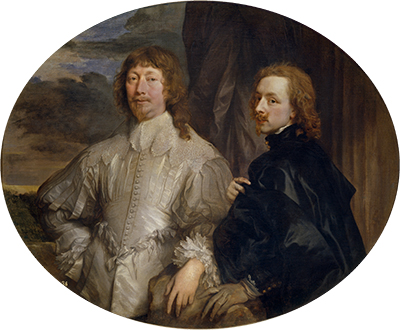
1639–40Self Portrait
c. 1640Contents
- Looking up at Elena
- Black cloth, red cuffs and a small sprig
- The person holding the parasol
- Architecture and Genoese display
- A family in three portraits
- From the Cattaneo family to Washington
Looking up at Elena
Start at the bottom of the picture. Plants gather around the hem, and a small projecting section of terrace parapet stands at the left. Above these low features, Elena rises almost the full height of the canvas. Her head is well above the distant horizon. The columns beside her continue beyond the top edge, so both the woman and the building appear to exceed the space available to them.
The effect depends on where Van Dyck places us. We look upwards into the parasol and towards the underside of its open canopy. The low viewpoint gives Elena a commanding position before we have read a facial expression or identified a family name. Her social importance has been made into a relationship between her body and ours.
There is more movement here than the imposing vertical format first suggests. The row of small bright fastenings down the bodice makes a slight diagonal. The skirt broadens towards the right, while one hand extends towards the open landscape on the left. The other hangs closer to the body, with long fingers set against the black cloth. These small departures from symmetry keep the figure from becoming as rigid as the columns.
The hem conceals much of the evidence that would let us reconstruct a step. We can see a sweep of fabric and an apparent shift of weight, but a portrait's suggestion of walking is a pictorial effect. Van Dyck gives the pose the freshness of an arrival without supplying a narrative destination. Nothing requires us to imagine an actual moment when Elena stepped out onto this particular terrace.
Her face is turned slightly across the body, while her eyes engage the viewer. The pale, relatively compact area of the face emerges from a much larger mass of dark clothing. It is tempting to turn this arrangement into a judgement about Elena's temperament. Looking closely gives a firmer account: the painting controls our access to her through elevation, distance and the direction of her gaze. Those are choices we can examine even when her private character remains beyond reach.
Black cloth, red cuffs and a small sprig
The dress repays a slower look. At a distance it reads as an immense dark shape; closer in, small changes of light suggest folds, ornament and differences between the surfaces of bodice, sleeves and skirt. The long line of fastenings gives the eye a path through this darkness. The dress both enlarges the body and makes its precise boundaries difficult to follow.
The grey ruff works differently. Its overlapping edges open out around the face, creating a fine, irregular contour against the sky and black shoulders. The ornament of the head covering adds another small concentration of light. Van Dyck distributes detail unevenly: the face and its surrounding fabrics invite concentrated attention, while much of the skirt is understood through breadth and silhouette.
Art historian Ana Howie places Elena's Spanish-influenced clothing within the international textile networks of Genoa's merchant nobility. Her study also stresses the absence of a known family wardrobe inventory. Its proposed associations with American logwood blacks and cochineal reds illuminate the portrait's commercial setting; they do not confirm the dyes in Elena's actual clothes. [2]
Howie also notes abrasion of the painted surface. The dress's present brownish blacks therefore need care: they cannot serve as a direct record of the colour or quality of a seventeenth-century textile. [2]
This context helps explain how much the apparently restricted palette can carry. Black occupies most of the image, but the red cuffs mark the two hands with surprising force. One lies near the central dark mass; the other projects beyond its edge. Their colour makes those separate gestures easy to locate and connects them visually with the much larger red canopy above.
Elena's right hand holds a small flowering sprig. The museum identifies orange blossom, traditionally associated with chastity. [1] The delicate plant also creates a useful difference of scale. Against the broad skirt, towering stonework and spreading parasol, its narrow leaves and small blossoms ask us to attend to a light touch. The outward hand offers a particularly clear view of the sprig, but the picture does not tell us what Elena herself thought about its meaning.
Watch: Van Dyck’s art and working methods
Choose a museum introduction, a specialist lecture or a conservation film to continue exploring Van Dyck’s work.
Van Dyck, The Anatomy of Portraiture
The Frick curators introduce Van Dyck’s portraits, drawings and prints.
Watch on YouTubeThe person holding the parasol
The African attendant enters from the right edge. Elena's body obscures part of his, and the frame cuts off the space around him. His arms reach forward and upwards to manage the parasol's long shaft. Follow that diagonal and the relation between the two figures becomes unmistakable: his action maintains the canopy above her head.
His face deserves attention independently of that task. It turns upwards towards Elena and the shaft, while the lit edge of his garment distinguishes his shoulder from the columns behind. The white sleeve, amber clothing, hands and face form a closely connected area of incident. This is one of the picture's busiest passages, placed beside the much broader, darker expanse of Elena's dress.
The museum leaves his actual state of servitude unknown and connects his presence with the slave trade between Africa and Genoa. His name and specific origins are also unknown. [1] The history matters without supplying a biography that has not survived. Howie likewise distinguishes the represented role from the unresolved question of whether Elena owned or employed such a person. [2]
The visible hierarchy is clear enough to discuss precisely. Elena has the uninterrupted full-length silhouette, the central position and the outward gaze. The attendant is placed behind her, near the edge, and shown performing a service. The parasol gives her an extended field of colour above her head; his hands make that field possible. Those unequal roles are built into the composition, regardless of the uncertainty surrounding his legal status.
Recognising the inequality need not make him disappear into a general account of luxury. Looking at his grip, the direction of his arms and his placement beside the stonework restores attention to the person represented. His presence also changes our sense of Elena's apparent ease. The picture distributes action unevenly: her expansive pose is accompanied by someone else's sustained physical task.
Architecture and Genoese display
The terrace joins two very different kinds of space. At the right, the closely packed columns form a solid architectural wall. At the left, a low barrier allows the eye to travel towards trees, hills and sky. Elena stands across that division. Her dark outline is legible against the open landscape, while her shoulder and sleeve overlap the columns.
The stonework gives the picture a powerful upward rhythm. Fluting repeats the vertical format of the canvas; carved capitals add concentrated ornament near the top. The parasol cuts across this rhythm with radiating diagonals. Its curved edge loosens the dense architectural corner and gives the face a bright, irregular surround.
The National Gallery relates the composition to Rubens's Marchesa Brigida Spinola Doria of 1606, and suggests Titian's portraits with Black attendants as a possible precedent. [1] These connections locate the picture within an existing language of elite portraiture. They do not explain away the particular relationships Van Dyck creates here: a dark figure against open sky, pale stone rising at her back, and a canopy supported from the picture's edge.
Genoa offered a receptive setting for this kind of display. Musei di Genova describes competition among the city's wealthy nobles to possess Van Dyck portraits for their palaces. [3] Howie identifies Elena's husband as Giacomo Cattaneo and places both the Cattaneo and Grimaldi families within far-reaching mercantile networks. [2] The broader story belongs to Van Dyck's Italian years ; here it helps us see why dress, architecture and scale could speak together so effectively.
The painted terrace supplies a setting for rank, but it does not identify a particular room or establish the appearance of the Cattaneo residence. Its usefulness is visible within the canvas. The columns extend Elena's height, the opening gives her figure room to register, and the parapet makes the drop into the distant landscape apparent. Architecture turns the portrait into an encounter conducted from below.
A family in three portraits
Van Dyck also painted Elena's children Filippo and Maddalena in 1623. An English visitor recorded their portraits flanking hers in December 1827. That arrangement is documented for 1827; it does not establish the original hanging in 1623. [1]
Thinking of these as three related pictures changes the demands made on Elena's portrait. Within its own frame, the attendant is the only other person represented. Within a family grouping, viewers could also turn from Elena to separately portrayed children. Her monumental image would acquire a further relationship across the wall, beyond the people and objects included on this canvas.
Separate portraits allow each sitter a distinct pictorial space. They also make a family arrangement changeable: spacing, height and the order of the pictures affect how viewers connect them. The nineteenth-century description preserves one actual arrangement within that history of viewing.
From the Cattaneo family to Washington
The portraits remained associated, apart from a separation in 1708–12. Elena's passed through her husband and descendants, leaving the Cattaneo collection in 1906. Peter A. B. Widener bought all three in 1908; the National Gallery received them in 1942. [1]
The move into a public collection made a family possession available to a wider audience. Its catalogue now connects the visible scene with records of inheritance and sale, preserving a history beyond the encounter on the terrace.
Artworks directory
A selected directory of paintings, drawings and prints, including works discussed in the articles and the Frick’s 2016 portraiture exhibition. It is not a complete catalogue of Van Dyck’s work. Print titles identify collaborators or later printmakers; disputed and workshop attributions are retained. The exhibition checklist supplies additional object records; current collection information governs the updated article entries. [4]
Frequently Asked Questions
The spreading skirt and uneven distribution of the hands create an impression of movement. Her feet are largely concealed, however, so the picture offers limited evidence for reconstructing a step. It is more useful to examine how Van Dyck suggests an arrival than to imagine a particular walk that the painting records.
Black alone does not establish mourning. Howie's study connects the dress to prestigious fashions, textile commerce and Spanish influence. [2] Within the picture, its broad dark surface also makes the face, hands, red cuffs and fine grey ruff particularly distinct.
Begin with the action and placement Van Dyck shows: he holds the parasol, stands behind Elena and looks upwards. His represented service is clear; his personal circumstances remain unresolved. [1] Giving his face and hands sustained attention helps keep the historical question connected to the individual represented.
Discussion
Look again at the images and ideas explored in Marchesa Elena Grimaldi Cattaneo. These editorial prompts invite your observations.
Reader Insights
Follow the parasol's shaft from the attendant's hands to the red canopy. How does that line change the relationship between the two figures?
Compare the fine detail around Elena's face with the broad dark shape of her skirt. Where does Van Dyck invite you to linger?
How would seeing the portrait between images of Elena's children change your response to its scale and setting?
Join the Conversation
Share a detail, comparison or question about Marchesa Elena Grimaldi Cattaneo below.
References
- National Gallery of Art , Marchesa Elena Grimaldi Cattaneo. View source .
- Ana Howie , Materializing the Global: Textiles, Color, and Race in a Genoese Portrait by Anthony van Dyck, Renaissance Quarterly 76, no. 2 (2023). View source .
- Musei di Genova , Antoon Van Dyck: L’attività genovese (Italian). View source .
- The Frick Collection, Van Dyck: The Anatomy of Portraiture, online exhibition checklist (2016). View source.