 by
Tom Gurney
Tom Gurney BSc (Hons) is an art history expert with over 20 years experience
Email:
tomgurney1@gmail.com
/ Phone:
+44 7429 011000
Thetis Receiving the Weapons of Achilles from Hephaestus: Introduction
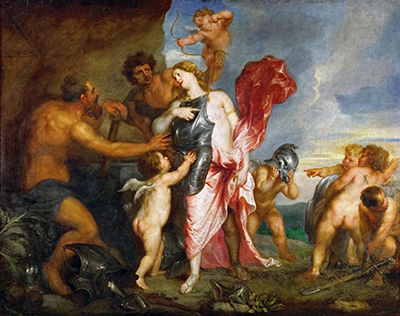
A dark breastplate occupies the centre of this scene, held against a goddess while hands reach towards it from three directions. The weapons promise a warrior’s return to battle, yet the exchange has the intimacy of a fitting. The Kunsthistorisches Museum in Vienna currently attributes this painting to the workshop of Anthony van Dyck. [1]
At a Glance
- Artist Workshop of Anthony van Dyck.
- Date About 1630–1632.
- Support Canvas.
- Original dimensions 117 × 156 cm.
- Collection Kunsthistorisches Museum, Vienna.
- Inventory number Gemäldegalerie 498, usually abbreviated GG 498.
- Subject Thetis obtaining armour for her son Achilles from Hephaestus, also called Vulcan. [1] [2]
This work across Anthony van Dyck’s career
Entry of Christ into Jerusalem
about 1617Frans Snyders
about 1620Rinaldo and Armida
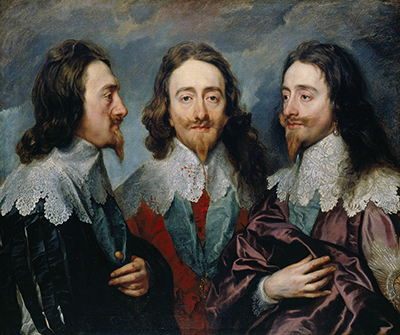
1629–1632; Louvre commentary proposes late1631–spring1632Charles I in Three Positions
1635–before June 1636Lord John Stuart and his Brother
about 1638Cupid and Psyche
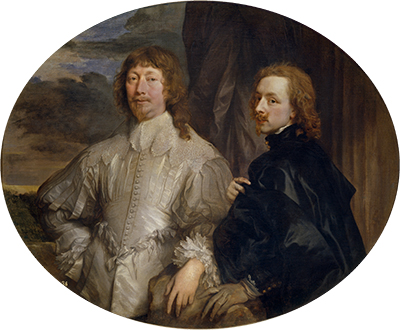
1639–40Self Portrait
c. 1640Contents
- A breastplate between three figures
- Why Achilles needs new weapons
- A fitting with an amorous undertone
- Children at play with the equipment of war
- Related compositions, different objects
- The canvas and its recorded history
A breastplate between three figures
Thetis stands at the meeting of two spaces. To her left, an overhanging rock encloses the smith and his helper in brown shadow. To her right, the picture opens into pale sky and a low, distant landscape. Her body and the metal held before it form a hinge between the enclosure and the open air. The pink fabric rising behind her shoulder carries the eye outwards, away from the weight of the forge.
Hephaestus sits low at the left, his bare back turning towards us. His extended arm crosses the dark interior to reach the armour. Thetis inclines her head towards him while bending one hand across the top of the breastplate. Below them, a winged child stretches upwards, pressing both hands against the metal. The three bodies approach the same object at different heights: the seated man reaches across, the goddess holds it close, and the child lifts from underneath.
That arrangement makes the breastplate unusually substantial. Its curved shoulder and breast catch thin, bright edges of light, while the long lower section descends towards the child’s hands. Beside it, skin appears soft and exposed. Thetis’s bare arm and the child’s unprotected back make the armour’s hardness easy to feel, even though nobody is wearing it for combat.
The metal also partly conceals the goddess. Her forearm crosses it, her pale shoulder emerges beside it, and the pink cloth begins again around her waist. The result is a sequence of surfaces, each responding differently to light. Small highlights articulate the armour; longer pale folds spread through the drapery. The pink fabric hangs heavily near her feet and rises in a broad, crumpled flare behind her. It gives her an outward momentum while the hands at the breastplate keep her attached to the group.
Why Achilles needs new weapons
Achilles himself is absent. In Book 18 of Homer’s Iliad , his need for armour follows the death of Patroclus, who had entered battle wearing Achilles’s equipment. Hector has taken it, and Achilles cannot return to the fighting properly armed. His mother Thetis promises to obtain a replacement from the divine smith. The names Hephaestus and Vulcan refer here to the same god in Greek and Roman usage; Samuel Butler’s English translation uses Vulcan. [2]
Homer’s visit unfolds through hospitality and remembered kindness. Thetis first meets Charis, the smith’s wife, who welcomes her and calls her husband. Hephaestus remembers that Thetis and Eurynome once sheltered him after his fall from heaven. Making the new armour offers him a way to repay her care. Thetis then explains the loss of Patroclus and asks for a shield, helmet, greaves and breastplate for her son. [2]
This gives the request a painful urgency. Thetis knows that Achilles’s life will be short. Hephaestus can provide extraordinary protection, but he cannot promise to keep death away when the hero’s appointed time arrives. His craftsmanship answers an immediate need without resolving the mother’s larger fear. Homer ends the book with the completed equipment laid before Thetis, who carries it away. There is no scene of the goddess trying on the breastplate in this episode. [2]
Knowing that background changes the weight of the objects scattered through the foreground. The brightly handled metal belongs to a story of bereavement and renewed violence. A helmet lying close to Hephaestus’s leg, the pieces below Thetis, and the sword extending towards the lower right anticipate a wearer who never enters the painted space. The picture lets us see weapons before they acquire the purpose that makes them dangerous.
Homer gives particular attention to the shield, describing a whole world of cities, agriculture, conflict and dancing worked upon it. Here the standing breastplate receives the clearest emphasis. The encounter is organised around the shape of a human torso, with a mother holding the protection intended for her absent son. That difference in emphasis allows the painting to remain legible without attempting to reproduce the poem’s elaborate shield imagery. [2]
Watch: Van Dyck’s art and working methods
Choose a museum introduction, a specialist lecture or a conservation film to continue exploring Van Dyck’s work.
Alejandro Vergara: Van Dyck and the Problems of Youth
Alejandro Vergara examines the ambitions and problems of Van Dyck’s early career.
Watch on YouTubeA fitting with an amorous undertone
The Kunsthistorisches Museum interprets the encounter as an armour fitting within a failed amorous bargain: Thetis departs with the finished weapons, leaving Hephaestus without the love he expected in return. This is the museum’s reading of the scene. [1]
Homer’s account offers the different explanation of gratitude for an earlier rescue. Its exchange contains neither the fitting nor that promised amorous payment. Keeping the two accounts distinct helps us recognise how much of the picture’s effect resides in gestures and proximity. The painted moment can invite an erotic interpretation without every detail being supplied by the Homeric episode. [2]
Look at the space between Hephaestus and Thetis. The god leans forward from his seat, his hand approaching the lower edge of the breastplate. Her gaze travels back towards him, but her torso remains upright. Behind her, the dark-haired helper bends into the same confined area, bringing his face close to hers. All three adults are gathered around an article of equipment, yet their attention seems to exceed the practical task of moving it.
Thetis’s pose keeps the exchange open to interpretation. Her tilted head and curved arm can suggest grace, appraisal or a studied willingness to be looked at. The breastplate offers a plausible reason for the figures to draw near while also acting as a barrier between their bodies. Reading the pose as flirtation is possible; the image does not give us spoken intentions.
Above them, the airborne archer makes desire a visible participant. He draws his bow towards the left, suspending another possible action over the smith’s outstretched arm. His small, compact body sits almost directly above the goddess’s head. From the hands around the breastplate to the arrow overhead, the composition repeatedly turns reaching and aiming into ways of directing our attention.
Children at play with the equipment of war
The winged children create a second rhythm along the lower half of the painting. The child at the breastplate participates earnestly in the adult transaction, reaching as high as possible. Just behind Thetis, another holds a helmet up to his own head. Its dark crest and broad opening make it look disproportionately large against his small body. The action turns a soldier’s protection into something that can be tried on and played with.
Farther right, a child points back towards the adults while another bends down near the weapons. These figures overlap and turn away from us, encouraging the eye to circulate through the group. They also prevent the right side from becoming a quiet landscape backdrop. The foreground remains busy with bodies, gleaming edges and things picked up or put down.
There is a gentle visual comedy in their scale. A child can lift an object without possessing the strength or stature implied by its intended use. The unarmoured bodies make the equipment appear cumbersome. At the same time, the games bring an unsettling ease to the handling of weapons. Read alongside the Homeric story, the contrast between this playful activity and the fighting awaiting Achilles becomes especially sharp.
The archer above carries a weapon appropriate to his own size. His bow connects the children’s activity with the charged encounter below, allowing the painting’s martial and amorous possibilities to occupy the same field.
Related compositions, different objects
A closely similar horizontal Thetis and Vulcan is in Potsdam, inventory GK I 7762. Blaise Ducos illustrates it in his Louvre catalogue, giving its dimensions as 107 × 144.5 cm. It is a separate painting from Vienna’s GG 498. His entry also examines the Louvre’s tall Venus Asking Vulcan for Arms for Aeneas , INV 1234, dated 1630–1632 and measuring 220 × 145 cm. There the divine mother is Venus and the intended recipient is Aeneas. [3]
Ducos discusses the reappearance, with variations, of the Potsdam composition’s central group in the Louvre painting. The comparison is useful for seeing how a goddess, smith, billowing drapery and attendant loves could form different narrative arrangements. It does not establish a direction of copying for the Vienna canvas or alter its current workshop attribution. [3] [1]
The subject therefore needs more than an identification of the winged children. Their presence alone cannot decide whether a goddess is Venus or Thetis. Here the Vienna museum’s identification gives the scene its title; the wider group of related pictures shows how readily similar figures could serve stories about different mothers and sons. The relationship between designs and their execution belongs to the larger subject of Van Dyck’s workshop and influence .
The canvas and its recorded history
The museum records later additions of 5.5 cm at the top and 15.5 cm at the right as concealed. It gives no date or maker for those extensions. Its provenance entry names the collection of Leopold Wilhelm. [1]
The concealed additions cannot be reconstructed from the reproduced image alone. The recorded original dimensions establish the horizontal format, while the brief provenance leaves the original commission and intended setting open.
Artworks directory
A selected directory of paintings, drawings and prints, including works discussed in the articles and the Frick’s 2016 portraiture exhibition. It is not a complete catalogue of Van Dyck’s work. Print titles identify collaborators or later printmakers; disputed and workshop attributions are retained. The exhibition checklist supplies additional object records; current collection information governs the updated article entries. [4]
Frequently Asked Questions
The current attribution is to his workshop. No individual assistant is named in the museum record. [1]
No. The Louvre canvas is a tall composition about weapons for Aeneas. Ducos’s catalogue also illustrates a separate horizontal Thetis and Vulcan in Potsdam. Neither object should be substituted for Vienna’s GG 498. [3]
Discussion
Look again at the images and ideas explored in Thetis Receiving the Weapons of Achilles from Hephaestus. These editorial prompts invite your observations.
Reader Insights
How does the breastplate change the relationship between the three adults gathered around it?
Do the children’s games make the weapons seem less threatening, or sharpen the contrast with their eventual use?
How does reading Homer’s account of Thetis’s visit affect your response to the painting’s amorous possibilities?
Join the Conversation
Share a detail, comparison or question about Thetis Receiving the Weapons of Achilles from Hephaestus below.
References
- Kunsthistorisches Museum , Thetis empfängt von Hephaistos die Waffen für Achill, GG 498. German. View source .
- Homer , The Iliad, Book 18, translated by Samuel Butler, Internet Classics Archive, Massachusetts Institute of Technology. English translation of ancient Greek. View source .
- Blaise Ducos , Musée du Louvre, Cat. 16: Vénus demandant à Vulcain des armes pour Énée, in Antoon Van Dyck. Catalogue raisonné des tableaux du musée du Louvre , 2023. French. View source .
- The Frick Collection, Van Dyck: The Anatomy of Portraiture, online exhibition checklist (2016). View source.