 by Tom Gurney
Tom Gurney BSc (Hons) is an art history expert with over 20 years experience
Published on June 19, 2020 / Updated on September 6, 2026
Email: tomgurney1@gmail.com / Phone: +44 7429 011000
Artemisia Gentileschi Biography
Artemisia Gentileschi was one of the most powerful painters of the seventeenth century, and one of the very few women of her age to build a sustained professional career at the highest level of European art. Born in Rome in 1593 and trained in the studio of her father Orazio Gentileschi, she became known for paintings that gave biblical, classical and allegorical women a rare physical and psychological force. Her life carried her from Rome to Florence, back to Rome, then to Naples and London, and her patrons included members of the Medici court, the Spanish monarchy and the Stuart court of Charles I. [1]
Her biography is often told through the brutal episode that changed the course of her youth: the rape committed by Agostino Tassi, the 1612 trial that followed, and the failure of Tassi's sentence to remove him from Roman artistic life. That history matters. It was recorded in unusual detail and it shaped how later generations read Artemisia's paintings. But it is not the whole of her life, and it is not enough to explain her art. Artemisia was not only a survivor of violence. She was a painter of ambition, intelligence and invention, a woman who learned the language of Caravaggism inside a family workshop and then used it to make subjects such as Susanna, Judith, Esther, Lucretia, Mary Magdalene and Saint Catherine feel newly urgent.
The best way to understand Artemisia is to follow her through the cities where she worked. In Rome she absorbed the dramatic naturalism of the generation around Caravaggio. In Florence she entered courtly and intellectual circles, became an early woman member of the Accademia delle Arti del Disegno, and painted self-images that made artistic identity a subject in itself. In Naples she ran a successful studio and took on major religious and courtly commissions. In London she entered the orbit of the Royal Collection and produced one of the boldest allegorical self-portraits in European art. Her career did not move in a straight line, but it never lost its sense of purpose.
Image reference: Artemisia Gentileschi image archive.
At a Glance
- BornRome, 1593 [1]
- DiedNaples, 1654 or later [1]
- TrainingOrazio Gentileschi's Roman workshop [1]
- Main citiesRome, Florence, Naples and London [1]
- Early signed workSusanna and the Elders, 1610 [1]
- Florentine milestoneAccademia delle Arti del Disegno membership, 1616 [1]
- Major subjectsBiblical, classical, devotional and allegorical women
- Historical importanceA leading woman painter of the Baroque, re-evaluated strongly in modern scholarship [2]
Contents
- Introduction
- Rome and the Gentileschi Workshop
- The First Breakthrough: Susanna and the Elders
- Agostino Tassi, the Trial and the Move to Florence
- Florence, Self-Portraiture and Ambition
- Return to Rome and Women at Moments of Decision
- Naples and the Mature Studio
- London and the Late Years
- Reputation, Rediscovery and Legacy
Rome and the Gentileschi Workshop
Artemisia was born into painting. Her father, Orazio Gentileschi, was a successful Tuscan-born artist working in Rome, and she grew up in a household where pigments, canvases, drawings, patrons and studio discipline were everyday realities. Because women were largely excluded from formal artistic training, the family workshop was not merely convenient; it was the main route by which she could become a painter at all. Orazio trained his daughter alongside the visual habits of his own circle, which had been transformed by Caravaggio's example: figures close to the picture plane, bodies caught in strong light, and stories told at the sharpest moment of action.
Rome around 1600 was not a quiet schoolroom. It was a city of churches, noble households, public commissions and fiercely competitive painters. The art Artemisia saw and the art Orazio made were steeped in dramatic realism. Caravaggio's influence did not mean one fixed style, but it did offer a way of bringing sacred and historical subjects into the viewer's space. For Artemisia, that lesson would become especially important. Her best paintings rarely feel distant or decorative. They feel as if the viewer has arrived at the instant when a decision, a threat or a revelation becomes unavoidable.
Her early training also had limits. As a young woman she could not move through the same academies, workshops and public spaces as male artists. She did not have the same access to nude models or professional networks. Yet the restrictions did not make her art timid. On the contrary, her early paintings show a young artist learning to make pressure itself visible: the pressure of bodies in a confined space, of hands performing difficult work, of women forced to act or endure while others look on.
The First Breakthrough: Susanna and the Elders
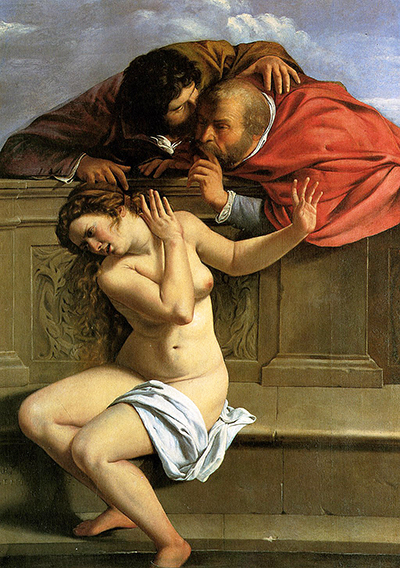
Artemisia's earliest signed and dated painting known today is Susanna and the Elders, painted in 1610 when she was still a teenager. The work now belongs to the Schloss Weissenstein collection in Pommersfelden, Germany, and it has become one of the crucial starting points for understanding her career. [1]
The subject comes from the biblical story of Susanna, a virtuous woman spied on and threatened by two older men. Many earlier artists had treated the scene as an opportunity to display the female nude. Artemisia's version is different in tone. Susanna twists away from the men above her; her arms cross and rise in a gesture that is both defensive and expressive of distress. The elders press into the composition from the top edge, turning the space around her into a trap. Instead of inviting the viewer to share their gaze, the painting makes that gaze uncomfortable.
This is why Susanna and the Elders has mattered so much to modern viewers. It shows Artemisia's early ability to make a familiar story newly charged, and it suggests how seriously she thought about women's bodies as sites of vulnerability, pressure and moral attention. It is tempting to read the painting through the violence Artemisia would suffer the following year, but the chronology matters: Susanna and the Elders predates the documented rape and trial. The painting is not evidence of that later event. It is evidence that Artemisia, even at the beginning of her career, could turn a traditional subject into an unusually intense study of coercion and resistance.
Agostino Tassi, the Trial and the Move to Florence
In 1611 Artemisia was raped by Agostino Tassi, a painter who knew Orazio and moved in the same professional world. The legal case that followed in 1612 is one of the most famous and painful documents in early modern art history. Artemisia testified during the trial, and Tassi was found guilty. He was sentenced to banishment from Rome, but the punishment was never effectively carried out. [1]
The trial has often dominated accounts of Artemisia's life. It is important because it reveals the danger and vulnerability that surrounded a young woman artist in early seventeenth-century Rome. It is also important because it affected how later generations approached her paintings, especially works in which women confront male violence. Yet the trial should not be allowed to do all the interpretive work. Artemisia did not become a great painter because terrible things happened to her. She became a great painter because she had the training, intelligence, discipline and ambition to turn difficult subjects into works of formal and emotional power.
Shortly after the trial, Artemisia married the Florentine artist Pierantonio di Vincenzo Stiattesi and left Rome for Florence. The move changed her career. Florence gave her access to a different network of patrons, scholars, courtiers and artists. It also separated her from the immediate public memory of the trial in Rome, allowing her to build an independent name in a city where intellectual culture and courtly display were closely bound together.
Florence, Self-Portraiture and Ambition
Artemisia's years in Florence were decisive. She had children there, entered artistic and literary circles, and established herself as an artist whose work could appeal to powerful patrons. In 1616 she became a member of the Accademia delle Arti del Disegno, an extraordinary achievement for a woman of her generation. [1] The membership did not erase the obstacles she faced, but it signaled that her ability was being recognised in institutional terms.
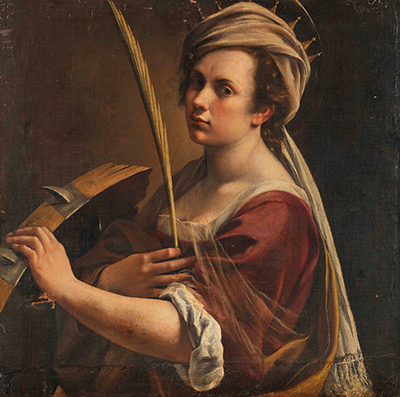
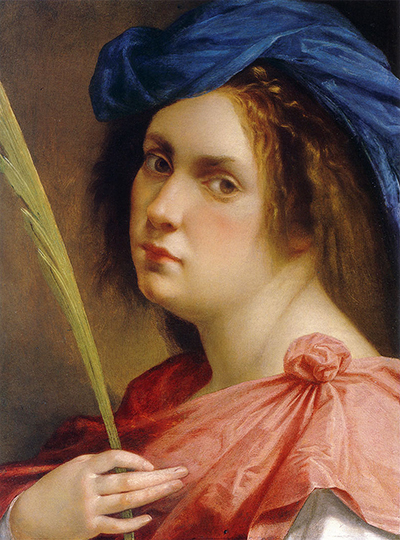
Florence also encouraged a different side of Artemisia's art: the construction of artistic identity. She painted women who act, think, choose and suffer, but she also painted herself in roles that made a claim about what a woman artist could be. Self-Portrait as Saint Catherine of Alexandria, now in the National Gallery in London, is usually dated to about 1615-17 and belongs to this Florentine phase. In it, Artemisia presents herself as the learned Christian martyr, leaning against the broken wheel that became Saint Catherine's attribute. [2]
The picture is not simply a portrait in costume. It brings together sanctity, endurance, self-presentation and painterly ambition. The National Gallery notes that Artemisia used her own image repeatedly in Florentine works, and that such self-images may have served as acts of self-promotion in a city where she was newly establishing her reputation. [2] The painting is tightly cropped, direct and concentrated. Catherine's wheel, the palm of martyrdom and the artist's gaze create a dense statement about resilience and identity, but the work is not reducible to one meaning. It belongs to a culture of saints and allegories as much as to Artemisia's own life.
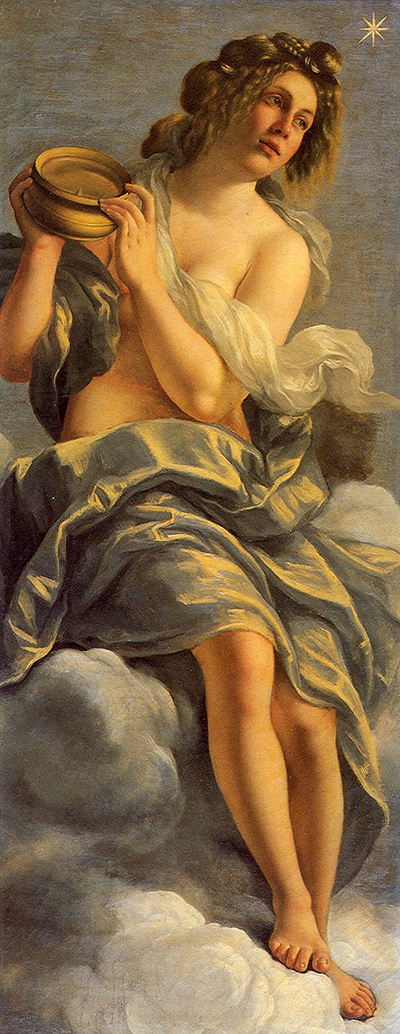
Another Florentine commission, Allegory of Inclination, shows how quickly Artemisia entered ambitious decorative and intellectual projects. Painted for Casa Buonarroti, the work formed part of a programme honouring Michelangelo. Later overpainting altered the figure's nudity, and modern restoration research has made the painting especially important for understanding both Artemisia's original conception and the later discomfort it produced. [3] In Florence, Artemisia was not merely making private devotional pictures. She was producing works for learned settings and patrons who understood painting as a language of reputation.
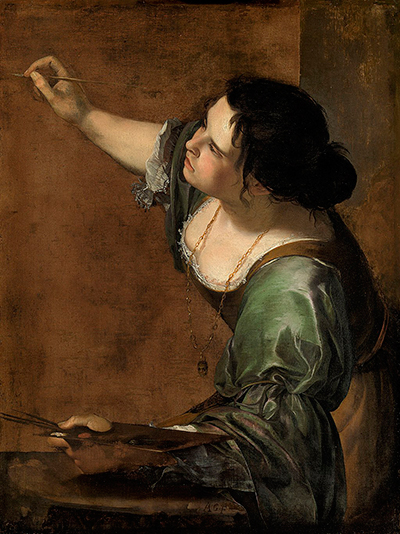
Artemisia's Florentine self-images answer a question early modern culture often refused to ask directly: what could a woman painter claim for herself? In Self-Portrait as Saint Catherine of Alexandria, she appears as a saint associated with learning, eloquence and steadfastness. In Self-Portrait as a Lute Player, she appears in a musical and courtly guise. In Self-Portrait as the Allegory of Painting, painted later and now in the Royal Collection, she would go further still, presenting herself as the female personification of Painting itself. [4]
These works should not be treated as simple diary entries. Artemisia was working within traditions of allegory, saintly imagery, music, courtly accomplishment and portraiture. But she understood that self-representation could be a professional tool. For a male painter, the allegorical figure of Painting was traditionally female and therefore external to his own body. Artemisia could inhabit that figure directly. The result was not only a likeness, but a statement about artistic authority.
Her career in Florence also brought financial and personal pressures. The National Gallery records that she returned to Rome in 1620 burdened by debts. [1] That detail is a useful reminder that artistic reputation did not guarantee stability. Artemisia had patrons and recognition, but she also had a household, children and a career that depended on commissions, payments and mobility. Her biography is full of success, but it is never free from negotiation.
Return to Rome and Women at Moments of Decision
Artemisia returned to Rome in 1620 and remained there for much of the decade, apart from a trip to Venice in 1628. [1] By this point she was no longer simply Orazio's daughter or the young woman whose testimony had filled a Roman courtroom. She was a known painter with a growing reputation. Rome offered a wider field of collectors and artists, but it also placed her back in a city that had already shaped her life in profound ways.
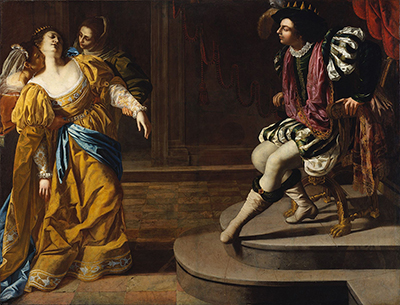
The paintings associated with these years show her continuing interest in dramatic women from scripture and antiquity. Esther before Ahasuerus, now in the Metropolitan Museum of Art, is dated by the museum to the 1620s and is among her most ambitious large-scale works. [5] The subject is not violent in the same way as Judith, but it depends on danger: Esther risks death by approaching the Persian king unbidden in order to save her people. Artemisia stages the scene with courtly drama. The Met notes the influence of contemporary theatre and points to a painted-out figure partly visible beneath the surface, evidence of revision and thought during the painting's making. [5]
Works such as Esther before Ahasuerus show how narrow it is to discuss Artemisia only through revenge or trauma. Her imagination returned again and again to women at moments of crisis, but crisis could mean many things: accusation, temptation, martyrdom, political courage, spiritual conversion, moral self-command. She was drawn to subjects in which the body reveals a decision under pressure. That is a broader artistic concern, and it helps connect the many phases of her career.
The women in Artemisia's paintings often occupy the instant when thought becomes action. Susanna raises her arms and twists away. Judith leans into the physical labour of killing Holofernes. Esther faints or falters before a ruler whose favour can save or destroy her people. Saint Catherine faces the viewer with the attributes of martyrdom close to her body. Mary Magdalene is caught between grief, devotion and spiritual ecstasy. These figures come from different traditions, but Artemisia repeatedly found ways to make their choices visible.
That emphasis does not mean every heroine is a disguised portrait of the artist. Early modern painters worked from biblical, classical and devotional subjects that patrons already knew. Artemisia inherited those subjects from a long visual tradition. Her originality lay in the angle of approach. She often brought the viewer close enough to feel the strain of hands, shoulders, fabric and breath. Her women are rarely weightless symbols. They occupy space with physical consequence.
This is where her relation to Caravaggio and Orazio becomes especially interesting. Caravaggio had shown how sacred and historical events could be staged with bodies that looked immediate and ordinary. Orazio refined that language in his own way. Artemisia absorbed both examples, but her paintings often make female experience less ornamental and more active. In Judith Slaying Holofernes, the subject had been painted many times before, yet Artemisia makes the killing feel like coordinated labour. In Susanna and the Elders, the exposed female body is not offered as a calm display; it is shown under pressure. In La Pittura, the female body is not a subject being watched, but the artist herself at work.
Naples and the Mature Studio
In 1630 Artemisia settled in Naples, one of the largest and most vibrant cities in Europe. There she ran a successful studio and worked for important patrons until the end of her life. [1] Naples gave her access to large commissions, religious subjects and a rich artistic culture shaped by local painters as well as by the Caravaggesque inheritance. It also placed her within the orbit of Spanish power, since Naples was under Spanish rule.
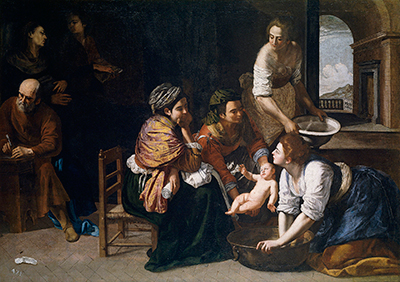
The Neapolitan period is central to understanding Artemisia as a mature professional. She was not a brief phenomenon of Roman scandal or Florentine novelty. She sustained a career over decades, adapted to new markets and produced works on a scale that required organisation, assistants and patron management. The Prado's The Birth of Saint John the Baptist, dated around 1635, belonged to a series connected with the life of Saint John the Baptist and made for a Spanish royal context. [6] The painting's domestic setting, with women attending the birth and household tasks, shows Artemisia's ability to give religious history a lived, bodily immediacy.
Naples is also the setting for one of the great Judith paintings now in the Museo e Real Bosco di Capodimonte. In Judith Slaying Holofernes, Naples, Artemisia returned to the biblical heroine who kills the Assyrian general to save her people. Capodimonte's commentary emphasises the struggle, the darkness and the physical effort of the scene. [7] Whether one looks at the Naples version or the related Uffizi version in Florence, the point is not only the violence of the subject. It is the coordinated action of Judith and her maidservant, the weight of the body on the bed, the pressure of hands, the refusal to soften the moment into elegance.
Artemisia's Naples was also a place of devotional painting. Works such as Annunciation and later Magdalene subjects belong to a world where spiritual feeling, bodily presence and dramatic light could be brought together. The National Gallery of Art in Washington acquired Mary Magdalene in Ecstasy in 2025, identifying it as a major work from around 1625 and tracing its modern rediscovery after a long disappearance from public record. [8] The painting is slightly earlier than Artemisia's permanent move to Naples, but its modern history shows how her oeuvre is still being recovered, studied and reassessed.
The scale of Artemisia's Neapolitan career also changes how her biography should be imagined. A painter who made only a handful of private pictures could be remembered through a few isolated stories. Artemisia's later life was different. She had to negotiate commissions, manage materials, work with assistants, satisfy patrons and keep a reputation alive in a crowded city. Her mature paintings also show range: Judith is severe and violent, The Birth of Saint John the Baptist is domestic and narrative, and Magdalene subjects turn inward toward penitence, ecstasy and spiritual intensity. This variety matters because it protects Artemisia from becoming a painter of one subject.
London and the Late Years
Artemisia briefly visited London in 1639. The National Gallery describes the trip as possibly connected to Orazio, who was working on ceiling paintings for the Queen's House at Greenwich and was nearing the end of his life. Artemisia was back in Naples the following year. [1] The London episode remains partly uncertain, but it matters because it connects her to the Stuart court and the Royal Collection.
Self-Portrait as the Allegory of Painting, or La Pittura, is the key work associated with this context. Now in the Royal Collection, the painting shows Artemisia as Painting personified: hair loose, body twisting, arm lifted, absorbed in the act of making art. [4] It is one of the most conceptually daring images of her career. The painting takes a traditional allegory and turns it into a self-portrait, collapsing the distance between the painter and the personification of her art.
This was not an accidental gesture. Allegory mattered deeply in seventeenth-century visual culture, and the figure of Painting was conventionally female. Artemisia's achievement was to make that convention serve a new purpose. The female body in the painting is not an object made for others to possess visually. It is the body of the artist at work. The picture makes artistic labour, not display, the centre of attention.
After London, Artemisia returned to Naples, where she continued to work. The last years of her life are less securely documented than the dramatic events of her youth or the major works of her middle career. The National Gallery gives her death as 1654 or later and notes that a recently discovered document records her still living in Naples in August 1654. [1] That is the safest way to state the matter: she died in Naples in or after 1654, but the precise date remains uncertain.
Reputation, Rediscovery and Legacy
Artemisia was admired during her lifetime. She worked for major patrons, entered elite collections and achieved a public identity unusual for any woman painter of the seventeenth century. Yet, like many artists outside the later canon's preferred line of male masters, she was neglected for long periods. The National Gallery notes that her work has been properly re-evaluated only over roughly the last half-century. [2]
That reevaluation has changed how museums display and discuss her art. Self-Portrait as Saint Catherine of Alexandria was discovered in 2017 and acquired by the National Gallery soon afterward, becoming one of the museum's most important additions to its account of seventeenth-century art. [2] Getty's acquisition of Lucretia and the National Gallery of Art's acquisition of Mary Magdalene in Ecstasy show the continuing momentum of that reassessment. [8][9]
The renewed attention has also made interpretation more demanding. Artemisia's images of women cannot simply be flattened into modern slogans, even when they speak powerfully to modern concerns. Judith, Susanna, Esther, Lucretia, Mary Magdalene and Saint Catherine came from religious, classical and allegorical traditions that had long histories before Artemisia painted them. Her originality lies in the way she entered those traditions and altered their temperature. She made women's gestures heavier, their choices more immediate, their distress less ornamental and their resolve more physical.
Her paintings ask viewers to look at action as work. Judith does not float through heroism; she grips, leans and presses. Susanna is not an available nude; she recoils under pressure. Saint Catherine is not a distant emblem; she meets the viewer with a living face. La Pittura is not a decorative personification; she is the artist in concentration. These are not only strong women. They are strong paintings.
Modern rediscovery has also changed the physical map of Artemisia's oeuvre. Paintings have emerged from private collections, changed attribution, entered public museums or received new technical study. When Artemisia's paintings move into major museums, they become part of the standard route through Baroque painting rather than exceptional side stories. Visitors can compare her with Caravaggio, Orazio, Ribera, Guido Reni, Van Dyck or Velazquez, and the comparison becomes less about rarity and more about quality, ambition and invention.
Artemisia Gentileschi matters because she forces art history to widen its sense of what Baroque painting could do and who could do it. She inherited the dramatic language of Caravaggio and Orazio, but she did not simply repeat it. She brought to it a particular interest in women under pressure, in the physical reality of action, and in the professional self-consciousness of a painter who knew that her own presence in the art world required unusual force.
Her story is not a simple rise from suffering to triumph. It is more complicated and more interesting than that. Artemisia lived within systems that constrained her, exploited her and sometimes recognised her. She made a career anyway. She painted for courts and churches, negotiated debts and commissions, crossed cities and countries, worked with family and assistants, and left behind works that still feel urgent because they refuse passivity.
To read Artemisia's biography well is to see the person and the painter together. The person endured violence, moved through difficult social conditions and pursued work with remarkable tenacity. The painter transformed inherited subjects into scenes of pressure, intelligence and action. Four centuries later, the power of her art lies in that combination: a life that cannot be ignored, and paintings strong enough not to be explained by life alone.
Frequently Asked Questions
Discussion
Artemisia Gentileschi's biography is unusually vivid, but the paintings need to be read as ambitious works of art rather than as illustrations of one life event.
Use the prompts below to think about how biography, technique and seventeenth-century artistic culture meet in her career.
Reader Insights
Which works make Artemisia's figures feel physically active rather than symbolically passive?
How does her movement between Rome, Florence, Naples and London change the way you understand her career?
Where is the line between using biography responsibly and letting biography over-explain the paintings?
Join the Conversation
Share your reading of Artemisia Gentileschi's life, career and paintings below.
References
- National Gallery, London, Artemisia Gentileschi (1593 - 1654 or later).
- National Gallery, London, Self-Portrait as Saint Catherine of Alexandria.
- Casa Buonarroti, The restoration of Artemisia Gentileschi's Inclination in Casa Buonarroti.
- Royal Collection Trust, Self-Portrait as the Allegory of Painting (La Pittura).
- The Metropolitan Museum of Art, Esther before Ahasuerus.
- Museo Nacional del Prado, The Birth of Saint John the Baptist.
- Museo e Real Bosco di Capodimonte, Giuditta decapita Oloferne di Artemisia Gentileschi.
- National Gallery of Art, Washington, Mary Magdalene in Ecstasy.
- Getty Museum, Getty Museum Acquires Recently Rediscovered Painting by Artemisia Gentileschi.
- Artemisia Gentileschi image archive.
 Artemisia Gentileschi.jpg)
 Artemisia Gentileschi.jpg)