 by Tom Gurney
Tom Gurney BSc (Hons) is an art history expert with over 20 years experience
Published on June 19, 2020 / Updated on September 6, 2026
Email: tomgurney1@gmail.com / Phone: +44 7429 011000
Jael and Sisera by Artemisia Gentileschi
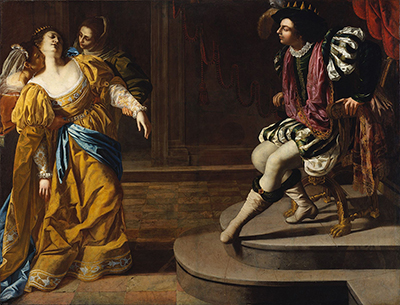
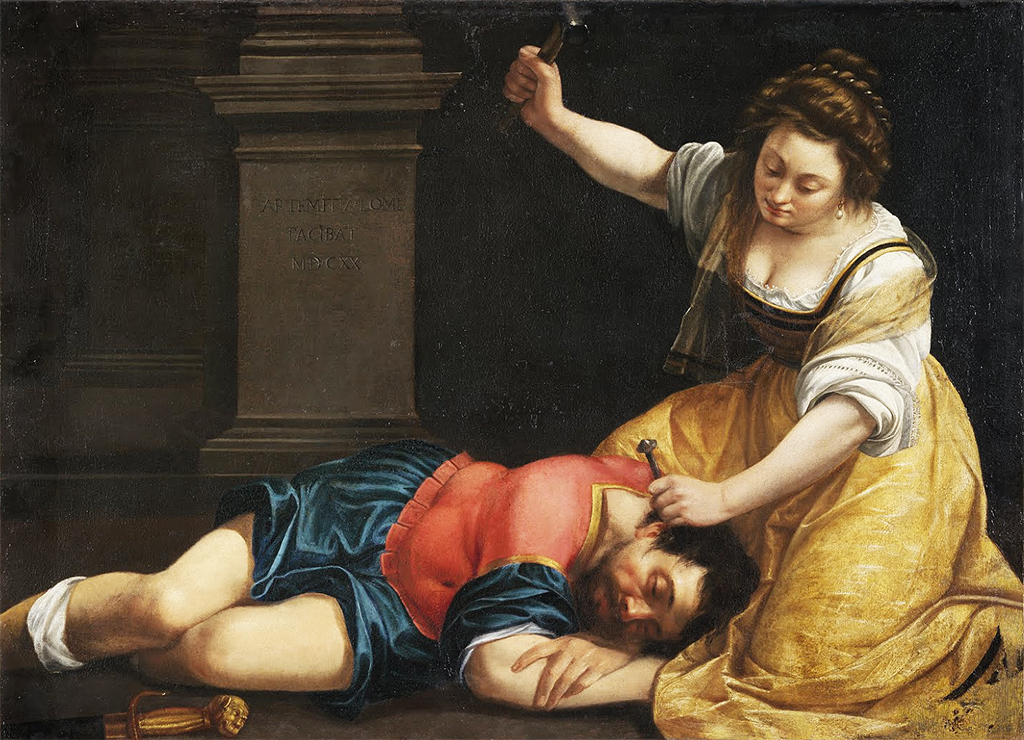
Artemisia Gentileschi's Jael and Sisera is a painting of action held one breath before impact. Jael stands over the sleeping Sisera with a hammer raised in one hand and a tent peg in the other. He lies across the foreground, richly dressed, vulnerable and unaware of what is about to happen. The scene is violent, but Artemisia does not show the blow itself. She paints the instant of decision. [1][4]
The painting is dated 1620 and belongs to the Museum of Fine Arts, Budapest. Google Arts & Culture, publishing the museum's object metadata, identifies it as oil on canvas, 86 x 125 cm, with the inventory number 75.11. A&AePortal records the same title, date, medium, dimensions, location and accession number. [1][2]
This page focuses on that Budapest object. It belongs near Artemisia's Judith paintings because it also shows a woman killing an enemy leader, but it is not the same story and should not be read as a simple repetition. Judith kills Holofernes to save her people after entering the enemy camp. Jael kills Sisera after offering shelter inside her tent. Artemisia understands the resemblance, but she also makes the differences matter.
Image reference: Museum of Fine Arts, Budapest metadata via Google Arts & Culture.
At a Glance
- ArtistArtemisia Gentileschi
- TitleJael and Sisera [1]
- Date1620 [1][2]
- Mediumoil on canvas [1][2]
- Dimensions86 x 125 cm [1][2]
- CollectionMuseum of Fine Arts, Budapest [1][2]
- Inventory number75.11 [1][2]
- SubjectJael preparing to kill Sisera with a tent peg and hammer [3][4]
- Signature noteinscribed with Artemisia Lomi's name and the 1620 date [4]
- Key themesfemale action, suspense, biblical deliverance, dark space, signature and Judith comparison
Contents
- The Story of Jael and Sisera
- The Budapest Object
- A Composition Built Around Suspense
- Jael's Calm
- The Dark Space and the Signature
- Jael and Judith
- Artemisia's Heroine Subjects
- What the Records Tell Us
- How to Read the Painting Today
The Story of Jael and Sisera
The story comes from the Book of Judges. Sisera is the commander of the Canaanite army of King Jabin. After the Israelite forces led by Barak defeat his army, Sisera flees on foot and seeks refuge with Jael, the wife of Heber the Kenite. She receives him, gives him milk, covers him and waits until he is asleep. Then she takes a tent peg and a hammer and kills him. [3]
The episode is startling because Jael is not introduced as a battlefield warrior. She acts inside a domestic space, using a household object rather than a formal weapon. The story turns on hospitality and danger. Sisera believes he has found safety; the viewer knows that the shelter has become the setting for his death.
Artemisia chooses the moment before the fatal strike. Jael's raised arm gives the painting its direction, but the blow is still suspended. That choice creates a different kind of tension from the Judith beheading scenes. In the Florence and Naples Judith Slaying Holofernes paintings, the killing is already underway. In Jael and Sisera, the painting pauses at the instant when intention is about to become action.
The Budapest Object
The Museum of Fine Arts, Budapest is the collection attached to the object metadata published through Google Arts & Culture. That record identifies Artemisia Gentileschi as creator, gives the date as 1620, lists the medium as oil on canvas, and records the dimensions as 86 x 125 cm. The inventory number is 75.11. [1]
A&AePortal's image record repeats the key object facts and gives the stable museum location as Budapest's Museum of Fine Arts. It also links the object to Jesse M. Locker's Artemisia Gentileschi: The Language of Painting, placing the painting within a scholarly discussion of Artemisia and Venetian painting. [2]
For readers, the essential point is simple: this is a specific 1620 Budapest painting, not a generic Jael image and not one of Artemisia's Judith versions. The article stays close to what the object record and reliable interpretive sources support.
A Composition Built Around Suspense
The National Gallery's close-looking story describes the painting as deceptively simple. There are only two main figures. Sisera lies across the lower part of the canvas. Jael stands above him. Behind them is a dark, largely empty space interrupted by a stone support that carries Artemisia's signature. [4]
The simplicity makes the action stronger. Artemisia does not crowd the scene with soldiers, servants, landscape, battle or divine signs. She removes almost everything except the sleeping man, the woman, the tools and the waiting darkness.
Jael's arms are crucial. One hand holds the peg, the other raises the hammer. The angle of her body and the lifted tool create the painting's future motion. The viewer completes the action mentally, because the next second is unavoidable.
Sisera's body works in the opposite direction. He is horizontal, exposed and unaware. The National Gallery story notes his invented military costume, pale bare legs and vulnerability. [4] Artemisia turns a commander into a body that cannot defend itself. The reversal is the point: the warrior has entered a space where military power no longer protects him.
Jael's Calm
Jael is not shown in frenzy. The National Gallery story draws attention to her neat hair, placid expression and methodical action. [4] That calm is unsettling. She is not swept away by rage; she appears focused, controlled and fully aware of what she is doing.
That steadiness gives the painting much of its power. Artemisia does not need Jael to grimace or strain theatrically. The raised hammer is enough. The quiet face and the violent intention make each other sharper.
This is one reason the painting belongs within Artemisia's larger group of women acting under pressure. Susanna resists coercion. Judith and her maidservant act together against Holofernes. Esther risks entering the king's presence. Lucretia confronts catastrophe in a very different moral and bodily register. Jael belongs in that company, but she is distinct: her scene is not public court, battlefield victory or aftermath; it is a private interior in which a sleeping enemy is about to be killed.
The painting therefore asks viewers to consider agency without making it comfortable. Jael's act is celebrated within the biblical story as deliverance, yet Artemisia shows it at its most intimate and disturbing. Heroism here is not clean or distant. It is close, physical and silent.
The Dark Space and the Signature
The empty darkness behind the figures is not passive background. It gives the hammer's arc room to exist. The National Gallery story notes that few earlier artists had used this kind of horizontal format or such a dark setting for the subject. [4]
That darkness also focuses attention on the signature. The National Gallery records the inscription on the base of a pilaster as ARTEMITIA. LOMI FACIBAT M.D. CXX. and explains its meaning as Artemisia Lomi made this in 1620. Lomi was a Tuscan family name Artemisia used, especially in connection with the reputation she had established in Florence. [4]
The signature matters because it is not tucked away as a minor administrative note. It sits inside the world of the painting. The artist places her name near the action, close to the visual path of the hammer and beside a heroine who acts decisively.
This does not mean the painting is a simple self-portrait in disguise. But it does show Artemisia making authorship visible. In a career shaped by questions of gender, training, reputation and professional independence, that visibility carries force. The painting says who made it, and it does so within the scene itself.
Jael and Judith
Jael and Sisera naturally invites comparison with Artemisia's Judith paintings. Both stories involve a woman killing a powerful enemy. Both involve a man whose military or political force collapses inside a controlled interior. Both allow Artemisia to paint strength, suspense and the body under pressure.
But the differences are just as important. Judith is usually accompanied by her maidservant, and the beheading of Holofernes is tied to a larger narrative of planned deliverance. Jael acts alone in the painting. Her tools are not a sword and basket but a hammer and peg. Sisera is not awake or struggling; he is asleep.
The timing is different too. The Judith beheading pages show the act with brutal immediacy. The Detroit Judith and Her Maidservant page shows suspense after the killing, as Judith and her companion prepare to escape. Jael and Sisera sits before the blow. Its violence is imminent rather than visible.
That gives the Budapest painting its own psychological register. It is not less intense because the blood has not appeared. It is intense because the viewer knows exactly what the raised hammer means.
Artemisia's Heroine Subjects
Modern readers often approach Artemisia through the idea of powerful women. That idea can be helpful, but only if it stays precise. Artemisia did not paint one generic type of heroine over and over. She painted different stories in which women occupy different kinds of danger, authority and action.
Jael is not Susanna. Susanna is threatened and falsely accused. Jael is the one preparing to kill. Jael is not Esther. Esther acts through appearance, speech and courtly risk. Jael acts through a physical strike. Jael is also not Lucretia, whose story turns on sexual violence, honour, death and Roman memory.
What connects these works is not a single message but Artemisia's seriousness about women at narrative turning points. She gives them bodies, choices and consequences. In Jael and Sisera, that seriousness appears in the stillness before violence. Jael does not perform strength for the viewer. She simply acts.
The painting's date, 1620, also places it at an important moment in Artemisia's career. The National Gallery story suggests it was probably made after her return to Rome in 1620, while the Lomi signature recalls the name under which she had built her Florentine reputation. [4] That makes the painting a hinge between places as well as between stories.
What the Records Tell Us
The public record for Jael and Sisera is strong enough to identify the work clearly, but it is not as expansive as the evidence for some other Artemisia paintings. The firm facts are the title, artist, 1620 date, oil-on-canvas medium, 86 x 125 cm dimensions, Budapest collection and inventory number 75.11. [1][2]
The National Gallery story adds a close reading of the composition, the dark background and the painted inscription. [4] Those are the most useful tools for understanding the work without inflating it into a larger technical or provenance history than the current public evidence provides.
That restraint is part of the painting's value here. A compact, object-led account can do more for readers than a longer essay that borrows certainty from unrelated Judith scholarship or from unsupported legacy notes.
How to Read the Painting Today
Begin with the pause. The painting is not the killing; it is the second before the killing. Artemisia makes anticipation do the work.
Then look at Jael's body. Her raised hammer, rolled sleeves and steady posture create the scene's force. She is not presented as decorative or passive. She is the agent of the action.
Look next at Sisera. His costume and position still identify him as a commander, but his sleeping body has lost command. Artemisia's reversal is stark: the man associated with military power lies helpless before a woman holding household tools.
Finally, look at the signature. Artemisia's name sits inside the painting, not outside it. The inscription gives authorship a visual presence near the heroine's act. That is one reason Jael and Sisera remains such a compact but powerful work in Artemisia Gentileschi's career: it brings biblical violence, female agency, artistic identity and suspense into one dark, concentrated image.
Related Pages
- Artemisia Gentileschi
- Artemisia Gentileschi Biography
- Artemisia Gentileschi Paintings
- Judith Slaying Holofernes, Florence
- Judith Slaying Holofernes, Naples
- Judith and Her Maidservant
- Susanna and the Elders
- Esther before Ahasuerus
- Lucretia
- Baroque Artists
Frequently Asked Questions
Discussion
What changes when Artemisia paints the moment before violence rather than the violence itself?
Reader Insights
How does the raised hammer make the viewer imagine the next second?
How does Jael's calm alter the emotional force of the biblical story?
What does Artemisia's visible inscription add to the scene's sense of authorship?
Join the Conversation
Share your reading of this painting below.
References
- Google Arts & Culture, Jael and Sisera. Object metadata published by Museum of Fine Arts, Budapest, for title, creator, 1620 date, 86 x 125 cm dimensions, oil-on-canvas medium, rights-route link and inventory number 75.11.
- A&AePortal, Jael and Sisera. Image record for title, creator, 1620 date, oil-on-canvas medium, 86 x 125 cm dimensions, Budapest location, accession number 75.11 and related scholarly context.
- Bible Gateway, Judges 4:17-22. Biblical story route used in paraphrase for Sisera's flight, Jael's hospitality, milk, sleep, tent peg and hammer.
- Google Arts & Culture / The National Gallery, London, Artemisia's 'Jael and Sisera'. Close-looking story for composition, dark background, Jael's calm, Sisera's vulnerability, the inscription and Lomi context.
 Artemisia Gentileschi.jpg)
 Artemisia Gentileschi.jpg)