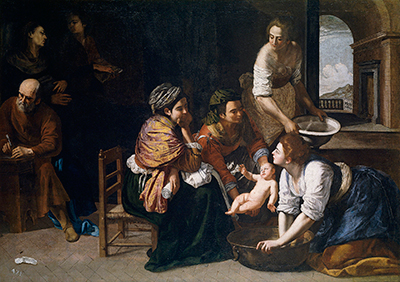
Artemisia Gentileschi.jpg)
 by Tom Gurney
Tom Gurney BSc (Hons) is an art history expert with over 20 years experience
Published on June 19, 2020 / Updated on September 6, 2026
Email: tomgurney1@gmail.com / Phone: +44 7429 011000
Judith Slaying Holofernes, Florence by Artemisia Gentileschi
Artemisia Gentileschi's Judith Slaying Holofernes in the Uffizi is one of the most uncompromising paintings of the Baroque. It shows the biblical heroine Judith at the instant she kills Holofernes, the Assyrian general threatening her people. Artemisia does not soften the scene into symbolic triumph. She brings the viewer close to the physical act: Judith gripping the sword and hair, her maidservant pressing down with decisive force, Holofernes struggling on the bed as blood marks the sheets and Judith's clothing. [1]
This page focuses on the Florence/Uffizi version of the subject. Artemisia painted more than one Judith Slaying Holofernes, and the Naples version in the Museo e Real Bosco di Capodimonte has its own history and intensity. The Uffizi painting should therefore be read as a distinct object, not as a generic image of Judith. It belongs to the Florentine and Medici world, it entered the Uffizi collection, and it has become one of the defining works through which modern viewers encounter Artemisia's art. [1][2]
The painting is often discussed through Artemisia's biography, especially the 1612 trial of Agostino Tassi. Those readings can help explain why the image has felt so urgent to modern viewers, but they should not replace looking. Judith Slaying Holofernes is not powerful only because of Artemisia's life. It is powerful because she knew how to make violence, courage, coordination and moral danger occupy the same space.
Image reference: Uffizi Galleries.
At a Glance
- ArtistArtemisia Gentileschi
- TitleJudith Beheading Holofernes / Judith Slaying Holofernes
- VersionFlorence/Uffizi version
- DateUffizi: c. 1620; National Gallery exhibition material has used earlier dating [1][3]
- MediumOil on canvas [1]
- Dimensions146.5 x 108 cm [1]
- CollectionUffizi Galleries, Florence [1]
- Inventory1890 no. 1567 [1]
- SubjectJudith killing Holofernes with Abra
- Companion pageNaples/Capodimonte version
Contents
- The Story of Judith and Holofernes
- Which Judith Version Is This?
- Artemisia, Florence and Rome
- Artemisia and Caravaggio
- The Composition
- Annotated Details
- Blood, Fabric and the Reality of Violence
- Judith and Abra
- Biography and Interpretation
- Dating the Florence Judith
The Story of Judith and Holofernes
The story of Judith comes from a biblical text included in Catholic tradition. Bethulia, Judith's city, is threatened by the Assyrian army led by Holofernes. Judith, a widow, goes into the enemy camp beautifully dressed and pretends to seek alliance or favour. Holofernes invites her to a banquet. After he drinks heavily and falls asleep, Judith takes his sword and cuts off his head. She returns with the head as proof of victory, and her people are delivered from the siege.
The story was popular because it joined violence to virtue. Judith could be understood as a heroine of courage, faith and political deliverance. In Renaissance and Baroque art, she often appeared as a symbol of a just cause triumphing over tyranny, or of divine protection working through an unexpected human agent. [4] In Florence, the subject had particular civic force: Donatello's earlier Judith and Holofernes had stood in relation to republican ideals and the defeat of tyranny, and later Florentine art continued to return to the theme. [5]
Artemisia's version is not the calm aftermath of victory. It is the act itself. Holofernes has not yet become a trophy or a symbol. He is a living body resisting death. Judith and her maidservant are not delicately removed from the violence; they are physically involved in it. This is why the painting feels so different from many elegant Judith images. Artemisia chooses the hardest moment.
Which Judith Version Is This?
Artemisia's Judith paintings can be confusing because several closely related subjects survive. The Florence/Uffizi painting is the version discussed here. It is the canvas listed by the Uffizi as Judith Beheading Holofernes, inventory 1890 no. 1567, displayed in the Uffizi's Caravaggio and Artemisia room. [1]
The Naples version, now at Capodimonte, depicts the same climactic subject and is often discussed beside the Florence painting. [2] The two works are close enough that readers naturally compare them, but they should not be collapsed into one page or one description. Their dating, collection histories, dimensions and visual handling need to be treated separately.
For a reader, the easiest distinction is this: this article follows the Uffizi object, while the companion Naples article belongs with the Capodimonte object. Both show Judith and her maidservant killing Holofernes. Both belong to Artemisia's most famous subject group. But each painting has its own material life.
Artemisia, Florence and Rome
The Uffizi dates the painting to around 1620 and states that it was completed in Rome after Artemisia returned there following seven years in Florence. [1] This detail places the painting at an important hinge in her career. Artemisia had left Rome after the 1612 trial, built an independent reputation in Florence, joined the Accademia delle Arti del Disegno in 1616, and then returned to Rome in 1620. [6]
The painting therefore belongs to a period when Artemisia had already proved herself in Florentine courtly and intellectual circles. She was no longer only Orazio Gentileschi's daughter or the teenager who had painted Susanna and the Elders. She had made self-images, allegories and ambitious history paintings, and she had learned how to work for powerful patrons.
Uffizi's account connects the painting with the Medici world and with the difficulty Artemisia had in securing payment after the death of Grand Duke Cosimo II de' Medici in 1621. The museum notes that Galileo Galilei helped her obtain the delayed payment. [1] That episode is useful because it shows the painting as part of a real professional life: commissions, patrons, courtly expectations, money and reputation.
Artemisia and Caravaggio
The Uffizi displays the painting in a room named for Caravaggio and Artemisia, and the connection is more than curatorial convenience. Artemisia learned in a Roman artistic world transformed by Caravaggio's naturalism: strong light, close figures, ordinary bodies, dramatic timing and the refusal to keep sacred or historical stories safely distant.
Caravaggio's own Judith Beheading Holofernes had already made the subject shocking. His Judith leans back as she cuts, tense and concentrated, while Holofernes cries out and the maidservant waits beside her. Artemisia's painting intensifies the physical struggle. Judith does not merely extend a blade. She leans into the action, and her maidservant becomes a full participant rather than a secondary observer.
That difference matters. Artemisia is not simply imitating Caravaggio. She is using the Caravaggesque language of proximity, tenebrism and bodily realism to ask a different question: what does it take for Judith and Abra to complete the act? The answer is not elegance. It is force, coordination and resolve.
The Composition
The composition is built around pressure. Holofernes lies diagonally across the bed, his body twisting as he resists. Judith stands or leans above him, one hand gripping his hair and the other driving the sword into his neck. Abra, the maidservant, presses down with both hands, helping hold him in place. The three bodies form a compact structure of force.
The bed is not a passive setting. It traps Holofernes and displays the violence of the act. The sheets catch the blood, making the white fabric a field on which the event becomes visible. Artemisia uses that contrast with startling directness. The bed is where Holofernes expected sexual or military triumph; instead it becomes the site of his defeat.
Judith's arms are crucial. They are extended, tensed and purposeful. The action depends on them. Her body is not decorative; it is working. Her sleeves, bodice and posture show that the heroine is physically engaged, not symbolically floating above the scene. This is a woman performing a task that requires strength.
Abra's role is equally important. She is not a passive servant standing aside with a sack. She is inside the action, using her body weight to restrain Holofernes. The painting turns Judith's victory into collaboration. One woman holds, the other cuts. The story may name Judith as the heroine, but Artemisia gives the maidservant a share in the labour.
Annotated Details from Judith Slaying Holofernes, Florence
This annotated close reading follows the Uffizi painting's structure of force: Abra's weight pressing down, Judith's extended arm controlling the blade, Holofernes's resisting body and the white sheets that turn the story's violence into visible evidence. The details keep the page focused on the Florence object, not the Naples version.
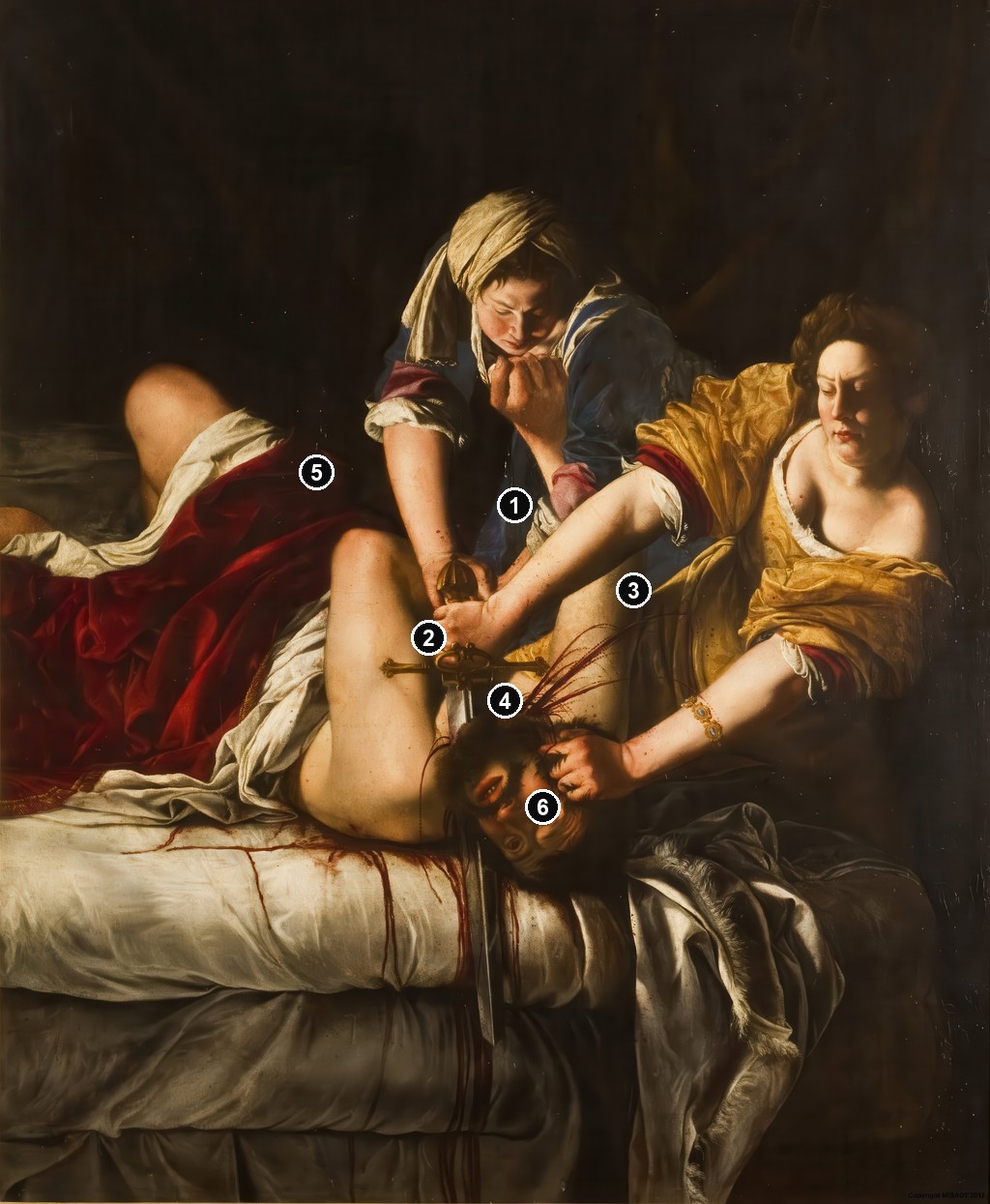
Details from JUDITH SLAYING HOLOFERNES, FLORENCE
The details show how Artemisia makes Judith's victory look like coordinated work rather than effortless symbol. Each point belongs to the Florence/Uffizi version's physical compression of bodies, cloth, blood and light.
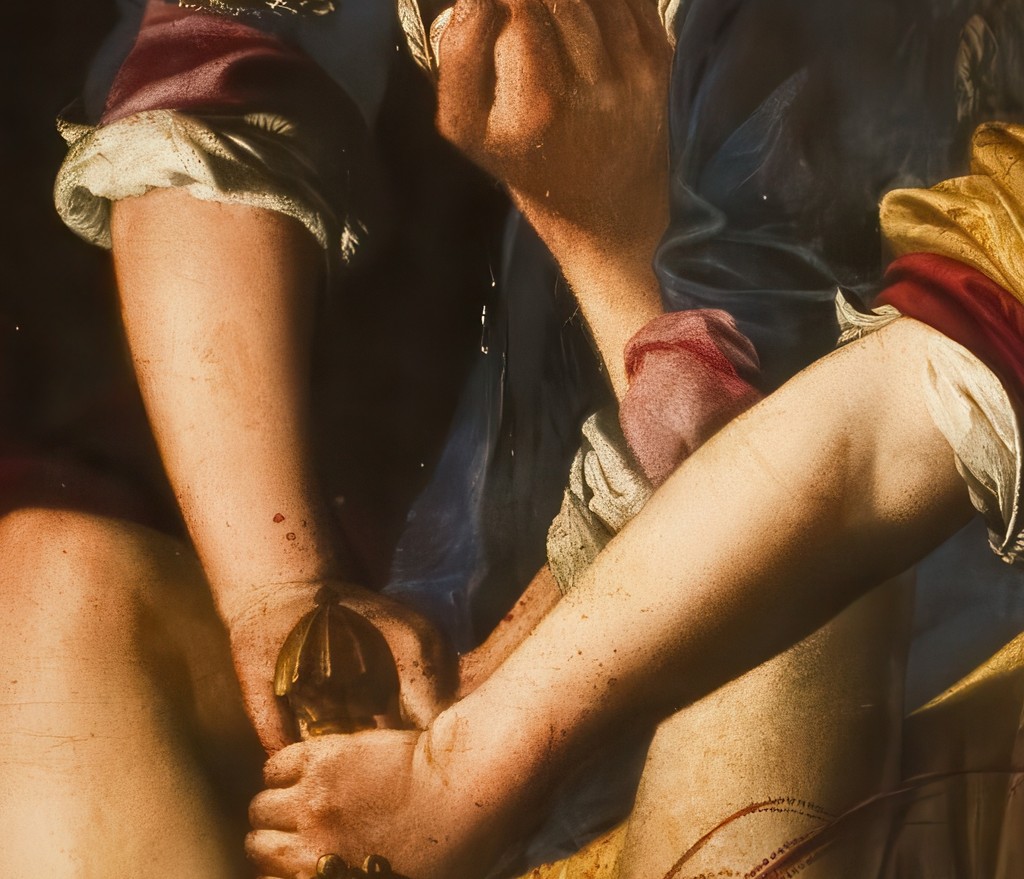
Abra's downward pressure
Abra's forearm and hand carry much of the scene's physical force. Artemisia makes the maidservant a participant in the action, not a distant attendant waiting for the aftermath.
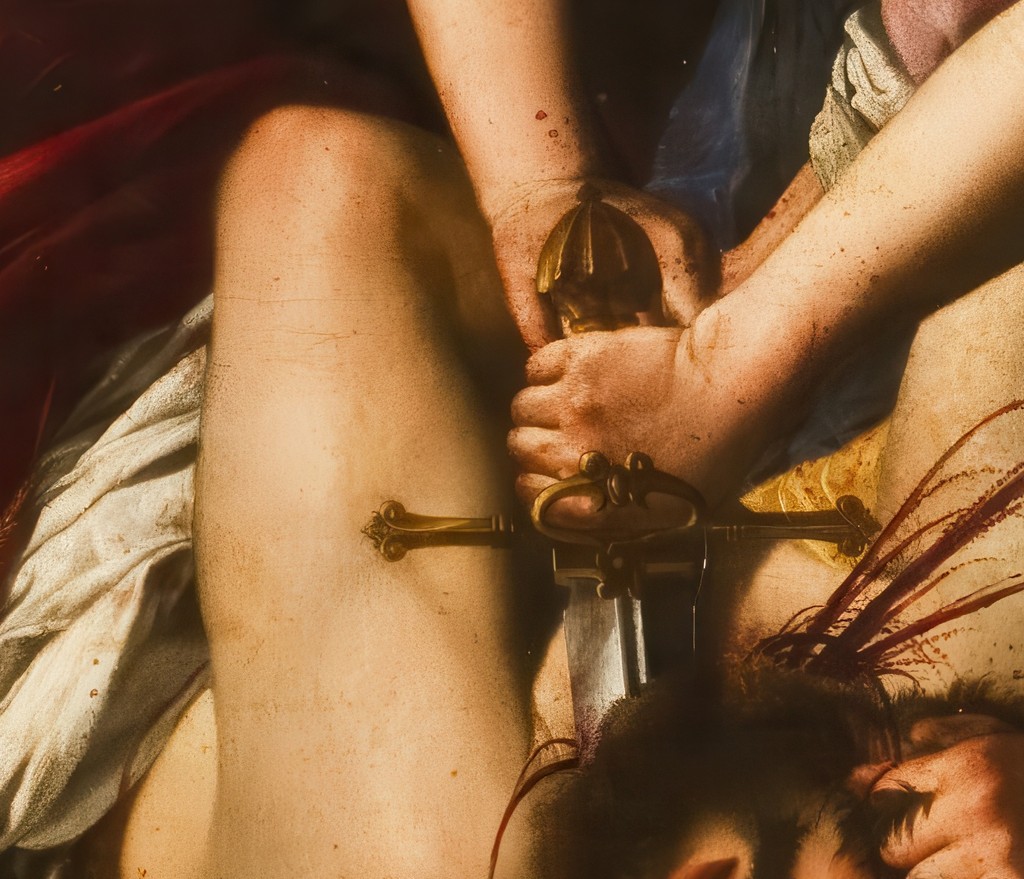
Sword at the neck
The blade is placed at the point where action becomes irreversible. Its horizontal line cuts through the centre of the composition and fixes the viewer on the difficulty of the deed.
Judith's braced arm
Judith's extended arm is tense and practical. The heroine is not posed as a remote emblem of virtue; her body is working inside the violence of the story.
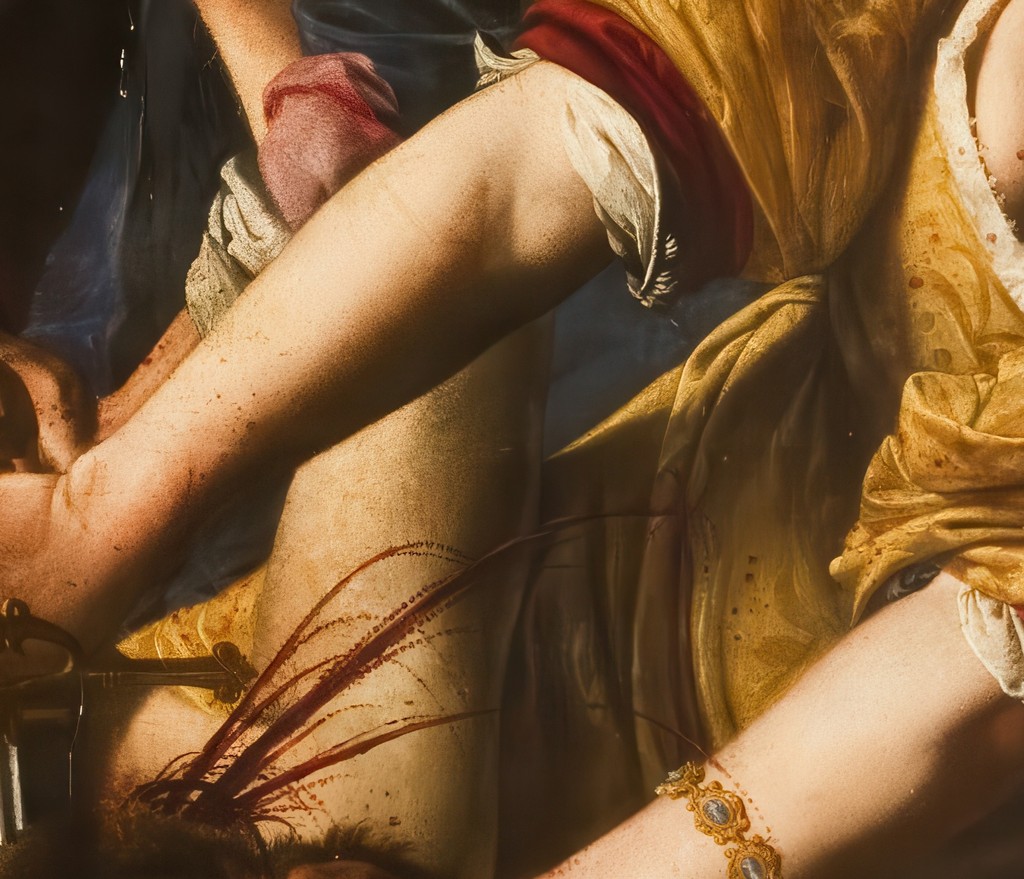
Blood across the sheets
The blood moves across pale fabric and refuses to let the episode become clean allegory. Artemisia uses the bed linen as a surface where moral action becomes bodily fact.
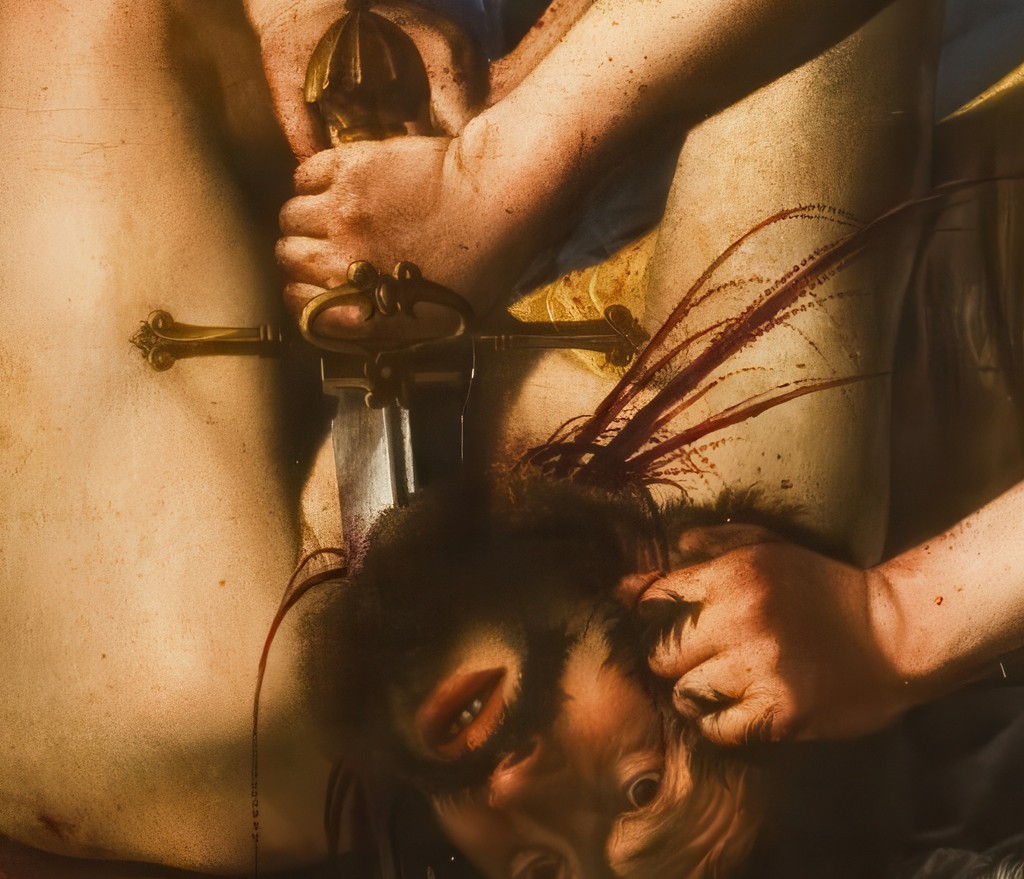
White sheet and red drapery
The bright sheet and deep red passages frame Holofernes's body. Their contrast makes the bed feel less like a setting than a compressed field of struggle.
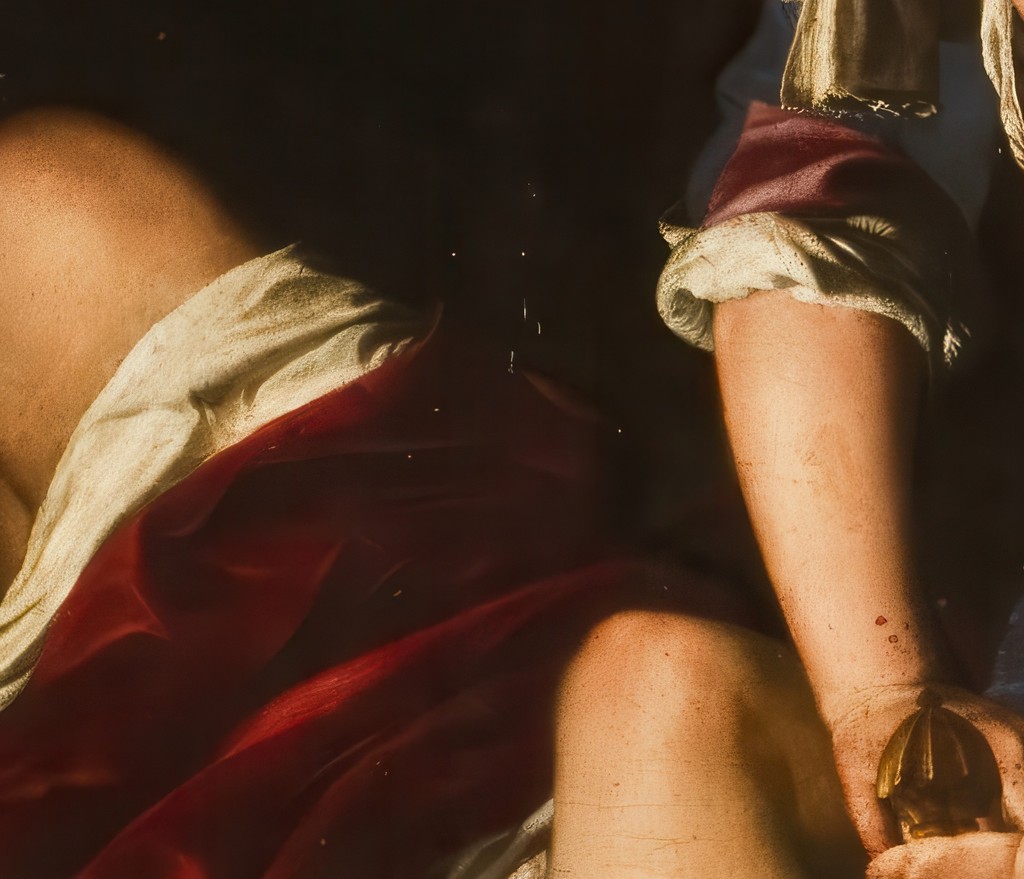
Holofernes's resisting face
Holofernes is not already a trophy. His face and body still register shock and resistance, which makes Judith and Abra's coordinated action feel dangerous and immediate.
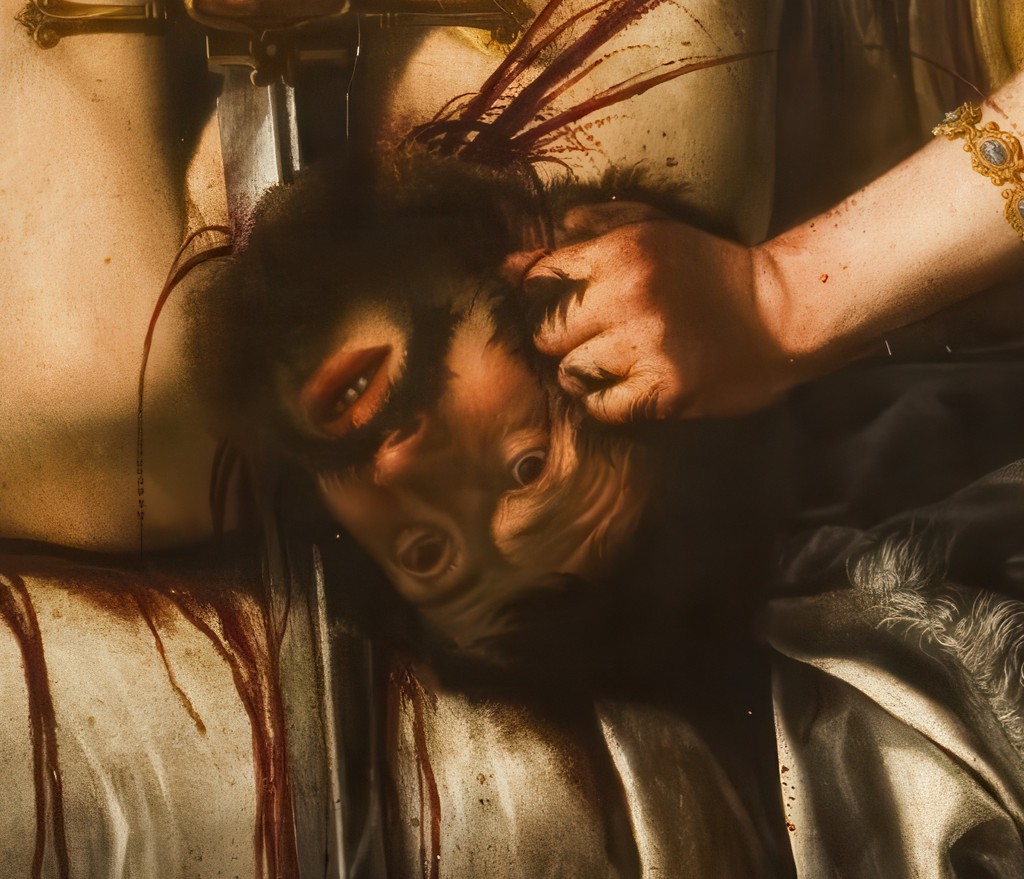
Blood, Fabric and the Reality of Violence
The blood in the Uffizi Judith is not incidental. Artemisia does not hide it at the edge of the scene. It emerges from the wound, marks the bed and stains Judith's clothing. Uffizi highlights the profusion of blood and the frightening force of the image. [1] Smarthistory similarly notes that the painting's realism transforms paint into something viewers experience as blood. [7]
This explicitness has sometimes made viewers uncomfortable. That discomfort is part of the painting's history. According to Smarthistory, the painting's horror led to its being pushed aside in the Uffizi in the late eighteenth century, where it remained out of prominence until much later. [7] Whether one frames that episode as taste, decorum or gendered discomfort, it confirms that Artemisia's painting has long disturbed the categories people try to place around it.
The violence is not gratuitous, though. It belongs to the story and to Artemisia's interpretation of the story. Judith's act saves her people, but the painting refuses to make salvation bloodless. The viewer is not allowed to enjoy a clean allegory of virtue. The canvas insists that the symbolic victory passes through physical reality.
Judith and Abra
One of Artemisia's greatest choices is to make Judith and Abra act together. In some earlier treatments of the story, the maidservant appears old, marginal or waiting to receive the severed head. Artemisia brings her into the centre of the work. Abra's hands press Holofernes down; her face and body align with Judith's purpose.
This makes the scene less like a single heroic gesture and more like coordinated work. Judith is still the central figure, but she is not alone. The painting recognises that the act requires more than symbolic courage. It requires physical help, timing and trust between the two women.
The coordination also changes the emotional balance. Judith's face is determined rather than ecstatic. Abra's energy is practical. Neither woman appears to take pleasure in the violence. They are committed to the necessity of the deed. That distinction is important because it prevents the painting from becoming merely sensational.
Biography and Interpretation
Artemisia's Judith paintings have often been read through her own history of sexual violence and the 1612 trial of Agostino Tassi. The connection is understandable. A woman artist who had testified publicly about rape later painted an extraordinarily forceful scene of a woman killing a violent man. The modern mind naturally notices the resonance.
But a responsible reading should not make the painting a simple act of personal vengeance. Judith was a major biblical and artistic subject long before Artemisia painted it. The story carried religious, civic and moral meanings, and Baroque artists were drawn to its dramatic potential. Smarthistory notes that Judith was associated with virtue over vice, divine protection and the Church, as well as the wider theatricality of Baroque art. [7]
Artemisia's biography matters because it shaped the world in which she worked and the way later viewers have understood her. It does not replace iconography, patronage, composition or artistic tradition. The painting is too strong to be explained by one event.
Medici Reception and Delayed Payment
The Uffizi source gives the painting a vivid professional afterlife. It says the work's naturalistic force provoked strong reactions when it arrived in Florence and that the painting was denied the honour of being exhibited in the Gallery. It also records that Artemisia had difficulty obtaining payment after Cosimo II de' Medici's death, with Galileo Galilei helping her secure the money that had been agreed. [1]
This episode is valuable because it reminds readers that great paintings do not exist only as images. They move through systems of patronage, display, taste and money. Artemisia made a work of extraordinary force, but force could be a problem as well as an achievement. The same qualities that make the painting famous now may have made it difficult to accommodate in a courtly gallery.
Florence, Civic Memory and Judith
Judith had a long Florentine life before Artemisia. Donatello's bronze Judith and Holofernes was tied to the city's political imagination, and the subject continued to appear in Florentine art. Uffizi's discussion of Cristofano Allori's Judith notes the theme's popularity in Florence and its meanings of courage, faith and liberation from oppression. [5]
Artemisia enters that tradition, but she shifts its tone. Donatello's Judith stands as a public emblem of virtue overcoming tyranny. Allori's Judith emphasises beauty, luxury and psychological theatre. Artemisia's Uffizi Judith strips the subject down to the bodily cost of liberation. The viewer sees not the emblem after the action, but the action itself.
Comparison with the Naples Version
The Naples version of Judith Slaying Holofernes belongs to the same subject group and has its own full treatment. For this page, the comparison should remain clear but contained. The Florence/Uffizi version is the object in focus.
The two paintings are often discussed together because they show Artemisia returning to the same climactic instant. That return is part of her artistic strength. She did not simply invent one shocking formula and leave it untouched. She explored how changes in date, handling, scale, light and collection context could alter the same scene.
The Florence version is especially important because of its Uffizi history, its Medici connection and its placement within a Florentine conversation around Judith. The Naples version brings its own Capodimonte history and visual identity. Readers should move from one page to the other not to decide which is "the real" Judith, but to see how Artemisia reworked one of her most powerful subjects.
Dating the Florence Judith
The dating of the Florence Judith needs careful public wording because sources do not always present the object in exactly the same way. The Uffizi's current object page lists the painting as circa 1620. [1] National Gallery exhibition material has described the Florence version as about 1613-14 when discussing the two Judith canvases together. [3] Rather than hiding that tension, a good account should make the identity of the source clear.
The dating matters because it changes how the painting sits in Artemisia's career. An earlier date places the Florence version closer to the immediate aftermath of the 1612 trial and the beginning of her Florentine period. The Uffizi's circa 1620 date places it around her return to Rome after years in Florence, at a moment when she was already an established artist with Medici connections and a record of ambitious work.
For the reader, the key point is not to solve the dating question in a sentence. It is to understand that the Uffizi painting belongs to Artemisia's mature emergence as a history painter capable of competing with the most demanding subjects of her age. Whether understood in relation to the years after the trial or to the later return to Rome, the work is not tentative. It is a statement of command.
A Painting About Work
One reason the Uffizi Judith feels so different from many heroic images is that it makes action look like work. Judith and Abra do not simply appear as symbols of virtue. They strain. Judith has to control the sword, hold Holofernes by the hair and keep her distance from the blood. Abra has to force down a body larger than her own. The image is frightening because the act is not effortless.
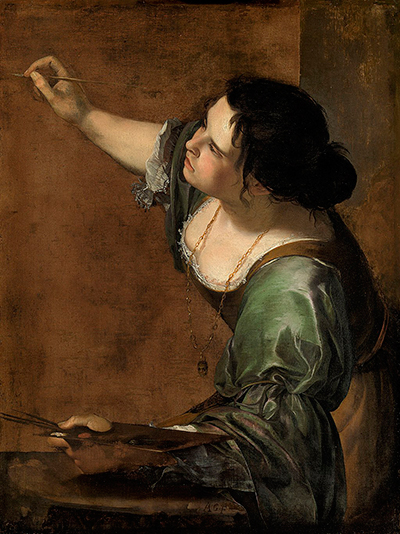
This emphasis on work connects the painting to Artemisia's wider art. In Susanna and the Elders, Susanna's body shows the effort of refusal. In Self-Portrait as the Allegory of Painting, the artist's body twists in concentration as she paints. In the Uffizi Judith, bodily effort becomes the very form of heroism. Artemisia repeatedly asks viewers to see women's actions as physical, intelligent and consequential.
Looking Closely at the Faces
The faces in the Florence Judith are less theatrical than the event itself. Judith's expression is controlled, intent and unsentimental. She does not seem transported by rage. She looks focused on completing the action. This restraint is one of the painting's strengths. It keeps her from becoming a caricature of vengeance.
Abra's face and body carry a different kind of concentration. Her work is practical: restrain, press, assist. She is close enough to the action that she cannot be treated as a witness. Artemisia makes her a participant in the story's moral and physical outcome.
Holofernes's face is the face of a man waking into death. His mouth, eyes and body register shock and resistance. He is not serenely defeated; he is still fighting. This is essential to the painting's realism. Artemisia does not make victory easy for Judith. She gives Holofernes enough force to make the women's action feel necessary and dangerous.
Why the Painting Still Feels Modern
The Uffizi Judith often feels modern because it refuses polite distance. Viewers may know they are looking at a seventeenth-century biblical subject, but the scene has the pressure of an event witnessed too closely. Artemisia collapses the distance between old story and present sensation.
That modern feeling should not tempt us to take the painting out of history. The work belongs to Catholic Baroque storytelling, Florentine collecting, Medici patronage and the artistic inheritance of Caravaggio. Its subject had long religious and civic meanings. Its force depends partly on the expectations Artemisia inherited and challenged.
Still, the painting remains unusually immediate because it confronts the viewer with questions that do not age easily. What does righteous violence look like? What happens when a woman becomes the agent of deliverance rather than the body at risk? How should viewers respond to an image that is both beautiful and horrifying? Why do some paintings make moral clarity feel physically difficult?
Relation to Susanna and Later Judith Works
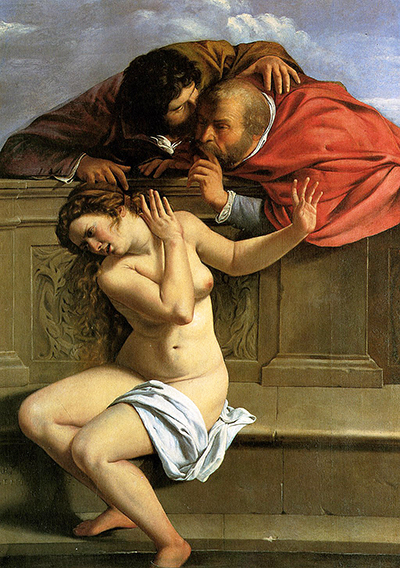
The Uffizi Judith can be read beside Susanna and the Elders, Artemisia's earliest signed and dated work. Susanna recoils from male coercion; Judith acts against male military violence. The emotional registers are different, but both paintings place a woman at the centre of a crisis shaped by male power.
The comparison should be handled carefully. Susanna was painted before the Tassi assault and should not be treated as autobiographical evidence. The Judith painting, likewise, should not be reduced to revenge. But both works show Artemisia's ability to redirect familiar stories toward women's experience, bodily pressure and moral agency.
Later Judith-related works extend the story further. Judith and Her Maidservant, in the Detroit Institute of Arts, shows a moment after the killing, when Judith and her maidservant prepare to escape. Smarthistory's discussion of that painting emphasises quiet violence, candlelight and the suspense of the aftermath. [8]
Reception and Modern Fame
The Uffizi Judith is now among Artemisia's most famous paintings, but fame has not made it easier. The image remains violent, graphic and difficult. Viewers often remember the blood first, then the force of the women's bodies, then the shock of recognising how controlled the composition is.
Modern exhibitions and museum narratives have placed the painting near the centre of Artemisia's reputation. The National Gallery's Artemisia exhibition brought versions of Judith beheading Holofernes into a wider public account of her career and described the subject as one of her most iconic compositions. [3] That visibility has helped make Judith the painting many people think of first when they hear Artemisia's name.
How to Read the Painting Today
Begin with the object. This is the Florence/Uffizi Judith, an oil painting displayed in a room that places Artemisia in direct conversation with Caravaggio. Its date should be handled with source awareness: Uffizi lists circa 1620, while some exhibition material has used earlier dating for the Florence version. [1][3] The important public point is that this is the Uffizi painting, not the Naples one.
Then look at the action. Judith and Abra are not decorative symbols; they are working bodies. Their force is coordinated. Their faces do not ask for admiration. Their hands carry the story.
Look also at Holofernes. Artemisia does not make him an abstract villain. He is heavy, alive and resistant. His struggle gives the women their task. Without him, Judith's courage would have no weight.
Finally, look at the space between beauty and horror. Artemisia's painting is beautifully made, but its beauty does not excuse the violence or make it tasteful. It makes the violence harder to dismiss. The brushwork, light and composition draw the viewer in, then refuse to let the scene become easy.
Related Pages
- Artemisia Gentileschi
- Biography
- Paintings
- Judith Slaying Holofernes, Naples
- Judith and Her Maidservant
- Jael and Sisera
- Susanna and the Elders
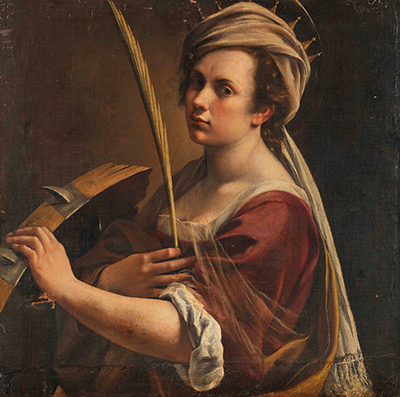
- Self-Portrait as Saint Catherine of Alexandria
- Self-Portrait as the Allegory of Painting
- Caravaggio
- Baroque Artists
Frequently Asked Questions
Discussion
What should readers notice when looking closely at Artemisia Gentileschi's Florence Judith Slaying Holofernes?
Reader Insights
What detail helps you keep the Uffizi painting distinct from the Naples version?
How does Abra's physical role change the way you read Judith's act?
How does the Uffizi's circa 1620 dating affect your sense of Artemisia's career at this moment?
Join the Conversation
Share your reading of this painting below.
References
- Uffizi Galleries, Judith Beheading Holofernes.
- Museo e Real Bosco di Capodimonte, Giuditta decapita Oloferne di Artemisia Gentileschi.
- National Gallery, London, Artemisia exhibition press release.
- National Gallery of Art, Washington, Judith with the Head of Holofernes.
- Uffizi Galleries, Judith with the Head of Holofernes by Cristofano Allori.
- National Gallery, London, Artemisia Gentileschi (1593-1654 or later).
- Smarthistory, Dr. Esperanca Camara, Artemisia Gentileschi, Judith Slaying Holofernes.
- Smarthistory, Dr. Beth Harris and Dr. Steven Zucker, Artemisia Gentileschi, Judith and Her Maidservant with the Head of Holofernes.
 Artemisia Gentileschi.jpg)