 by Tom Gurney
Tom Gurney BSc (Hons) is an art history expert with over 20 years experience
Published on June 19, 2020 / Updated on September 6, 2026
Email: tomgurney1@gmail.com / Phone: +44 7429 011000
Self-Portrait as a Lute Player by Artemisia Gentileschi
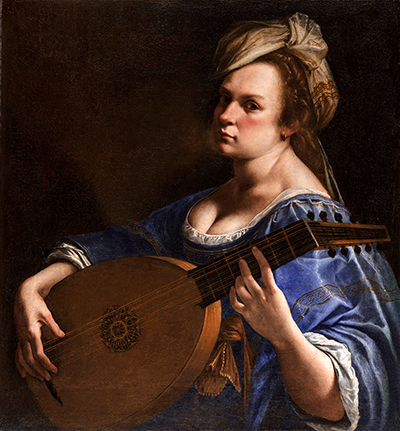
Artemisia Gentileschi's Self-Portrait as a Lute Player shows the artist in a different register from her better-known heroines and saints. She is not Judith with a sword, Susanna recoiling from danger, Saint Catherine beside the broken wheel, or La Pittura absorbed in the work of painting. Here she appears as a musician, holding a lute, turning toward the viewer with the controlled presence of a performer. [1][2]
The painting belongs to the Wadsworth Atheneum Museum of Art in Hartford, Connecticut. It is usually dated to Artemisia's Florentine years, around 1615-1618, and it has become one of the key works for understanding how she shaped her public image. [1][2] The subject may look quieter than Judith Slaying Holofernes, but it is not slight. It asks how a woman painter could present herself through music, courtly accomplishment, costume and gaze.
Self-Portrait as a Lute Player is best treated as its own object and idea. It belongs beside Artemisia's Saint Catherine and La Pittura self-images, but it should not be reduced to either of them. The musical role gives the painting a distinct mood: cultivated, performative, elegant and quietly assertive.
Image reference: Wadsworth Atheneum Museum of Art / Wikimedia Commons.
At a Glance
- ArtistArtemisia Gentileschi
- TitleSelf-Portrait as a Lute Player
- Dateabout 1615-1618, with sources using either 1615-1617 or circa 1615-18. [1][2][3]
- Mediumoil on canvas. [1][2]
- Dimensions77.5 x 71.8 cm, also recorded as 30 1/2 x 28 1/4 in. [2][4]
- CollectionWadsworth Atheneum Museum of Art, Hartford, Connecticut. [1][2]
- Credit line/accession routeCharles H. Schwartz Endowment Fund, 2014.4.1. [1][2]
- SubjectArtemisia presenting herself as a lute player
- Career contextFlorentine period, close to the date of Self-Portrait as Saint Catherine of Alexandria
- Related worksSelf-Portrait as Saint Catherine of Alexandria, Self-Portrait as the Allegory of Painting, Allegory of Inclination
- Main themesself-portraiture, music, performance, courtly identity, Florence, women artists and professional self-fashioning
Contents
- A Self-Portrait Through Music
- Object and Collection
- Florence and Courtly Self-Fashioning
- The Face, Pose and Gaze
- Annotated Details
- Music, Gender and Performance
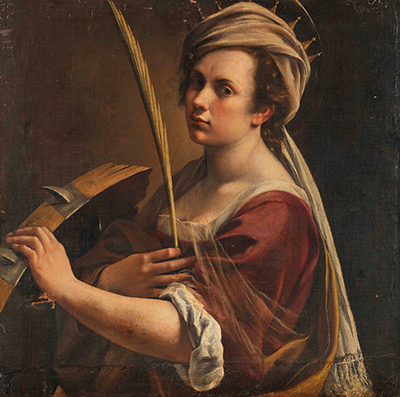
- Comparison with Saint Catherine
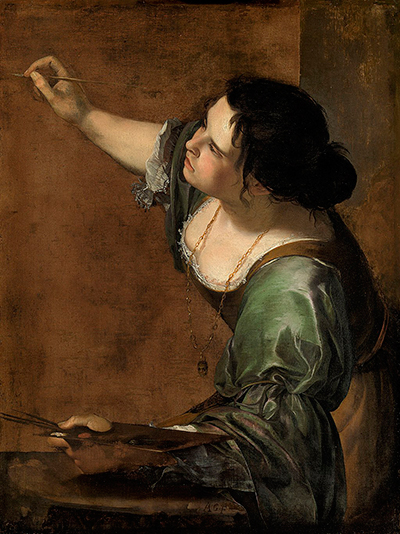
- Comparison with La Pittura
- Women Artists and the By Her Hand Context
- What This Painting Adds to Artemisia's Story
A Self-Portrait Through Music
The painting's first surprise is that Artemisia presents herself through music rather than through the tools of painting. She does not hold brushes, palette or easel. She holds a lute, an instrument associated with skill, harmony, refinement and performance. The choice shifts the self-portrait away from workshop labour and toward courtly accomplishment.
That does not make the image less professional. In early modern elite culture, music was a sign of education, sociability and cultivated presence. To represent oneself with a lute was to enter a language of performance and polish. Artemisia shows herself as someone who can command an audience, not only as a maker of painted images but as a figure who understands the codes of presentation.
The Wadsworth's own public programming has recognised that musical context. A 2016 Gallery Music programme invited visitors to listen to music of Artemisia's time beside the painting, especially works featuring lute and women composers of the seventeenth century, including figures connected with early Baroque Florence. [1]
That does not prove the painting illustrates a particular song or performance. It does show why the lute matters. The instrument opens a world of sound, poise and learned sociability around the image.
Object and Collection
The Wadsworth Atheneum identifies the painting as Self-Portrait as a Lute Player, circa 1615-18, oil on canvas, Charles H. Schwartz Endowment Fund, accession 2014.4.1. [1] The Detroit Institute of Arts By Her Hand exhibition page records the same work as Self-Portrait as a Lute Player, dated 1615-1617, oil on canvas, from the Wadsworth Atheneum Museum of Art. [2]
The National Gallery catalogue gives the dimensions as 77.5 x 71.8 cm and places the painting in Hartford. [4] It also dates the work to about 1615-17, connecting it closely with Self-Portrait as Saint Catherine of Alexandria and another related Saint Catherine painting. [4]
Those details matter because the public object record is more bounded than for some other Artemisia works. The Wadsworth page used here is an event record rather than a full collection catalogue entry, while the National Gallery provides the richest published comparison through its Saint Catherine catalogue. That is enough for a strong but bounded reading, not for speculative expansion.
The core identity is clear: this is a Wadsworth Atheneum painting, associated with Artemisia's Florentine years, showing the artist in the role of a musician. The painting is clearest when provenance, patronage and display claims remain tied to the available sources.
Florence and Courtly Self-Fashioning
The date places the painting in the period when Artemisia was building a new professional life in Florence. She had left Rome, worked for patrons in a courtly and intellectual environment, and in 1616 became the first woman admitted to the Accademia delle Arti del Disegno. That Florentine setting matters because the painting is an image of self-presentation, not merely a likeness.
Florence offered Artemisia several languages of identity. In Allegory of Inclination, she painted a personification for Casa Buonarroti and Michelangelo's family memory. In Self-Portrait as Saint Catherine of Alexandria, she took on the guise of a learned martyr. In Self-Portrait as a Lute Player, she enters the world of performance, music and cultivated display.
These roles are different, but they share a common problem: how to make a woman artist visible as an intelligent, skilled and socially legible professional. A plain self-portrait might have answered part of that problem. Artemisia's role portraits answer it more richly. They let her appear as artist, saint, allegory and performer.
The lute therefore belongs to a social world as much as a musical one. It suggests an environment of courtly conversation, poetry, song and refined accomplishment. Artemisia does not need to show a palace or audience. The instrument and the pose carry that atmosphere.
The Face, Pose and Gaze
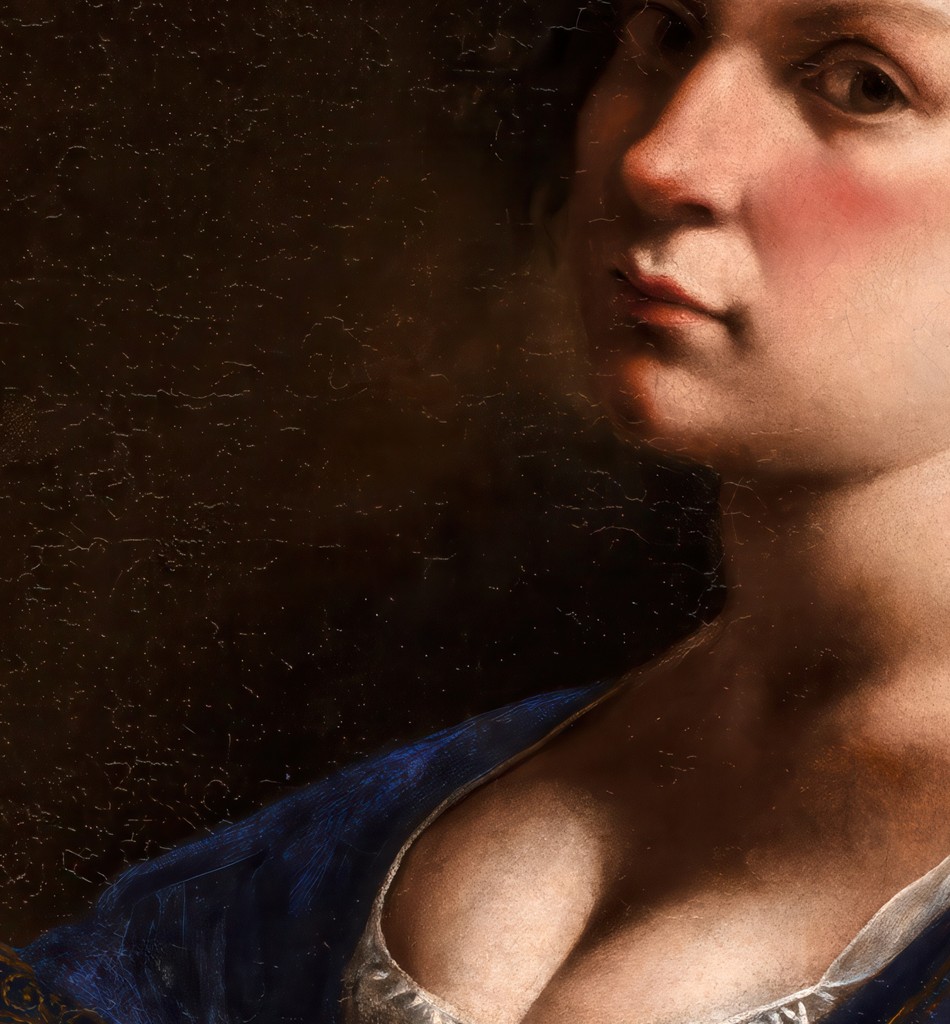
The National Gallery catalogue describes the Lute Player as a half-length self-portrait against a plain dark background, with Artemisia in the role of a performer-musician. It notes the close crop, near-square format, luminous blue gown and gold decoration. [4]
Those features give the painting its directness. The dark ground removes distraction. The figure comes forward. The blue and gold costume catches attention without needing a narrative setting. The lute occupies the lower part of the image, while the face and gaze hold the viewer.
The gaze is essential. Artemisia does not look lost in private music-making. She turns toward the viewer, aware of being seen. That awareness makes the painting performative in the fullest sense. It is not simply a woman with an instrument; it is an artist staging her own presence.
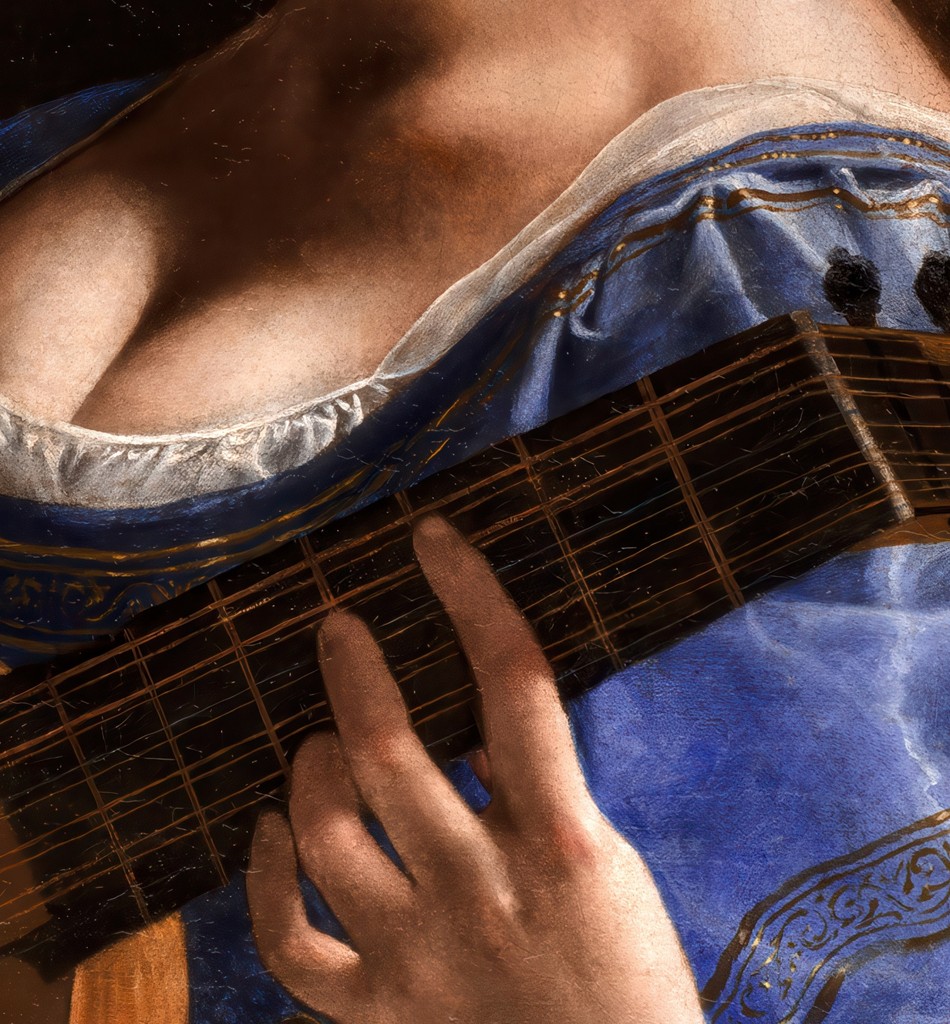
The hands matter too. A lute player is known through touch, timing and control. The instrument asks the viewer to imagine skill as something embodied: fingers on strings, posture held, sound about to happen. Painting and music meet in the idea of disciplined performance.
Annotated Details from Self-Portrait as a Lute Player
This annotated close reading follows the Wadsworth painting as a self-image built through performance: the direct face, lute soundboard, blue-and-gold dress, turned pose, hand on the strings and dark background all help Artemisia present artistic identity through music rather than through brush and palette. The module belongs to the Lute Player page and remains distinct from Saint Catherine and La Pittura.
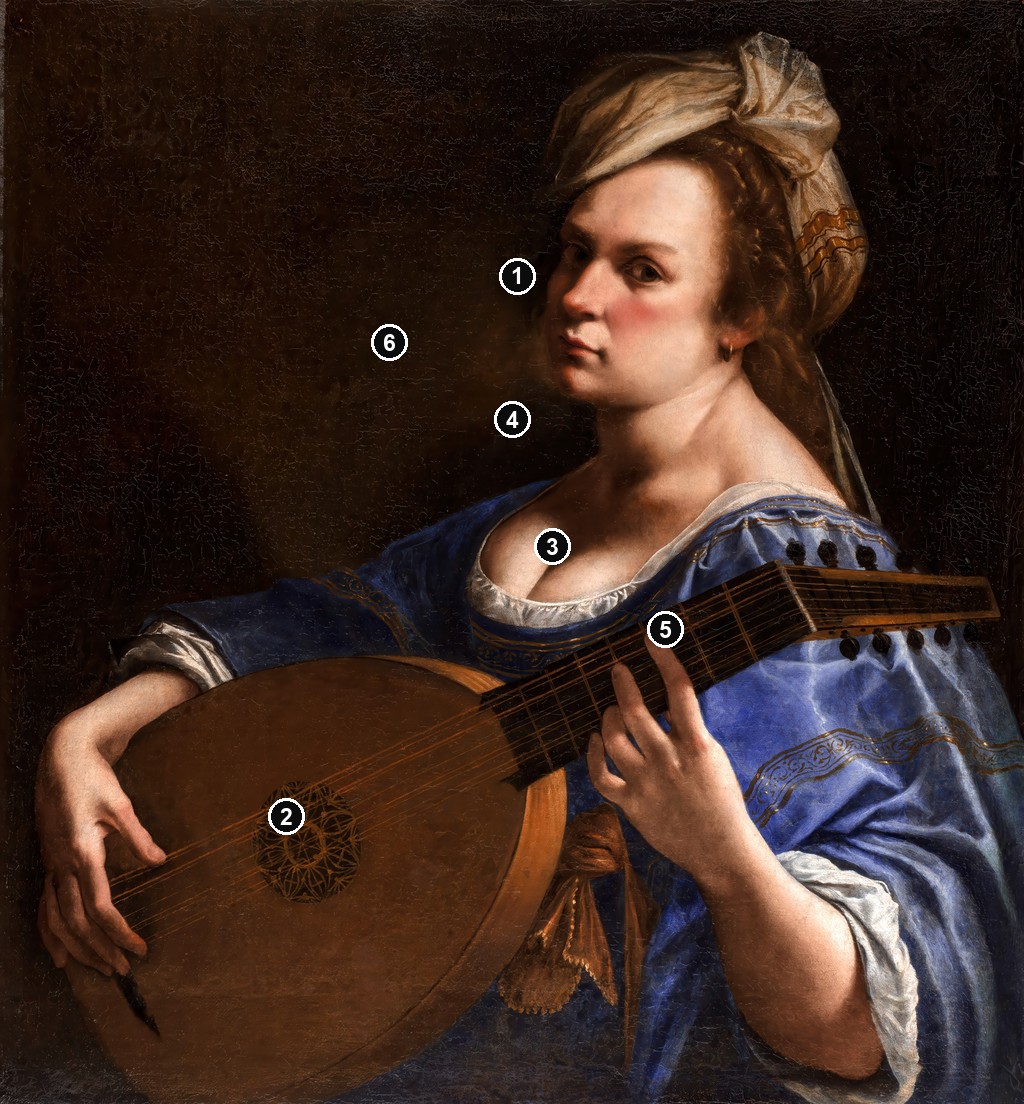
Details from SELF-PORTRAIT AS A LUTE PLAYER
The details show how music, costume, gaze and touch make the self-portrait feel both courtly and controlled. Artemisia turns the role of lute player into a statement of cultivated professional presence.
Face and direct presence
The face turns toward the viewer with controlled awareness. Artemisia is not absorbed in private music-making; she stages herself as a performer who knows she is being seen.
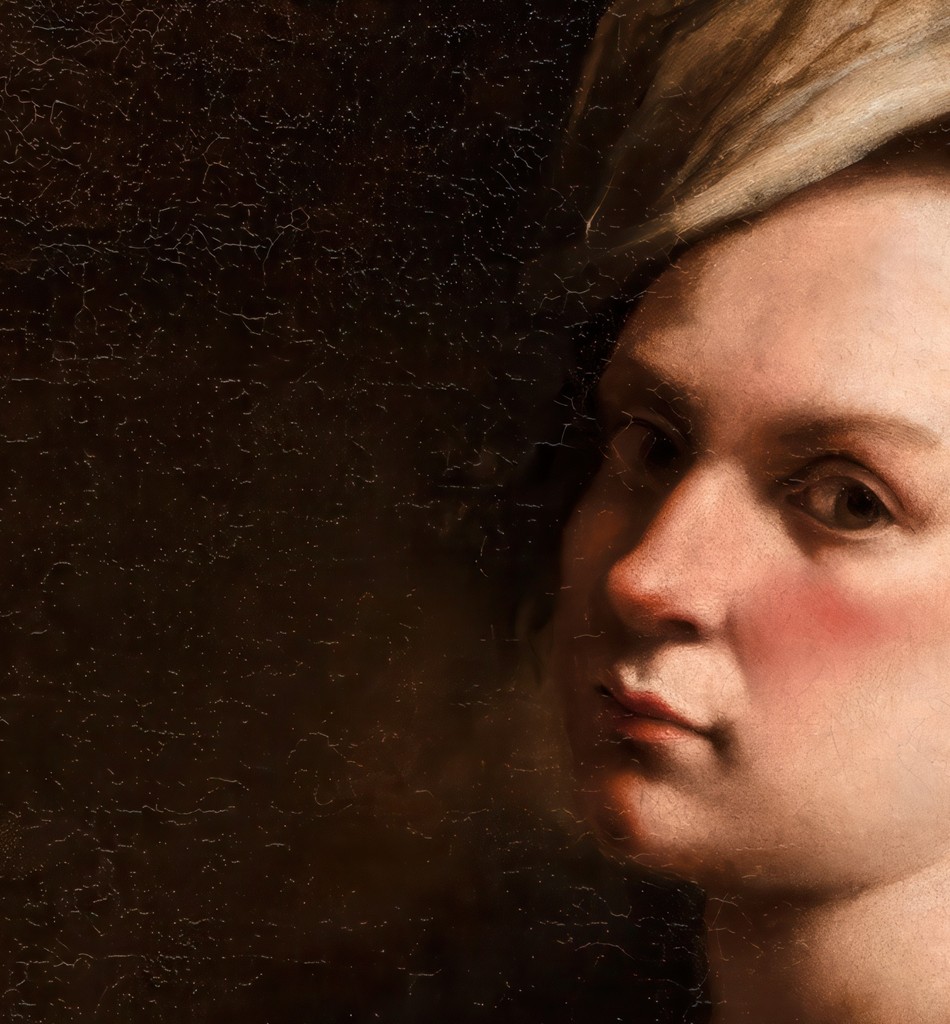
Lute soundboard
The broad body of the lute fills the lower image. It gives the self-portrait its musical identity and asks the viewer to imagine skill as sound, touch and timing.
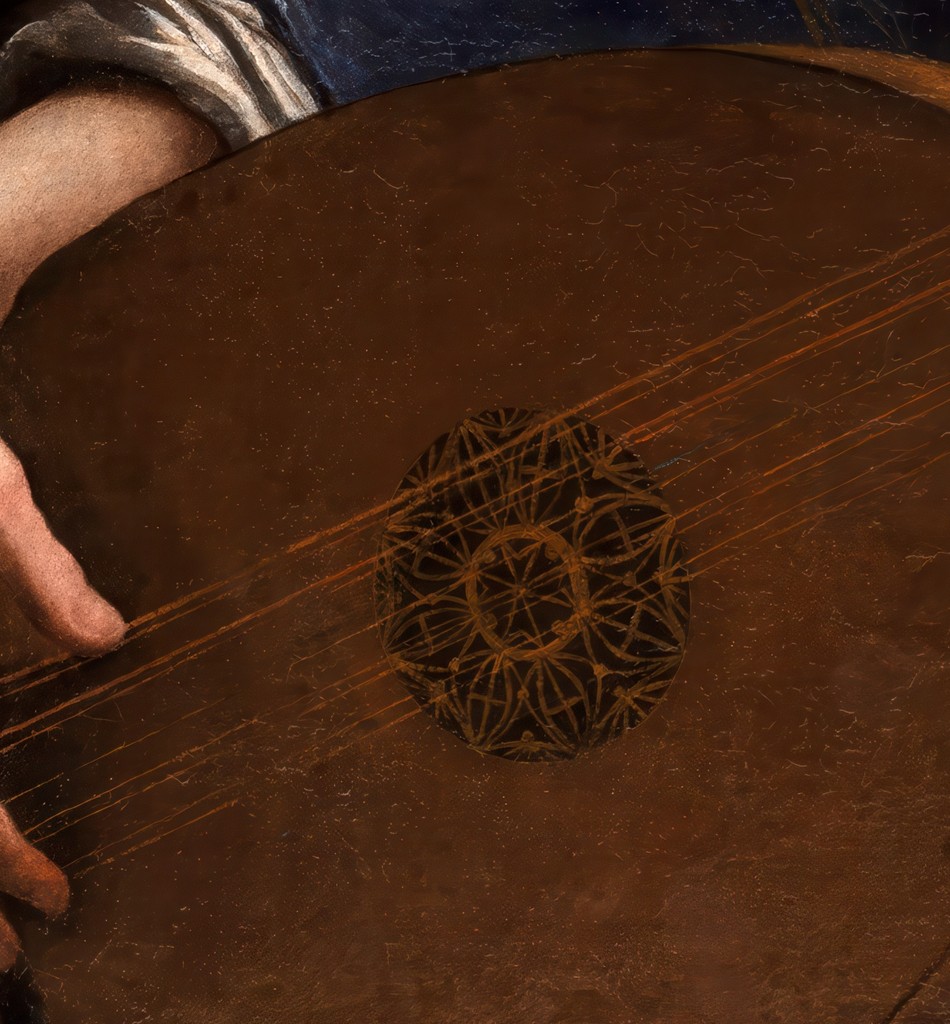
Courtly neckline and blue dress
The luminous blue dress, neckline and gold decoration place the figure in a courtly register. Costume becomes part of Artemisia's public self-fashioning.
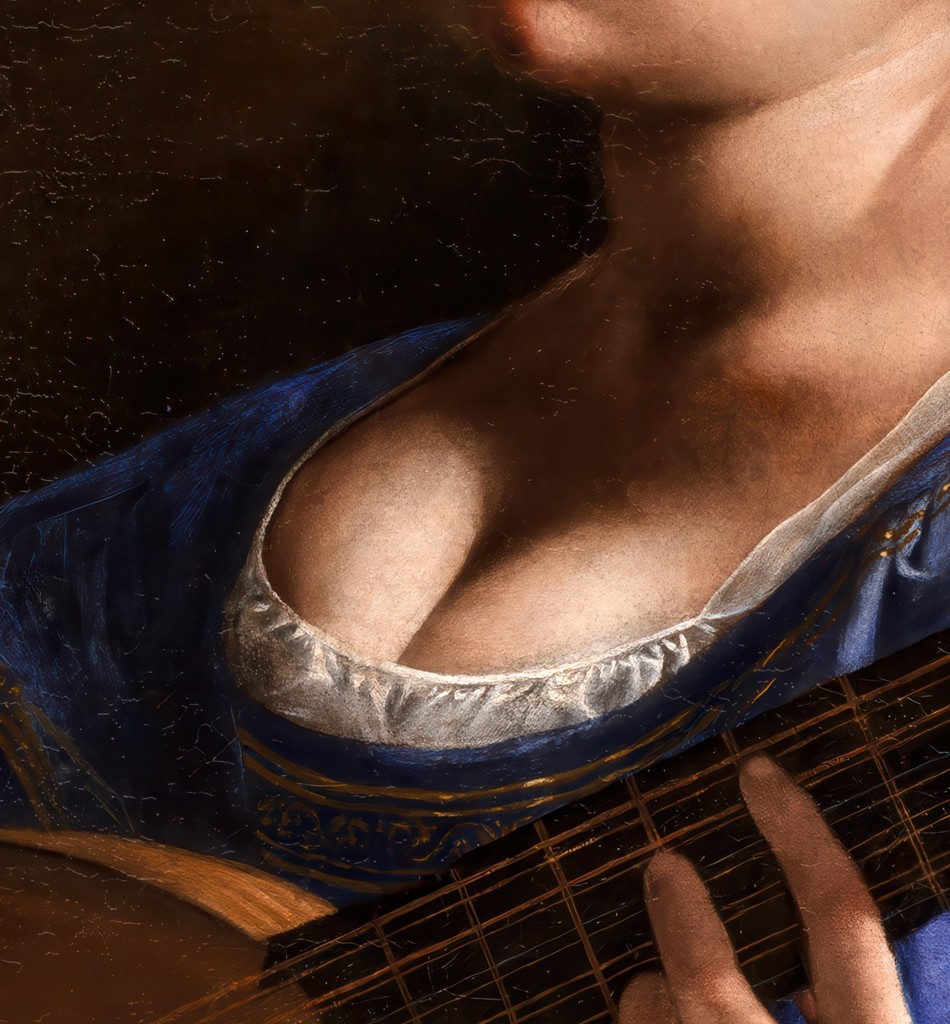
Turned neck and poised body
The neck and upper body pivot between the instrument and the viewer. That turn makes the portrait feel like a poised performance rather than a static likeness.
Hand, strings and instrument neck
The fingers and strings bring the role into the body. The painting suggests trained control through touch, just as Artemisia's painted surface demonstrates control through brushwork.
Shadowed background
The plain dark ground removes narrative distraction and pushes the figure forward. The background helps turn costume, gaze and instrument into the whole drama of the image.

Music, Gender and Performance
A lute could signal accomplishment, but it also carried gendered expectations. Women in elite culture were often praised for musical grace, refinement and controlled display. Artemisia uses that language, but she does not disappear into it.
The painting is powerful because the performer is also the painter. The image presents a role, yet the role is chosen and made by Artemisia herself. She controls the costume, crop, instrument and gaze. She is both the subject of performance and the author of the performance.
This makes the painting different from images where women appear as decorative musicians for someone else's pleasure. Artemisia's self-portrait does not simply offer charm. It asks the viewer to recognise cultivated self-command.
The Wadsworth music programme's inclusion of women composers connected with early Baroque Florence is useful context, because it reminds readers that music was not only a background symbol. Women could participate in musical culture as performers, composers and courtly figures, even when that participation was shaped by social limits. [1]
Artemisia's painting belongs to that broader world of visible accomplishment. The lute is not a prop pasted onto a portrait. It is the means through which the self is staged.
Comparison with Saint Catherine
Self-Portrait as a Lute Player is especially important because of its relationship to Self-Portrait as Saint Catherine of Alexandria. The National Gallery catalogue treats the works together, noting that the Lute Player, the Saint Catherine self-portrait and an Uffizi Saint Catherine are all generally accepted as Florentine-period works, though scholars differ on exact dating and sequence. [4]
The comparison is visual as well as chronological. The National Gallery catalogue includes overlays and discusses the close relationship between the heads, necks and shoulders of the Lute Player and Saint Catherine. It also warns that the reuse of design was not mechanical; the handling and meaning of the two paintings differ. [4]
That distinction is crucial for reading the painting. The Lute Player should not be treated as a rehearsal for Saint Catherine or as an inferior version of it. It is a different self-image. Saint Catherine gives Artemisia a learned, sacred and martyrial role. The Lute Player gives her a courtly, musical and performative role.
In both paintings, Artemisia turns herself into more than a likeness. But the emotional tone changes. Catherine carries endurance, sanctity and threatened violence. The lute player carries refinement, sound, self-possession and display. Reading them together makes each clearer.
Comparison with La Pittura
The later Self-Portrait as the Allegory of Painting, or La Pittura, presents Artemisia through the language of the artist's profession itself. There, she becomes Painting: active, absorbed, leaning into the work. The Lute Player does something subtler. It does not show the act of painting, but it still represents artistry.
Music and painting were both arts of skill, discipline and performance. By presenting herself with a lute, Artemisia connects her image to a cultivated art that unfolds in time and requires trained hands. The comparison with La Pittura helps readers see that the Lute Player is not a retreat from professional identity. It is another path into it.
La Pittura makes artistic labour explicit. The Lute Player makes artistic presence social. One shows the painter at work; the other shows the painter as a performer in a world of courtly culture. Both are self-fashioning images, but they speak in different registers.
The difference also protects the Lute Player from being overread. It is not necessary to make it secretly about painting in order for it to matter. Music is enough. Performance is enough. Artemisia's self-presentation through another art is part of its richness.
Women Artists and the By Her Hand Context
The Detroit Institute of Arts included Self-Portrait as a Lute Player in By Her Hand: Artemisia Gentileschi and Women Artists in Italy, 1500-1800, an exhibition about women artists' creativity and professional navigation in a male-dominated Italian art world. [2]
That context is useful because it places the painting among works by other women rather than isolating Artemisia as a solitary exception. Her self-portrait belongs to a wider history of women artists shaping public identity through portraiture, devotional works, still lifes, allegory, performance and professional skill.
The painting's confidence matters in that setting. Artemisia does not appear apologetic. She looks out, dressed for visibility, holding an instrument associated with accomplishment. The image participates in a culture that often constrained women, but it also shows a woman artist using that culture's codes to make herself legible and memorable.
This is one reason the painting is poorly served by a narrow trauma-first framing. Artemisia's biography matters, but this painting is not primarily a scene of suffering. It is a self-image of cultivated authority.
What This Painting Adds to Artemisia's Story
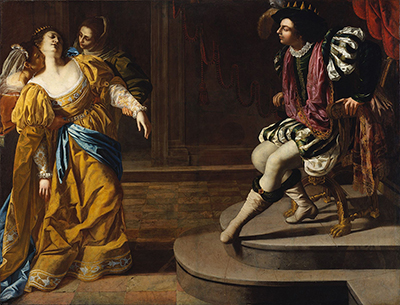
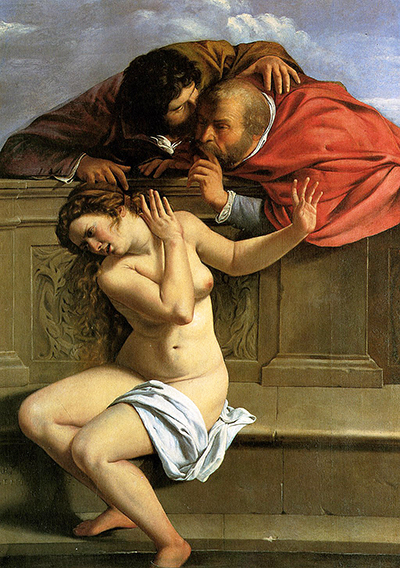
Self-Portrait as a Lute Player expands the range of Artemisia's public image. Many readers first meet her through narrative paintings of pressure, violence or moral decision: Susanna watched by the elders, Judith killing Holofernes, Esther risking herself before Ahasuerus. Those works are central, but they do not exhaust her art. The Wadsworth self-portrait shows Artemisia thinking about identity in a quieter and more socially polished key.
The painting also helps correct the idea that Artemisia's importance depends only on dramatic subject matter. Here, the drama is internal to presentation. She asks what can be said through a glance, a dress, a musical instrument and a close format. She makes the viewer attend to self-command rather than narrative action.
That is why the work belongs in conversation with Allegory of Inclination, Saint Catherine and La Pittura. In each case, Artemisia works through a role. Inclination turns a personified quality into a body painted for Casa Buonarroti. Saint Catherine makes self-portraiture speak through a learned martyr. La Pittura turns the woman painter into the allegory of painting. The Lute Player belongs to the same imaginative pattern, but its language is music and courtly presence.
The painting is also useful because it lets readers see Artemisia's ambition without forcing every work into the same biographical frame. The Florentine period was a moment of professional repositioning, and the self-portrait's elegance suits that context. It does not need to prove a single patron's request or a hidden personal confession to matter. Its force lies in Artemisia's ability to make a cultivated social role feel like an assertion of authorship.
For that reason, the painting is best read with confidence and restraint. The sources support its title, date range, collection identity, format, relation to Saint Catherine and exhibition context. They also support reading the painting as a self-image built through music and performance. They do not justify unsupported claims about a specific musical performance, detailed provenance, or direct commission circumstances.
How to Read the Painting Today
Begin with the role. Artemisia appears as a lute player, not simply as herself in ordinary dress. The role is part of the meaning. She is presenting a self shaped by music, performance and courtly culture.
Then look at the format. The dark background, close crop and near-square canvas concentrate attention on the figure. There is no elaborate setting. The self is made through face, dress, instrument and gaze.
Look next at the lute. It is not a decorative accessory. It asks the viewer to imagine skill, sound and touch. The instrument turns the portrait into a poised performance.
Finally, compare the painting with Saint Catherine and La Pittura without letting those works take it over. Saint Catherine uses sacred identity. La Pittura uses artistic allegory. The Lute Player uses music. Together they show Artemisia exploring several ways a woman artist could occupy a public image.
That is why Self-Portrait as a Lute Player deserves its own page. It is not the most violent, famous or source-rich Artemisia painting, but it gives readers one of the clearest views of her self-fashioning: elegant, intelligent, performative and fully aware of being seen.
Related Pages
- Artemisia Gentileschi
- Artemisia Gentileschi Biography
- Artemisia Gentileschi Paintings
- Self-Portrait as Saint Catherine of Alexandria
- Self-Portrait as the Allegory of Painting
- Allegory of Inclination
- Baroque Artists
Frequently Asked Questions
Discussion
What should readers notice when looking closely at Artemisia Gentileschi's Self-Portrait as a Lute Player?
Reader Insights
How does the lute change the meaning of a self-portrait by a painter?
Where does Artemisia seem to perform for the viewer, and where does she seem to control the encounter?
How does this image differ from Artemisia's Saint Catherine and La Pittura self-images?
Join the Conversation
Share your reading of this painting below.
References
- Wadsworth Atheneum Museum of Art, Gallery Music: Artemisia Gentileschi's Self-Portrait as a Lute Player. Credit line for reproduction: Artemisia Gentileschi, Self-Portrait as a Lute Player, c. 1615-18, oil on canvas, Charles H. Schwartz Endowment Fund, 2014.4.1, Wadsworth Atheneum Museum of Art.
- Detroit Institute of Arts, By Her Hand: Artemisia Gentileschi and Women Artists in Italy, 1500-1800.
- National Gallery, London, Artemisia exhibition page.
- National Gallery, London, Self-Portrait as Saint Catherine of Alexandria catalogue entry.
- A&AePortal, Self-Portrait as a Lute Player.
- Wikimedia Commons, File: Artemisia Gentileschi - Self-Portrait as a Lute Player.JPG. Reproduction route listed as Public Domain Mark 1.0 on Commons; original artwork by Artemisia Gentileschi is public domain.
 Artemisia Gentileschi.jpg)
 Artemisia Gentileschi.jpg)