 by Tom Gurney
Tom Gurney BSc (Hons) is an art history expert with over 20 years experience
Published on June 19, 2020 / Updated on October 14, 2023
Email: tomgurney1@gmail.com / Phone: +44 7429 011000
Camille Claudel: Introduction
In Camille Claudel’s The Waltz (La Valse), two dancers lean so far into their turn that either body on its own would seem about to fall. Their hold makes the tilt possible. In The Mature Age (L’Âge mûr), a kneeling woman reaches towards a man being led away, and the little interval between their hands makes his departure feel final. Claudel (1864–1943) could make a sculpture turn on the difference between a grip and a gap. In other works, the decisive feature is a stone screen that hides a conversation, or the lifted face of a child who seems to have just noticed someone. The scale changes with the kind of attention each sculpture asks for. [1] [2] [3] [4]
The French sculptor first exhibited busts in Paris in the early 1880s. She went on to show large figure groups at the Salon and to make scenes small enough for a cabinet or a mantelpiece. These formats overlap throughout her career. The year her dancers appeared at the Salon, she also exhibited a figure almost immobilised by her own hair. Around the time Eugène Blot was issuing versions of her sculptures in bronze, she was still making portraits of her family. Follow the sculptures across these changes of subject and size, and the choices about who can move, who is held and what the viewer gets to see come into focus. [5] [6] [7]
Camille Claudel Auguste Rodin
At a Glance
- Dates1864–1943
- FieldSculpture
Camille Claudel in context
Symbolism in the visual arts
Broad visual span, 1870s–1910sAuguste Rodin
Claudel’s atelier years and later professional contactOld Hélène
c. 1881–82Sakuntala
Plaster shown in 1888The Waltz
Developed c. 1889–93The Little Châtelaine
First model c. 1892–93The Gossips
Described in 1893, shown in 1895The Mature Age
First and second versions, c. 1894–99The Wave
Plaster shown in 1897, mixed-material object dated 1897–1903 (?)Perseus and the Gorgon
Nogent design and marble, c. 1897–1902The Wounded Niobid
Modelled in 1906Camille Claudel’s artistic connections
Trace the people who shaped her training and the ways her sculpture reached later audiences.
- Alfred Boucher Boucher encouraged Claudel’s early modelling and advised the young sculptors who shared a studio in Paris. [5]
- Auguste Rodin Claudel worked in Rodin’s atelier while exhibiting independently. Her portrait of him gives the relationship a form we can still study. [11]
- Eugène Blot Blot brought Claudel’s bronzes to collectors and exhibited her work alongside Bernhard Hoetger in 1905. [22]
- Musée Camille Claudel The museum in Nogent-sur-Seine brings together distinct versions of her sculpture, making changes in scale and material easier to compare. [24]
Contents
- From a brother’s profile to a child’s upward glance
- An embrace, a turn and a separation
- A private conversation and a wave about to break
- How a sculpture changes at a different scale
- How to look at Claudel’s sculpture in a gallery
- Where to see Camille Claudel’s sculptures
From a brother’s profile to a child’s upward glance
The portrait known as Paul Claudel at Sixteen Years Old also goes by Jeune Romain and Mon frère. The second name brings us into the family, while Young Roman directs attention to the set of the head and the shape of the bust. The museum at Nogent-sur-Seine connects the format with early Italian Renaissance busts Claudel could study at the Louvre. In the painted plaster at the Art Institute of Chicago, mottled colour gives the surface something of the appearance of aged bronze. The effect brings a teenager into a tradition that reaches well beyond the household. Claudel’s portrait of Paul at thirty-seven brings the comparison back to the individual. In the bronze at Nogent, the heavier lower face and the treatment of the neck change the weight of the likeness. She modelled it in 1905, and P. Converset cast this example in 1912–13. [5] [7] [8] [9]
In The Little Châtelaine (La Petite Châtelaine), the upturned face gives a bust a reach beyond its base. The head turns as it tilts and the eyes look above our own when the sculpture is set at a suitable height. A view at eye level makes the broad forehead and wide eyes the first things one sees. Move to the side and the angle of the neck becomes the feature that holds the pose together. The sitter was Marguerite Boyer, aged six when Claudel began the portrait in 1892 at the Château de l’Islette. The different hair treatments in the marble versions change how the eye follows the head around. The Getty’s exhibition included a marble with a straight plait and described another version in which Claudel thinned the stone enough to make parts of the face appear translucent. The patinated plaster at Nogent offers a different way to see the portrait, with the tilt legible through the changing planes of cheek and neck. [4] [5]
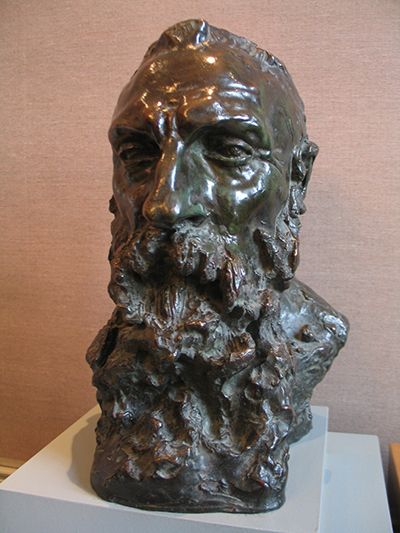
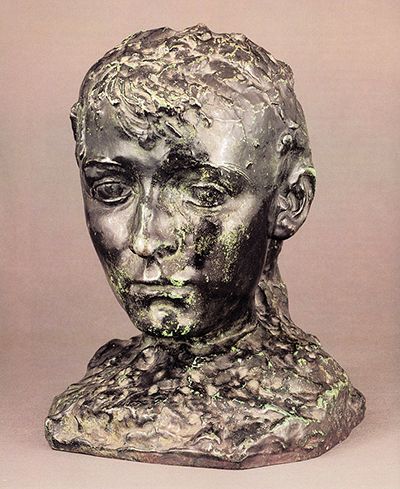
An early terracotta, Old Hélène (La Vieille Hélène), brings out the turn of a face through the uneven relief around the cheeks, eyes and mouth. In Claudel’s Bust of Auguste Rodin, the strongly modelled forehead and nose stand forward above the broken texture of the beard. The Musée Rodin’s own bronze was cast by Gruet in 1892, the year Claudel first exhibited the portrait. These heads put different demands on the eye. One is small enough to bring the viewer close to the marks in the clay. The other gives the sitter’s features the prominence of a public likeness. The overlap is in the way a forehead, cheek or jaw can carry expression well beyond the eyes. [10] [11]
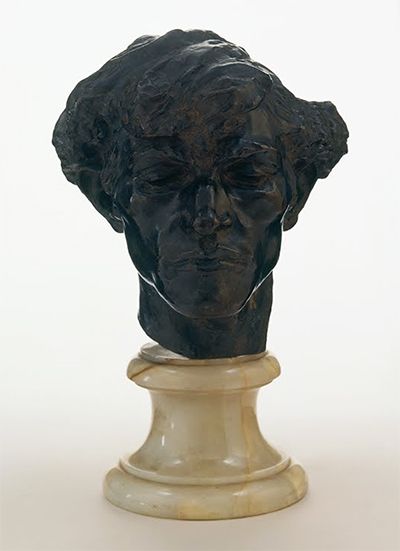
Claudel studied at the Académie Colarossi and shared rented studio space with other women sculptors in Paris. Alfred Boucher encouraged her training, and she was making and exhibiting her own sculpture while working in Rodin’s studio. Family portraits gave her an early public foothold. A bust of her sister entered a French museum through a gift from Baroness Charlotte de Rothschild when Claudel was still in her twenties. Her biography follows the whole career, and the account of Claudel and Rodin looks at the studio and their relationship in detail. [5] [12]
An embrace, a turn and a separation
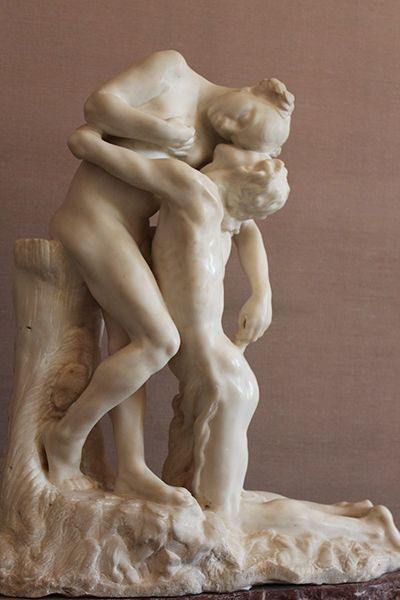
In Sakuntala (also spelled Sakountala), the kneeling figure lifts himself towards a woman who folds down into his embrace. The action takes place at two levels, and the joined bodies give it a clear direction. Trace the curve from her inclined head through the shoulders towards his bent legs. From the side, the space around their torsos opens up and makes it easier to see how much each leans into the other. The subject in the 1888 Salon plaster was the reunion from Kālidāsa’s play, after King Dushyanta recovers his memory of Sakuntala. The sculpture earned an honourable mention, and that plaster, just over 190 centimetres high, belongs to the Musée Bertrand in Châteauroux. [5] [13]
The composition had a second life under two more titles. In the Musée Rodin’s 1905 marble, Vertumne et Pomone (Vertumnus and Pomona), the bodies are white against a red marble plinth. The museum records it at 91 centimetres high, a marked change from the Salon plaster. The new title gives the reunion a Roman mythological setting. In Blot’s bronze edition it became L’Abandon (The Abandonment), a title that directs attention to the surrender of one body to the other. The three names belong to specific versions and their histories. That distinction lets us see how much of the encounter still comes across after the names of the lovers, the height and the substance of the object have changed. [5] [13] [14]
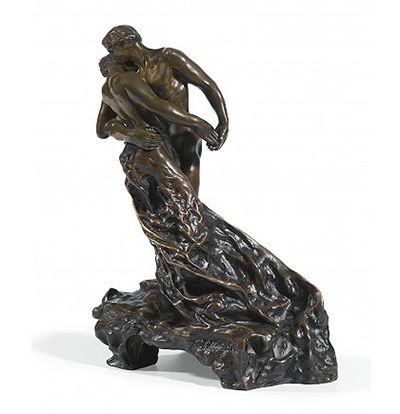
The Waltz takes a related closeness and gives it a moving axis. On the Musée Rodin’s bronze, the man’s lifted foot and the cloth drawn out to one side set the movement going in the same direction. The narrow stance makes the bodies look as though they need the next step to stay upright. Look higher and the faces remain close, with the partners’ attention contained inside the turn. Drapery entered the design after the state-appointed inspector objected to the nudity of the first composition. The plaster exhibited in 1893 included drapery, but the projected state marble did not go ahead. Claudel reduced the cloth and changed the base in subsequent versions. At Nogent, a glazed stoneware edition by Émile Muller and a bronze issued by Blot give the folds quite different surfaces. Glaze can carry colour across a fold as the form rounds away from the light. In bronze, highlights on the ridges can make the same passage read as a succession of short turns. [1] [5] [15]
Claudel exhibited Clotho at the same Salon in 1893. In the Musée Rodin’s plaster, thick strands of hair weigh down the elderly figure. The mythical Fate traditionally spins the thread of life. Here the strands seem to hamper the spinner herself. Where the dancers’ folds flare into the surrounding air, Clotho’s hair draws a boundary around a body that seems scarcely able to move. The two sculptures use flowing lines to make opposite things happen, one casting the eye out into space, the other sending it back towards the figure. [1] [6]
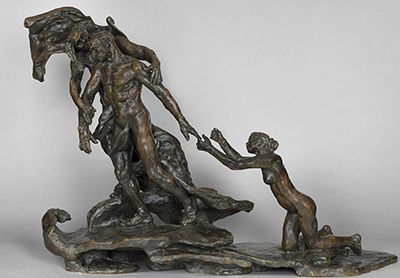
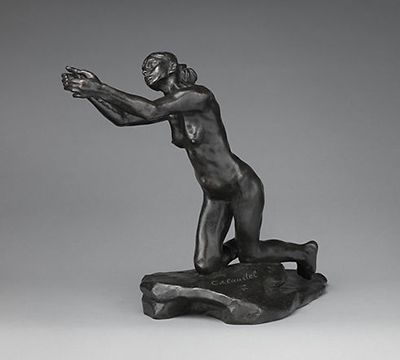
In The Mature Age, motion runs across the group. An older woman draws a man forward while the young kneeling figure reaches after him. The first version survives in plaster. In it, the young woman retains a hold on the man. In the later composition their hands part, and the space between them makes the sculpture seem to unfold in time. Compare the low, long reach of the kneeling figure with the advancing mass of the other two. The body that stays behind takes up space very differently from those that move on. The Implorer (L’Implorante, also La Suppliante) also exists independently, where the lift of the arms directs the eye out towards a space the group would have filled. [2] [16]
The Musée Rodin reads the group as an allegory of destiny. Paul Claudel later identified the kneeling woman with his sister, a reading that has helped attach the figures to the story of her relationship with Rodin. The changing positions of the hands give the two interpretations a common point of departure. They make the difference between being able to hold someone and having to watch them go intelligible at a glance. The French state initiated the commission for the second version in 1895 and paid for work on it, but the model was never delivered to the state’s marble depot. Captain Louis Tissier backed the bronze now at the Musée d’Orsay, cast around 1902. The Musée Rodin holds a separate bronze cast by Carvilhani in 1913. [2] [5] [17]
The Orsay record describes a bronze group in three parts. Claudel’s signature appears at the front of the base, while the foundry named its workshop and marked the cast as a first proof on the back. The two inscriptions place different kinds of work on the same object. One belongs to the sculptor who worked out the figure group, the other to the workshop that made this particular bronze. The front offers the scene almost as a single sweep, from the young woman’s fingers to the older woman’s drapery. Turning to the back gives that sweep a material history. The dated cast survived even after the later plaster model disappeared. [2] [17]
A private conversation and a wave about to break
In The Gossips (Les Causeuses, also Les Bavardes), four seated women incline towards one another beside a screen. The head turned towards the speaker and the hand lifted towards a face are gestures one might notice in passing. Together they make a circle of attention. The screen interrupts the view from one side and makes it possible to discover the group by moving round it. The bronze and onyx marble example at the Musée Rodin is only 45 centimetres high. From close by, the colour and markings of the stone make the screen a surface to linger over in its own right. Seen from farther away, the enclosure is what lets the sculpture suggest that something is being said out of earshot. A plaster version was exhibited in 1895, and Claudel showed an onyx and bronze version two years later. [3]
In The Wave (La Vague, also Les Baigneuses), the same pairing of materials serves a different action. The curved mass of greenish onyx marble overhangs three small bronze bathers. Their repeated knee bends give the eye three beats against the single movement of the water. The stone has to look substantial enough to threaten them and thin enough at the curl to suggest water in motion. A view across the bathers stresses their repetition, while a side view reveals how far the crest projects. The Musée Rodin compares the shape and colour of the composition to Hokusai’s celebrated print. The effect specific to Claudel’s sculpture is that the stone occupies the space above the figures, and from some angles seems ready to fill it. [18]
These works belong with Claudel’s sketches from life (Croquis d’après nature), which turn ordinary acts into small, self-contained scenes. The sequence can be as slight as a group leaning in to listen or a woman bending towards a hearth, as in Dream by the Fireside (Rêve au coin du feu). The example shown by the Getty combines bronze and alabaster. Setting a body next to a distinct block of stone lets Claudel use the object’s structure to establish the space a figure inhabits. The screen at the edge of a conversation, the crest above the bathers and the hearth beside the solitary figure are as necessary to the scene as the gestures. Their size lets the viewer see the whole enclosure and then come closer to make out what the figures are doing inside it. [3] [5] [18]
How a sculpture changes at a different scale
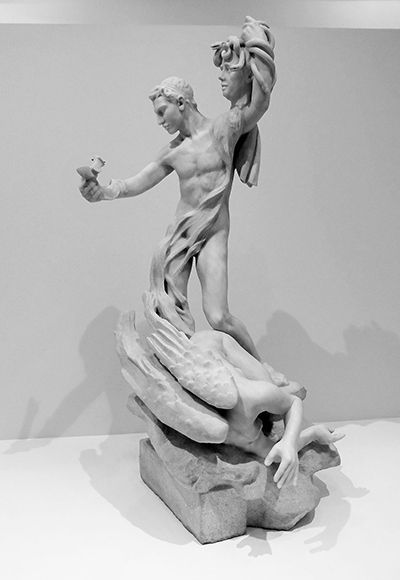
The marble Perseus and the Gorgon (Persée et la Gorgone) in Nogent is 196 centimetres high. Perseus stands above the folded, headless figure of Medusa and holds her head aloft. Looking up at the work makes the vertical distance between the two feel longer. Countess de Maigret commissioned the marble, and François Pompon carved it from Claudel’s plaster model. The marble was completed in 1902. The National Museum of Western Art in Tokyo holds an unnumbered bronze proof that Blot sand-cast in 1905–06. At 51 centimetres high, it lets a viewer take in head, figure and base almost together. The Tokyo bronze retains the shield, which is absent from the Nogent marble. It gives Perseus’s gaze a destination across from the raised head, recalling the reflected view that allowed him to face Medusa. The scale and survival of that detail change where the viewer looks first. [19] [20] [21]
Claudel’s technique and materials help explain why a museum may give two dates for a sculpture. Modelling establishes the form, and the production of a particular bronze can follow years later. Plaster could be an exhibition work, as it was for Sakuntala in 1888. It could also serve as a model for someone to carve in marble, as with Perseus. An edition might bring a design into several collections, with variations in size, material or surface that reward separate attention. Blot issued bronzes and also put Claudel’s work before gallery visitors, pairing her with the German sculptor Bernhard Hoetger in an exhibition in 1905. Following the patrons, exhibitions and editions gives another view of what it took to move a sculpture from the studio to a public room. [13] [20] [22]
How to look at Claudel’s sculpture in a gallery
Start with the distance the sculpture asks you to stand from it. The nearly two-metre marble of Perseus and the Gorgon brings the standing figure and the severed head above the eye level of most visitors. Medusa’s body occupies the lower part of the composition, and a viewer who remains fixed on the heads will miss much of the story. Tokyo’s half-metre bronze lets the eye cross the whole group in a single glance, from the shield to the base. In a photograph of either work, the dimensions printed on the label help restore the difference between those two encounters. A reproduction scaled to the width of a page can make very different objects look like twins. [19] [20] [21]
Then change sides. The raised head of The Little Châtelaine seems directed at someone just above the child. From the side it becomes clear how much of that impression depends on the chin, the long line of the throat and the angle at which the head leaves the shoulders. Looking farther around the bust, the treatment of the hair can help you identify which version you are seeing. Apply the same exercise to The Waltz. A side view lets the eye separate the dancers’ bodies and notice where cloth extends the outline. The turn of the figures becomes easier to imagine when their profiles and the fabric stop overlapping. [5] [15]
Compare colour at the junction between materials. In the Musée Rodin’s The Wave, the dark bathers and the stone above them describe the instant before a collision. The shadow below the stone matters as much as its colour. In The Gossips, Claudel put colour and shade to a different use by leading the eye toward a space shared by several listeners. Those two small groups reward the pace of a portrait. Follow a bent arm or a turned head first, then look for the line of stone that draws the figures together or threatens to close over them. [10] [18]
The Getty’s 2024 exhibition, organised with the Art Institute of Chicago, brought together about sixty sculptures. Its selection included a small bronze Torso of a Crouching Woman, modelled in the mid-1880s and cast decades later, as well as a bronze Bust of Rodin. That juxtaposition gives two different starting points for the career. One focuses on how much of a pose a sculptor can preserve in a fragment. The other begins with the public identity of a famous sitter. In either case, a model date tells you when Claudel developed the form, while the date of a cast tells you when that particular piece of metal came into being. [23]
Where to see Camille Claudel’s sculptures
At the Musée Camille Claudel in Nogent-sur-Seine, the collection brings the early portraits, variants of The Waltz and the monumental Perseus together. The museum opened in 2017, building on the town’s earlier sculpture museum and its acquisition of the collection assembled by Claudel’s great-niece Reine-Marie Paris and Philippe Cressent. In Paris, the Musée Rodin holds The Gossips and The Wave, a pair worth comparing for the different work the stone does in each. It also holds the marble Vertumne et Pomone. For The Mature Age, check both the Musée Rodin and the Musée d’Orsay records for the individual casts. The Orsay bronze measures 163 centimetres across, while the Musée Rodin records a width of just over 181 centimetres for its bronze. Nogent holds a smaller bronze version, which gives the advancing figures and the kneeling woman a more compact presence. [2] [3] [14] [15] [17] [18] [24] [25]
The works came into these collections in stages. The Musée Rodin mounted the first Claudel retrospective in 1951, eight years after her death. Interest widened again in the 1980s through exhibitions, books and films. Later surveys could borrow works from several collections and set versions side by side, as the Getty did with different marbles of The Little Châtelaine. The history of Claudel’s rediscovery also helps explain which parts of her career a visitor can see in one place. In Nogent, setting Claudel beside other sculptors of her period makes it easier to recognise a shared format like the portrait bust and then to notice what she did with it. [5] [24]
Further afield, the Musée Bertrand holds the tall Sakuntala plaster in Châteauroux, the Art Institute of Chicago holds the painted plaster Young Roman, and Tokyo has the Blot bronze of Perseus. For a visit, consult the museum guide and confirm the display of the specific work with its holding institution. Collection photographs can also make a first comparison possible across cities. With The Waltz, start by tracing the drapery towards the base. With The Gossips, follow the angle of the screen. With The Mature Age, find a view where the two reaching hands can be seen apart. A change of angle can bring out the small decision on which a whole group depends. [1] [2] [3] [5] [13] [21]
Follow Camille Claudel’s career through four stages
Essential works
The Waltz
c. 1889–93 · The dancers’ shared balance changes with the view.
The Mature Age
c. 1894–99 · A gap between reaching hands carries the drama.
Sakuntala
1886–88 · Two lovers meet in a composition Claudel later reworked in marble and bronze.
Perseus and the Gorgon
c. 1897–1902 · A monumental marble and related bronzes give different weight to the shield and figure.
The Implorer
c. 1894–99 · The kneeling figure developed its own life outside the group.
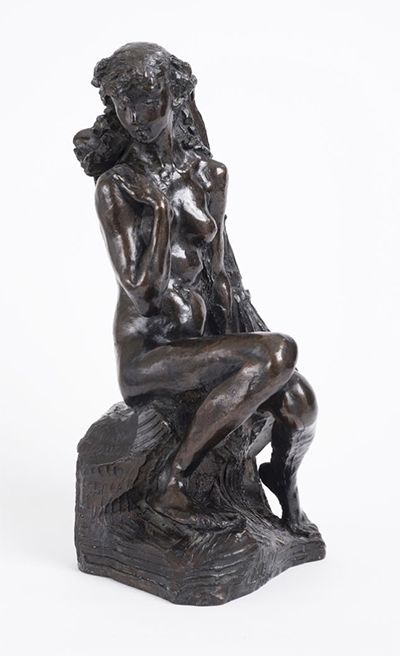
Young Girl with a Sheaf
c. 1886–87 · The bent figure draws the sheaf into its compact silhouette.
Explore Camille Claudel’s life and work
- Biography
- Claudel and Rodin
- Technique and materials
- Training and women sculptors in Paris
- Patrons, exhibitions and editions
- Where to see Claudel’s sculptures
- Claudel’s Sketches from Life
- Camille Claudel’s Letters
- Camille and Paul Claudel
- Myth and Allegory in Claudel’s Sculpture
- The Rediscovery of Camille Claudel
Artworks directory
| Name | Date | Medium |
|---|---|---|
| The Mature Age | 1894–99 | Sculpture |
| The Waltz | c. 1889–93 | Sculpture |
| Sakuntala | 1886–88 | Sculpture |
| The Little Châtelaine | 1892–93 | Sculpture |
| The Gossips | c. 1893 | Sculpture |
| The Wave | 1897–1903 | Sculpture |
| Perseus and the Gorgon | c. 1897–1902 | Sculpture |
| The Implorer | c. 1894–99 | Sculpture |
| Clotho | 1893 | Sculpture |
| Bust of Auguste Rodin | c. 1886–89 | Sculpture |
| Paul Claudel at Sixteen Years Old | c. 1882–87 | Sculpture |
| Young Girl with a Sheaf | c. 1886–87 | Sculpture |
| Giganti | c. 1885 | Sculpture |
| Crouching Woman | c. 1884–85 | Sculpture |
| The Hungry Dog | c. 1893 | Sculpture |
| Old Hélène | c. 1881–82 | Sculpture |
| Fortune | c. 1902–05 | Sculpture |
| The Wounded Niobid | 1906 | Sculpture |
| The Siren, or The Flute Player | c. 1904–05 | Sculpture |
| Deep Thought | c. 1898 | Sculpture |
| Dream by the Fireside | c. 1899 | Sculpture |
| Paul Claudel at Thirty-Seven | 1905 | Sculpture |
| Portrait de Madame Claudel | c. 1883 | Sculpture Musée Camille Claudel. |
| Jeune Femme aux yeux clos | c. 1885 | Sculpture Musée Camille Claudel. |
| Ferdinande de Massary | 1888 | Sculpture Musée Camille Claudel. |
| Léon Lhermitte | 1889 | Sculpture Musée Camille Claudel. |
| Étude de main gauche | c. 1889 | Sculpture Musée Camille Claudel. |
| Vieil aveugle chantant | c. 1894 | Sculpture Musée Camille Claudel. |
| Tête de vieillard | c. 1890 | Sculpture Musée Camille Claudel. |
| Étude pour la tête d’Hamadryade | c. 1895 | Sculpture Musée Camille Claudel. |
| Aurore | c. 1900 | Sculpture Musée Camille Claudel. |
Discussion
Look again at the images and ideas explored in Camille Claudel. These editorial prompts invite your observations.
Reader Insights
How does the gap between two hands change the action in The Mature Age?
What changes when you look from a portrait bust to one of Claudel’s small groups?
Join the Conversation
Share a detail, comparison or question about Camille Claudel below.
References
- Musée Rodin, The Waltz or The Waltzers, bronze S.01013,. View source.
- Musée Rodin, L’Âge mûr, comparison of versions and collection record for S.01380,. View source.
- Musée Rodin, The Gossips or Women Chatting, S.1006,. View source.
- Musée Camille Claudel, La Petite Châtelaine, patinated plaster 2010.1.12,. View source.
- J. Paul Getty Museum, Camille Claudel, exhibition guide and object captions,. View source.
- Musée Rodin, Clotho, plaster S.01379,. View source.
- Musée Camille Claudel, Paul Claudel à trente-sept ans, bronze 2016.1.1,. View source.
- Musée Camille Claudel, Camille Claudel portraitiste, collection gallery,. View source.
- French Sculpture Census, Young Roman, Art Institute of Chicago 2022.1438, including the Art Institute’s description of the painted finish,. View source.
- Musée Camille Claudel, Old Hélène or Old Woman, terracotta 2010.1.1,. View source.
- Musée Rodin, Portrait of Rodin, bronze S.1021,. View source.
- Musée de Pont-Aven, In Camille Claudel’s Time, Being a Sculptress in Paris, exhibition texts,. View source.
- Musée Bertrand and Ministère de la Culture, Sakountala, Joconde collection record for patinated plaster 518,. View source.
- Musée Rodin, Vertumne et Pomone, marble S.01293,. View source.
- Musée Camille Claudel, Autour de La Valse, collection gallery,. View source.
- Musée Rodin, L’Implorante, dit aussi La Suppliante, bronze S.01377,. View source.
- Musée d’Orsay, L’Age mur, bronze RF 3606,. View source.
- Musée Rodin, The Wave or The Bathers, S.06659,. View source.
- Musée Camille Claudel, Perseus and the Gorgon, marble 2009.1.1,. View source.
- Musée Camille Claudel, La mythologie au musée, Perseus and the Gorgon teaching sheet,. View source.
- National Museum of Western Art, Perseus and the Gorgon, bronze proof S.2021-0001,. View source.
- Alte Nationalgalerie, Camille Claudel und Bernhard Hoetger. Emanzipation von Rodin, reconstruction of the 1905 exhibition,. View source.
- J. Paul Getty Museum, Camille Claudel, exhibition overview and illustrated checklist,. View source.
- Musée Camille Claudel, Histoire du musée, formation of the collection and opening in 2017,. View source.
- Musée Camille Claudel, The Age of Maturity, Blot bronze 2010.1.16,. View source.