 by Tom Gurney
Tom Gurney BSc (Hons) is an art history expert with over 20 years experience
Published on June 19, 2020 / Updated on October 14, 2023
Email: tomgurney1@gmail.com / Phone: +44 7429 011000
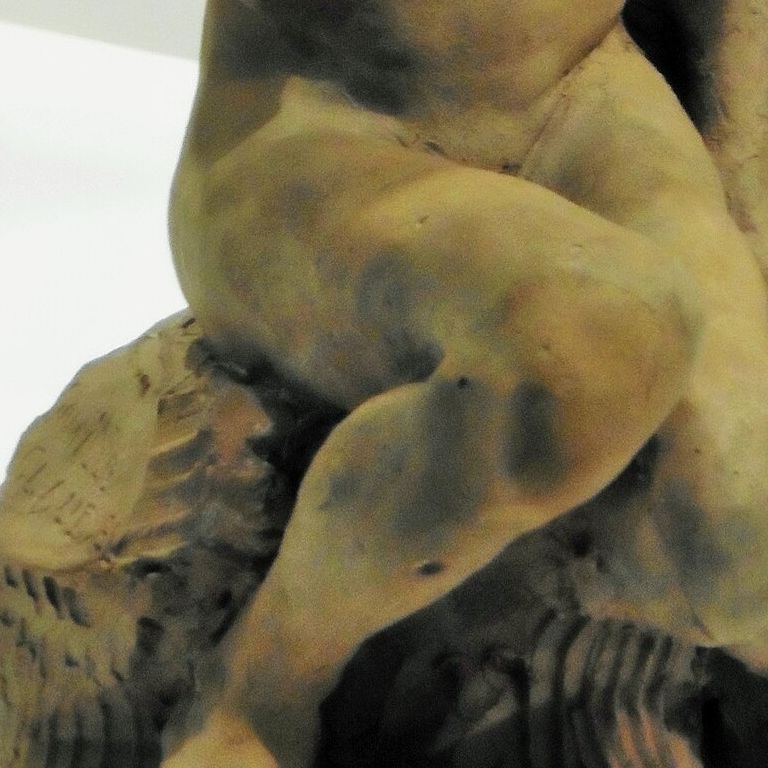
Young Girl with a Sheaf: Introduction
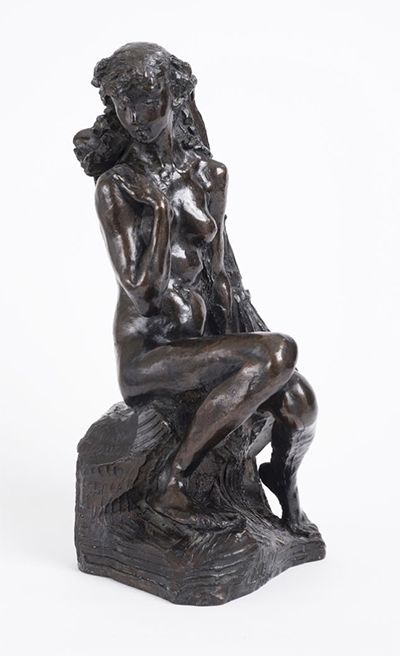
A young woman sits with her knees drawn together, her right hand touching her shoulder and her head turned towards it. One foot lies sideways on the ledge beneath her while the other reaches down. Behind her, the wheat climbs almost as high as her head. In Camille Claudel’s Young Girl with a Sheaf, the bundle holds the figure upright in the composition even as her limbs seem to fold in on themselves. The clay is softly rounded at the shoulder and thigh, ridged along the stalks and worked into deep, broken folds around the hair. The signed terracotta at the Musée Rodin, catalogued as 1887, stands just 35.6 centimetres high. Claudel used that small space to give the figure a pose that changes markedly as you walk around it. [1]
Young Girl with a Sheaf Camille Claudel
At a Glance
- French titleJeune Fille à la gerbe
- Musée Rodin exampleTerracotta, S.06738
Camille Claudel in context
Old Hélène
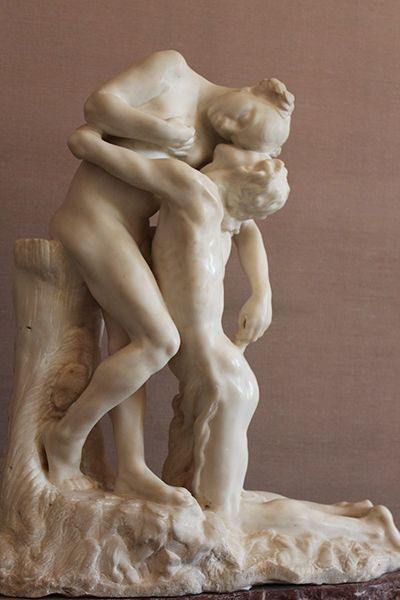
c. 1881–82Sakuntala
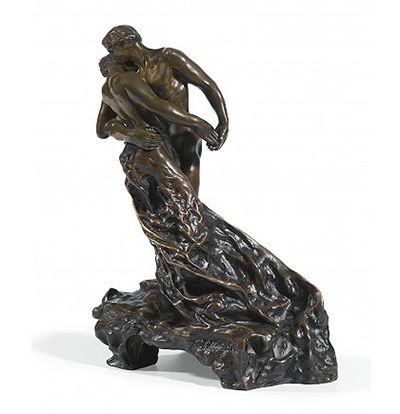
Plaster shown in 1888The Waltz
Developed c. 1889–93The Little Châtelaine
First model c. 1892–93The Gossips
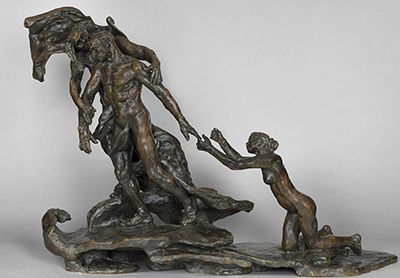
Described in 1893, shown in 1895The Mature Age
First and second versions, c. 1894–99The Wave
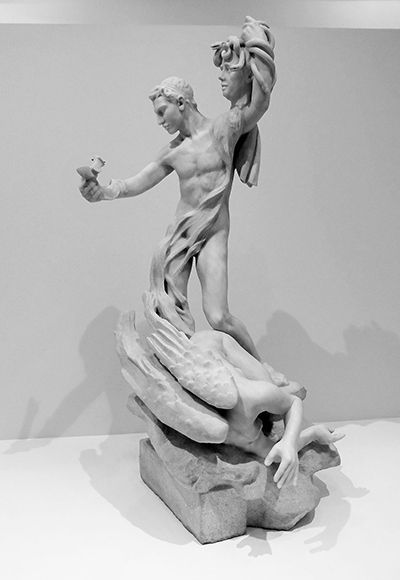
Plaster shown in 1897, mixed-material object dated 1897–1903 (?)Perseus and the Gorgon
Nogent design and marble, c. 1897–1902The Wounded Niobid
Modelled in 1906Contents
- How the figure turns
- The wheat and the fired clay
- The Salon record and the Lhermitte terracotta
- Two later bronzes
- What Rodin’s Galatea shares with the figure
How the figure turns
In a view from near the front, the thigh extends across the sculpture and the shin cuts back diagonally towards the ledge. The change in direction gives the lower half its shape. Above it, the elbow projects slightly from the ribs and the hand returns to the top of the shoulder. Each bend redirects the eye back across the figure. The bare skin around the collarbone and the side of the neck catches enough light to show the turn of the head. Even where the limbs are close, their outlines remain legible. A narrow shadow separates the bent arm from the torso, and an opening near the ankles breaks up the weight of the base. [1]
From the side, the inclination of the face is easier to see. The chin drops, the eyes are lowered, and a curl projects above the brow. The shape of the back becomes clearer below the shoulder. At this angle the right arm looks drawn up and held there, while the rest of the body is settled on its support. The National Museum of Women in the Arts reads the pose as modest and draws attention to the tension of its arrangement. The two effects can coexist. Claudel brings the knees close and keeps the gesture within the silhouette from some angles. From others, you can see how the turn of the neck, the bent elbow and the placement of the feet keep the seated figure poised. [1] [2]
That balance helps explain why the sculpture can seem self-contained without appearing static. The wrist flexes where the fingers come to rest. The figure leaves much of her weight on the ledge, but the lower foot meets the support at an angle. A viewer can follow these small adjustments without settling on a particular emotion. The lowered face gives little away. Claudel puts much of the expressive work into the distance between the limbs and into the places where they touch the body or the base. [1]
The wheat and the fired clay
The view from behind gives the wheat almost the entire centre of the sculpture. Long, shallow grooves carry the stalks upwards, and raised strips cut across them where the sheaf is bound. The upper end breaks into clustered heads. Seen from the front, those rough forms are partly caught up in the outline of the hair. The rear view makes the distinction easier to follow. The line of the bundle stays nearly upright while the girl’s back changes direction between shoulder and hip. Below, the stalks and the ridges of the base converge around the part of the ledge that takes her weight. [1]
The harvested wheat makes an autumn reading possible. Claudel leaves the action open. The girl sits beside the bundle with her hand up at her shoulder. Her hands tell us little about who gathered or bound it. A field, a tool or another figure could have made the scene more specific. Here the sheaf gives just enough context to suggest the season, and its mass gives the body something to lean against. It also makes the front and rear views unusually different. Follow the stalks up from the base and you arrive close to the same place as when you follow the curve of the neck up from the shoulder. [1] [2]
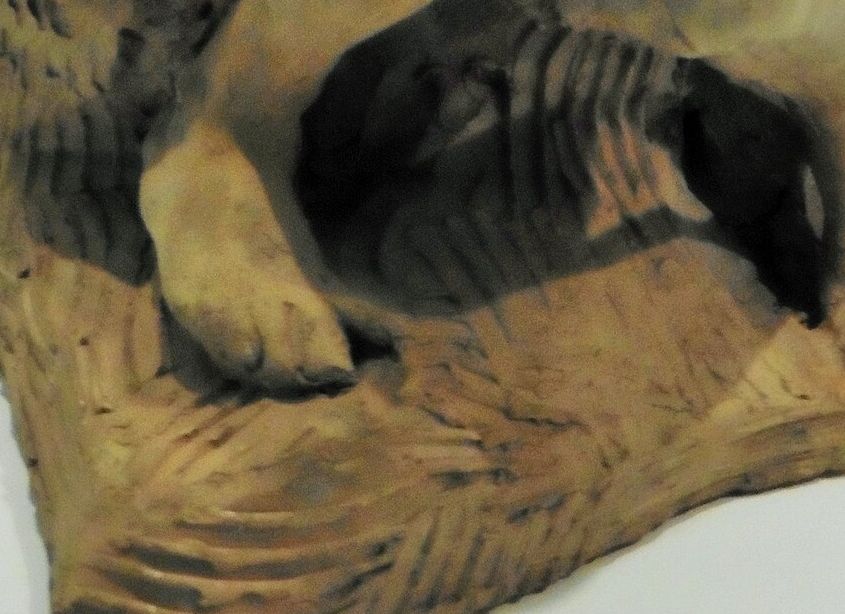
The Musée Rodin catalogues modelling among the terracotta’s techniques. The fired clay preserves abrupt changes of texture at a small scale. Broad, relatively even surfaces across the body show where the light moves gradually. At the base there are rows of scoring, with more irregular cuts and small pits on the ledge. From a distance, those marks gather into a darker mass and make the planes of the body easier to read. Close up, the varying lengths and directions of the marks give the ledge and the stalks textures of their own. The French national treasures commission singled out the liveliness of the handling when it considered the terracotta in 2003, describing fired clay as an uncommon surviving material in the work of an artist who more often used plaster. [1] [3]
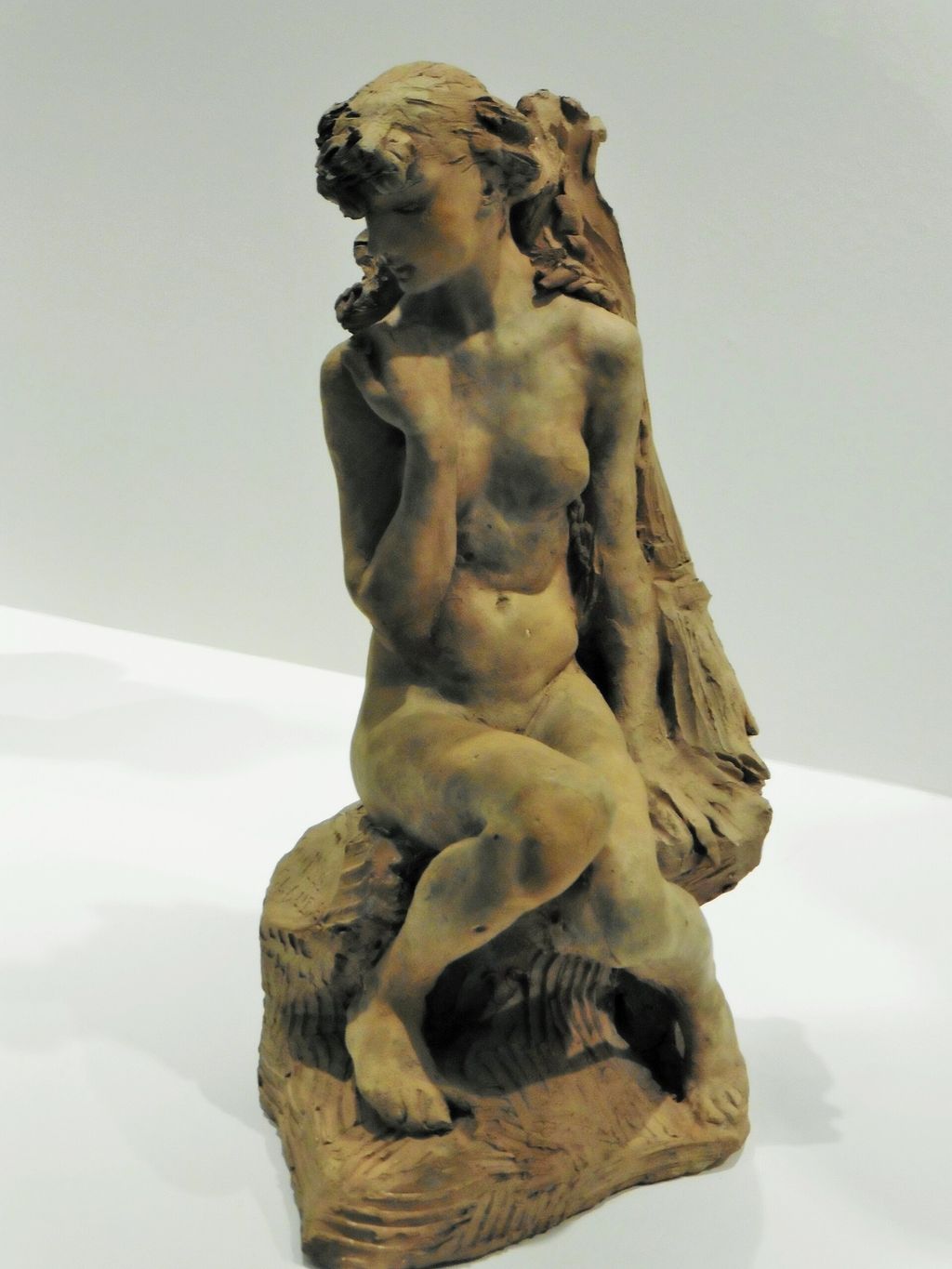
Terracotta of Young Girl with a Sheaf photographed in the Claudel exhibition at La Piscine, Roubaix. Photograph by Pierre André Leclercq. Image source. CC BY-SA 4.0. Resized photograph, shared under CC BY-SA 4.0.
The Salon record and the Lhermitte terracotta
The Musée Camille Claudel places Young Girl with a Sheaf at the 1887 Salon of the Société des Artistes Français alongside Young Roman, Claudel’s portrait of her brother Paul. The illustrated Salon catalogue lists Young Roman as a bronze bust under number 3779. A separate entry for Young Girl with a Sheaf is missing from that catalogue’s listings under Claudel, and the chronology published for the Chicago and Getty retrospective lists only Young Roman among her Salon exhibits that year. The Nogent museum’s account therefore gives a possible early public showing for the terracotta. The catalogue independently confirms the appearance of the portrait. [4] [5] [6]
The terracotta’s ownership record begins with the painter Léon Lhermitte. The Musée Rodin gives no date for his acquisition. In 2003, after an application for an export certificate, the French national treasures commission recommended refusal. Its published opinion cited both the quality and rarity of the clay work and its relationship to Rodin’s sculpture. The French state bought the statuette from Lhermitte’s descendants and assigned it to the Musée Rodin in 2004. The museum records the purchase on 7 September and gives the signed work inventory number S.06738. Its history in that collection begins with this purchase, more than a century after Claudel modelled the figure. [1] [3]
In 2005 the terracotta appeared as S.6738 in the official loan list for Camille Claudel et Rodin. La rencontre de deux destins at the Musée national des beaux-arts du Québec. The list identifies it as a loan from the Musée Rodin. The same exhibition listed the museum’s marble Galatea under Rodin’s name. [7]
Two later bronzes
In Nogent-sur-Seine, the Musée Camille Claudel holds a bronze made by the Coubertin foundry in 1983, numbered 3/8. The museum dates the composition to about 1886 and gives the cast, inventory 2010.4.3, a height of 35 centimetres. It bought the bronze from Reine-Marie Paris de La Chapelle in 2008. The gallery checklist places it near a plaster of Rodin’s Brother and Sister. That pairing offers a way to study the seated figure alongside a composition in which a young woman turns towards a child. The Art Gallery of Hamilton used the same comparison in its exhibition The Artist’s Dream, where it brought together a bronze of Claudel’s figure and Rodin’s group. [8] [9] [10]
The National Museum of Women in the Arts in Washington, D.C., holds a bronze cast in 1984, a gift from Wallace and Wilhelmina Holladay. Its record dates the composition to 1887, gives the cast’s height as 14⅛ inches and describes it as the eighth example in a series of twelve. The museum features the bronze in its account of its 1988 Claudel retrospective, the first US exhibition devoted to her work. In photographs of the Washington cast, highlights on the shoulder and knees pick out the smooth surfaces, while the modelling behind the back registers in dark recesses. The contrast is recognisable from the terracotta, although clay and bronze catch the light differently. Each bronze has its own casting and ownership history. Their dates show how much later audiences came to know this particular composition in metal. [2] [11]
What Rodin’s Galatea shares with the figure
In Rodin’s marble Galatea, the nude sits with the legs folded and one hand raised near the shoulder. As in Claudel’s terracotta, the lowered head turns away from the line of the body. In Rodin’s sculpture the mass behind her is rock. It rises around the back and head, and at the rear it dominates the sculpture. The surface is pitted where the stone is rough and smoother where the figure comes forward. Seen from the side, the lower arm descends along the edge of the rock. The stone makes the figure look as though she is still emerging from the block, an effect that suits the myth of Pygmalion’s statue coming to life. In Claudel’s work the lines behind the girl belong to something that has been gathered and bound. The change of support changes the subject even where the pose is close. [1] [12] [13]
The Musée Rodin dates the conception of its marble Galatea, S.01110, to 1887–88 and its execution to 1888–89. Its related plaster used to transfer measurements to stone, S.02434, is dated 1887–88. The museum records that Eugenia Errazuriz commissioned the marble and that it was shown at the Galerie Georges Petit in 1889. Its essay on Claudel places her composition around 1886–87 and interprets it as preceding Rodin’s. The national treasures commission likewise treated the terracotta as a likely source for the marble and suggested that Rodin may have intended a tribute. The date ranges overlap around 1887, so the precise order of the earliest modelling remains uncertain. The date of the marble’s execution, the resemblance of the poses and the different treatment of the support make a case for influence from Claudel to Rodin. A tribute is one possible explanation of that exchange. [3] [12] [14] [15]
For Rodin and Camille Claudel, working near one another gave each sculptor an opportunity to see how the other handled the body. The most revealing place to compare these works is where the seated figure meets the mass behind her. Rodin’s rock surrounds the figure and gives substance to the story of a body taking form in stone. Claudel’s bound stalks separate clearly from the body when seen from behind, then almost mingle with the hair from the front. The viewer discovers the wheat by moving around the object, much as the crossings of the limbs only become clear as the angle changes. Both effects belong to Claudel’s treatment of the seated figure in the round. [1] [12] [13] [15]
A closer look at Young Girl with a Sheaf
Annotated Details from Young Girl with a Sheaf
Terracotta of Young Girl with a Sheaf photographed in the Claudel exhibition at La Piscine, Roubaix. Photograph by Pierre André Leclercq. Image source. CC BY-SA 4.0. Overview numbered and details cropped. Both are shared under CC BY-SA 4.0.
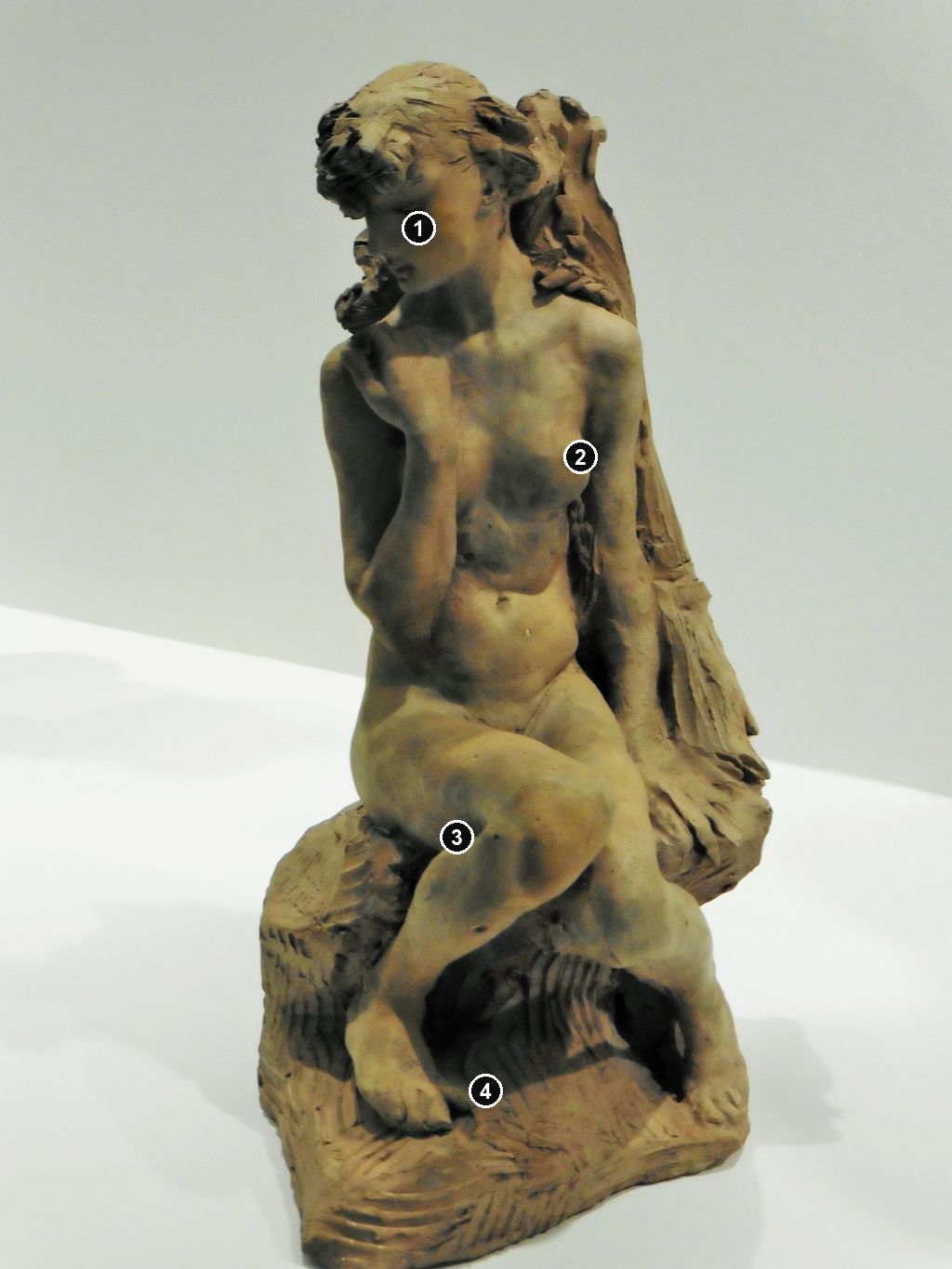
Details from YOUNG GIRL WITH A SHEAF
Follow the numbered details, then return to the complete view.
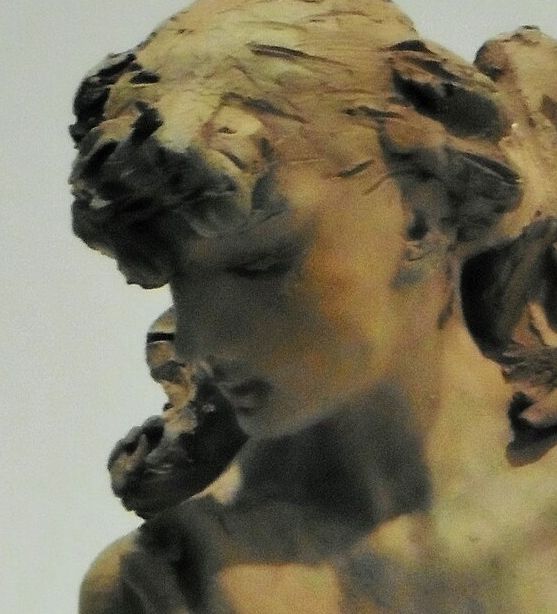
The lowered face
The lowered face turns toward the arm, bringing the direction of the gaze into the curve of the body.
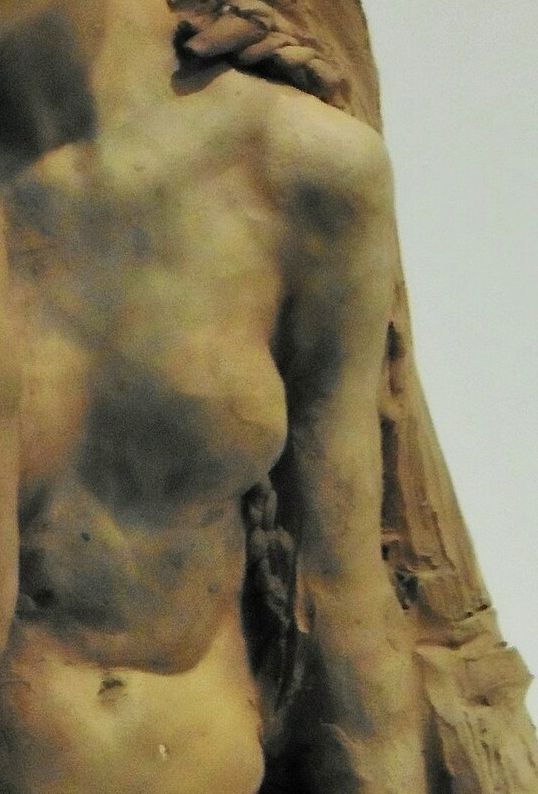
The sheaf behind the shoulder
The raised bundle makes a rough ridge behind the back and keeps the more delicate contours of the shoulder visible.
The angle of the bent legs
The knee draws inward while a foot drops toward the lower edge of the group. The two directions keep the seated pose from looking rigid.
Marks on the base
Short grooves around the foot distinguish the irregular ground from the smoother surfaces of the figure.
Artworks directory
| Name | Date | Medium |
|---|---|---|
| The Mature Age | 1894–99 | Sculpture |
| The Waltz | c. 1889–93 | Sculpture |
| Sakuntala | 1886–88 | Sculpture |
| The Little Châtelaine | 1892–93 | Sculpture |
| The Gossips | c. 1893 | Sculpture |
| The Wave | 1897–1903 | Sculpture |
| Perseus and the Gorgon | c. 1897–1902 | Sculpture |
| The Implorer | c. 1894–99 | Sculpture |
| Clotho | 1893 | Sculpture |
| Bust of Auguste Rodin | c. 1886–89 | Sculpture |
| Paul Claudel at Sixteen Years Old | c. 1882–87 | Sculpture |
| Young Girl with a Sheaf | c. 1886–87 | Sculpture |
| Giganti | c. 1885 | Sculpture |
| Crouching Woman | c. 1884–85 | Sculpture |
| The Hungry Dog | c. 1893 | Sculpture |
| Old Hélène | c. 1881–82 | Sculpture |
| Fortune | c. 1902–05 | Sculpture |
| The Wounded Niobid | 1906 | Sculpture |
| The Siren, or The Flute Player | c. 1904–05 | Sculpture |
| Deep Thought | c. 1898 | Sculpture |
| Dream by the Fireside | c. 1899 | Sculpture |
| Paul Claudel at Thirty-Seven | 1905 | Sculpture |
| Portrait de Madame Claudel | c. 1883 | Sculpture Musée Camille Claudel. |
| Jeune Femme aux yeux clos | c. 1885 | Sculpture Musée Camille Claudel. |
| Ferdinande de Massary | 1888 | Sculpture Musée Camille Claudel. |
| Léon Lhermitte | 1889 | Sculpture Musée Camille Claudel. |
| Étude de main gauche | c. 1889 | Sculpture Musée Camille Claudel. |
| Vieil aveugle chantant | c. 1894 | Sculpture Musée Camille Claudel. |
| Tête de vieillard | c. 1890 | Sculpture Musée Camille Claudel. |
| Étude pour la tête d’Hamadryade | c. 1895 | Sculpture Musée Camille Claudel. |
| Aurore | c. 1900 | Sculpture Musée Camille Claudel. |
Discussion
Look again at the images and ideas explored in Young Girl with a Sheaf. These editorial prompts invite your observations.
Reader Insights
How does the sheaf change the space enclosed by the figure?
Which features would you compare with Galatea to judge the resemblance?
Join the Conversation
Share a detail, comparison or question about Young Girl with a Sheaf below.
References
- Musée Rodin, La Jeune Fille à la gerbe, signed terracotta S.06738, catalogue and object photographs,. View source.
- National Museum of Women in the Arts, Young Girl with a Sheaf, bronze cast in 1984,. View source.
- Commission consultative des trésors nationaux, opinion no. 2003-12, 29 October 2003,. View source.
- Musée Camille Claudel, chronology for 1886–93,. View source.
- Société des Artistes Français, Salon de 1887. Catalogue illustré, sculpture, no. 3779,. View source.
- Art Institute of Chicago and J. Paul Getty Museum, Camille Claudel, 2023 exhibition catalogue, chronology for 1887,. View source.
- Gazette officielle du Québec, Camille Claudel et Rodin. La rencontre de deux destins, 6 April 2005, exhibition decree and loan list, pp. 1154, 1157 and 1163,. View source.
- Musée Camille Claudel, Jeune Fille à la gerbe, Coubertin bronze 3/8, 2010.4.3,. View source.
- Musée Camille Claudel, press dossier, gallery 11 checklist, p. 27,. View source.
- Art Gallery of Hamilton, The Women Artists of French Symbolism, on the display of Claudel and Rodin in The Artist’s Dream,. View source.
- National Museum of Women in the Arts, Camille Claudel: 1864–1943, 1988 exhibition,. View source.
- Musée Rodin, Galatée, marble S.01110, catalogue and object photographs,. View source.
- Musée Rodin, Rodin, la chair, le marbre, exhibition essay on figure and rock,. View source.
- Musée Rodin, Galatée, plaster pointing model S.02434,. View source.
- Musée Rodin, Camille Claudel, artist essay on the chronology and comparison,. View source.