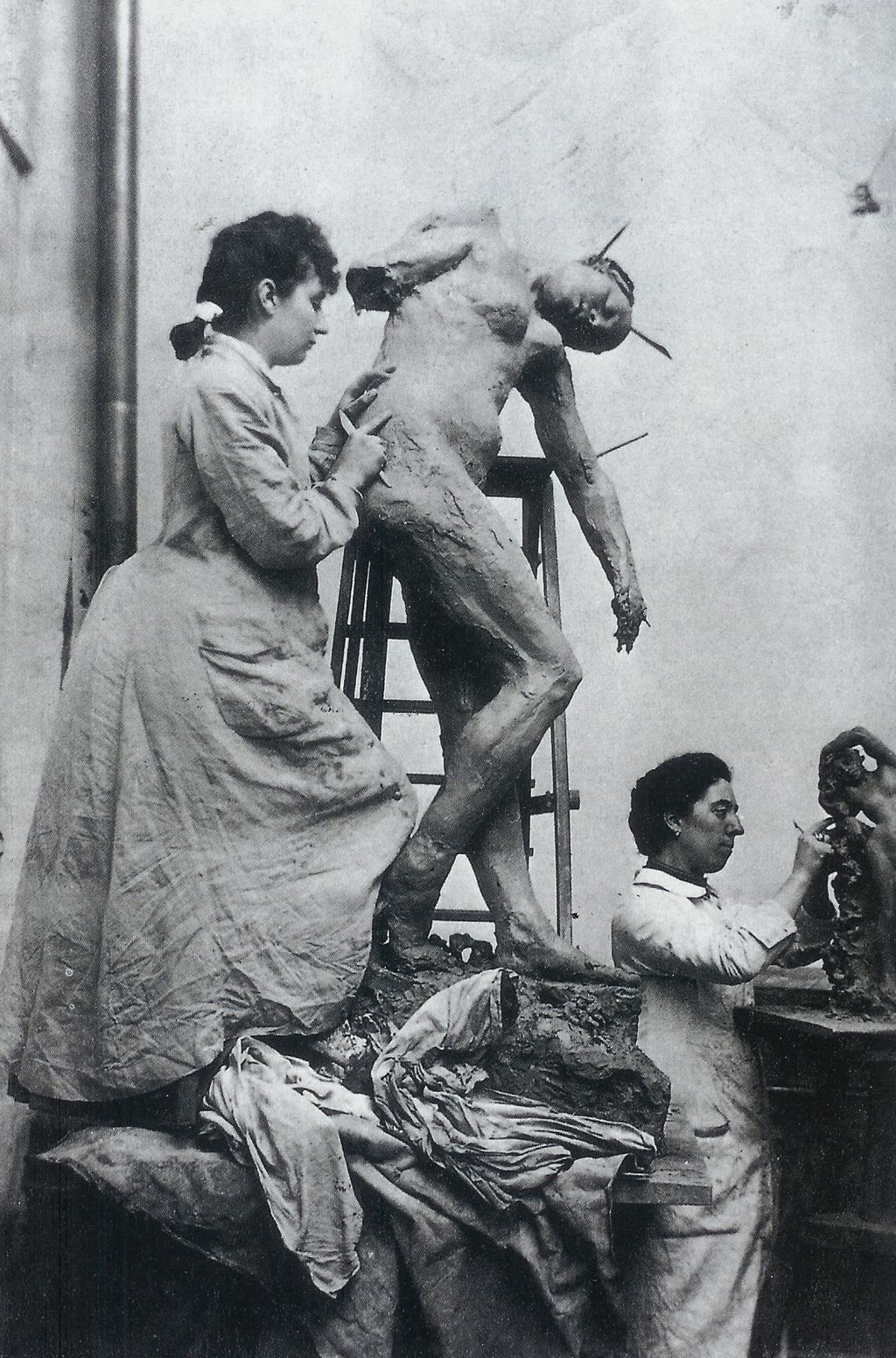
Camille Claudel, left, works on Sakuntala while Jessie Lipscomb works beside her in their shared studio in 1887. Musée Rodin, Ph.01773. Photograph by William Elborne. Image source. Public domain. Resized from the original photograph.
 by Tom Gurney
Tom Gurney BSc (Hons) is an art history expert with over 20 years experience
Email: tomgurney1@gmail.com / Phone: +44 7429 011000
Claudel and Rodin: Introduction
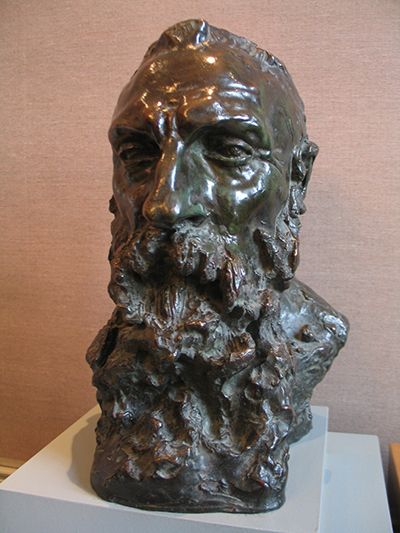
In Camille Claudel’s bronze portrait of Auguste Rodin, the sculptor’s brow and nose catch the light above a beard that darkens the lower half of the head. In one of Rodin’s sculptures of Claudel, a hand almost as large as her face rises behind it. The hand belonged to a figure in his monument to the burghers of Calais. Claudel gave Rodin the likeness that would accompany exhibitions of his work. Rodin took a likeness of Claudel and made it one half of an unsettling encounter between two pieces of plaster. [1] [2]
Claudel and Rodin were teacher and student, fellow sculptors and lovers. Those ties began and loosened at different times. The earliest evidence of acquaintance predates Claudel’s regular work in his atelier. Letters about sculpture continued after she had set out to make work she felt would be recognisably her own. The objects they left, and the dates on which they modelled, cast or exhibited them, give this history a different shape from the dates of their affair. [3] [4] [5]
At a Glance
- ArtistsCamille Claudel and Auguste Rodin
- SettingParis and the surrounding studio networks
Contents
- From a shared studio to Rodin’s atelier
- Two studios in William Elborne’s photographs
- Two crouching figures and a girl with a sheaf
- What the letters show
- How they portrayed each other
- From a portrait bust to an image in print
- The end of the affair and the work that continued
- What The Mature Age can tell us
From a shared studio to Rodin’s atelier
Rodin first came into Claudel’s working life as a visitor to a studio she rented with other women at 117 Rue Notre-Dame-des-Champs in Paris. Alfred Boucher had been visiting the group to review their work. When he left for Italy in the autumn of 1882, Rodin took over those visits. A letter to Rodin from the painter Léon Lhermitte, dated 9 March 1883, places the two sculptors in contact by that spring. The photograph William Elborne took of Claudel and Jessie Lipscomb in 1887 shows the women at the Rue Notre-Dame-des-Champs address. The room in that photograph was the shared studio Rodin visited as a teacher. [3] [4]
Claudel began working regularly in Rodin’s atelier around 1884. A practitioner named Camille appears in records for The Gates of Hell as early as 1882, but the first name alone leaves the identification open. Rodin already had the government commission for the doors and was assembling a workforce. The project put Claudel in a setting where figures could be built, altered, cast in plaster and tried in new positions. A bent limb or a tilted head could take on a different expression when it was set among other figures, and work begun for the doors could eventually circulate on its own. [3] [4] [6]
The Musée Rodin considers hands and feet among Claudel’s likely assignments. These were parts that had to carry weight, indicate tension or complete a gesture at a small scale. Getty showed a bronze Study of Left Hand, about 1889, from the Xavier Eekhout Collection alongside its account of Claudel’s time in the atelier. It offers a way to see the kind of close attention a hand could demand. The surviving evidence leaves the authorship of specific hands and feet on the doors unresolved. [4] [5] [6]
Two small heads give the question of authorship a firmer footing. The Musée Rodin catalogues Claudel as the sculptor of the plaster Head of a Slave, S.03902, and the bronze Head of a Laughing Man, S.00759. The latter bears the name A. Rodin below the left ear. Its foundry mark is that of Alexis Rudier, and the museum records that this particular bronze was made for its collection in 1925, after both the model’s creation and Rodin’s death. The signature, the casting date and the current attribution describe three different things. The museum also distinguishes these heads from the head of Avarice in Avarice and Lust, which it says was wrongly attributed to Claudel. [4] [7] [8]
At the same time she was sending her own work to exhibitions. The 1885 Salon included her bronze Giganti and the terracotta Old Helen. Three years later, the large plaster Sakuntala earned an honourable mention. The young woman who worked on parts in an atelier was also arranging two bodies on a large scale and finding out what a jury and a public would make of the whole. Even when Claudel identified herself as Rodin’s pupil in an October 1889 letter to the ministry, she could already point to several years of exhibiting sculpture under her own name. [3] [4] [9]
Two studios in William Elborne’s photographs
An album given to Rodin by Jessie Lipscomb preserves a photograph of Rodin in his own studio with Lipscomb and Claudel. The Musée Rodin now identifies the two women in its record for Ph.06390 and attributes the photograph to William Elborne. It dates the photograph to about 1887 and gives the location as 117 Boulevard de Vaugirard. Lipscomb’s dedication in the album is dated 1 September 1887. It addresses Rodin as both friend and teacher. The dedication is evidence of how one of the sculptors described the relationship at that moment, and the location fixes the photograph in Rodin’s place of work. [10]
The photograph of Claudel and Lipscomb at 117 Rue Notre-Dame-des-Champs is a different scene. It is easy to confuse the addresses because the street numbers match. In the second photograph, catalogued as Ph.01773, Claudel stands at the large model of Sakuntala while Lipscomb works at a smaller piece beside her. The image gives a sense of how much room the larger clay demanded and how close the two sculptors could work to one another. Rodin is absent from the frame. The two photographs record different workplaces that Claudel and Lipscomb both used during the same period. Seen together they make visible the overlap between participation in Rodin’s atelier and work on a sculpture Claudel would exhibit under her own name. [11] [3]
The attribution problems in the atelier have a material history of their own. The Musée Rodin distinguishes the heads it now attributes to Claudel from the head of Avarice, which it considers wrongly assigned to her. Where an object passed from a model to a workshop cast, an inscription can register how the work was understood or circulated at the time of casting. It does not automatically identify the person who modelled the original. An album can give a documented occasion when several people shared a room. A cast and its accession record give a different kind of evidence about the work they did. Both are necessary to understand why the two sculptors’ proximity makes attribution difficult in some cases and possible in others. [4] [7] [8] [10] [11]
Two crouching figures and a girl with a sheaf
Rodin’s Crouching Woman, conceived about 1882, folds a figure tightly around herself. In the Musée Rodin plaster S.02857, one hand presses into the breast from the narrow space between thigh and chest. The gathered limbs make the body compact, yet the angle of the arm makes that compactness look uncomfortable. Getty connects Claudel’s own Crouching Woman to a terracotta of Rodin’s figure and identifies her Torso of a Crouching Woman as a further reworking of her own model. The Getty bronze, 2018.32, preserves a model of about 1884–85 and was cast by 1913. [12] [13] [14]
In Claudel’s bronze, the head and arms are gone and one knee ends at a cut. The torso still hovers above its support, with the legs gathered under it. Look along the curve from the shoulder to the hip and the pose reads as an act of balance. In Rodin’s plaster the closed gesture of the hand helps give the figure its inward tension. In Claudel’s torso, much of the expression falls to the tilt of the pelvis and the pull of flesh over bone. The likely route through Rodin’s figure helps explain why she began with a crouch. The two objects show how much she could change by taking away the parts that made his gesture most explicit. [12] [13] [14]
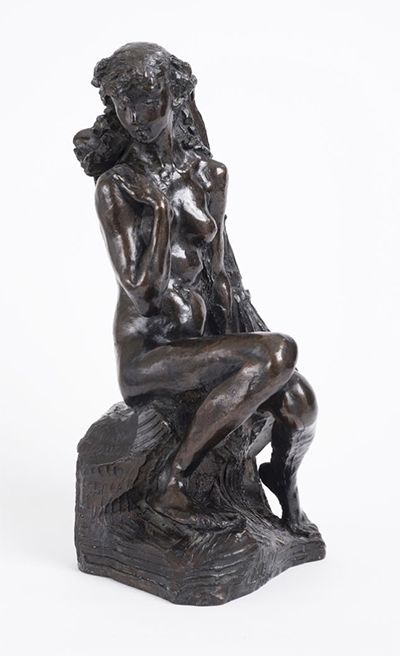
The Musée Rodin proposes an example of influence in the other direction. It places Claudel’s Young Girl with a Sheaf before Rodin’s Galatea. Claudel’s signed terracotta, S.06738, is dated 1887. The museum dates Rodin’s model to 1887–88 and the execution of its marble, S.01110, to 1888–89. Their dates are close enough that it matters which event is being compared. The marble was exhibited in 1889, and the collection also preserves a plaster model for transferring the form to stone. The comparison concerns the conception of the figures as well as the objects that survive. [4] [15] [16] [17]
In both works a bent arm rises beside the face, and one knee projects across the front of the body. Claudel places her figure against a sheaf. Its stalks give the soft clay body a rough neighbour while keeping the subject in the world of a girl with something gathered in a field. In Rodin’s marble the polished flesh stands against rough stone. With the name Galatea, that difference in finish becomes part of a story about a sculpted woman coming to life. The likeness of pose is visible in the two objects. The claim that Rodin drew on Claudel is the Musée Rodin’s reading of their proximity and sequence. The catalogue dates allow for an overlap in 1887. [4] [15] [16] [17]
What the letters show
In a letter the Musée Rodin dates to about 1886, Rodin addresses Claudel affectionately and writes at length about the pain of being apart. The writing crowds the page, with corrections still visible. He asks to see her every day and wants to know why she did not wait for him at the atelier. The studio figures in the letter as a place he hoped to find her. The handwriting and the museum’s approximate date place a particular appeal in the early relationship and leave open when the affair began. [18] [19]
A separate document bears the date 12 October 1886. In it Rodin promises to have Claudel as his sole pupil, put his influential friends at her disposal and do what he can for her exhibition placement and press coverage. He also sets out plans for travel, a promise of marriage and a schedule of visits to her studio. The planned marriage never took place. The terms show how closely exhibition prospects and access to influential people could be bound up with the promises he made her in private. [4] [19] [20]
Claudel’s letter from the Château de l’Islette, dated by the museum to the summer of 1890 or 1891, has a different movement. She addresses him as Monsieur Rodin and starts with the pleasures of the place. She has eaten in the middle room, which she describes as a greenhouse with a view of the garden on either side. She reports what the hostess has offered and holds out the prospect of a room in which he could work. The invitation to return and the demand for fidelity belong to the same letter. There is a garden to walk in, somewhere to eat and a place to get on with a sculpture. [21] [19]
At l’Islette, each found a different sitter. Claudel began modelling The Little Châtelaine in 1892 from Marguerite Boyer, the owner’s six-year-old granddaughter. Rodin worked from a local carter whose appearance suggested Balzac to him. Claudel made the raised face and open look of a particular child the centre of a bust she would revisit in several materials. Rodin was looking for a living body from which to imagine an absent writer. The letter’s description of a room to work in is earlier than the documented beginning of Claudel’s bust. The two records show how a private place acquired a separate use for each sculptor. [3] [5] [21] [22]
How they portrayed each other
Claudel’s Portrait of Rodin was publicly shown in 1892 at the Salon of the Société Nationale des Beaux-Arts. The Musée Rodin’s bronze S.1021 was sand cast by Gruet that year. A later set commissioned through Mathias Morhardt for the Mercure de France involved another founder, François Rudier. By then the likeness was available for a purpose well beyond the sittings that had produced it. Claudel’s bust appeared at the 1893 World’s Columbian Exposition in Chicago, and examples continued to appear abroad as exhibitions introduced Rodin’s work to new audiences. [1] [3]
The brow, cheek and bridge of the nose make the face immediately legible above the irregular beard. From the side the outline becomes almost as distinctive as the features seen head on. Claudel allows the weight of the head and the strength of the profile to carry the authority of the likeness. The portrait has no need of a hand with a tool or an attribute from one of Rodin’s monuments. The sitter’s professional identity comes through the head she modelled. [1]
Rodin made more than one likeness of Claudel. The Mask of Camille Claudel and Left Hand of Pierre de Wissant, S.00349, gives a particularly clear view of what happened when he reused one. The Musée Rodin tentatively dates the plaster assemblage to about 1895 and identifies the hand as the left hand of the Calais figure. The mask brings the eyes and mouth close to the viewer’s attention. The broad hand enters behind it on a scale no single body could have. With the seams still visible in the plaster, the face has the physical immediacy of a likeness and the strangeness of a piece lifted into a new composition. [2] [4]
Claudel also made two drypoints for Léon Maillard’s study of Rodin, published in 1899. In one he works on a piece of sculpture. In the other he looks towards his subject. The figure in the bronze bust is still and self-contained. The prints distinguish two movements a sculptor makes continually in the studio, the movement of a hand towards the work and the shift of attention back towards the subject. Claudel had seen these closely enough to make each the subject of a separate print. [1] [3] [23]
From a portrait bust to an image in print
Claudel’s portrait of Rodin acquired a second form through a printmaker. The 1897 portfolio Les Dessins d’Auguste Rodin contains three wood engravings by Léveillé. One is a portrait of Rodin after the bust Claudel made, printed on thin paper in the copy catalogued by Sotheby’s. The portfolio also contains a much larger body of reproductions of Rodin’s drawings. In that setting a small print based on Claudel’s sculpture introduces Rodin’s features before the reader encounters his work on paper. The portrait’s role has changed. In the Salon the bust could be viewed in its own right and from several sides. In a portfolio its likeness is fixed from a chosen angle and placed in the service of a publication about its sitter. [24]
Maillard’s project gave Claudel a different role. The 2023 catalogue chronology dates his commission for the drypoints to 1896, three years before the book appeared. One proof of Rodin Working is in the Musée Rodin, while the catalogue reproduces Rodin Looking at the Subject from the Getty Research Institute’s copy of the book, where it appears on page 20. The titles distinguish two moments a sculptor might ordinarily move between, the looking and the making. Unlike the print after the bust, these are images Claudel made in the print medium herself. Their commission falls after her emergence as an independent exhibitor. It offers a specific example of a project about Rodin’s work in which she participated as an artist in her own right. [3] [24]
The end of the affair and the work that continued
Several dates mark Claudel’s separation from Rodin. The Musée Rodin’s gallery account puts the rupture in 1892. Getty’s exhibition guide uses 1893 as the point at which Claudel turned to a more independent practice. That December she sent her brother Paul sketches of works she was planning, including the group that became The Gossips and an idea for The Mature Age. She told him that the new work had moved away from Rodin. It is a dated statement about the direction she wanted her sculpture to take. [3] [5] [25] [26]
Professional contact continued. In 1895 Rodin wrote to arrange a visit to her studio by Georges Leygues, the minister of public instruction and fine arts. In April 1896 she declined Rodin’s invitation to be introduced to President Félix Faure. Late in 1897 Claudel sent Rodin her opinion of his Balzac. Rodin had asked for it through his studio assistant Henri Lebossé. She singled out the contrast between the strongly modelled head and the simplicity of the drapery. She also liked the loose sleeves, which to her suggested the writer’s indifference to his appearance. In his reply of 2 December, preserved in a copy in his secretary’s hand, Rodin told her that her judgment had made him more confident and asked her to look at the sculpture with him outdoors. Rodin’s clients would reject the monument after it was shown in 1898. Claudel’s letter records what she saw in it before it went on public view. [3] [19] [27] [28]
The same exchange shows her assessing a commission of her own. She told Rodin that the Mercure de France wanted ten bronze busts of him. The payment had to cover the founder, and she reckoned that engraving the journal’s emblem would take a day per bronze and that removing the seams properly would take five or six. She asked him to tell Morhardt she could not continue under those terms. Rodin urged her to go on with the bronzes and leave out the emblem and the work on the seams. The letter that treats him as a sculptor who wants her opinion also asks him, as the subject of her portrait, to help her renegotiate the work of making it. [3] [19]
In 1898 Claudel moved to a studio on Rue de Turenne. According to the Musée Camille Claudel, she asked Morhardt to persuade Rodin to stop visiting so that her work could be seen as her own. Even later support could take place at a distance. The Musée Rodin reports that he paid her studio rent in 1904. The surviving correspondence and these accounts distinguish the end of regular contact from the ability to offer help through other people. [3] [4] [19] [29]
Claudel’s direction is visible in the 1897 onyx and bronze Gossips at the Musée Rodin, S.01006. Three figures bend towards a fourth, and the screen makes a small interior around them. Their bodies tell the viewer who is listening, while their closeness makes it seem that the exchange could be missed by someone a pace away. The sculpture uses the bodily precision she had exercised in the atelier to catch an ordinary moment. The intimacy is built at the scale of a conversation, with a screen and closely spaced figures setting the terms on which a viewer can look in. [5] [26]
What The Mature Age can tell us
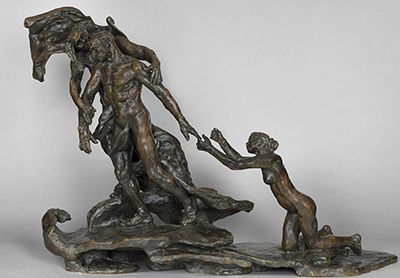
The later version of The Mature Age has long drawn viewers back to the affair. In the Orsay bronze, RF 3606, the older woman leads the man forward while the kneeling figure reaches after him. Paul Claudel later identified the young woman with his sister, and the figures have often been read as Camille Claudel, Rodin and his longstanding partner, Rose Beuret. That reading has a place in the history of how the sculpture was seen. It leaves room for the drama Claudel made out of age and the passage of time. [5] [30] [31]
The change between the two versions is worth following in its own right. In the early plaster described by the Musée Rodin, the young figure still has a firm hold on the man. In the later composition the hands are separated. A viewer can see the distance between them and follow the direction in which the two standing bodies are going. Claudel made release happen in the space between two gestures. Viewers can recognise that separation even without knowing the names that Paul and others brought to the group. [30] [31]
The commission has a different chronology from the personal relationship. The state commissioned the work in 1895. The catalogue records Claudel’s complaint about unpaid money in December 1898, the eventual payment for the plaster and the cancellation of the bronze order in June 1899. The plaster was shown that year, and Louis Tissier financed the bronze now at the Musée d’Orsay, cast about 1902. The reason for the cancellation remains uncertain. The commission records establish the distinct roles of the state and Tissier, while the surviving bronze shows the outcome of Claudel’s revision. [3] [5] [30] [31]
The two sculptors remained connected in the exhibition record after Claudel moved to Rue de Turenne. In 1899, the year the later plaster of The Mature Age appeared in Paris, Claudel’s bust of Rodin was shown in the Netherlands and Belgium. Audiences could encounter her as the maker of his public likeness and as the sculptor of a work in which a few inches between two hands carried the force of an entire group. The rest of Claudel’s sculpture follows the uses she made of that control of the figure, from the scale of a small room to the scale of a monument. [1] [3] [5] [30]
Artworks directory
| Name | Date | Medium |
|---|---|---|
| The Mature Age | 1894–99 | Sculpture |
| The Waltz | c. 1889–93 | Sculpture |
| Sakuntala | 1886–88 | Sculpture |
| The Little Châtelaine | 1892–93 | Sculpture |
| The Gossips | c. 1893 | Sculpture |
| The Wave | 1897–1903 | Sculpture |
| Perseus and the Gorgon | c. 1897–1902 | Sculpture |
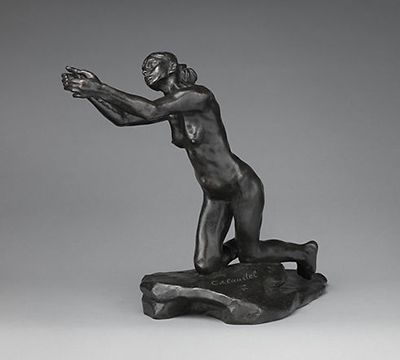
| The Implorer | c. 1894–99 | Sculpture |
| Clotho | 1893 | Sculpture |
| Bust of Auguste Rodin | c. 1886–89 | Sculpture |
| Paul Claudel at Sixteen Years Old | c. 1882–87 | Sculpture |
| Young Girl with a Sheaf | c. 1886–87 | Sculpture |
| Giganti | c. 1885 | Sculpture |
| Crouching Woman | c. 1884–85 | Sculpture |
| The Hungry Dog | c. 1893 | Sculpture |
| Old Hélène | c. 1881–82 | Sculpture |
| Fortune | c. 1902–05 | Sculpture |
| The Wounded Niobid | 1906 | Sculpture |
| The Siren, or The Flute Player | c. 1904–05 | Sculpture |
| Deep Thought | c. 1898 | Sculpture |
| Dream by the Fireside | c. 1899 | Sculpture |
| Paul Claudel at Thirty-Seven | 1905 | Sculpture |
| Portrait de Madame Claudel | c. 1883 | Sculpture Musée Camille Claudel. |
| Jeune Femme aux yeux clos | c. 1885 | Sculpture Musée Camille Claudel. |
| Ferdinande de Massary | 1888 | Sculpture Musée Camille Claudel. |
| Léon Lhermitte | 1889 | Sculpture Musée Camille Claudel. |
| Étude de main gauche | c. 1889 | Sculpture Musée Camille Claudel. |
| Vieil aveugle chantant | c. 1894 | Sculpture Musée Camille Claudel. |
| Tête de vieillard | c. 1890 | Sculpture Musée Camille Claudel. |
| Étude pour la tête d’Hamadryade | c. 1895 | Sculpture Musée Camille Claudel. |
| Aurore | c. 1900 | Sculpture Musée Camille Claudel. |
Discussion
Look again at the images and ideas explored in Claudel and Rodin. These editorial prompts invite your observations.
Reader Insights
Which formal similarities stand out in the two artists’ sculptures?
What kind of artistic relationship do the dated letters document?
Join the Conversation
Share a detail, comparison or question about Claudel and Rodin below.
References
- Musée Rodin, Portrait de Rodin, Gruet bronze, S.1021. View source.
- Musée Rodin, Assemblage: Masque de Camille Claudel et main de Pierre de Wissant, plaster, S.00349. View source.
- Anne-Lise Desmas and Emerson Bowyer, eds., Camille Claudel, chronology and notes, J. Paul Getty Museum and Art Institute of Chicago, 2023, pp. 5–8 and 10–16. View source.
- Musée Rodin, “Camille Claudel”, sections on the meeting, studio, mutual influence and patronage. View source.
- J. Paul Getty Museum, Camille Claudel, exhibition guide, studio, The Age of Maturity, The Little Lady and sketches from life. View source.
- Musée Rodin, The Gates of Hell, history of the commission and composition. View source.
- Musée Rodin, Tête d’esclave, plaster, S.03902. View source.
- Musée Rodin, Tête de Rieur, Alexis Rudier bronze, S.00759. View source.
- Musée Bertrand and French Ministry of Culture, Sakountala, original patinated plaster, inv. 518. View source.
- Musée Rodin, Rodin in his studio with Jessie Lipscomb and Camille Claudel, Ph.06390, album dedication and location. View source.
- Musée Rodin, Camille Claudel working on Sakountala with Jessie Lipscomb, William Elborne, Ph.01773. View source.
- Musée Rodin, Femme accroupie, plaster, S.02857. View source.
- J. Paul Getty Museum, acquisition of Claudel’s Torso of a Crouching Woman, 2018. View source.
- J. Paul Getty Museum, Torso of a Crouching Woman, bronze, 2018.32. View source.
- Musée Rodin, La Jeune Fille à la gerbe, signed terracotta, S.06738. View source.
- Musée Rodin, Galatée, marble, S.01110. View source.
- Musée Rodin, Galatée, plaster model for pointing, S.02434. View source.
- Musée Rodin, letter from Auguste Rodin to Camille Claudel, about 1886, manuscript images and object record, L.01451. View source.
- Château de l’Islette, French transcriptions of letters from the Musée Rodin archives, L.1452, L.1451, Ms.00362, Ms.365 and L.1394. View source.
- Musée Camille Claudel, English museum press kit, biographical chronology for 1886–93, October 1886 agreement. View source.
- Musée Rodin, letter from Camille Claudel to Auguste Rodin, summer 1890 or 1891, manuscript images and object record, Ms.00362. View source.
- Musée Rodin, La Petite Châtelaine, 1895 marble, S.01007. View source.
- Musée Rodin, Rodin sur le morceau, drypoint by Camille Claudel, G.07635. View source.
- Sotheby’s, Les Dessins d’Auguste Rodin and Auguste Rodin statuaire, lot 115, description of the 1897 portfolio and the 1899 book. View source.
- Musée Rodin, “Camille Claudel,” gallery theme, section on the relationship and rupture. View source.
- Musée Rodin, Les Causeuses ou Les Bavardes, onyx and bronze, S.01006. View source.
- Musée Rodin, Monument to Balzac, 1898 exhibition and reception, Meudon plaster S.3151. View source.
- Musée Rodin, “Multiples, fragments, assemblages”, Henri Lebossé’s work in the atelier. View source.
- Musée Camille Claudel, “1893–1908,” the years of independent work, 1898 move and request to Morhardt. View source.
- Musée Rodin, The Age of Maturity, account of the first and later versions. View source.
- Musée d’Orsay, L’Âge mûr, Tissier bronze, RF 3606. View source.