 by Tom Gurney
Tom Gurney BSc (Hons) is an art history expert with over 20 years experience
Published on June 19, 2020 / Updated on October 14, 2023
Email: tomgurney1@gmail.com / Phone: +44 7429 011000
The Mature Age: Introduction
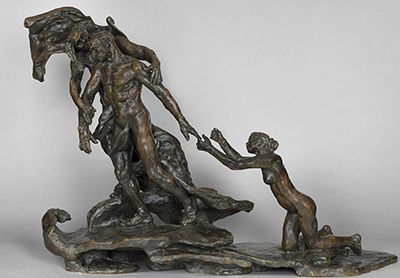
A man is stepping away, but one of his arms still reaches behind him. The young woman on her knees raises both hands to meet it. In Camille Claudel’s The Mature Age (L’Âge mûr), the fingers come so close that it takes a moment to see the air between them. Then look down. The woman kneels on a low shelf of bronze. The man’s feet are on higher, broken ground, where an older woman draws him on. Their faces are close, and her arm comes over his shoulder. Claudel gives the two standing figures the bodily contact that the young woman can no longer reach. [1]
The bronze in the Musée d’Orsay, cast around 1902, gives the separation a different emphasis from each angle. From the broad side the group spreads out like a procession. The kneeling figure has room to project her arms, and the distance from her knees to the man’s feet makes the step away seem long. Viewed more nearly from the advancing end, the bodies bunch up. The man’s chest comes into view, the older woman is partly screened by him, and the younger woman’s lifted hands stand out below his trailing arm. One view gives the departure its length. The other brings out how awkwardly the man is being carried forward, his upper body leaning one way as his arm reaches the other. [1]
The Mature Age Camille Claudel
At a Glance
- Orsay bronzeRF 3606, cast c. 1902
- Earlier plasterMusée Rodin, S.01378
Camille Claudel in context
Old Hélène
c. 1881–82Sakuntala
Plaster shown in 1888The Waltz
Developed c. 1889–93The Little Châtelaine
First model c. 1892–93The Gossips
Described in 1893, shown in 1895The Mature Age
First and second versions, c. 1894–99The Wave
Plaster shown in 1897, mixed-material object dated 1897–1903 (?)Perseus and the Gorgon
Nogent design and marble, c. 1897–1902The Wounded Niobid
Modelled in 1906Contents
- The ground beneath the figures
- When the young woman could still hold him
- Studies and heads apart from the group
- From a state commission to Tissier’s bronze
- The bronzes in Paris and Nogent
- How the numbered reductions came back into view
- What the figures can mean
The ground beneath the figures
Begin at the older woman’s end of the Orsay bronze. The edge of the base curls up, then the ground flattens beneath the man’s leading foot. Behind him, the younger woman’s platform is lower and thinner. Seen from the side, the shelves overlap like layers of rock or the edges of a breaking wave. They give the man a place to put his weight as he moves away, and the young woman a different level to reach from. The drop helps make the interval between the bodies legible even from a position where the fingers appear to overlap. [1]
The knees hold the younger woman in place. Above them her hips and torso incline forward, and both forearms rise. She directs nearly everything she can move towards the departing pair. The man’s body has a different rhythm. The long slant of his legs leads towards the higher platform, while the line from his shoulder to his fingertips carries the eye back down towards her. His hand hangs more loosely than hers. The unevenness of their gestures matters as much as the distance between them. She reaches with her whole body while he has only an arm to give to the movement back. [1]
Behind the man, the older woman’s hand comes across his upper arm and the drapery climbs above their heads. Its sharp turns enlarge the outline of the two bodies. Lower down, the folds stream behind his legs towards the space the pair is leaving. As you move towards the older woman’s end, the cloth takes up more of the view and interrupts the clear sequence of the three bodies. In the dark recesses of the bronze, a shoulder and a fold can seem to run together, while light striking the lifted edges makes their direction easy to follow. The Musée Rodin relates the turbulent drapery and deep shadows of the later composition to Art Nouveau. Here the long, curling outlines have a particular job. They carry movement around two bodies that are pressed close enough to read as a single mass. [1] [2]
The base allows a last connection. Look from the woman’s knees along the low shelf until the ground rises beneath the man. The figures stand apart in the upper half of the composition, but below them the bronze still gives the eye a route from one to the other. The Orsay records the work as a group in three parts and gives a total weight of 327 kilograms. Its listed left and right weights, 283 and 44 kilograms respectively, register a literal disparity between the ends of the sculpture. In profile that imbalance takes on an expressive form. A mass of bodies, ground and cloth advances at one end, with one figure stretched out behind it at the other. [1]
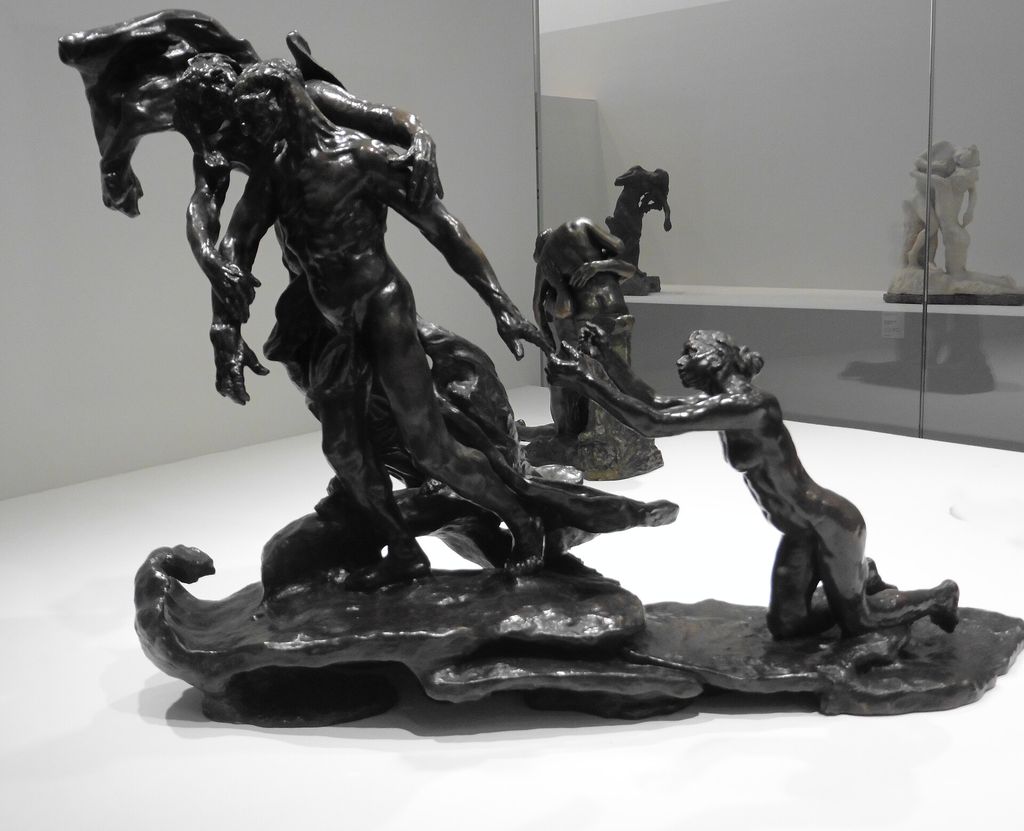
A bronze of the later composition on display at La Piscine, Roubaix, in 2015. Photograph by Pierre André Leclercq. Image source. CC BY-SA 4.0. Resized photograph, shared under CC BY-SA 4.0.
When the young woman could still hold him
The surviving plaster of the first version is at the Musée Rodin, inventory S.01378. The collection catalogue dates it to around 1893, while the museum’s account of the group places it in 1894–95 and points to a December 1893 letter in which Claudel told her brother Paul about a group of three. She considered including a leaning tree to give the idea of destiny more force. The tree did not become part of the group. It is worth considering what such a form might have done. A slanting trunk could have given all three bodies a line to lean with or against. In the later composition the older woman’s drapery and the irregular rise of the base provide lines with that kind of sweep, but they are inseparable from the action of the figures themselves. [2] [3] [4]
Set the plaster beside the later composition and start with the young woman’s elbows. In the plaster they bend close to her as she holds the man’s hand near her chest. Her torso is comparatively upright over her knees. Across the group, the older woman bends close to his shoulder, and the man, with his head high, stands between the two. The relatively level ground gives all three figures a common footing. The hand at the younger woman’s chest brings the standing and kneeling bodies into one connected shape above that ground. There is pressure on the man from both sides, and the younger woman has a hold with which to answer it. [2] [3]
In the later group the young woman’s elbows extend away from her body and the man’s fingers have slipped clear. He has a more pronounced forward inclination, and the ground beneath the two departing figures rises above hers. Those changes work together. Simply separating the hands would have made the plaster’s figures touch at fewer points. Changing the levels and shifting the man’s weight gives a direction to the separation. The first version can make a viewer wonder which pull will prevail. In the later version the man’s body has already begun to answer, even as his hand suggests a moment of reluctance. [1] [2] [3]
The first plaster and the two larger surviving bronzes thus preserve different decisions. Plaster and bronze also make light behave differently. On the early plaster the irregular patches of modelling across the man’s thigh and the broad planes of his chest can be read in a continuous pale surface. On the Orsay bronze, light catches at the thigh or rib and breaks against the shadow cast by the older woman’s body. The metal makes those contrasts conspicuous, but the extra distance between the figures was already a feature of the later model. The exhibition visitors who saw it in plaster in 1899 encountered the divided group before a foundry ever put that version into bronze. [1] [2] [3] [4]
Studies and heads apart from the group
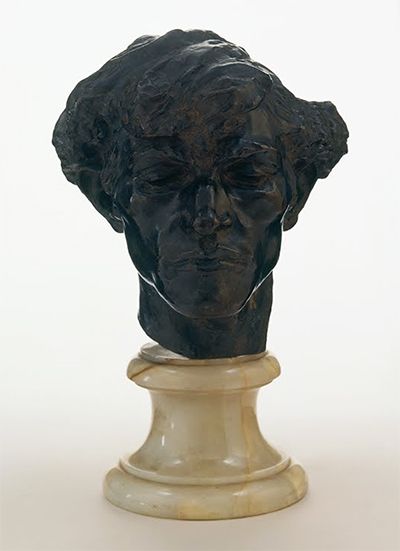
The two large compositions make the man’s body do much of the expressive work, but Claudel also modelled an older man’s head independently. The Musée Camille Claudel exhibits a bronze Head of an Old Man as a study for The Mature Age. It is another Blot cast, no. 1, dated 1905 by the museum. That number belongs to the edition of the head. The reduction of the entire group had its own numbering, and an example of that group numbered 1 was cast two years later. The same number on two bronzes can therefore point to quite different objects, even where the sculptures are related and the publisher is the same. [5] [6]
A head catalogued by Galerie Malaquais as a study for the central figure offers a comparison at the scale of a face. In its photographs, the forehead pushes out above the recessed eyes, with the lips and chin set close together below. The neck is cut off while it is still broad enough to carry the head. That short ending asks the viewer to stay with the weight of the features. In the group, the man’s head is one part of a larger movement. Its position relative to the older woman’s shoulder matters before the expression comes into focus. The smaller work lets the shadow beneath the brow hold our attention much longer. [7] [1]
The Nogent collection also holds a plaster Head of an Old Blind Singer, dated about 1894 and acquired in 2017. In the published gallery checklist it appears near the cast of the head identified as a study, along with the separate Implorer. The grouping makes it possible to compare what happens when Claudel concentrates on one face, one kneeling figure or three figures across a broad base. The singer has a separate title and inventory. The museum’s decision to exhibit the objects together does not establish that the singer was used as a model for the man in the larger composition. [5] [8]
From a state commission to Tissier’s bronze
The French state commissioned the work in July 1895. The Musée d’Orsay credits Auguste Rodin with intervening on Claudel’s behalf to obtain the commission. By late 1898 Claudel was seeking the balance of the payment for the plaster. The Getty exhibition chronology places full payment in 1899, when the later plaster appeared as no. 28 at the Société nationale des beaux-arts. The Musée Rodin’s summary gives 1898 for completion and payment. The Musée Rodin and the Musée d’Orsay agree that Claudel never delivered the plaster to the Dépôt des marbres. The Getty chronology describes the bronze order as cancelled in June 1899, while the Orsay archive describes the bronze as never commissioned. The state paid for the model and the proposed public bronze fell through. The reason remains uncertain. [1] [2] [4] [9]
Showing the plaster and getting it cast were separate achievements. The 1899 Salon gave visitors a chance to see the later group alongside several other Claudel sculptures, among them the marble Clotho and the large plaster of Perseus and the Gorgon. The Getty exhibition records a response from a critic who saw the group as evidence that Claudel could rival Rodin. The following year the Société nationale’s selection for the Exposition Universelle excluded The Mature Age and her bust of the Countess de Maigret. Claudel resigned from the society. Within a year the same plaster had become an occasion for critical recognition and the subject of a dispute about where she could show her work. [4] [10]
Captain Louis Tissier provided the means to put the group into bronze. He had already commissioned a separate bronze of the kneeling figure in 1899. In the Orsay’s archive, the letters that follow take the reader from the smaller transaction to the practicalities of the larger one. In a letter dated 12 January 1902 in the museum’s inventory, Claudel reports François Rudier’s quotation of 6,000 francs for casting the group, with a note from Rudier on the back. A different letter, dated 25 February 1902 in the archive inventory, documents Claudel making the plaster group available to the founder Fumière. The quotation establishes one price under discussion. The surviving bronze names the workshop that ultimately undertook the cast. [1] [4] [9] [11] [12]
On the front of the base Claudel’s signature records the maker of the model. On the reverse of the wave the foundry inscription names Thiébaut Frères, Fumière et Gavignot, Paris, and marks the bronze as the first proof. The location of the inscription rewards walking around the work for a reason quite different from following the drama. One face of the base identifies the sculptor and the other records the bronze as a specific product of a Paris foundry. The letters give that division of work a date and a set of names. They also show one of the ways patrons and exhibitions shaped Claudel’s career. A collector’s agreement could take a work from the temporary visibility of an exhibition to the durable form in which later audiences would know it. [1] [9] [12]
The bronzes in Paris and Nogent
The Tissier cast appeared at the 1903 Salon of the Société des artistes français at the Grand Palais, catalogue no. 2658. The Musée d’Orsay acquired it from André Tissier, the captain’s son, in 1982. André gave eight pieces of correspondence from Claudel to his father on the occasion of the acquisition. The bronze entered the collection as RF 3606, while the correspondence was kept at the central library of the national museums until it came to the Orsay archives in 2016. The acquisition made it possible to study the bronze alongside the working exchanges that preceded its casting. [1] [9]
At the Musée Rodin, S.01380 is the larger bronze of the later composition. The museum dates its casting by Carvilhani to 1913 and records it as a gift from Paul Claudel in 1952. At just over 181 centimetres wide, it has a longer span than the 163-centimetre Orsay bronze. Paul gave the first-version plaster as part of the same group of gifts. The two works entered the museum together, putting a surviving early idea and a later casting in a collection where the movement of the figures could be studied across both. The model for the later bronzes is now lost. [1] [2] [3] [13]
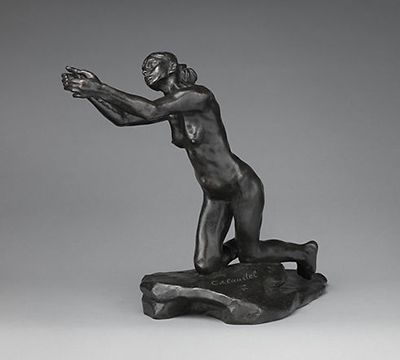
The bronze in Nogent-sur-Seine gives another sense of scale. The Musée Camille Claudel identifies its example as Eugène Blot’s no. 3 from 1907, inventory 2010.1.16. The whole group is 85 centimetres wide, a little over half the span of the Tissier bronze. A viewer can more easily take in the crest of the ground, the man’s trailing hand and the two reaching arms in one glance. At the same time the curved end of the base and the cloth behind the man still carry the eye out around the figures. Blot reduced the whole composition in this bronze. The separately cast kneeling figure, The Implorer, asks the viewer to imagine who or what lies beyond her hands. In Blot’s reduced group the answer is still there, within sight and beyond reach. [14] [15]
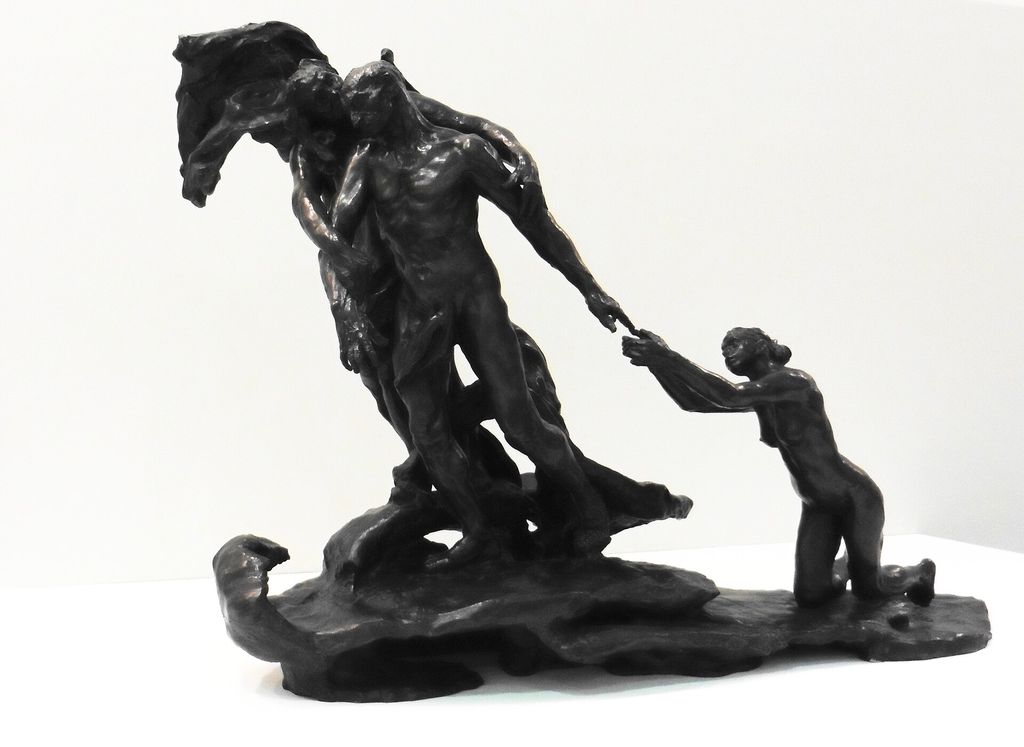
Side view of a bronze shown at La Piscine, Roubaix. The gap between the hands is visible against the light background. Photograph by Pierre André Leclercq. Image source. CC BY-SA 4.0. Resized photograph, shared under CC BY-SA 4.0.
How the numbered reductions came back into view
The Musée Camille Claudel’s no. 3 anchors the reduced edition in a public collection. Two other objects documented separately make clear how unevenly the edition has come into view. The French auction regulator’s report identifies the sand-cast bronze no. 1, 61.5 centimetres high and 85 wide, with its number placed at the kneeling figure’s feet. It dates the cast to 1907 and records its sale by Philocale at Orléans in February 2025. The report traces the work’s known exhibition history to Blot’s gallery in 1907 and 1908, followed by a gap before it was recognised during an inventory. Those are milestones in the record for one bronze. They do not tell us where it spent every intervening decade. [6]
Philocale catalogued a separate reduction, no. 5, as lot 12 for its September 2026 sale in Paris. The listing gives the same height and width as no. 1 and places the signature, the publisher’s stamp and the cast number on the object. It dates the sand casting to around 1907. Its published provenance begins with a French private collection in the 1990s and records a later descent. That is a different chain of evidence from the early Blot exhibitions reported for no. 1. The sale entry identifies and describes no. 5, while the owner’s museum record remains the more appropriate source for dimensions or accession details of the Nogent cast. [16] [14]
The numbered reductions give readers a practical way to distinguish versions. The 85-centimetre span can help identify the reduced model in a photograph with a known scale, but it cannot separate nos. 1, 3 and 5. The number and the object’s provenance do that work. Conversely, the inscription on the much larger Orsay bronze describes its position as the first proof from the foundry that cast Tissier’s commission. That phrase identifies a different casting history from Blot’s no. 1. The shared composition makes comparison possible, while the material records explain why two objects sometimes described as the first cast should be followed separately. [1] [14] [6] [16]
What the figures can mean
An early response to the Tissier bronze comes from Charles Morice, who reviewed the 1903 Salons in the Mercure de France. He praised the work’s bitterness and defended Claudel against the charge of resembling Rodin. Yet he thought the gnarled fingers and toes and the treatment of ageing flesh made physical ugliness too insistent. To him the gestures had already made the sadness plain. Looking at the group with his review in mind brings out an argument the bronze still invites. You can follow the movement from the young woman’s shoulders to the old woman’s hold without scrutinising a single face. Look closer, and the textures of flesh, tendon and drapery tell you how differently each body is bearing the strain. [1] [17]
The Musée Rodin gives other titles for the work, among them Destiny and The Path of Life. The Getty’s reading gives Youth, Maturity and Old Age a body each. The space between Youth and Maturity shows how the past can remain painfully near even as it becomes irrecoverable. The man’s feet follow the older woman, yet his trailing hand keeps his former attachment visible. One reason the allegory works is that the figures register the passage of time in their positions and gestures. The man is already leaving, the younger woman still reaching, and the older woman already close. [2] [10]
Claudel also explored age outside this group. In Clotho she made the Fate who spins the thread of life an old woman whose hair falls around her like a binding material. The old woman in The Mature Age acts on someone else’s body, and the long sweep of her drapery extends her motion. The Orsay preserves a small plaster head, catalogued as a study for The Mature Age and dated around 1890. Just eleven centimetres high, it gives the ageing face an attention independent of the group. Set beside the later sculpture, the study suggests how the work of modelling a single head could serve a composition in which the character of old age ultimately emerges through a whole body in motion. [1] [18] [19]
In a retrospective account, Paul Claudel recognised his sister in the kneeling woman and described the departure as the tearing away of her soul. The Musée d’Orsay reads the group closely through Claudel’s relationship with Rodin. The Getty exhibition presents the identifications as associations viewers might have made, with Claudel as the young woman, Rodin as the man and his long-term partner Rose Beuret as the older woman. Paul’s reading has had a long afterlife, in part because he helped bring both versions into public view. It tells us how a family member understood the sculpture decades later. The allegory gives a different emphasis to the same passage of bodies. The older woman’s hold can be read as the force of time, even as the younger woman’s gesture conveys an individual loss. [1] [10] [13]
The 1988–89 exhibition devoted to The Mature Age at the Orsay, followed by its presentation in Lyon, gave this one work an exhibition history of its own. More recently the Tissier bronze travelled to the Claudel retrospectives in Chicago and Los Angeles, where it could be seen in the company of a wide range of her sculptures. Comparing it with the early plaster puts a particularly exact question to the later work. How much needs to change for a woman holding on to become a woman left behind? In the Orsay bronze the answer passes through the whole group, from the rising base to the forward step. At the fingertips, where that step finally breaks the contact, Claudel leaves the smallest space in the sculpture to mark what has happened. [1] [2] [3] [10]
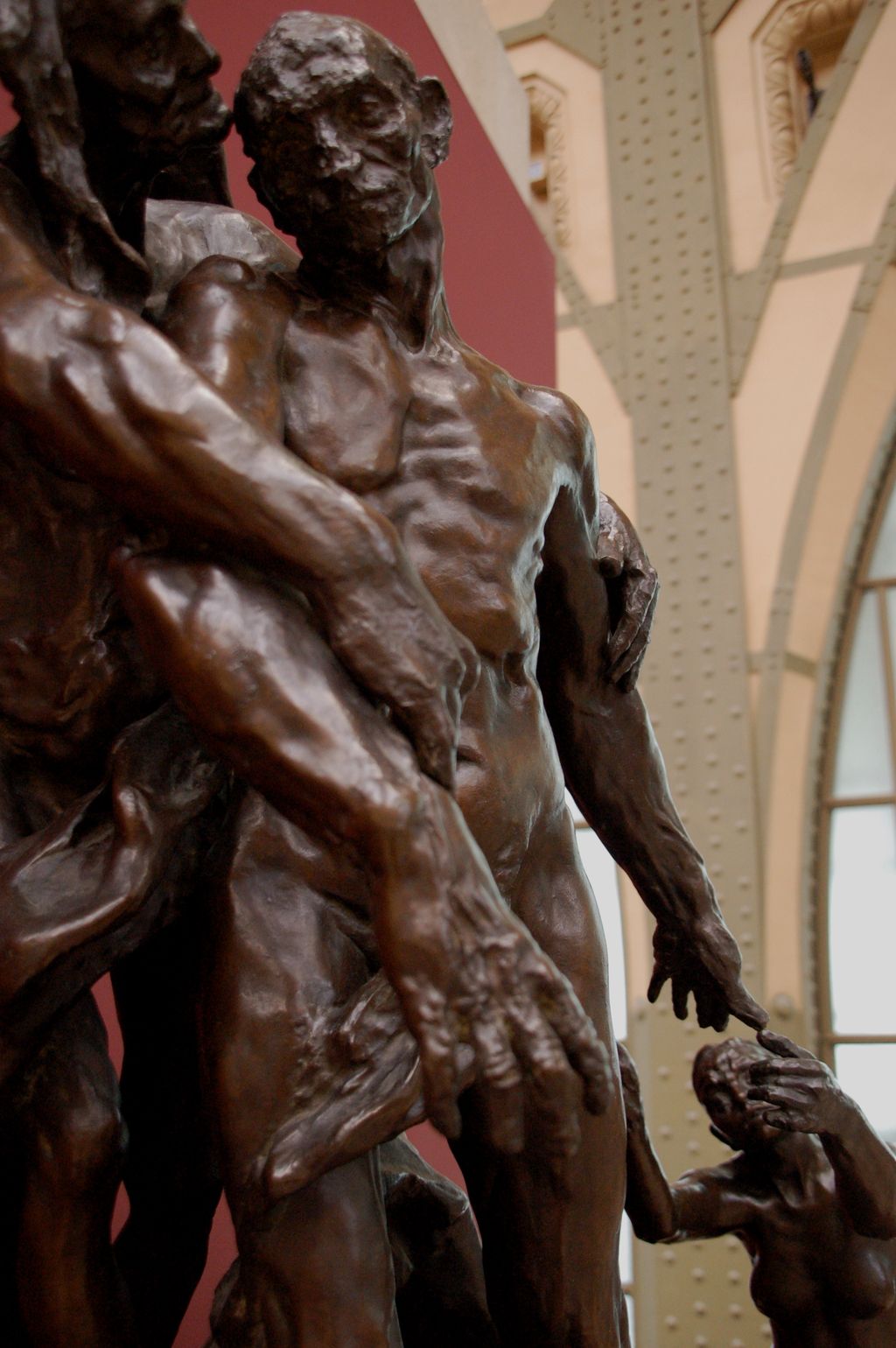
The man and the reaching hands in the Orsay bronze. Photograph by Gautier Poupeau. Image source. CC BY 2.0. Resized from the original photograph.
Artworks directory
| Name | Date | Medium |
|---|---|---|
| The Mature Age | 1894–99 | Sculpture |
| The Waltz | c. 1889–93 | Sculpture |
| Sakuntala | 1886–88 | Sculpture |
| The Little Châtelaine | 1892–93 | Sculpture |
| The Gossips | c. 1893 | Sculpture |
| The Wave | 1897–1903 | Sculpture |
| Perseus and the Gorgon | c. 1897–1902 | Sculpture |
| The Implorer | c. 1894–99 | Sculpture |
| Clotho | 1893 | Sculpture |
| Bust of Auguste Rodin | c. 1886–89 | Sculpture |
| Paul Claudel at Sixteen Years Old | c. 1882–87 | Sculpture |
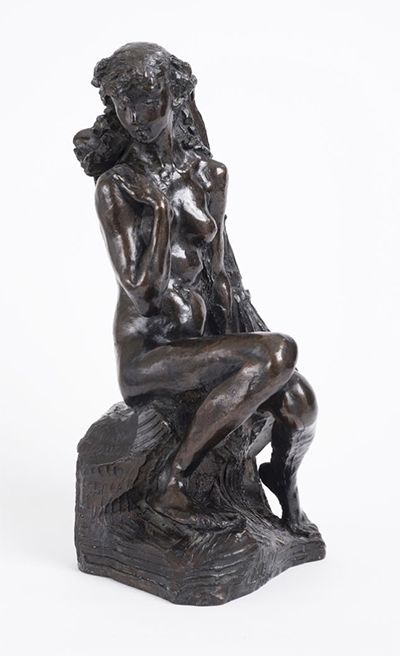
| Young Girl with a Sheaf | c. 1886–87 | Sculpture |
| Giganti | c. 1885 | Sculpture |
| Crouching Woman | c. 1884–85 | Sculpture |
| The Hungry Dog | c. 1893 | Sculpture |
| Old Hélène | c. 1881–82 | Sculpture |
| Fortune | c. 1902–05 | Sculpture |
| The Wounded Niobid | 1906 | Sculpture |
| The Siren, or The Flute Player | c. 1904–05 | Sculpture |
| Deep Thought | c. 1898 | Sculpture |
| Dream by the Fireside | c. 1899 | Sculpture |
| Paul Claudel at Thirty-Seven | 1905 | Sculpture |
| Portrait de Madame Claudel | c. 1883 | Sculpture Musée Camille Claudel. |
| Jeune Femme aux yeux clos | c. 1885 | Sculpture Musée Camille Claudel. |
| Ferdinande de Massary | 1888 | Sculpture Musée Camille Claudel. |
| Léon Lhermitte | 1889 | Sculpture Musée Camille Claudel. |
| Étude de main gauche | c. 1889 | Sculpture Musée Camille Claudel. |
| Vieil aveugle chantant | c. 1894 | Sculpture Musée Camille Claudel. |
| Tête de vieillard | c. 1890 | Sculpture Musée Camille Claudel. |
| Étude pour la tête d’Hamadryade | c. 1895 | Sculpture Musée Camille Claudel. |
| Aurore | c. 1900 | Sculpture Musée Camille Claudel. |
Discussion
Look again at the images and ideas explored in The Mature Age. These editorial prompts invite your observations.
Reader Insights
Follow the two reaching hands. Where does your eye go next?
How does the relation between the three figures change from the plaster to the later design?
Join the Conversation
Share a detail, comparison or question about The Mature Age below.
References
- Musée d’Orsay, L’Âge mûr, collection record and photographs for RF 3606,. View source.
- Musée Rodin, L’Âge mûr, collection essay and record for S.01380,. View source.
- Musée Rodin, L’Âge mûr, première version, collection record for S.01378,. View source.
- Emerson Bowyer and Anne-Lise Desmas, editors, Camille Claudel, Getty Publications, 2023, chronology for 1893–1903,. View source.
- Musée Camille Claudel, March 2024 press dossier, room 14, head and group in the Blot editions,. View source.
- Conseil des maisons de vente, Les ventes aux enchères 2024, pp. 40–41, identification and sale of Blot no. 1,. View source.
- Galerie Malaquais, Head of an Old Man, study for The Age of Maturity, object dossier and photographs,. View source.
- Musée Camille Claudel, Head of an Old Blind Singer, plaster 2017.1.3,. View source.
- Nadège Horner, Musée d’Orsay, Fonds Camille Claudel, detailed inventory of the Tissier correspondence, Ms 360.1–11,. View source.
- J. Paul Getty Museum, Camille Claudel, exhibition guide, section on The Age of Maturity,. View source.
- Camille Claudel, letter to Captain Tissier on François Rudier’s casting quotation, 12 January 1902, Musée d’Orsay, Ms 360 8, 9 et 8bis,. View source.
- Camille Claudel, letter to Captain Tissier making the plaster group available to Fumière, catalogued as 25 February 1902, Musée d’Orsay, Ms 360 10, 11 et 10bis,. View source.
- Musée Rodin, Camille Claudel, account of the 1952 donation of both versions,. View source.
- Musée Camille Claudel, The Age of Maturity, collection record and photographs for bronze 2010.1.16,. View source.
- Musée Rodin, L’Implorante, dit aussi La Suppliante, collection record for the independent figure,. View source.
- Philocale, September 2026 sale catalogue, lot 12, Blot no. 5, on Gazette Drouot,. View source.
- Charles Morice, Les Salons de la Société nationale et des Artistes français, Mercure de France, June 1903, pp. 666–692, especially p. 691,. View source.
- Musée Rodin, Clotho, collection record,. View source.
- Musée d’Orsay, Tête de vieille femme, étude pour l’Âge mûr, collection record for RF MO S 2017 5,. View source.