 by Tom Gurney
Tom Gurney BSc (Hons) is an art history expert with over 20 years experience
Published on June 19, 2020 / Updated on October 14, 2023
Email: tomgurney1@gmail.com / Phone: +44 7429 011000
Giganti: Introduction
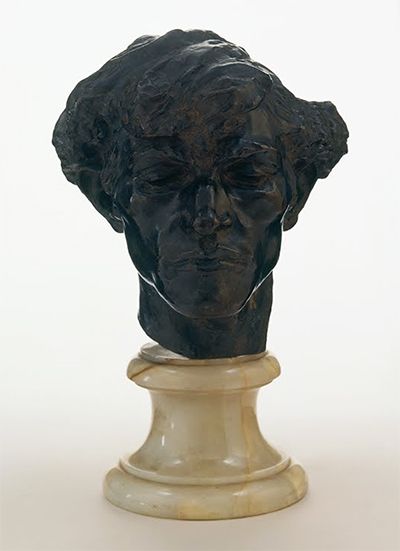
Camille Claudel raises Giganti’s chin until the underside of his jaw comes into view. His eyelids sit low beneath the brows, and the corners of his closed mouth draw down slightly. The face appears composed even as thick, uneven locks crowd the forehead and spread over both ears. The bronze at the Musée Camille Claudel in Nogent-sur-Seine is catalogued as Giganti, the name of the Italian model. It measures 32 by 26 by 27 centimetres and stands on a red marble pedestal. Another name for the work, Tête de brigand (Head of a Brigand), makes the lifted chin sound like a challenge. The sculpture offers a more particular encounter, with a man whose expression shifts depending on where you stand. [1] [2] [3]
Giganti (Tete de brigand) Camille Claudel
At a Glance
- Alternate titleTête de brigand
- Nogent exampleBronze, 2010.5.1
Camille Claudel in context
Old Hélène
c. 1881–82Sakuntala
Plaster shown in 1888The Waltz
Developed c. 1889–93The Little Châtelaine
First model c. 1892–93The Gossips
Described in 1893, shown in 1895The Mature Age
First and second versions, c. 1894–99The Wave
Plaster shown in 1897, mixed-material object dated 1897–1903 (?)Perseus and the Gorgon
Nogent design and marble, c. 1897–1902The Wounded Niobid
Modelled in 1906Contents
- Looking up at the face
- A study, a sitter and a brigand
- How Claudel and Lipscomb treated the same model
- What the surviving bronzes tell us
- What the title brings to an exhibition
Looking up at the face
From the front, the nose, mouth and chin line up above the narrow part of the pedestal. The face seems nearly symmetrical at first. The two lids differ in how they open and in the thickness of the ridges around them, and the eyebrows take slightly different paths above them. The lower lip forms a broad, lit surface, while the line between the lips bends at the centre and trails off unevenly at either end. Above it, a lock dips between the brows and helps cast the eyes into shadow. There is enough variation across the face for the expression to change as the light moves, even when the head is viewed almost straight on. [1]
The three-quarter view makes the length of the neck easier to see. Its lower edge slopes against the horizontal rim of the pedestal, and the jaw projects well beyond it. The ear nearest the viewer opens a deep hollow between the mass of hair and the cheek. From here the head seems less squarely planted, and the cheek picks up a broad patch of light that gives way to a darker plane below the bone. Claudel ends the bronze before the shoulders. The raised chin and the angle of the neck carry the pose on their own. The shaped foot of red marble gives that abrupt lower edge a clearly defined place to meet the support. [1] [3]
The surface changes most sharply where the face meets the hair. On the cheek, light spreads over a relatively continuous curve. On the crown, it strikes the crests of ridges and stops at hollows between locks. Some of the locks are broad enough to look flattened, while smaller knots break the outline around the ear. Below the face, the front of the neck has several small ridges and depressions that interrupt the longer vertical forms. These differences are visible in the museum’s frontal and three-quarter photographs. The locks give the head its broad silhouette, while the smoother planes allow small movements around the eyes and mouth to register within it. [1]
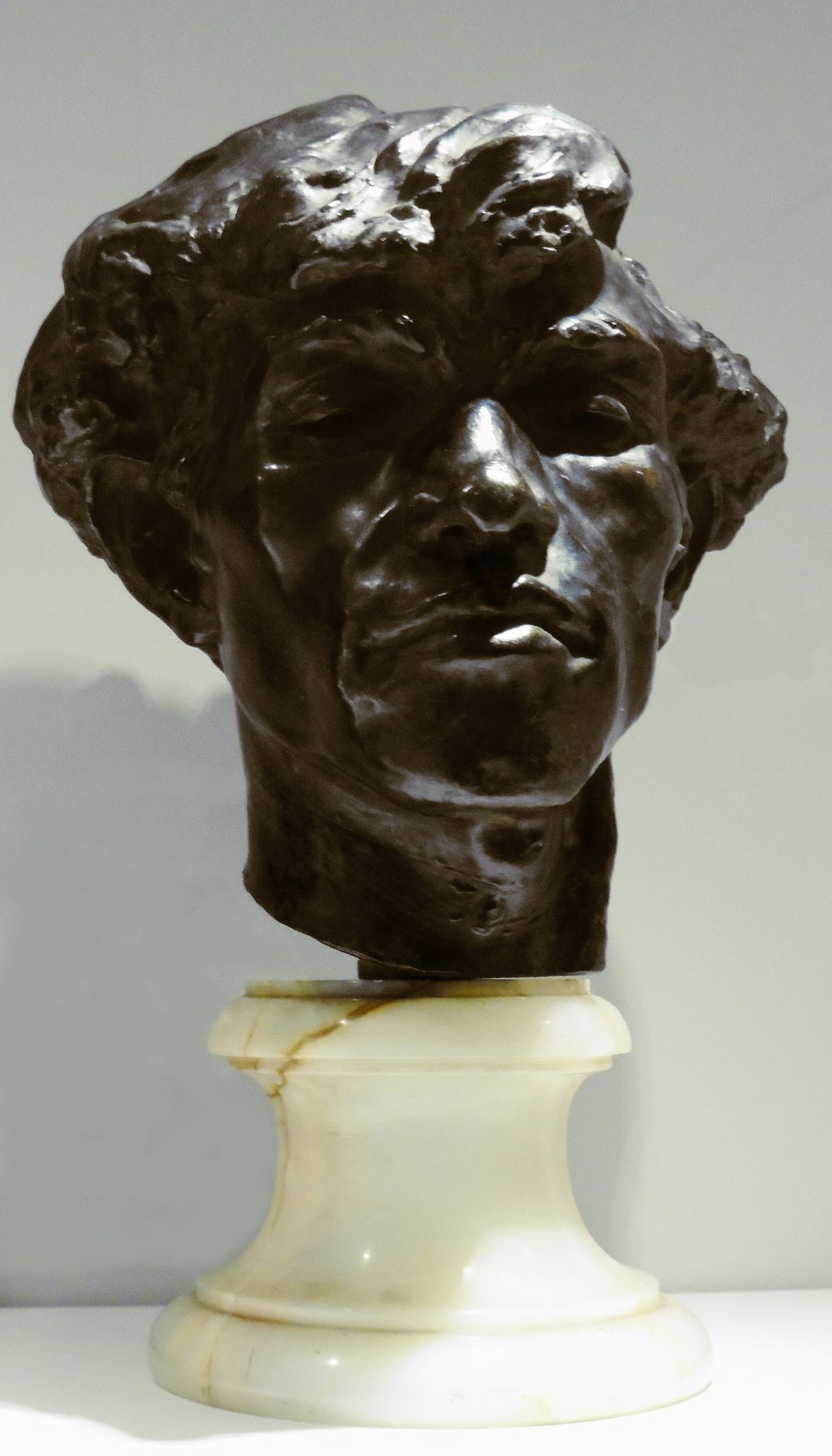
Frontal view of the Giganti bronze exhibited at La Piscine, Roubaix. Photograph by Pierre André Leclercq. Image source. CC BY-SA 4.0. Resized photograph, shared under CC BY-SA 4.0.
A study, a sitter and a brigand
At the Paris Salon of 1885, the illustrated catalogue of the Société des Artistes Français lists a bronze Étude (Study) by Camille Claudel under no. 3496. The next number is her terracotta Vieille femme (Old Woman), known today as Old Helen. The Chicago and Getty retrospective chronology identifies the bronze study as Giganti. The entry establishes the title and medium under which the composition appeared at the Salon. Modern catalogues connect the exhibition with different surviving bronzes, and the original entry gives too little detail to single out a cast securely. [4] [5] [6] [7]
The critic Théodore Véron noticed the broad mouth, wide nose and thick hair falling towards the brow. Writing about the Salon bronze, he described the subject as a labourer and found character and a certain nobility in the head. The structure of his appraisal is revealing. He treated those distinctive features as details a sculptor might need to overcome to achieve an elevated effect. In the bronze they are the means of achieving it. The breadth of the mouth lends weight to the lower face, and the locks that jut over the brow make the gaze below them more arresting. [1] [8]
The name Giganti also takes us into Claudel’s working life. While she was developing Sakuntala, Giganti posed for the male figure. The Musée Camille Claudel draws on her letters to Florence Jeans to trace the sittings. In a letter dated 25 December 1887, Claudel wrote that his departure had left her with changes that would take time and cost money. The museum reports that he had returned to Italy. Marie-Hélène Montout-Richard, writing about the Reims bronze, identifies him more specifically as a man from Naples who lived on the rue du Château in Paris. Reims catalogues Tête de brigand as an alternate title. The surviving accounts identify Giganti through his work as a model, and the label brigand belongs to the sculpture’s interpretation. [2] [3] [9]
How Claudel and Lipscomb treated the same model
The 2025 exhibition In the Time of Camille Claudel, Being a Woman Sculptor in Paris brought together interpretations of Giganti by Claudel, the English sculptor Jessie Lipscomb and Auguste Rodin. The exhibition dossier reproduces Lipscomb’s bronze, dated about 1885 and held in a private collection. Her head is raised on a pedestal too, but she carries the neck down into a small spread of shoulders. The two shoulders widen the lower outline, and the lines on either side of the throat open into them. At the brow, compact curls rise off the forehead and leave a comparatively clear area above the eyes. Claudel gathers more of the hair into a heavy sweep across the brow and ends the neck just where it reaches the pedestal. In Lipscomb’s sculpture the neck settles into the upper chest, whereas in Claudel’s the light under the chin gives the jaw a distinct edge almost all the way across. [1] [10]
A separate object also titled Giganti shows what Rodin could do with the same model at the scale of a statuette. The example at the Musée Rodin, S.02843, is a bronze cast by Émile Godard in 1986. It represents the man nude and standing, with both arms and parts of the legs omitted. The face belongs to an arrangement that also includes the turn of the torso and the position of the legs. Claudel’s portrait concentrates the sitter’s bearing in the cant of the head and the way the neck meets the support. The two works share a title because of the model, and the body formats make their different purposes immediately visible. [1] [9] [11]
What the surviving bronzes tell us
The Musée Camille Claudel dates the composition to about 1885 and considers its bronze, inventory 2010.5.1, likely to have been cast by Gruet before 1892. It bought the bronze from Philippe Cressent in 2008. Alphonse de Rothschild gave other casts to museums in Lille, Reims and Cherbourg between the early 1890s and 1902, working through the critic and dealer Léon Gauchez. Lille catalogues its head as 32 centimetres tall and 46 with the base. The 1901 Reims gift, 901.27.1, has Claudel’s full name and a painted wooden support. Its head measures 31.2 centimetres, and the assembled object reaches 48.3. The Cherbourg bronze, MTH 2008.0.140, arrived in 1902 and carries the signature C. Claudel. The individual records distinguish casts that can look much alike when reproduced at the same scale. [1] [2] [3] [7] [12] [13]
The Kunsthalle Bremen bronze is shorter at 26.5 centimetres, and the neck ends higher than in the Nogent example. It carries the signature A. Rodin. Bremen nonetheless attributes the sculpture to Claudel, drawing attention to the character of the expression and the handling of the brown-black surface. Berlin’s Alte Nationalgalerie listed the Bremen loan under Claudel in its 2025 exhibition on her and Bernhard Hoetger. The signature makes the cast especially instructive when seen alongside the others. The proportions and modelling of the head connect it with the Claudel bronzes, and the shorter neck gives it a different outline from the examples on taller mounts. [1] [3] [14] [15]
A much smaller plaster study, traditionally dated about 1885, is recorded in the artist’s family in the 2001 catalogue raisonné, as summarised by Montout-Richard. She also records a related plaster or terracotta whose whereabouts were unknown. The plaster study points to work at a different scale. The public bronze records tell a different part of the story, showing how a head of roughly the same size could be signed or mounted differently as individual casts circulated. [3] [7] [13]
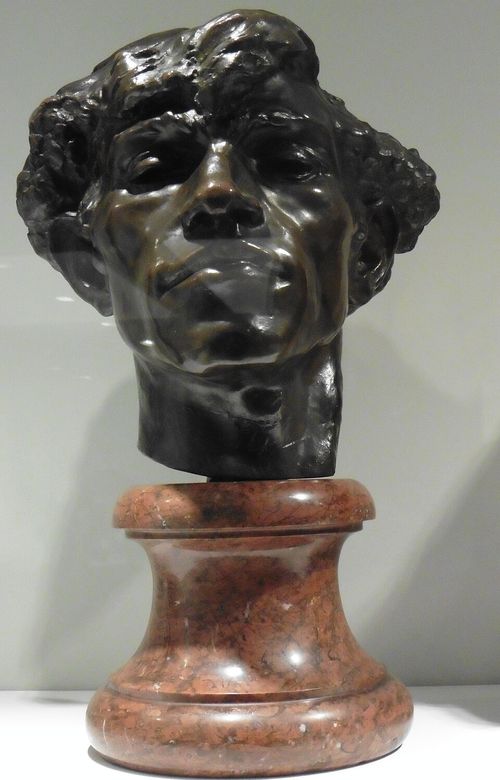
A bronze example of Giganti on a turned stone pedestal, photographed at La Piscine, Roubaix. Photograph by Pierre André Leclercq. Image source. CC BY-SA 4.0. Resized photograph, shared under CC BY-SA 4.0.
What the title brings to an exhibition
Lille’s bronze was reproduced under the title Giganti in the July 1913 issue of L’Art décoratif, alongside Paul Claudel’s essay on his sister’s sculpture. The museum records it in the exhibitions at the Musée Rodin and the Musée Sainte-Croix in 1984, and in the Chicago and Getty retrospective in 2023–24. The Reims bronze travelled to Québec for Camille Claudel et Rodin. La rencontre de deux destins in 2005. In 2021 it appeared in the Musée de Bastia’s Banditi! exhibition on brigandage in Corsica and Italy, with both titles in the exhibition dossier. In a show about banditry, the French title invites attention to the figure’s air of defiance. In Nogent’s exhibition alongside Lipscomb’s bronze, differences in the treatment of the same sitter came to the fore. The chin is raised in both portraits. The tightly framed face and the shadow across the eyes give Claudel’s its particular force. [7] [10] [16] [17] [18]
Artworks directory
| Name | Date | Medium |
|---|---|---|
| The Mature Age | 1894–99 | Sculpture |
| The Waltz | c. 1889–93 | Sculpture |
| Sakuntala | 1886–88 | Sculpture |
| The Little Châtelaine | 1892–93 | Sculpture |
| The Gossips | c. 1893 | Sculpture |
| The Wave | 1897–1903 | Sculpture |
| Perseus and the Gorgon | c. 1897–1902 | Sculpture |
| The Implorer | c. 1894–99 | Sculpture |
| Clotho | 1893 | Sculpture |
| Bust of Auguste Rodin | c. 1886–89 | Sculpture |
| Paul Claudel at Sixteen Years Old | c. 1882–87 | Sculpture |
| Young Girl with a Sheaf | c. 1886–87 | Sculpture |
| Giganti | c. 1885 | Sculpture |
| Crouching Woman | c. 1884–85 | Sculpture |
| The Hungry Dog | c. 1893 | Sculpture |
| Old Hélène | c. 1881–82 | Sculpture |
| Fortune | c. 1902–05 | Sculpture |
| The Wounded Niobid | 1906 | Sculpture |
| The Siren, or The Flute Player | c. 1904–05 | Sculpture |
| Deep Thought | c. 1898 | Sculpture |
| Dream by the Fireside | c. 1899 | Sculpture |
| Paul Claudel at Thirty-Seven | 1905 | Sculpture |
| Portrait de Madame Claudel | c. 1883 | Sculpture Musée Camille Claudel. |
| Jeune Femme aux yeux clos | c. 1885 | Sculpture Musée Camille Claudel. |
| Ferdinande de Massary | 1888 | Sculpture Musée Camille Claudel. |
| Léon Lhermitte | 1889 | Sculpture Musée Camille Claudel. |
| Étude de main gauche | c. 1889 | Sculpture Musée Camille Claudel. |
| Vieil aveugle chantant | c. 1894 | Sculpture Musée Camille Claudel. |
| Tête de vieillard | c. 1890 | Sculpture Musée Camille Claudel. |
| Étude pour la tête d’Hamadryade | c. 1895 | Sculpture Musée Camille Claudel. |
| Aurore | c. 1900 | Sculpture Musée Camille Claudel. |
Discussion
Look again at the images and ideas explored in Giganti. These editorial prompts invite your observations.
Reader Insights
Where does the texture of the bronze interrupt the outline?
How does the portrait read before and after you learn its alternate title?
Join the Conversation
Share a detail, comparison or question about Giganti below.
References
- Musée Camille Claudel, Giganti, Nogent bronze 2010.5.1, French object record and photographs,. View source.
- Musées de Reims, Giganti, bronze 901.27.1, collection record and essay by Marie-Hélène Montout-Richard,. View source.
- Marie-Hélène Montout-Richard, Tête de brigand, par Camille Claudel, Reims object essay in the Institut national d’histoire de l’art’s Rothschild collections project,. View source.
- Société des Artistes Français, Catalogue illustré du Salon de 1885, sculpture entries 3495–3497, p. LVII,. View source.
- Art Institute of Chicago and J. Paul Getty Museum, Camille Claudel, 2023 exhibition catalogue, chronology for 1885,. View source.
- Musée Camille Claudel, 1881–1885: Her arrival in Paris and encounter with Auguste Rodin, chronology and identification of the Nogent cast,. View source.
- Palais des Beaux-Arts de Lille, Tête de Giganti, bronze Sc. 15, catalogue and exhibition history,. View source.
- Théodore Véron, Dictionnaire Véron, 1885 Salon, p. 535, excerpt reproduced in the Grand Palais and Musée Camille Claudel educational dossier, p. 10,. View source.
- Musée Camille Claudel, Camille Claudel à l’œuvre : Sakountala, exhibition dossier, pp. 6–7, with Claudel’s letter to Florence Jeans of 25 December 1887 and the caption for Rodin’s S.02843,. View source.
- Musée Camille Claudel, In the Time of Camille Claudel, Being a Woman Sculptor in Paris, 2025 exhibition dossier, pp. 3 and 8,. View source.
- French Ministry of Culture, Giganti, Joconde record for the Musée Rodin’s Godard bronze S.02843,. View source.
- Institut national d’histoire de l’art, inventory of Rothschild donations to the Palais des Beaux-Arts de Lille, p. 9,. View source.
- Musée Thomas Henry and Institut national d’histoire de l’art, inventory of Rothschild gifts to Cherbourg, bronze MTH 2008.0.140, p. 2,. View source.
- Kunsthalle Bremen, Giganti (Tête de brigand), object details and attribution in the museum’s Google Arts & Culture collection,. View source.
- Staatliche Museen zu Berlin, Camille Claudel and Bernhard Hoetger, 2025 exhibition checklist, Bremen bronze,. View source.
- L’Art décoratif, no. 193, July 1913, photograph and caption of Lille’s bronze accompanying Camille Claudel, statuaire,. View source.
- Gazette officielle du Québec, Camille Claudel et Rodin. La rencontre de deux destins, 6 April 2005, Reims bronze on the official exhibition loan list, p. 1156,. View source.
- Musée de Bastia, Banditi! Brigandade et banditisme, Corse–Italie 1600–1940, 2021 exhibition dossier, p. 7,. View source.