 by Tom Gurney
Tom Gurney BSc (Hons) is an art history expert with over 20 years experience
Published on June 19, 2020 / Updated on October 14, 2023
Email: tomgurney1@gmail.com / Phone: +44 7429 011000
Sakuntala: Introduction
Look at the man’s hand in Camille Claudel’s Sakuntala. From the side of the original plaster that exposes the woman’s back, his fingers spread against her ribs, just below the shoulder blade. His knees are down and his head is raised. She stands above him, yet the line from her hips to her shoulders bends sharply towards him. Their faces all but disappear into the space between the two bodies. Claudel lets you see the effort of the embrace most clearly from the side where you see least of the lovers’ expressions. [1] [2]
The surviving plaster at the Musée Bertrand in Châteauroux stands 190.5 centimetres high. From the other side, the rough upright behind the woman and the line of her legs restore a sense of how high she is standing. The upright catches the eye low down while the bodies join high up. One figure seems to give way and the other stretches to receive her. It takes a moment to register that the person who is standing appears the more precarious of the two. Claudel had tried a very different arrangement in clay, with the woman kneeling. She changed who had to look up before the group went to the Paris Salon in 1888. [1] [2] [3]
Sakountala, the title used by the Musée Bertrand, names the woman in Kālidāsa’s Sanskrit drama. By 1905 the couple would also appear as the Roman figures Vertumne et Pomone (Vertumnus and Pomona) in a marble commissioned by the Comtesse de Maigret. The dealer Eugène Blot issued a bronze version in two sizes as L’Abandon (The Abandonment). The positions of the lovers make the works recognisable as relatives. Their supports, surfaces and titles give each encounter a different character. [1] [2] [4]
Sakuntala Camille Claudel
At a Glance
- Châteauroux plasterMusée Bertrand, no. 518
- Musée Rodin marbleVertumnus and Pomona, S.01293
Camille Claudel in context
Old Hélène
c. 1881–82Sakuntala
Plaster shown in 1888The Waltz
Developed c. 1889–93The Little Châtelaine
First model c. 1892–93The Gossips
Described in 1893, shown in 1895The Mature Age
First and second versions, c. 1894–99The Wave
Plaster shown in 1897, mixed-material object dated 1897–1903 (?)Perseus and the Gorgon
Nogent design and marble, c. 1897–1902The Wounded Niobid
Modelled in 1906Contents
- The recognition of Shakuntala
- Changing who kneels
- How the terracotta studies survived
- Paris in 1888 and Châteauroux in 1895
- Maigret’s marble and the Roman story
- Blot’s two bronze sizes
- The story after the plaster
The recognition of Shakuntala
In Kālidāsa’s The Recognition of Shakuntala, King Dushyanta meets Shakuntala, the foster daughter of the sage Kanva, while hunting near a forest hermitage. They fall in love and marry. After the king departs, the sage Durvasas arrives at the hermitage. Shakuntala, thinking about her absent husband, fails to attend to the visitor. The offended sage curses her so that the man she is thinking of will forget her. Her friends persuade him to relent enough to allow a token of recognition to lift the curse. Dushyanta has left her a ring. She loses it on the way to his court, where he fails to recognise her. A fisherman later finds the ring inside a fish and the king remembers her when he sees it. [5] [6]
The ring restores memory before the lovers meet again. In the final act Dushyanta encounters a child at a celestial hermitage, learns he is his son and is reunited with Shakuntala. The recognition has stages. He has to remember, see his wife again and answer for the hurt he caused. He lowers himself before her, and she asks him to rise. The group makes the difference between those acts tangible. In the plaster he is still on his knees even as she is coming towards him. A hand that could steady her can also be read as a plea. On stage the child is still present when the king and Shakuntala meet. In the sculpture the two figures have the space to themselves. Claudel concentrates the action in the distance between two bodies and the way it closes. [1] [2] [5] [6]
The story had a French audience long before the plaster went on view. Antoine-Léonard de Chézy’s French translation with the Sanskrit text appeared in 1830. In 1858 the Paris Opéra staged Lucien Petipa’s ballet Sacountala, with a scenario by Théophile Gautier. Designs for that production give the story an elaborate world of costumes and scenery. The plaster asks a viewer to locate the drama in the tilt of a head and the position of a hand. Claudel could have encountered the story in several forms. The exact edition she read remains uncertain. [2] [7]
Changing who kneels
The Musée Rodin’s terracotta sketch S.06772, made around 1886, stands just 15.5 centimetres high. Shakuntala kneels beneath the man’s reaching arm. The compact outline pulls the eye towards the place where their heads come close, while the clay is rougher and wider around their feet. The upper figure gathers the lower one into the middle of the composition. The Musée Rodin sees a kinship here with the pyramidal arrangement of Rodin’s The Kiss. Claudel had access to that sculptural language while working in his circle. It makes the decision to open up the bodies and reverse their relative heights in the subsequent group especially apparent. [2] [3]
At the Musée d’Orsay, Étude II pour Sakountala is a separate terracotta, 21.5 centimetres high and also dated around 1886. Dushyanta is already the kneeling figure. In this study, as in the eventual plaster, the woman can bend towards a face that is rising to hers. The gap that would otherwise be left by the difference in height becomes the subject of the sculpture. This change does more than move the top of the group. It puts the act of asking for forgiveness in the man’s posture and gives the woman the movement that answers it. Both terracottas passed through Claudel’s family and entered public collections through pre-emption at the same 2017 sale. Their respective inventory numbers, S.06772 and RF MO S 2017 4, keep these two quite different proposals identifiable. [3] [8]
The demands of the larger group show up in Claudel’s letters to Florence Jeans. By November 1886 she was devoting long studio days to the work. The Musée Camille Claudel identifies the models as Jasmina and Giganti, both familiar figures in her practice. In December 1887 she wrote that Giganti had returned to Italy, leaving her with changes that would cost her time and money. She began the group in the rue Notre-Dame-des-Champs and completed it after moving to the boulevard d’Italie in January 1888. A photograph of the group in the studio shows how far the support rises behind the woman. In the photograph, the upright almost reaches the woman’s hip, leaving the bend above it free of the support. [2] [9]
The clay was modelled and the finished group was moulded in plaster. The original patinated plaster is signed low on the group and catalogued by the Musée Bertrand as inventory 518. Its visible contours are one kind of evidence. Period photographs and Claudel’s own drawing record aspects of the group at an earlier point in its life. In the drawing, the man’s shins extend behind him across the base while the woman’s bent leg stands out against the upright. The drawing separates those lines even where a view from another side brings the limbs and the support together. It also shows how strongly the pose depends on a difference in direction. He comes up out of the horizontal line of his legs and she curves down out of the vertical one behind her. [1] [2]
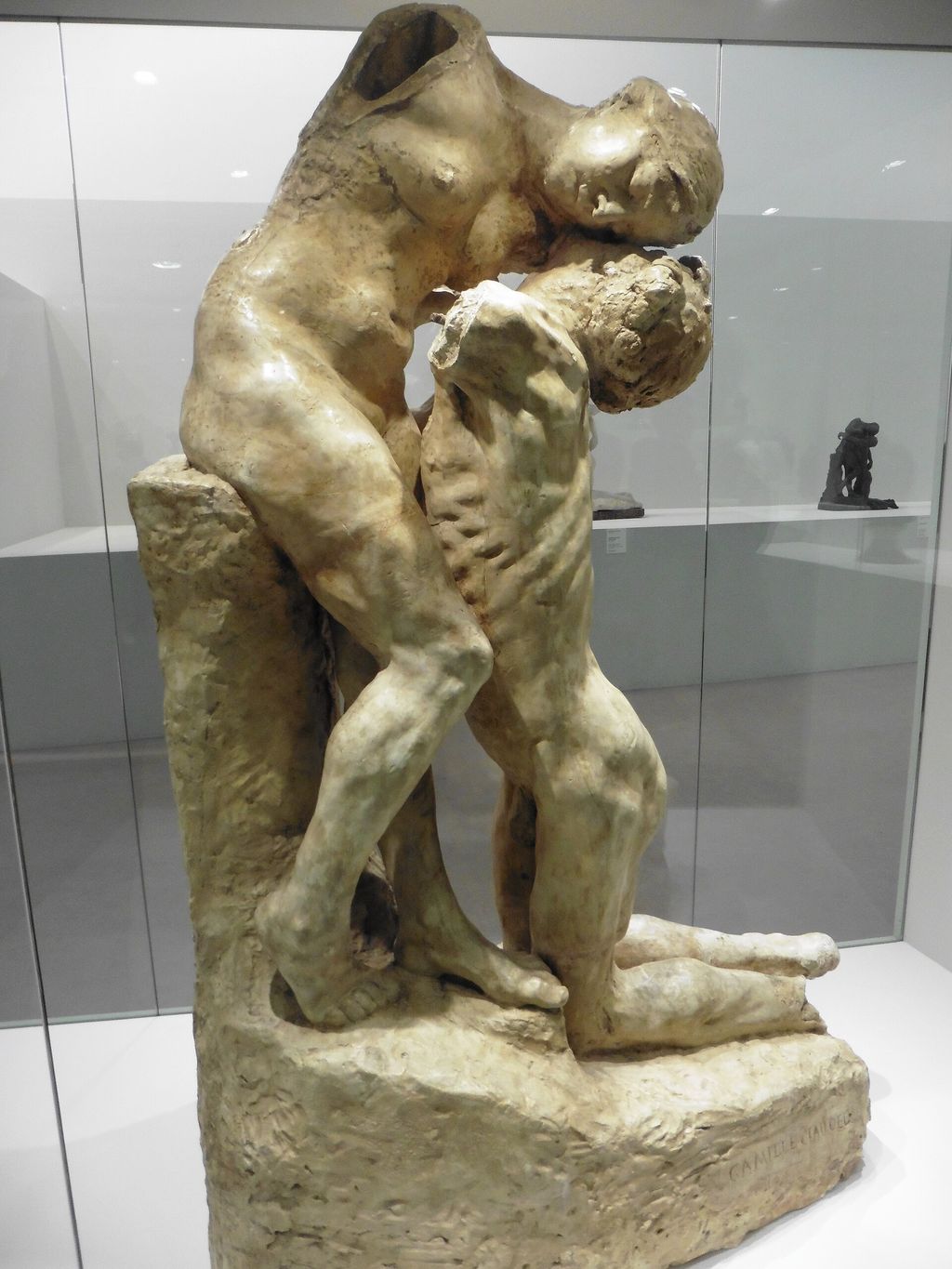
Study for the embracing group, photographed at La Piscine, Roubaix, in 2015. Photograph by Pierre André Leclercq. Image source. CC BY-SA 4.0. Resized photograph, shared under CC BY-SA 4.0.
How the terracotta studies survived
A third terracotta, S.00235, is also at the Musée Rodin. It is less finished than the other studies and is just under fifteen centimetres high without its marble stand. The study fixes the relative heights of the final group. The woman stands and the man kneels, so the encounter reads even at a scale where a face or hand can scarcely carry an expression. The rough modelling allows the direction of the bodies to come through before any individual feature does. The same relationship holds in the large plaster, where the greater surface gives Claudel room to make the contact between the bodies much more specific. [2] [10]
The Rodin catalogue records a number on the base and a donation in 1916 for S.00235. The Orsay terracotta followed a different route. The museum traces it to Claudel’s studio and then to Louise de Massary, Claudel’s sister, and her heirs. The Orsay acquired it by exercising a right of pre-emption at the November 2017 Artcurial sale, where it was lot 3. The Ministry of Culture’s account lists the sketch and a separate plaster head for The Mature Age among the works acquired for the Orsay. These objects can be considered together as evidence of how Claudel prepared sculptures even though they belong to different projects. [8] [10] [11]
The surviving clay studies tell us about choices of posture and contact at a scale that makes it possible to try a different arrangement without building a full-size group. Their shared approximate dating makes it harder to turn them into a precise calendar. The Nogent exhibition describes the third as the most summary of the three and treats it as a proposal that fixes the pose. It is possible to follow that structural sequence and leave open how much time passed between the studies, or whether Claudel returned to a particular model while she worked at a larger scale. [2] [8] [10]
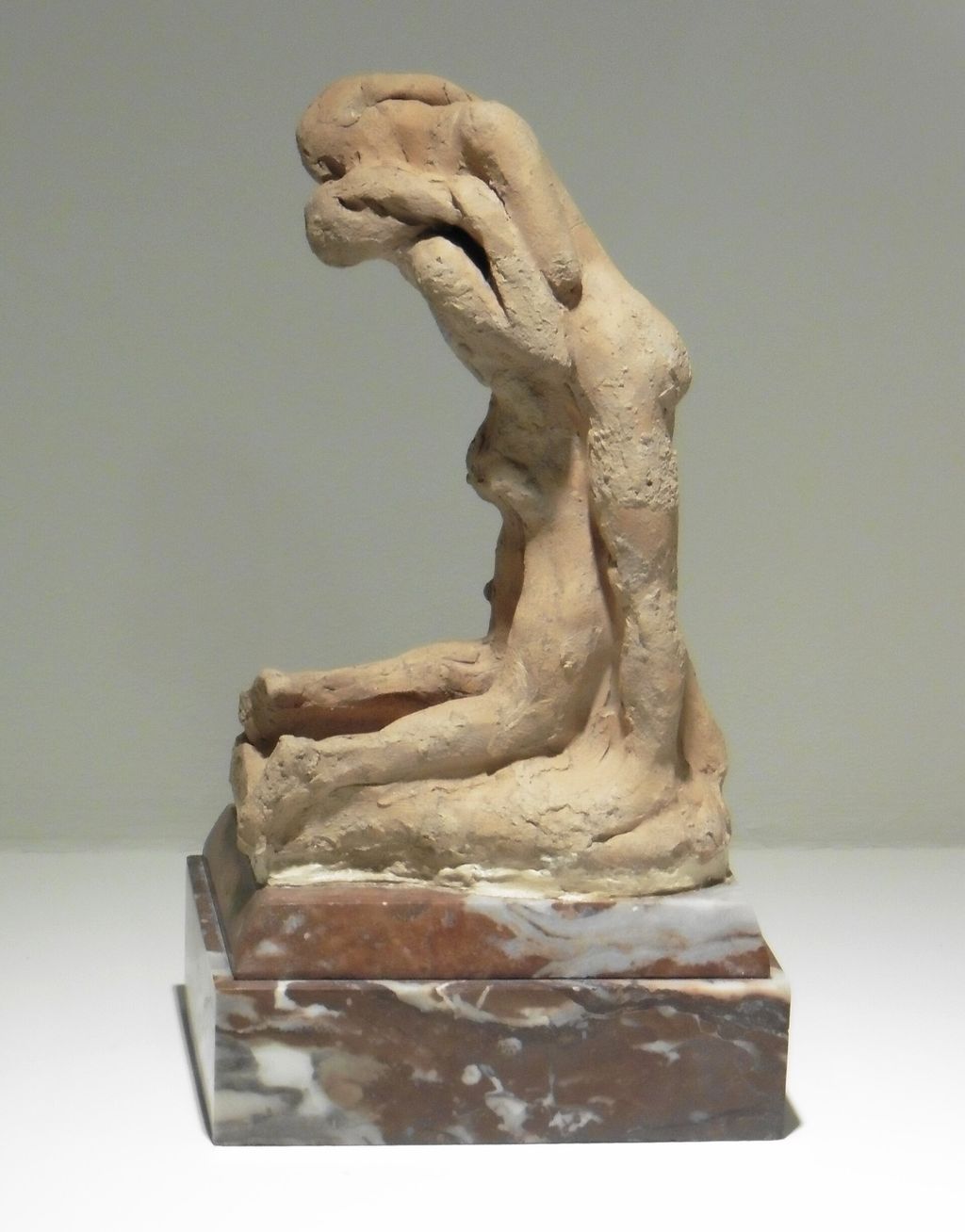
A small study for Sakuntala shown at La Piscine, with the man kneeling beneath the woman. Photograph by Pierre André Leclercq. Image source. CC BY-SA 4.0. Resized photograph, shared under CC BY-SA 4.0.
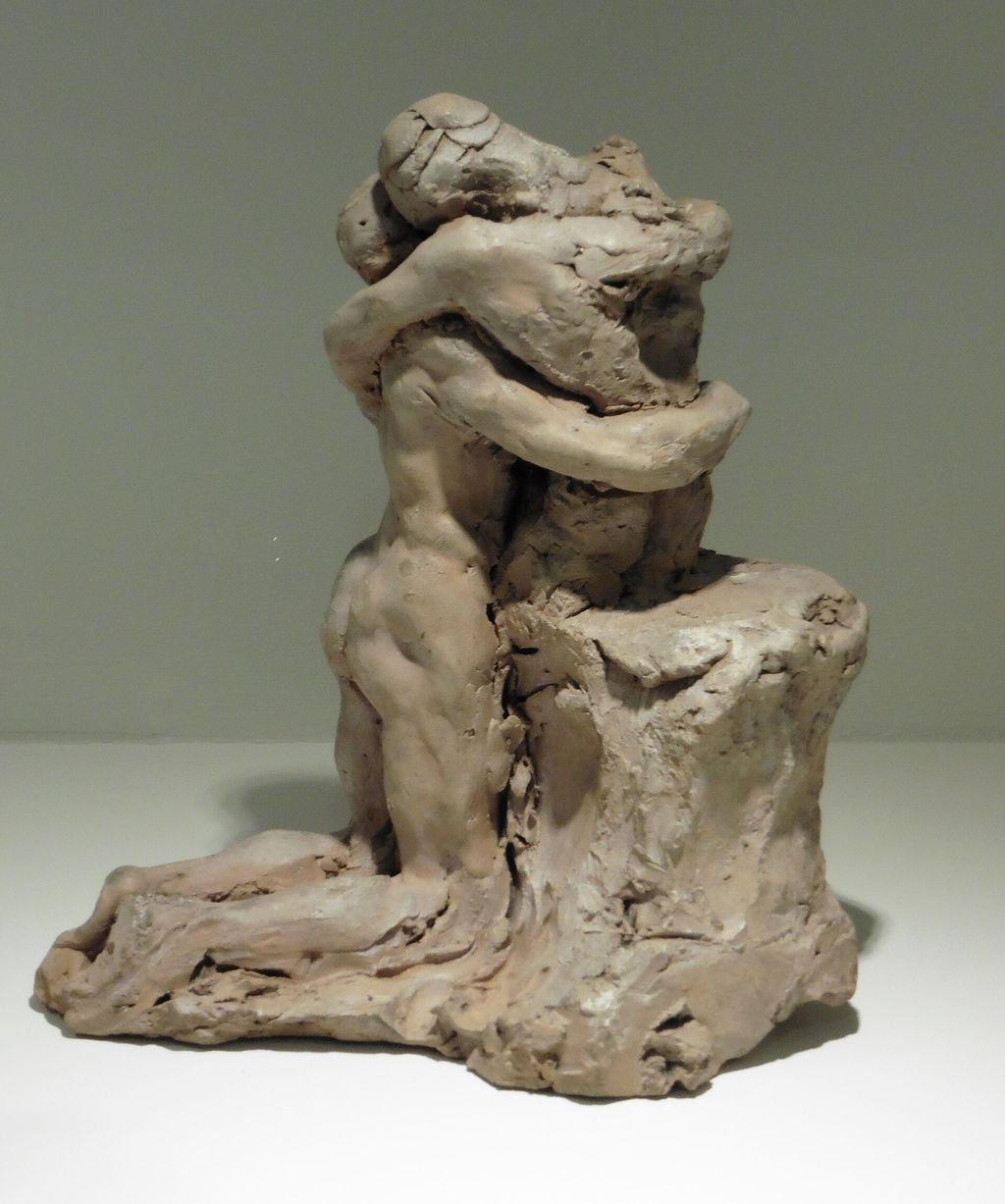
A study for Sakuntala shown at La Piscine, with the figures gathered close together. Photograph by Pierre André Leclercq. Image source. CC BY-SA 4.0. Resized photograph, shared under CC BY-SA 4.0.
Paris in 1888 and Châteauroux in 1895
The Société des Artistes Français exhibited the plaster at the Palais des Champs-Élysées in 1888, and the jury awarded it an honourable mention. Critics looked closely at the couple’s contact. Paul Leroi, writing in L’Art, singled out the hand of the kneeling man, which he imagined still hesitating before it fully embraced her. The magazine carried an illustration based on Claudel’s charcoal drawing, giving readers a side view of the suspended gesture. In Le Voltaire, Roger Marx treated the group’s emotional directness as part of the modernity he saw in the Salon’s sculpture. The reviews also show the terms under which a young woman was judged. Leroi couched his praise of Claudel’s assurance in masculine terms. Marx introduced her through her teachers, Rodin and Paul Dubois, before describing what her modelling achieved. [2] [12]
A state commission would have paid for the group to be executed in marble, a separate decision she pursued for years. In 1895 Rodin and the critic Gustave Geffroy supported an unsuccessful effort to secure it. The same year Claudel gave the plaster to Châteauroux through the intermediary of Georges Lenseigne, a collector with ties to Rodin and the local museum. The Musée Bertrand’s record connects the gift to the museum’s purchase of a painting by Alexander Harrison that Claudel owned. A plaster celebrated in Paris had found a municipal collection through a different set of relationships from those that determined a state commission. [1] [13] [14]
The owning museum’s collection plan records that the work spent a long period in reserve after challenging local conventions, and that it deteriorated during those years. Nogent’s exhibition dossier reports that the man’s left foot broke during installation and connects the return to public view with the research of Jacques Cassar and the renewed attention to Claudel from the late 1970s. A plaster can come back into view with marks from its storage and handling still visible. The studio photograph and the Salon drawing help a viewer distinguish that history from the rough areas Claudel gave the support and the base in the first place. [1] [2] [14]
Maigret’s marble and the Roman story
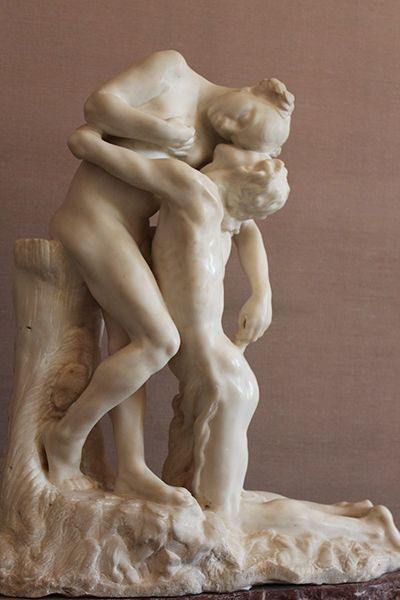
The Comtesse de Maigret commissioned the smaller marble that Claudel completed in 1905. The Musée Rodin records S.01293 as white marble on a red marble base, with an overall height of 91 centimetres. Claudel signed it at the rear and inscribed Vertumne et Pomone at the front of the terrace. According to the Nogent exhibition dossier, she took pride in having carved it herself. It appeared at the Salon des Artistes Français that year as catalogue no. 2980. Maigret also commissioned Perseus and the Gorgon. For the reunited couple her patronage paid for a new carving at a reduced scale, nearly two decades after Claudel started the plaster group. [2] [4] [15] [16]
In Book XIV of Ovid’s Metamorphoses, Pomona tends an orchard and keeps would-be suitors outside it. Vertumnus gets near her in various guises, eventually entering as an old woman and pleading his own case. When he casts off the disguise, Pomona responds to his revealed form. Where the Sanskrit play deals with the recovery of a marriage, Ovid's episode deals with a courtship and the revelation of a suitor’s identity. The same downward bend of the woman’s body can therefore mark a different moment. With the original title, she comes towards a man who owes her an apology. With the Roman title, her movement suggests a first yielding to his advances. Fruit, vines and drapery in the marble give the new title visible points of reference. [2] [5] [17]
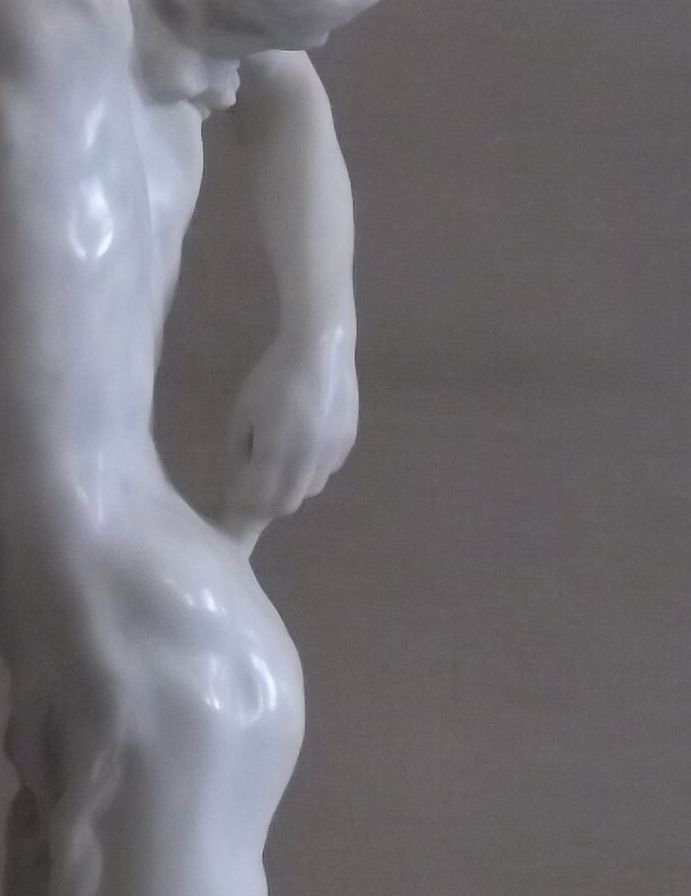
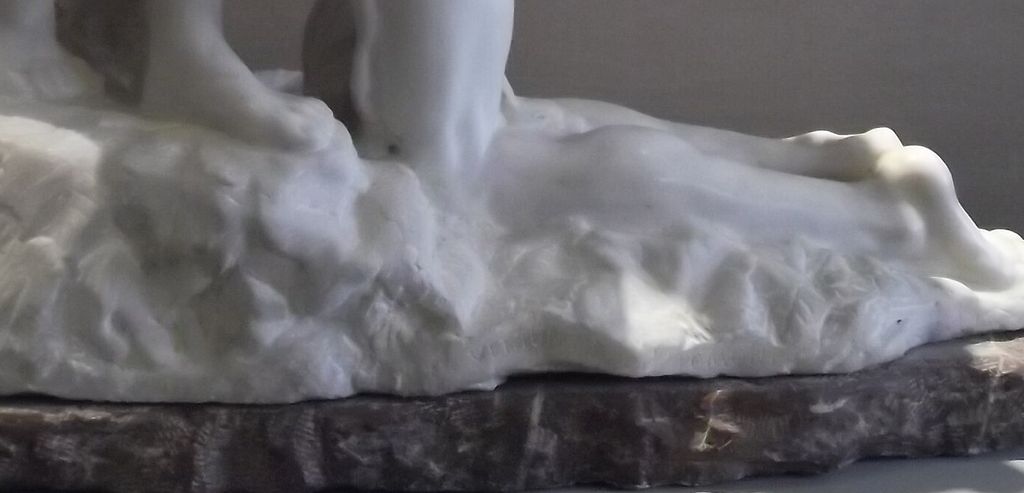
In the Musée Rodin marble, follow the woman’s free arm down past the man’s shoulder. The hand hangs at the outer edge of the group, in a patch of open space above his hip. Across from it, his arm draws a firm diagonal around her waist. Their heads are close, but you can pick out the lowered lids of the woman and the hair at the back of the man’s head. Smooth passages of torso and thigh meet a busier surface around the support. The pale stone lets the change in texture run almost continuously from the bodies to their ground. The red plinth gives this flow a clear stopping point. As the sculpture shrinks in scale, the eye can follow the hanging hand, the clasp and the support in a single view. [2] [4] [15]
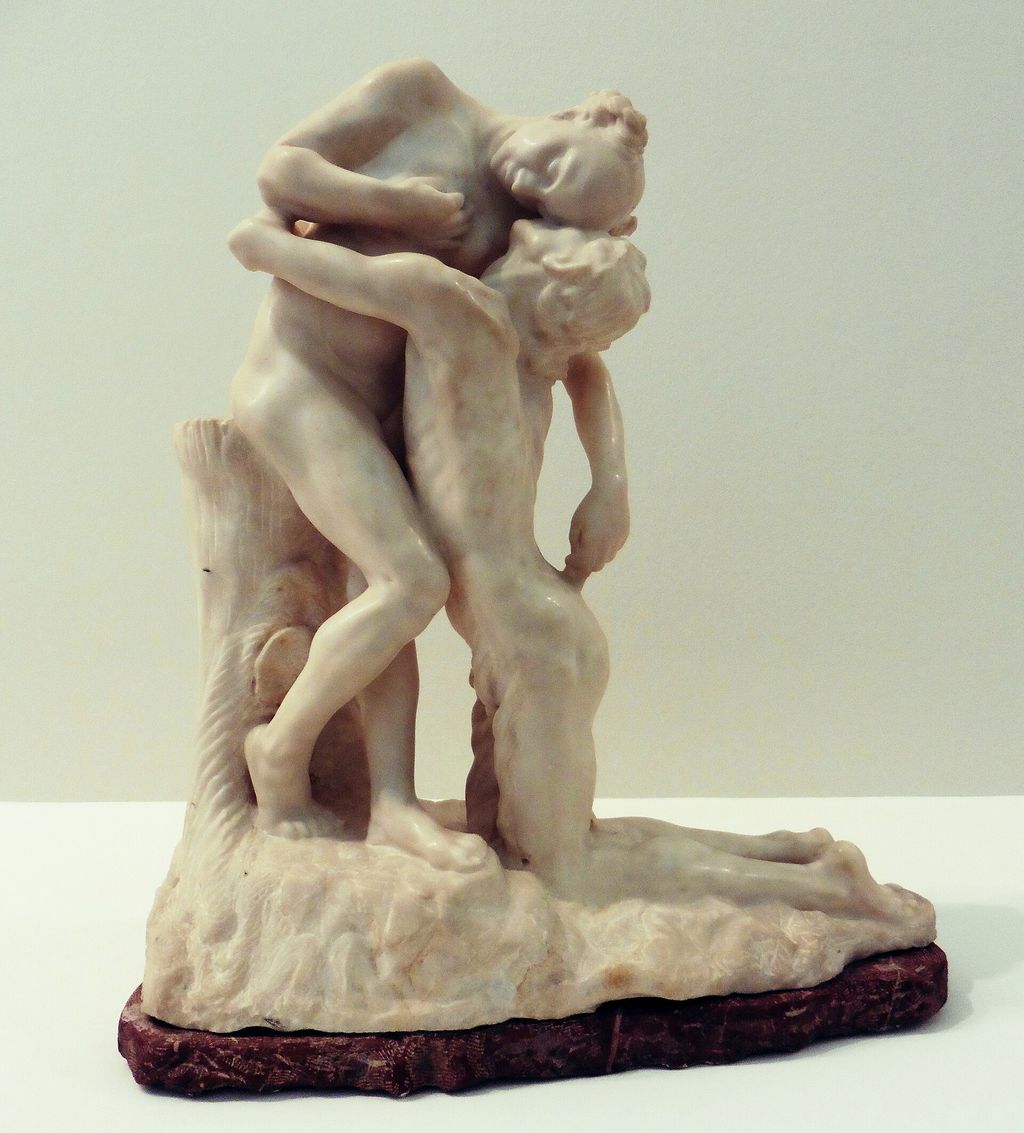
Vertumnus and Pomona in the Roubaix exhibition. From this angle the lowered hand appears beside the man’s back. Photograph by Pierre André Leclercq. Image source. CC BY-SA 4.0. Resized photograph, shared under CC BY-SA 4.0.
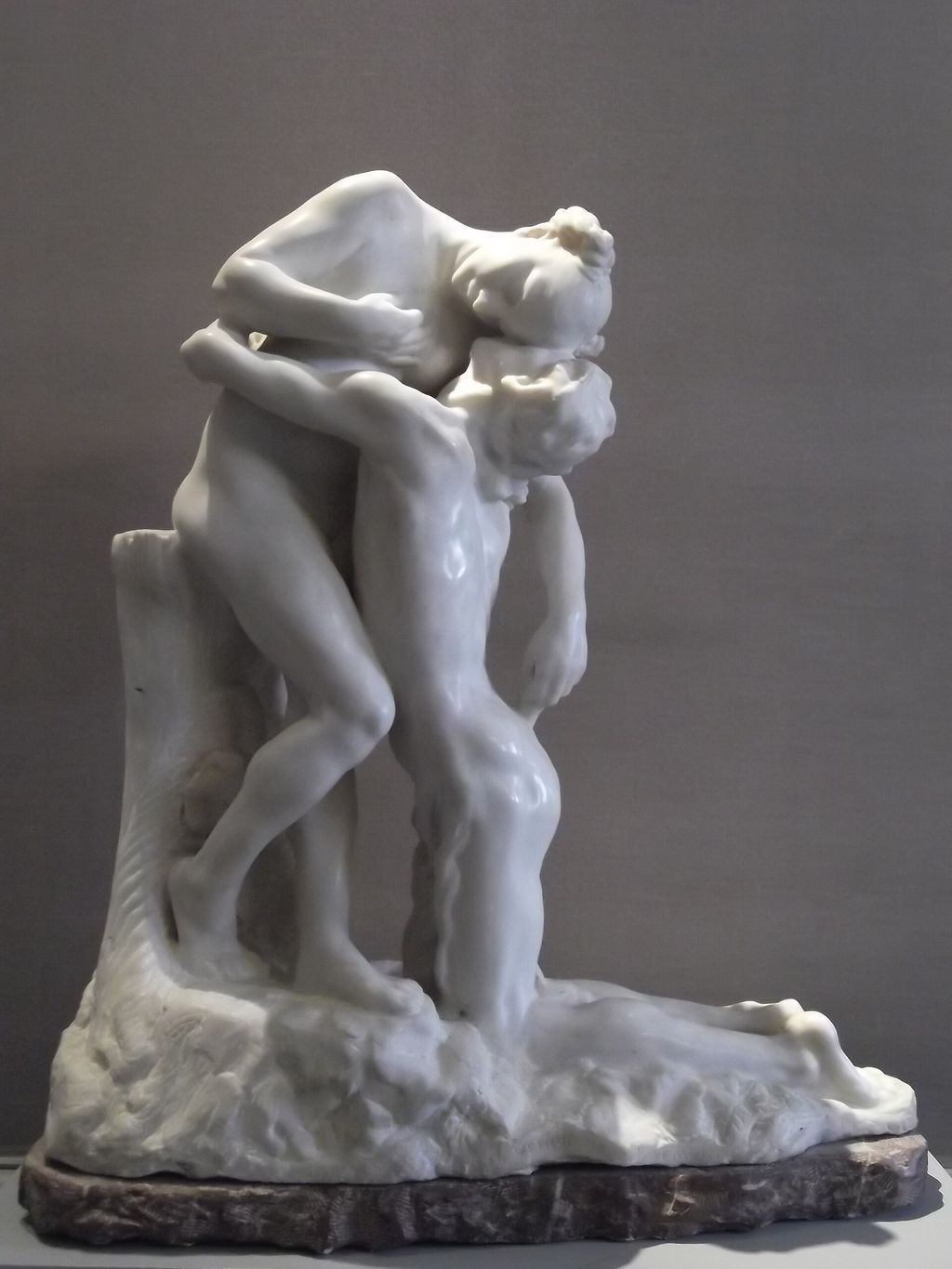
Vertumnus and Pomona, the 1905 marble version of Sakuntala in the Musée Rodin, S.01293. Photograph by couscouschocolat. Image source. CC BY 2.0. Resized from the original photograph.
Blot’s two bronze sizes
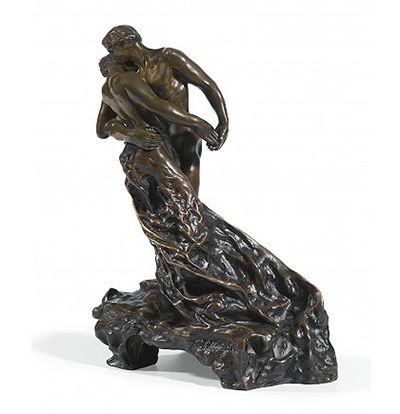
At the 1905 Salon d’Automne, the group appeared in bronze under the title L’Abandon. Eugène Blot issued it in two sizes. The Musée Camille Claudel’s small model, 2010.1.23, is 42.3 centimetres high and records a 1905 Blot cast numbered 2. A distinct large model documented by Christie’s stands 62.2 centimetres and is also stamped with Blot’s name and the number 2. The measurements matter when identifying a bronze from a base inscription or photograph. The date of the early model and the date of a particular bronze likewise tell different parts of its history. In 1907 the French state purchased a cast through Blot that was entrusted to the museum in Cambrai. It was buying an edition bronze, after Maigret had already paid for the marble commission. [2] [16] [18] [19]
On the small Nogent bronze, the woman’s right arm folds across her chest and her weight settles on her left leg. The other arm hangs beside him. In the museum’s side view, flashes on her shoulder and his back pick the two bodies out of a dark mass. His back takes the eye up towards her descending face, while his feet run back along the ground. At this scale a slight shift of viewpoint can bring the hand and the edge of the waist into silhouette together. The bare title makes the gesture harder to settle into a single emotion. In French, abandon can suggest both being left and the act of yielding. The two meanings can coexist as you watch how carefully she keeps a foot beneath her even as her upper body slackens into the embrace. [18]
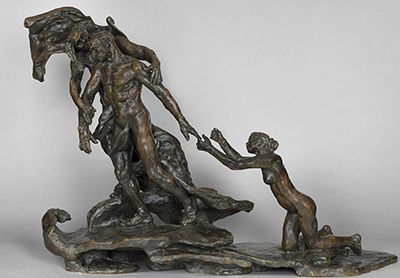
Paul Claudel read the group alongside The Kiss, praising the way his sister held tenderness and passion together and contrasting her kneeling man with Rodin’s more dominant male figure. The resemblance had a different significance for the early sketch, before the positions of the lovers changed. Reading Claudel and Rodin together is most revealing when it brings those changes into view. The long survival of the motif in Claudel’s own work gives a second comparison. In The Wounded Niobid, she reworked the bent woman as a figure suffering alone. The free arm still hangs, but its weight now belongs to a body for which there is no answering embrace. [2] [3] [8]
The Musée Camille Claudel brought the Châteauroux plaster, preparatory material and later versions together in its 2024–25 exhibition Camille Claudel à l’œuvre : Sakountala. The rediscovered charcoal associated with the 1888 review appeared in the exhibition. It preserves a choice Claudel made about how readers might first see the monumental work, with the figures in profile and the kneeling man’s lower legs extending almost to the edge of the sheet. Across the group’s history, drawings, photographs, loans and editions gave viewers different kinds of access to the same encounter. In the plaster it is possible to begin at the man’s hand and work outwards to the height of the woman’s supporting leg. In the small bronze the two figures can first register as a single silhouette, and the supporting leg emerges only when the eye has had time to separate them. [2] [18] [20]
The story after the plaster
The play continued to have a life on the French stage after Claudel finished the plaster. The Nogent exhibition placed the 1858 ballet beside the Théâtre de l’Œuvre’s 1895 L’Anneau de Çakuntalâ. Its surviving programme, attributed to Albert André, shows how the title could bring the lost ring to the foreground for a theatre audience. That production came after the 1888 Salon, so it is evidence of the story’s continuing circulation, rather than a source for Claudel’s original decision about the pose. The sculpture asks how recognition might be visible between two bodies. The title of the playbill instead calls attention to the object that makes it possible. [2] [5]
The exhibition also traced Maurice Pottecher’s later adaptation for the Théâtre du Peuple in Bussang. Pottecher completed his adaptation in 1914. The war delayed it, and it first reached the stage in 1922. Later performances used costumes to give the story a setting the audience could recognise as distinct from its own. The sculpture achieves much of its specificity without those visible cues. In the plaster, the bent figure and the man’s knees have to convey the recognition before a viewer knows about the ring or the earlier separation. Exhibiting the objects of theatre alongside the small studies made that restraint easier to see. [2] [20]
A closer look at Vertumnus and Pomona
Annotated Details from Vertumnus and Pomona
Vertumnus and Pomona, the 1905 marble version of Sakuntala in the Musée Rodin, S.01293. Photograph by couscouschocolat. Image source. CC BY 2.0. Overview numbered and details cropped.
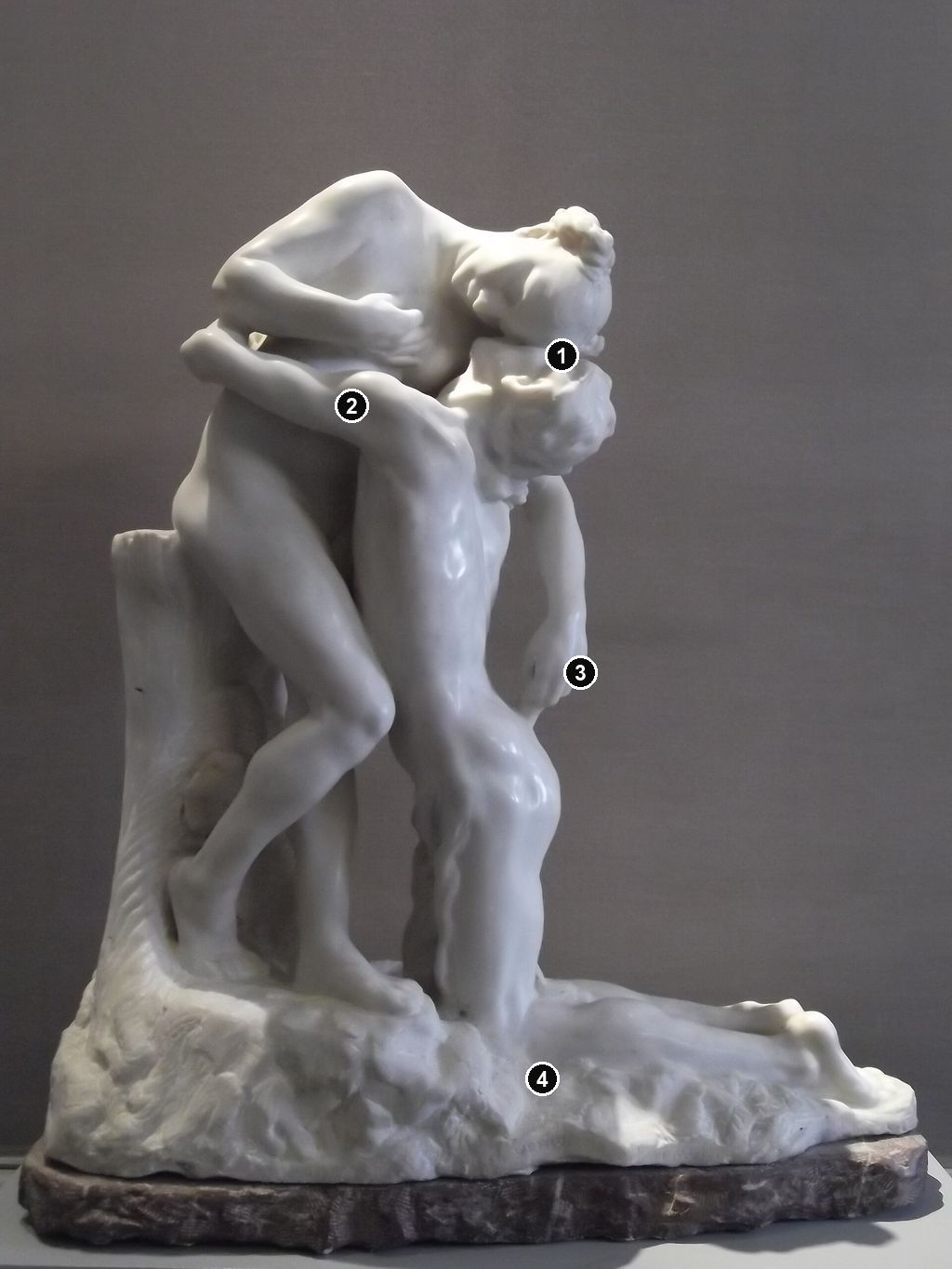
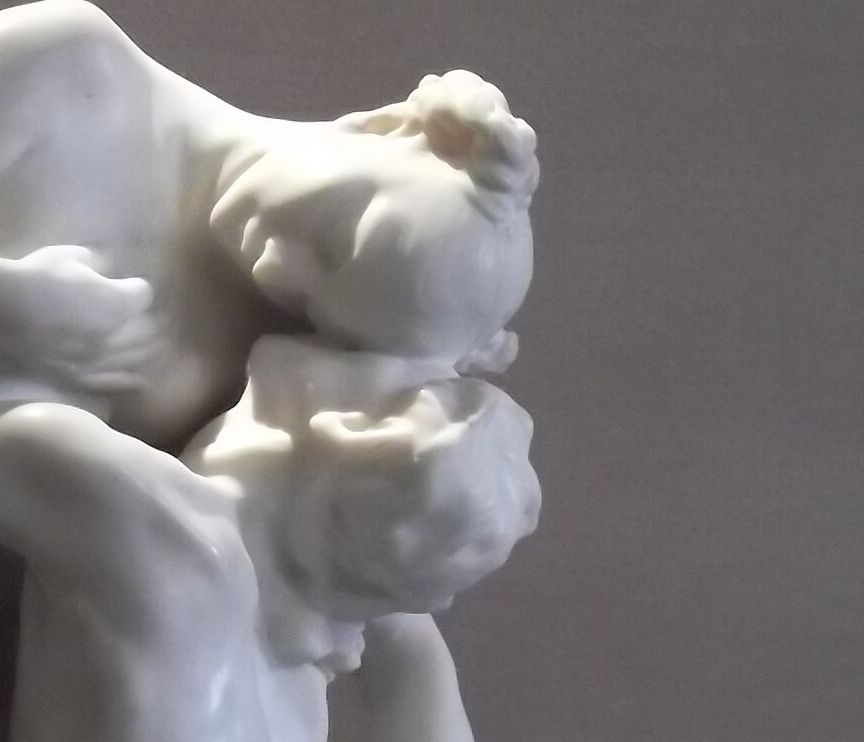
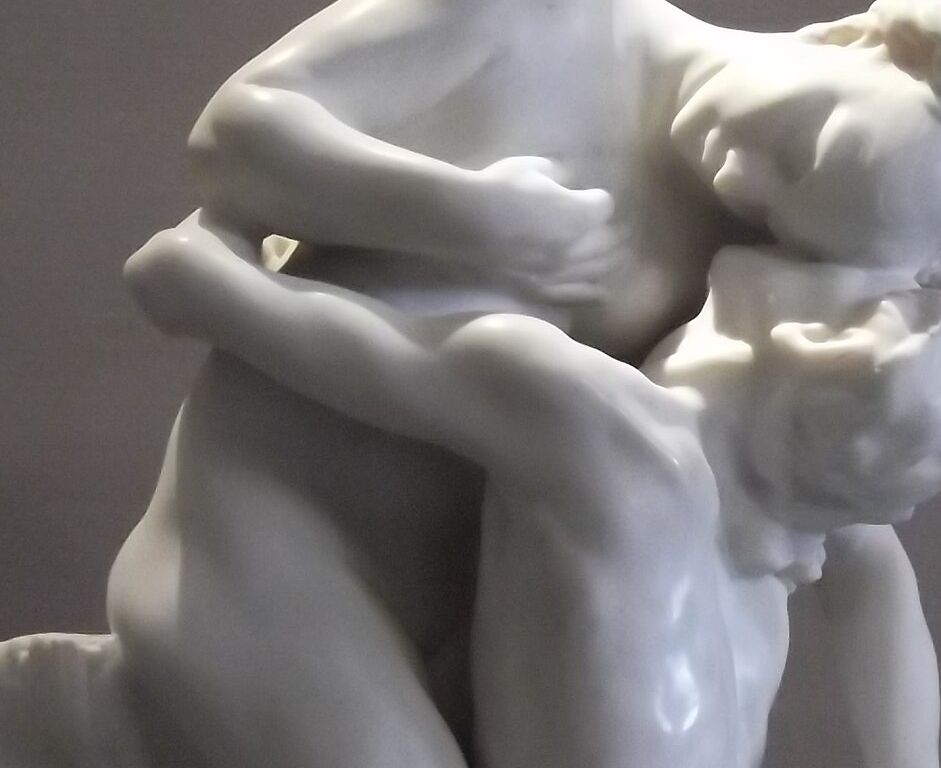
Details from VERTUMNUS AND POMONA
Follow the numbered details, then return to the complete view.
The heads meet
The upper figure bends toward the upturned face, so the profiles meet just below the high point of the group.
The arm around the body
The arm runs diagonally across the upper body, linking the figures even where the torsos pull apart.
The lowered hand
The lowered arm follows the outside of the central figure. The hand comes to rest above the base.
The uneven marble base
Rougher carving in the marble base catches the light in a different way from the smoother figures above it.
Artworks directory
| Name | Date | Medium |
|---|---|---|
| The Mature Age | 1894–99 | Sculpture |
| The Waltz | c. 1889–93 | Sculpture |
| Sakuntala | 1886–88 | Sculpture |
| The Little Châtelaine | 1892–93 | Sculpture |
| The Gossips | c. 1893 | Sculpture |
| The Wave | 1897–1903 | Sculpture |
| Perseus and the Gorgon | c. 1897–1902 | Sculpture |
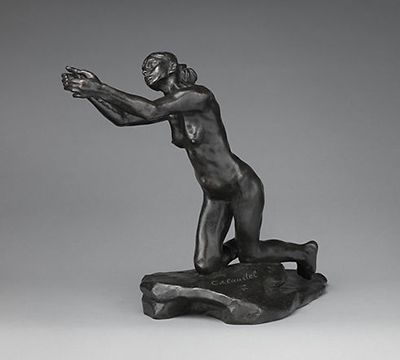
| The Implorer | c. 1894–99 | Sculpture |
| Clotho | 1893 | Sculpture |
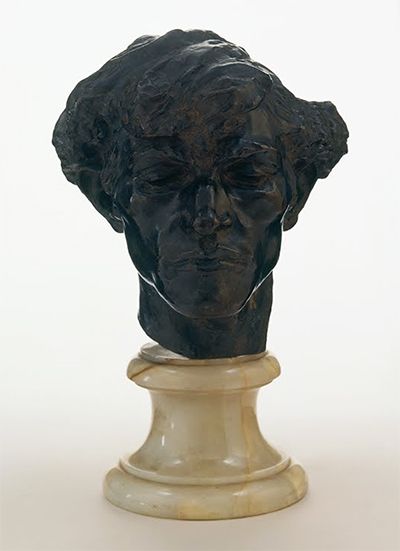
| Bust of Auguste Rodin | c. 1886–89 | Sculpture |
| Paul Claudel at Sixteen Years Old | c. 1882–87 | Sculpture |
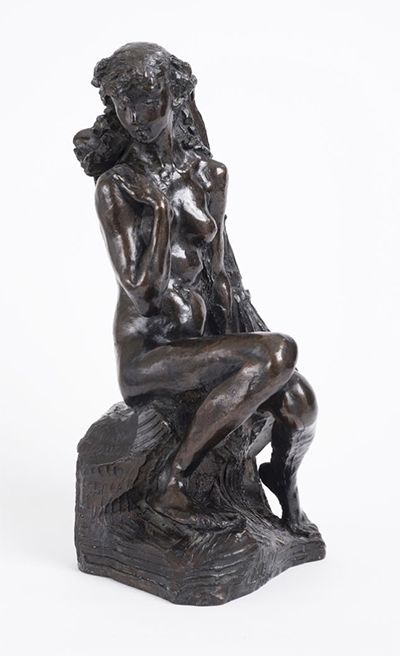
| Young Girl with a Sheaf | c. 1886–87 | Sculpture |
| Giganti | c. 1885 | Sculpture |
| Crouching Woman | c. 1884–85 | Sculpture |
| The Hungry Dog | c. 1893 | Sculpture |
| Old Hélène | c. 1881–82 | Sculpture |
| Fortune | c. 1902–05 | Sculpture |
| The Wounded Niobid | 1906 | Sculpture |
| The Siren, or The Flute Player | c. 1904–05 | Sculpture |
| Deep Thought | c. 1898 | Sculpture |
| Dream by the Fireside | c. 1899 | Sculpture |
| Paul Claudel at Thirty-Seven | 1905 | Sculpture |
| Portrait de Madame Claudel | c. 1883 | Sculpture Musée Camille Claudel. |
| Jeune Femme aux yeux clos | c. 1885 | Sculpture Musée Camille Claudel. |
| Ferdinande de Massary | 1888 | Sculpture Musée Camille Claudel. |
| Léon Lhermitte | 1889 | Sculpture Musée Camille Claudel. |
| Étude de main gauche | c. 1889 | Sculpture Musée Camille Claudel. |
| Vieil aveugle chantant | c. 1894 | Sculpture Musée Camille Claudel. |
| Tête de vieillard | c. 1890 | Sculpture Musée Camille Claudel. |
| Étude pour la tête d’Hamadryade | c. 1895 | Sculpture Musée Camille Claudel. |
| Aurore | c. 1900 | Sculpture Musée Camille Claudel. |
Discussion
Look again at the images and ideas explored in Sakuntala. These editorial prompts invite your observations.
Reader Insights
Which figure seems to carry more weight as their bodies meet?
How does seeing the reunion in plaster compare with seeing it in marble or bronze?
Join the Conversation
Share a detail, comparison or question about Sakuntala below.
References
- Musée Bertrand, Sakountala, patinated plaster, inventory 518, Joconde notice 02470000239,. View source.
- Musée Camille Claudel, Camille Claudel à l’œuvre : Sakountala, exhibition dossier, pp. 6–13,. View source.
- Musée Rodin, Esquisse pour Sakountala, terracotta S.06772,. View source.
- Musée Rodin, Vertumnus and Pomona, marble S.01293,. View source.
- Kālidāsa, translated by Monier Monier-Williams, Śakoontalá, or The Lost Ring, especially Acts IV–VII,. View source.
- Kālidāsa, translated by Arthur W. Ryder, Shakuntala, in Translations of Shakuntala and Other Works,. View source.
- J. Paul Getty Museum, Camille Claudel, exhibition guide, “Tales of Passion”,. View source.
- Musée d’Orsay, Étude II pour Sakountala, terracotta RF MO S 2017 4,. View source.
- Musée Camille Claudel, 1886–1893 : Auguste Rodin et Camille Claudel, chronology and Claudel’s letter to Florence Jeans,. View source.
- Musée Rodin, Étude pour Sakountala, terracotta S.00235, base and acquisition details,. View source.
- French Ministry of Culture, Acquisitions of major works by Camille Claudel, 2017 pre-emption and family provenance,. View source.
- Paul Leroi and Roger Marx, 1888 Salon reviews in L’Art and Le Voltaire, transcribed in Brigitte Gauthier’s Les Images de Camille Claudel,. View source.
- Musée Rodin, Camille Claudel, career account and the 1895 state commission initiative,. View source.
- Musée Bertrand and Châteauroux Métropole, Projet scientifique et culturel, section 21,. View source.
- Musée Rodin, Vertumne et Pomone, collections portal, inscriptions and photographs of S.01293,. View source.
- Musée Camille Claudel, 1893–1908: Period of Solitary Creation, chronology and exhibition entries,. View source.
- Ovid, translated by A. S. Kline, Metamorphoses, Book XIV, lines 623–771, University of Virginia Ovid Collection,. View source.
- Musée Camille Claudel, The Abandonment, small bronze model 2010.1.23,. View source.
- Christie’s, L’Abandon, 62.2 cm Eugène Blot bronze no. 2, lot 5650330,. View source.
- Musée Camille Claudel, Camille Claudel à l’œuvre : Sakountala, exhibition record and installation photographs,. View source.