 by Tom Gurney
Tom Gurney BSc (Hons) is an art history expert with over 20 years experience
Published on June 19, 2020 / Updated on October 14, 2023
Email: tomgurney1@gmail.com / Phone: +44 7429 011000
Perseus and the Gorgon: Introduction
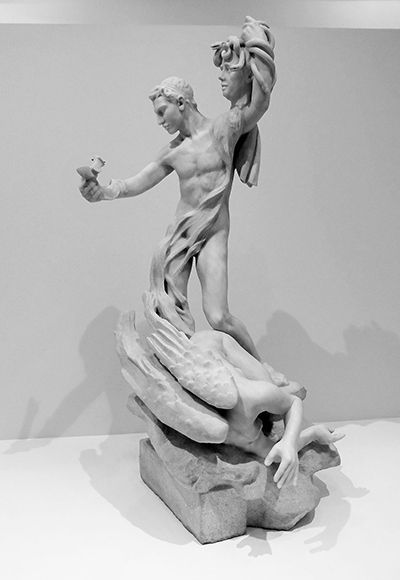
Perseus holds up the head of Medusa, but his own face turns down and away. In Camille Claudel’s marble at the Musée Camille Claudel in Nogent-sur-Seine, his left arm lifts the head almost beside his own. His right hand reaches into the space in front of him. It once held a polished shield that served as a mirror. At his feet, Medusa’s wings sweep across the stone and her hand hangs over the edge of the rock. Claudel lets us see the head that Perseus himself approaches by way of a reflection. The shield is missing from the marble, but the direction of his attention is still clear. [1] [2]
The French title is Persée et la Gorgone. The Nogent museum dates Claudel’s conception to about 1897. She showed the group in plaster in 1899. The Countess Arthur de Maigret commissioned the marble for her Paris home, and François Pompon carved it from Claudel’s model. The marble was completed and exhibited in 1902. A few years later, Eugène Blot issued the composition in bronze on a much smaller scale. One of those casts, now in Tokyo, still has the shield. Between the two works, a gesture that looks unfinished in the marble becomes intelligible again. [1] [3] [4] [5]
Perseus and the Gorgon Camille Claudel
At a Glance
- French titlePersée et la Gorgone
- Monumental marbleMusée Camille Claudel, 2009.1.1
Camille Claudel in context
Old Hélène
c. 1881–82Sakuntala
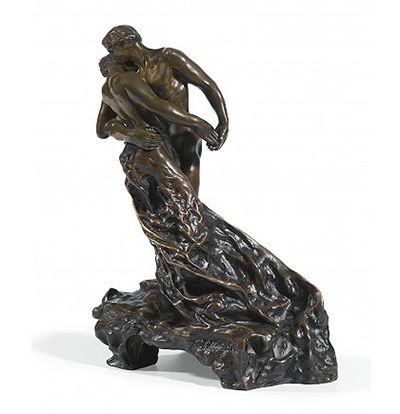
Plaster shown in 1888The Waltz
Developed c. 1889–93The Little Châtelaine
First model c. 1892–93The Gossips
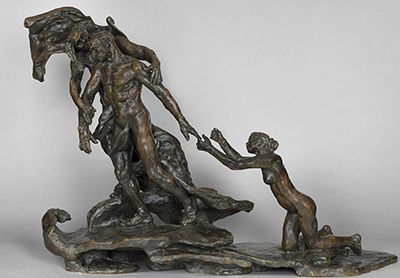
Described in 1893, shown in 1895The Mature Age
First and second versions, c. 1894–99The Wave
Plaster shown in 1897, mixed-material object dated 1897–1903 (?)Perseus and the Gorgon
Nogent design and marble, c. 1897–1902The Wounded Niobid
Modelled in 1906Contents
- Looking at the marble from the ground up
- The shield and the moment after the killing
- The two Salon appearances and the Maigret commission
- Seeing the marble before the Salon
- Paul Claudel and the face of Medusa
- Eugène Blot’s bronze and the cast in Tokyo
Looking at the marble from the ground up
The stone at the bottom of the group has several kinds of edge. The lowest block presents a level front and a straight corner. Above it the rock projects irregularly, with a rough face underneath the smooth forms of the fallen body. Medusa’s dangling hand carries the action right to the edge of that rough ledge. Its long fingers hang below the line of the wings and just outside the mass of the base. The eye can follow their fall and then reverse direction, taking in the wings as they rise into the space Perseus occupies. [1] [2]
In the museum’s frontal photograph, the wings run across the lower part of the composition in overlapping bands. Their outer ends lift into the air, while their thicker roots hide much of the folded torso. Farther up, a narrow trail of drapery follows the hero’s leg. It picks up the direction of the wings but turns it upwards. The contrast between the compact base and the open space around the upper body makes Perseus’s turn unusually easy to follow. The transition from rock to body to open air can be read even before the identities of the figures are clear. [1] [2]
The museum’s side details show how much the wings conceal in that frontal view. A knee folds tightly beside the trunk and one open palm lies close to the rock. Perseus has a foot on a broad shelf of stone, with Medusa’s limbs gathering just around it. The shelf gives him a surface to stand on even as the wing tips seem to sweep across his legs. The pitted rock makes the smooth ankles and fingers particularly distinct. Looking at this part of the group from the side also separates the weight of a planted foot from the fall of a hand over an edge. [1]
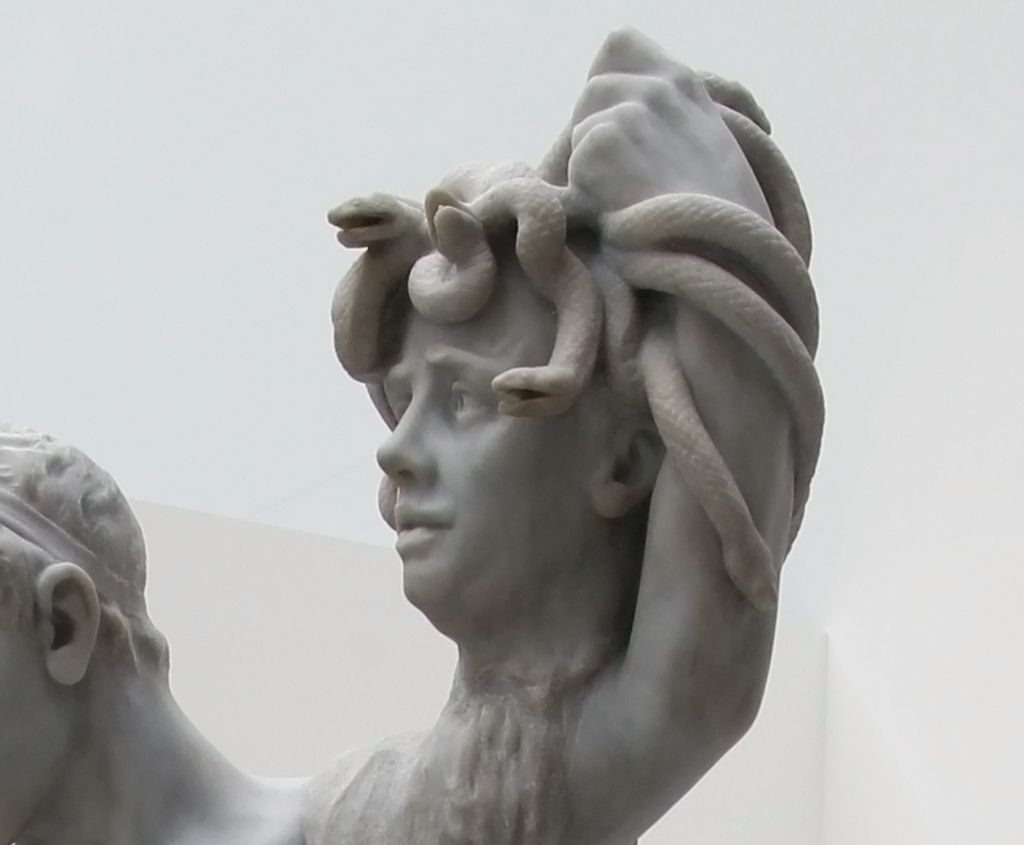
The raised arm has its own set of contours. Serpents loop out from Medusa’s hair and curl around the arm. The face lies inside their more restless outline, its features large enough to hold our attention at the top of a nearly two-metre group. Beneath the head, the museum identifies the trailing forms as blood that mingles visually with the drapery. The stone gives both forms a similar rhythm, so the eye can travel down from the head towards the figure at the hero’s feet. The distance between head and body tells us what has happened. The running curves bring the two parts of Medusa back into the same composition. [1] [2]
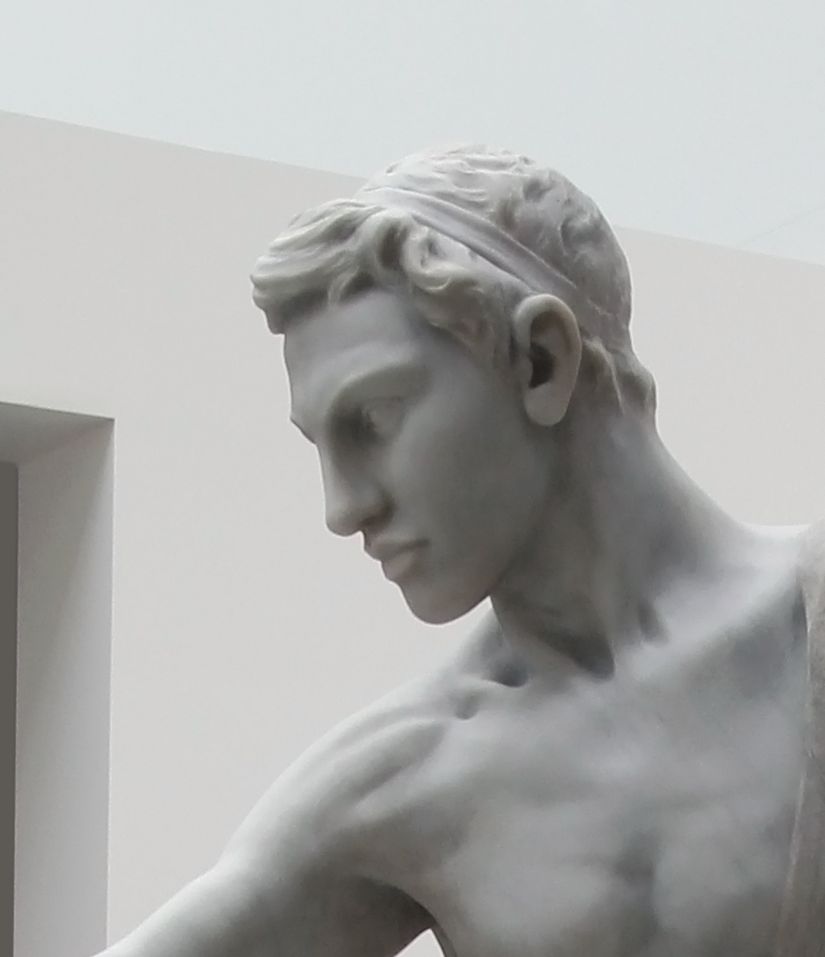
Claudel gives the two heads different inclinations. Medusa’s comes forward and remains exposed, framed by the snakes. Perseus dips his chin and turns towards the hand extended away from her. His torso is almost upright, with the weight of the movement carried by the change of direction at the shoulders and the waist. The left arm makes an emphatic upward gesture. The right is comparatively close to the body and occupied with something more precise. That uneven distribution of effort gives the group a sense of victory with a task still to finish. [1] [2]
The museum connects the poses to Claudel’s earlier The Waltz and Crouching Woman. The comparison with The Waltz is clearest in the way the upright figure’s turn extends into the fabric. The crouching figure offers another kind of compactness, in which a body folds in on itself and its outline is easier to read than the position of every limb. Here Claudel uses the first movement to lift and turn a standing figure and the second to pack a fallen figure into the narrow space at his feet. Both become part of the same upward sweep. [1]
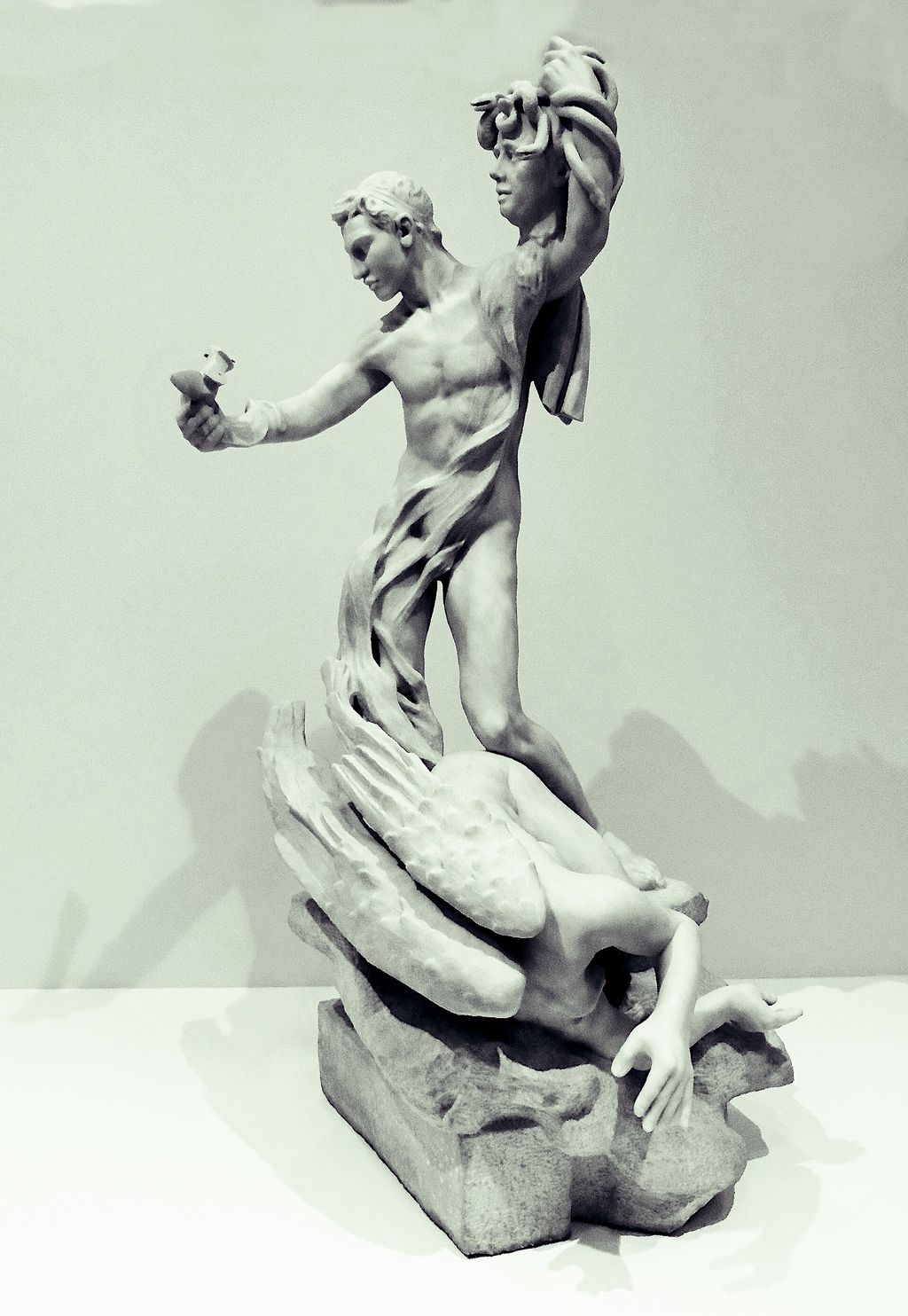
Perseus and the Gorgon in profile at La Piscine, Roubaix. The upper figure and the stone mass beneath him meet along a long diagonal. Photograph by Pierre André Leclercq. Image source. CC BY-SA 4.0. Resized photograph, shared under CC BY-SA 4.0.
The shield and the moment after the killing
In Book IV of Ovid’s Metamorphoses, Perseus tells the story himself. On his approach to the Gorgons he sees people and animals already changed to stone by the sight of Medusa. He looks at her reflected in his polished bronze shield and strikes while she and her snakes are asleep. Ovid has Perseus carry the shield on his left arm. Claudel puts the reflecting surface in his right hand and has him lift the severed head with his left. Ovid supplies an ancient account of the trick, and the difference in the hands shows how freely a sculptor could arrange it for a particular group. [2] [5] [6]
The moment Claudel described while making the work is also a little different from the one Perseus recounts. In a June 1898 letter to the critic Léon Gauchez, who wrote as Paul Leroi, she described a young man in an antique pose looking in a mirror at the Gorgon’s head. In Ovid the shield first lets him get close enough to kill her. Claudel keeps it in use when the head is already in his hand. That choice gives the hero two things to do at once. He can hold up what he has won, but he still has to be careful about how he sees it. [3] [6]
Gustave Babin, writing about the 1902 Salon, imagined that the polished surface would have mingled the faces of Perseus and Medusa. His account, reproduced by Marie Gevart-Dekaeke, catches something that even the missing shield leaves behind. The two faces are close enough in the upper half of the sculpture for the eye to take them in together, even as Perseus looks down and Medusa faces out. The reflection is an effect the critic imagined from the position of the figures and the direction of the shield. In the Tokyo bronze it is possible to see the angle of the shield itself and understand where that reading began. [4] [5]
The two Salon appearances and the Maigret commission
A studio photograph reproduced by the Musée Rodin shows Claudel standing beside the large plaster. Her dark coat makes a useful contrast to the pale figure, and her height gives a sense of how much space the model took up. The Société Nationale des Beaux-Arts exhibited it at its 1899 Salon at the Champ-de-Mars. Gevart-Dekaeke identifies the plaster as catalogue no. 29 and the marble exhibited by the same society in 1902 as no. 47. The two appearances trace the same design at different stages, from the form Claudel established in the studio to the commission that put it into stone. [1] [4] [7]
The Countess Arthur de Maigret commissioned the marble for her residence on the rue de Téhéran. It was one of several projects she supported, including a portrait of herself and a marble version of Claudel’s Sakuntala called Vertumne et Pomone. A study drawing on Pompon’s account books gives the plaster’s height as 246 centimetres and records two successive agreements for reducing it in stone. The first, of May 1899, envisaged a marble of about 210 centimetres. The revised agreement of April 1900 specified 190 centimetres. The finished work stands 196 centimetres high. Those figures give a sense of the decisions involved in taking a studio model into a new material and a particular interior. [1] [3] [8]
Pompon was the praticien, the specialist who translated the model into marble. The study of his account books describes a transfer by measured points, a method that let him establish the position and depth of forms at the new scale. In this group, a change to the proportions involved more than the height of the standing figure. The relation between the raised head and the tilt of Perseus’s face, the arc of the drapery and the amount of stone below the fallen hand all had to remain legible together. Claudel devised the composition. Pompon’s documented work was to realise it in stone, and the museum names both contributions in its account of the commission. [1] [3]
At the 1902 Salon the marble was placed outdoors. In a letter to Joanny Peytel that May, Claudel objected to the effect of the placement on how the group could be seen and to the exposure of the marble to bad weather. A newspaper clipping preserved by the Musée Bourdelle puts her life-size marble, under the title Persée et la Gorgone, in the same garden as works by Bourdelle and Albert Bartholomé. It records the work as the public encountered it, in a succession of sculptures outdoors. Claudel’s letter gives a different sense of the setting, measured against the interior she had planned for the work. [3] [4] [9]
Nogent’s museum calls it Claudel’s only monumental marble and records it as 2009.1.1, measuring 196 × 111 × 90 centimetres. It purchased the work in 2009 from Assurances Générales de France with support from the French state’s National Heritage Fund and corporate patrons. The Musée Rodin holds another, much smaller marble. Its record, S.01015, names Claudel as artist and Pompon as praticien, dates the carving to 1903 and gives the height as 52.3 centimetres. That is the marble its catalogue connects with a 1910 exhibition. A title and a carver’s name can match while the scale, exhibition and object are quite different. [1] [10]
Seeing the marble before the Salon
In December 1901 a visitor could see the marble at 3 rue Campagne Première. Maurice Pottecher, a theatre director and friend of Paul Claudel, gave that address to Gustave Geffroy in a letter dated 13 December. He spoke of the work in terms of its importance within Claudel’s career. That judgement came before the marble’s public appearance in the following year’s Salon and after the plaster had already been shown. It is evidence of how a new version could be introduced to critics through private access to the workshop. [3]
The address makes the marble easier to place in the sequence of events. At the workshop it was still part of a working space, where a visitor could take stock of the size and angle of the group without the crowd of a public exhibition. At the Salon it entered the company of other works and had to contend with the conditions Claudel objected to in her letter about outdoor display. The commission eventually took it into the countess’s private collection. Those settings offered different kinds of access. A workshop visit depended on an introduction. The Salon gave the sculpture a public entry in a catalogue. A private residence could place it near other things chosen by the patron. [1] [3] [4] [9]
The object that critics discussed had also passed through different physical stages. For a viewer of the plaster in 1899, the overall action and dramatic balance were already present. With the finished marble in 1902, the thickness of the stone and the support of the ledge were visible properties of the commissioned object. Babin’s description of the marble drew attention to the two faces implicated in the reflection. Pottecher’s letter framed the same work in terms of ambition. Together they show that an early response can be useful either for reconstructing what a visitor could see or for understanding how a sculpture acquired a reputation before many people had the chance to see it. [3] [4]
Today an accession photograph can sometimes do what a Salon review could do only in words. It lets the reader follow the ledge under Perseus and compare it with a view of the bronze’s shield. A review, in turn, can preserve a feature or effect that a present-day visitor may struggle to locate in the stone. The best comparison keeps the date and version of each record attached to it. Pottecher’s letter concerns the large marble in the workshop. The Tokyo collection photographs describe a small bronze made for a different kind of circulation. [3] [5]
Paul Claudel and the face of Medusa
In Ma sœur Camille, written for the 1951 retrospective at the Musée Rodin, Paul Claudel pauses over the face at the end of the raised arm and says he seems to recognise its distorted features. The Musée Camille Claudel takes the passage as a suggestion that his sister gave Medusa something of her own face. The uncertainty in Paul’s wording matters. He writes as a brother looking back many decades after the work was made. His remarks establish that the resemblance was part of the sculpture’s reception, and leave open how the face acquired its features in the studio. [1] [4] [11]
The features give that reading something to work with. A viewer can study the parting of the lips, the brow and the cheeks as individual details, even with the thick mass of snakes crowding the face. At the same time, the sculpture makes the act of recognition indirect. We see the head at the end of someone else’s arm. Perseus can study the face only at an angle, as an image in his shield. Paul’s account makes that predicament personal. Babin had already seen a different complication in the same arrangement when he pictured both faces sharing the shield. The shield makes the resemblance a question about what Perseus sees as much as what the viewer sees. [1] [4]
Eugène Blot’s bronze and the cast in Tokyo
The dealer and editor Eugène Blot brought Claudel’s small bronze version into a different exhibition setting. At the joint Claudel and Bernhard Hoetger show in his Paris gallery, held from 4 to 16 December 1905, the catalogue lists the group as no. 3, Persée, and announces an edition limit of thirty casts. That number describes what the gallery offered. The entry records an announced limit for the edition as a whole. The Tokyo museum identifies its own cast through its material, marks and documented ownership. [5] [12] [13]
The National Museum of Western Art in Tokyo catalogues S.2021-0001 as an unnumbered bronze proof with brown-green patina, 51 × 30 × 22 centimetres. Its date field gives 1898–1905 for the work and 1905–06 for Eugène Blot’s sand casting. The bilingual record locates the Blot foundry mark on the base behind Perseus and the signature C. Claudel on the side below the shield. The inscription gives the foundry’s boulevard de la Madeleine address. The object’s recorded ownership begins in a French private collection around 1960. It passed down in the family, sold at Caen Enchères in April 2019 to Galerie Malaquais, and entered the Tokyo museum by purchase on 29 July 2021. [5] [14]
From the front, the bronze preserves the rise from folded wings to twisting torso and suspended head. In the marble, a short crosspiece remains at the extended hand. In Tokyo, the shield itself projects from the right hand at an angle. It is a small interruption in the outline, nearly edge-on in some views and broad enough to recognise in profile. From behind, the shield and the raised head sit on either side of Perseus’s back. Light travels down his shoulder and the side of his leg while the shadows collect among the folds and wings at the bottom. The museum’s different views make it possible to follow the change from a scene with a conspicuous trophy to a study of the hero’s stance between two things he is holding. [2] [5]
The bronze is a little over a quarter as tall as the Maigret marble. At that scale the head and the fallen body fit into a single glance, and the projected shield can lead the eye back to Perseus’s own face. At Nogent, looking from the dangling hand up to Medusa’s head involves a much longer journey. The pale stone and the dark patinated bronze distribute the shadows differently, too. In the marble they gather at the underside of the wings and around the forms at the base. In the bronze the lit edges of the shield, the serpents and the wings stand out sharply against the darker hollows. In both works the connection between Perseus’s eyes and his outstretched hand determines what the apparent victor is still doing. [1] [2] [5]
A closer look at Perseus and the Gorgon
Annotated Details from Perseus and the Gorgon
The Maigret marble from the Musée Camille Claudel, photographed on loan in Rennes. Photograph by Vassil. Source. CC0. Numbers added to the overview. Details cropped from the photograph.
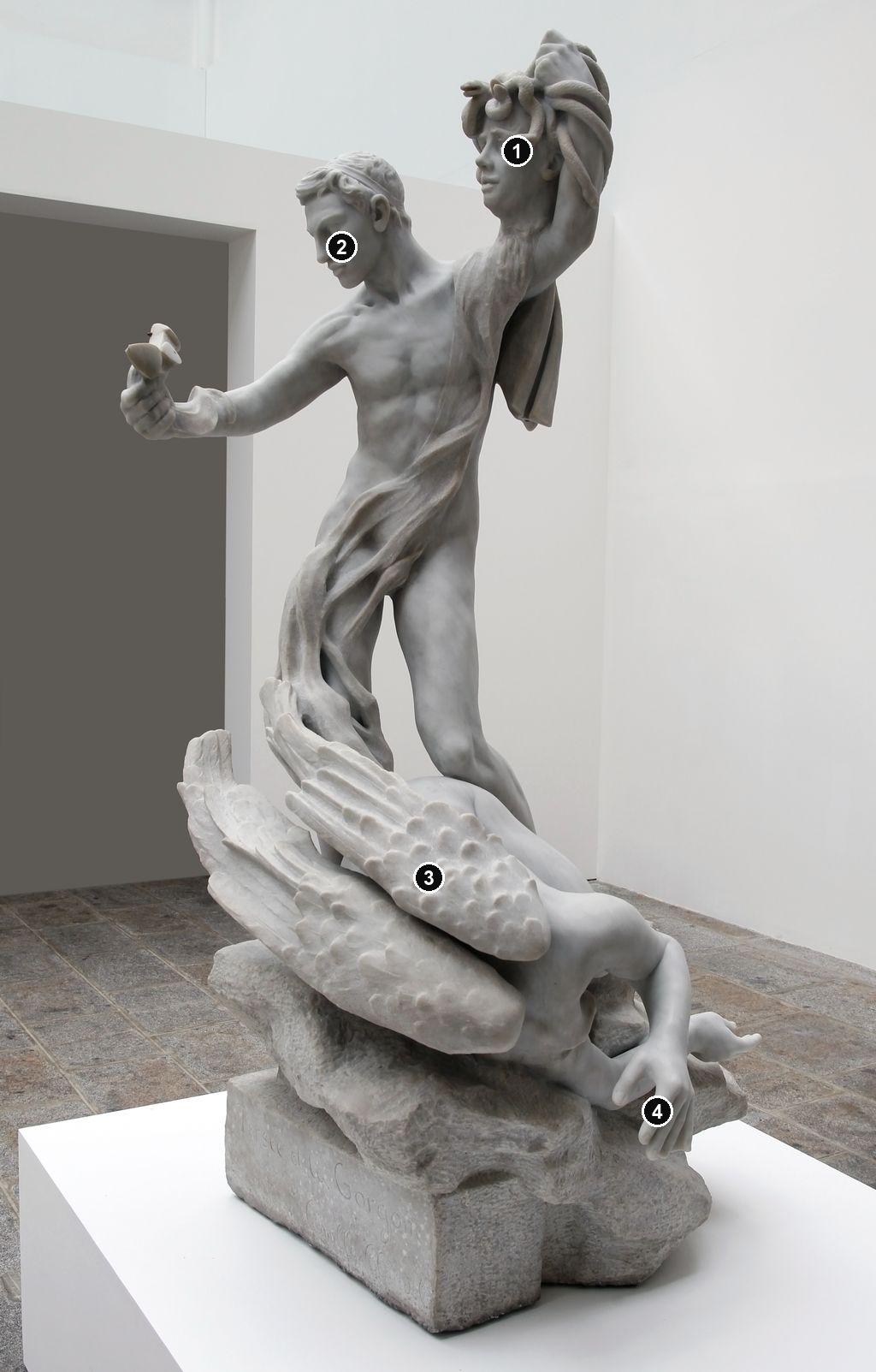
Details from PERSEUS AND THE GORGON
Compare the carved surfaces at the head, wings and base.
Medusa’s face and snakes
The head remains upright. The snakes project against the pale background and frame a face we can look at directly.
Perseus looks down
His gaze falls away from Medusa and toward the object in his extended hand.
Folded wings
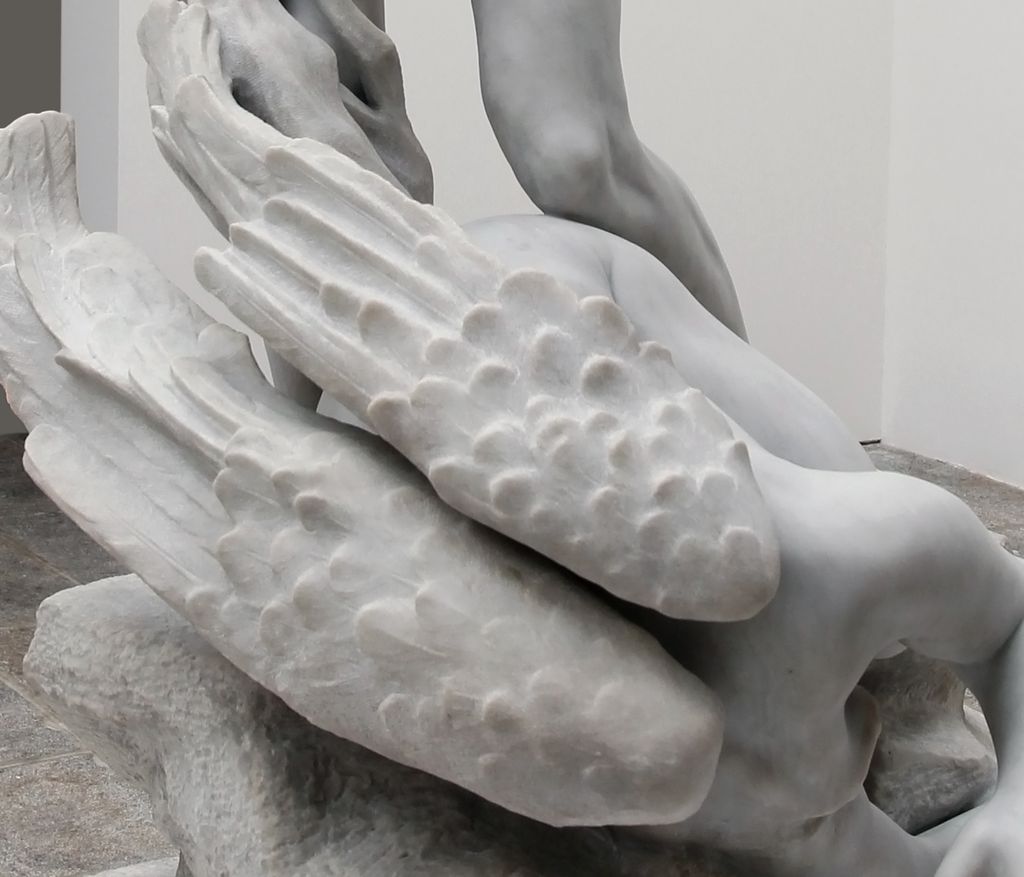
Overlapping rows of feathers make a broad fan across the collapsed body, giving the lower figure its own diagonal.
A hand against rough stone
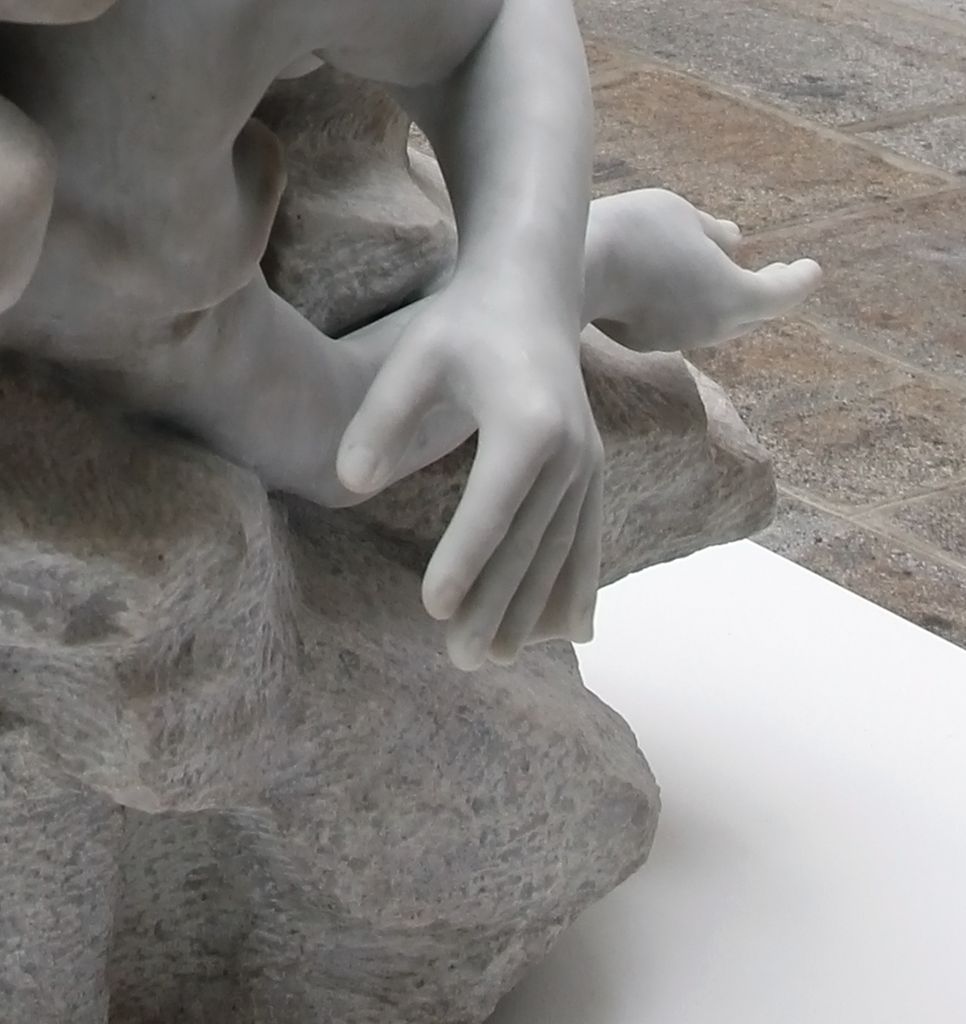
The fingers descend against the rough mass below. The contrast helps separate the figure from the rocky support.
Artworks directory
| Name | Date | Medium |
|---|---|---|
| The Mature Age | 1894–99 | Sculpture |
| The Waltz | c. 1889–93 | Sculpture |
| Sakuntala | 1886–88 | Sculpture |
| The Little Châtelaine | 1892–93 | Sculpture |
| The Gossips | c. 1893 | Sculpture |
| The Wave | 1897–1903 | Sculpture |
| Perseus and the Gorgon | c. 1897–1902 | Sculpture |
| The Implorer | c. 1894–99 | Sculpture |
| Clotho | 1893 | Sculpture |
| Bust of Auguste Rodin | c. 1886–89 | Sculpture |
| Paul Claudel at Sixteen Years Old | c. 1882–87 | Sculpture |
| Young Girl with a Sheaf | c. 1886–87 | Sculpture |
| Giganti | c. 1885 | Sculpture |
| Crouching Woman | c. 1884–85 | Sculpture |
| The Hungry Dog | c. 1893 | Sculpture |
| Old Hélène | c. 1881–82 | Sculpture |
| Fortune | c. 1902–05 | Sculpture |
| The Wounded Niobid | 1906 | Sculpture |
| The Siren, or The Flute Player | c. 1904–05 | Sculpture |
| Deep Thought | c. 1898 | Sculpture |
| Dream by the Fireside | c. 1899 | Sculpture |
| Paul Claudel at Thirty-Seven | 1905 | Sculpture |
| Portrait de Madame Claudel | c. 1883 | Sculpture Musée Camille Claudel. |
| Jeune Femme aux yeux clos | c. 1885 | Sculpture Musée Camille Claudel. |
| Ferdinande de Massary | 1888 | Sculpture Musée Camille Claudel. |
| Léon Lhermitte | 1889 | Sculpture Musée Camille Claudel. |
| Étude de main gauche | c. 1889 | Sculpture Musée Camille Claudel. |
| Vieil aveugle chantant | c. 1894 | Sculpture Musée Camille Claudel. |
| Tête de vieillard | c. 1890 | Sculpture Musée Camille Claudel. |
| Étude pour la tête d’Hamadryade | c. 1895 | Sculpture Musée Camille Claudel. |
| Aurore | c. 1900 | Sculpture Musée Camille Claudel. |
Discussion
Look again at the images and ideas explored in Perseus and the Gorgon. These editorial prompts invite your observations.
Reader Insights
How does the shield shape your route around the sculpture?
Which parts of the small bronze read differently in the monumental marble?
Join the Conversation
Share a detail, comparison or question about Perseus and the Gorgon below.
References
- Musée Camille Claudel, Persée et la Gorgone, full collection record for 2009.1.1,. View source.
- Musée Camille Claudel, La mythologie au musée, object photograph and account of the absent shield,. View source.
- Galerie Malaquais, Camille Claudel, bilingual research dossier, pp. 6–11 and 32–37, with letters, Pompon account book references and photographs,. View source.
- Marie Gevart-Dekaeke, La sculpture et l’intime en France (1865–1909), Université Paris Nanterre and École du Louvre, 2018, pp. 95–96 and notes 113–124, including Babin’s 1902 review and Paul Claudel’s 1951 catalogue essay,. View source.
- National Museum of Western Art, Tokyo, Perseus and the Gorgon, accession S.2021-0001, English collection record, provenance, bibliography and five views,. View source.
- Ovid, Metamorphoses, Book IV, lines 753–803, translated by A. S. Kline, University of Virginia Ovid Collection,. View source.
- Musée Rodin, Camille Claudel, with studio photograph of Claudel beside the plaster,. View source.
- Musée Camille Claudel, La plus grande collection d’œuvres de Camille Claudel, gallery guide with Maigret commission and destination,. View source.
- Musée Bourdelle, Salon press-clipping collection, Rappel notice naming the life-size marble,. View source.
- Musée Rodin, Persée et La Gorgone, full collection record for the 1903 marble, S.01015,. View source.
- Société Paul Claudel, Claudel et la sculpture, on the two essays and the 1951 retrospective,. View source.
- Galerie Eugène Blot, December 1905 catalogue, list of Claudel’s bronzes, no. 3, Musée Camille Claudel facsimile,. View source.
- Musée Camille Claudel, 1905 : l’exposition Claudel & Hoetger, exhibition history and catalogue facsimiles,. View source.
- National Museum of Western Art, Tokyo, bilingual collection record for S.2021-0001, Japanese signature and foundry inscription field,. View source.