 by Tom Gurney
Tom Gurney BSc (Hons) is an art history expert with over 20 years experience
Email: tomgurney1@gmail.com / Phone: +44 7429 011000
Clotho: Introduction
A woman stands with one arm held out from her body. A loop of hair runs under the arm and comes up to the hand, while heavier locks spill forward from the crown and wind around the legs. From the front, the face is hard to separate from the folds that partly cover it. Move towards the back and the hair opens over the shoulders, revealing a broad stretch of bare skin. Camille Claudel made the hair change our view of the body as we move around the sculpture. At 90 centimetres high, the plaster is smaller than a standing adult, but the mass of hair makes the figure seem to occupy far more space than its frame requires. [1] [2]
This is the full standing Clotho, dated 1893 and held by the Musée Rodin in Paris under inventory number S.01379. Claudel exhibited the composition in plaster at the Salon of the Société Nationale des Beaux-Arts that year. A subscription later paid for a marble, which she exhibited in 1899 and which is now lost. There are also smaller sculptures of Clotho’s bare head and torso, including a plaster at the Musée d’Orsay and a posthumous bronze at the Musée Camille Claudel. The standing plaster is the surviving work in which the movement of the body and the reach of the hair can be seen together in three dimensions. [1] [2] [3] [4] [5]
At a Glance
- Paris Salon1893, in plaster
- Musée Rodin plasterS.01379
Camille Claudel in context
Old Hélène
c. 1881–82Sakuntala
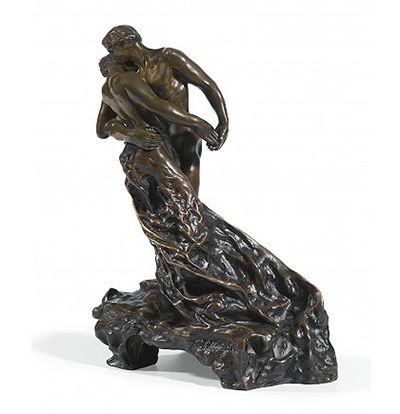
Plaster shown in 1888The Waltz
Developed c. 1889–93The Little Châtelaine
First model c. 1892–93The Gossips
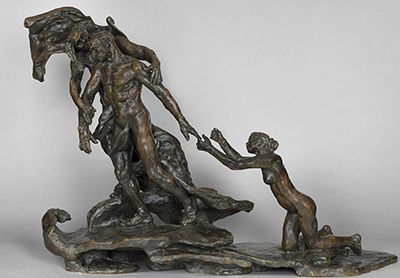
Described in 1893, shown in 1895The Mature Age
First and second versions, c. 1894–99The Wave
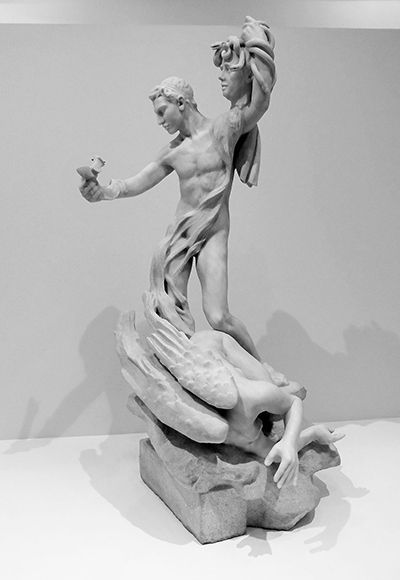
Plaster shown in 1897, mixed-material object dated 1897–1903 (?)Perseus and the Gorgon
Nogent design and marble, c. 1897–1902The Wounded Niobid
Modelled in 1906Contents
- How the plaster holds the figure in place
- The Fate who spins the thread
- What visitors and critics saw in 1893
- The marble commission and the missing work
- The bald torso in plaster and bronze
- How the torso became a museum object
How the plaster holds the figure in place
Begin with the base. Its straight lower edge quickly gives way to an uneven rise under the feet. One foot can be made out where it meets the rough ground, while a thick strand comes down almost like another leg. At knee height a lock crosses the figure on a slant. The spaces on either side of it are important. They let a knee or the line of a shin come into view for a short distance before the next overlap interrupts it. The woman remains upright, yet the legs are the hardest part of the pose to disentangle. A step seems possible if you isolate a foot or a knee, and much harder to imagine when you see the figure whole. [2]
Higher up, the plaster makes two different surfaces legible in the same light. On the abdomen, small rises and depressions give way to a long, relatively continuous slope down the thigh. The hair is ridged and broken into folds, some narrow enough to catch the light in a single bright line. From the front, the fall of the strands cuts the torso into unequal parts. One flank is largely exposed and the other comes and goes behind the hair. The outstretched arm opens a gap against that dense front. From an oblique angle you can see the strands rise towards the flexed fingers, then follow the loop back towards the body. The hand seems to hold something, but its reach stops short of escape. [2]
The back gives the figure a different breadth. Beneath the high bank of hair, the shoulder blades and spine carry the eye down to the hips. Loops that crossed the body in the frontal view now hang at either edge of it. They are like a frame for the back, where the same forms seen from the front had seemed to close over the body. That change in visibility matters more than any single expression in the face. A photograph taken from directly in front can make the woman seem almost submerged. The back view shows how much of the body Claudel modelled in the open, and how carefully the hair was distributed to leave some planes visible and cut across others. [2]
The Fate who spins the thread
Clotho is one of the Moirai, the Greek Fates, known in Roman tradition as the Parcae. In Hesiod’s Theogony, Clotho, Lachesis and Atropos allot good and ill to mortals. In the familiar telling that gives each sister a task, Clotho spins the thread of life, Lachesis measures or dispenses it and Atropos cuts it. The name on the Salon label therefore identifies a figure associated with the beginning of a life. Claudel gives her the appearance of a woman far along in her own. The Musée Camille Claudel reads the aged figure as bringing qualities of the three sisters together. [3] [5] [6]
The plaster gives the thread a physical presence even without a visible spindle or shears. The lengths across the body are recognisable as hair because they lead back to the head. They can also be read as thread because they make turns, hang in loops and pass through the hand’s reach. The strands are bulky enough to seem to have weight. That is an important change from the idea of an individual life as a fine line. To follow the thread here is to find it multiplying into something with its own volume, which takes up the space the figure might otherwise move through. The woman who should be able to spin or release it appears subject to it herself. [1] [2] [5]
Claudel put a different aspect of time into The Mature Age. There an older woman moves with a man whose hand is withdrawing from a younger kneeling figure. The intervals between bodies make a moment of separation visible. Clotho has one body, and the thing that restricts its movement comes from that body. In both works the form of an older woman carries some of the meaning, but it does different work in each. The comparison locates the sense of fate in the movement Claudel gives each figure. [1] [7]
What visitors and critics saw in 1893
The illustrated Salon catalogue lists Claudel as an associate of the Société Nationale and describes Clotho, no. 38, as a small plaster figure. It follows no. 37, the plaster group The Waltz. The entries are adjacent in print, and several reviewers considered the works together. The Waltz draws fabric around two dancers in a turn. Clotho gives the lines circling the body enough weight to interrupt that motion. The shared Salon date makes the comparison especially revealing. The difference between the two works comes from how Claudel directed the long curves, where she held them close to the figures and where she let them open into surrounding space. [1] [3] [8]
Octave Mirbeau placed Claudel’s two exhibits among the best in the Salon in his 12 May review for Le Journal. His Clotho is remarkably active. He imagined the Fate swinging the lengths around her like strips of cloth and gave her long, agile legs. He also admired the outline Claudel had achieved with a body that unsettled ordinary expectations of beauty. Firmin Javel, writing in L’Art français on 13 May, found the sculpture troubling and disorienting even as he praised Claudel’s imagination. His Fate plays with the threads of lives already cut, effectively bringing the end of life into a scene named for the spinner. Both descriptions show how differently the same outward reach of the arm could be read. [8]
Frantz Jourdain, writing in La Grande Bataille on 19 May, connected the animation of the young couple with the prospect of old age embodied by Clotho. He was among those who situated Claudel in Rodin’s circle while also recognising a distinct artistic personality. Mirbeau’s praise came with a different qualification. He presented her originality and power as surprising in a woman and introduced her through Rodin and her brother Paul. Those reviews show both the attention the work attracted and the terms in which reviewers were accustomed to discussing its maker. [8]
Claudel, Rodin and Jules Desbois may have worked from the same sitter, an elderly Italian model named Maria Caira. The Musée Rodin treats that shared identification as probable in its discussion of Desbois’s Misery. Rodin’s She Who Was the Helmet Maker’s Once-Beautiful Wife, inspired by a poem by François Villon, lets the seated figure fold forward over her own body. Desbois showed Misery in plaster at the 1894 Salon. In the Musée Rodin’s terracotta version, the figure bends and closes in on herself. Claudel sets her woman upright and exposes her back, then puts an elaborate network of hair around her. The observed body gives the sculpture its particulars, while the name and the hair give it an existence beyond the identity of a possible sitter. [2] [5] [9] [10]
The marble commission and the missing work
In January 1895 a committee honouring the painter Pierre Puvis de Chavannes commissioned a marble version through a subscription organised at the instigation of the critic Mathias Morhardt. It was intended for the Musée du Luxembourg in Paris. The Musée Rodin dates the completion of the marble to 1897. The 1899 illustrated Salon catalogue lists it as no. 27 and describes Clotho as the Fate who lets fall the thread of life. The Getty and Art Institute of Chicago exhibition chronology names the Puvis de Chavannes committee as the owner at the time of the Salon. Claudel was now listed as a full member of the Société Nationale, and the marble appeared in her catalogue entry beside the plaster of The Mature Age and a full-size plaster model of Perseus. [1] [11] [12]
The marble can still be compared with the plaster from a photograph attributed to Lémery, published in L’Art décoratif in 1913 and reproduced by the Musée Camille Claudel. It shows a wide, grooved length falling from the outstretched hand all the way to the base. In the plaster, the arm and its shorter loop leave that space beneath the hand open. In the photograph of the marble, the added sweep encloses a tall, irregular opening beside the body. Another set of strands spreads across the stone beneath the feet. The hair has a more continuous course from crown to ground. The photograph shows how the profile changed on that side, while leaving the finish, carving sequence and appearance from other angles open. [2] [13]
At the 1899 Salon, Maurice Guillemot suggested that a Rodin drawing had inspired Clotho. In a letter reproduced in the Bulletin de la Société Paul Claudel, Claudel rejected the claim. She said she did not know Rodin’s drawings and had ideas of her own in abundance. The letter gives us Claudel’s own account of the invention, in answer to a specific claim about a drawing. The survival of that reply makes it possible to distinguish the resemblance a reviewer claimed to see from the process the sculptor described. [11] [14]
Accounts of the marble’s passage through the Luxembourg differ. The Musée Camille Claudel’s torso entry says the intended gift was refused, while the Musée d’Orsay’s account of its 1988 exhibition reports the marble as having disappeared from the Luxembourg after 1913. The intended destination, the Salon listing and the published photograph give the sculpture three documented points of reference. Its current whereabouts are unknown. [1] [5] [11] [13] [15]
The bald torso in plaster and bronze
The Musée d’Orsay’s Torse de Clotho, RF 4216, is a 44.5-centimetre plaster model dated about 1893, acquired in 1988. The Musée Camille Claudel’s Torse de Clotho chauve, 2010.4.4, is a 41-centimetre bronze bearing the Claude Valsuani foundry mark and number 3/8. Its model is also dated about 1893. The bronze was cast after Claudel’s death. Another posthumous Valsuani bronze, marked II/IV, is documented in an auction catalogue. The two marks distinguish individual casts of the torso design. The Nogent museum proposes that the bald torso was probably a study for the standing figure. The dating and formal resemblance make the relationship persuasive, with the sequence of the surviving objects and the precise relationship between their moulds left open. [4] [5] [16]
In the bronze the bare head turns slightly, exposing the temple, eye socket and narrow line of the mouth. There is a clear drop from the side of the jaw to the neck. The arms end abruptly at the shoulders and the lower edges cut across the upper thighs. The gaze that is so hard to locate beneath the hair in the standing figure becomes a question about the shape of the sockets and the tilt of the face. The compressed form also brings the chest much closer to the viewer’s attention. It takes time to reach that part of the body in the full plaster, where the hair is the first thing most views bring forward. [2] [4] [5]
The plaster of the full figure entered the Musée Rodin in 1952, a gift from Paul Claudel alongside three other sculptures by his sister. He had described Clotho in 1951 using the image of an aged figure entangled like a spider in its own web. That reading, preserved in the Musée d’Orsay’s exhibition account, comes decades after Mirbeau’s agile, frightening Fate. The plaster allows for both responses. Follow the ridges from the hand to the head and the figure seems to be gathering the strands. Follow the same ridges down towards the knees and they seem to have gathered her. [2] [8] [15] [17]
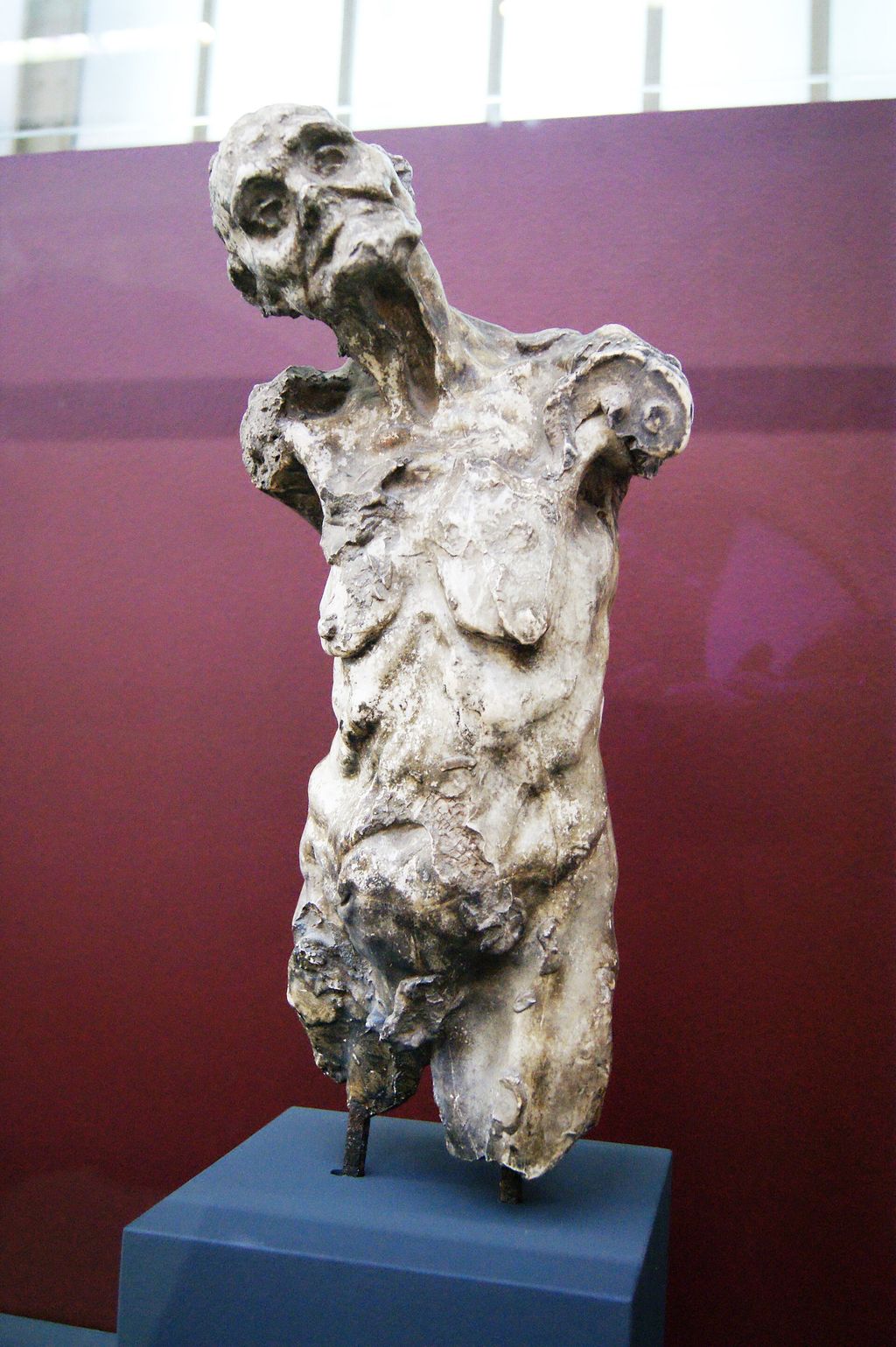
Torso of Clotho, the separate plaster model in the Musée d’Orsay, RF 4216. Photograph by Lomita. Image source. CC BY-SA 4.0. Resized photograph, shared under CC BY-SA 4.0.
How the torso became a museum object
The Orsay plaster gives the torso a public history of its own. The museum acquired it by exercising its right of pre-emption at a public sale at the Hôtel Drouot on 18 March 1988. It showed the torso in its exhibition on The Mature Age that autumn, and the exhibition travelled to Lyon the following year. A collection entry can make the torso seem like a timeless fragment, but the dates distinguish the approximate time of modelling from the much later moment when the plaster became available for sustained comparison with objects in national collections. [4] [15]
Orsay also catalogues an object made from that later encounter. In 2006 Juan Manuel Castro Prieto photographed the plaster. The resulting colour print, mounted on aluminium, has its own inventory number, ODO 2007 12 6. Orsay describes it as a photograph of the plaster Torse de Clotho and gives separate dimensions for the print. The photograph is therefore another museum object with a maker, a date and a scale of its own. Those distinctions are especially valuable in the case of a sculpture with several versions and a famous missing marble. [4] [18]
The two photographs connected with Clotho have different documentary jobs. Lémery’s published view gives an outline for a sculpture whose present location remains unresolved. Castro Prieto’s print takes a surviving plaster as its subject. It belongs to a later history of looking closely at that particular object. A comparison based on the modern photograph concerns the head, shoulders and body of the plaster torso. A comparison based on Lémery’s image also has to account for the upright figure, the hand and the long sweep of marble. A reference to a picture of Clotho can mean either of these, and the difference changes what the picture can answer. [4] [13] [18]
This also changes how the Valsuani bronze can be used. An angled view of the cast makes the shape of the shoulders and the turn of the upper body easy to compare with the plaster. The surface of the metal draws its own highlights, and the foundry and proof marks belong to the cast. A photograph of one object cannot settle the dating or ownership of another. Read together, the collection records give the torso several distinct lives as a plaster, as a cast in bronze and as the subject of a photographic print. [4] [5] [16] [18]
Artworks directory
| Name | Date | Medium |
|---|---|---|
| The Mature Age | 1894–99 | Sculpture |
| The Waltz | c. 1889–93 | Sculpture |
| Sakuntala | 1886–88 | Sculpture |
| The Little Châtelaine | 1892–93 | Sculpture |
| The Gossips | c. 1893 | Sculpture |
| The Wave | 1897–1903 | Sculpture |
| Perseus and the Gorgon | c. 1897–1902 | Sculpture |
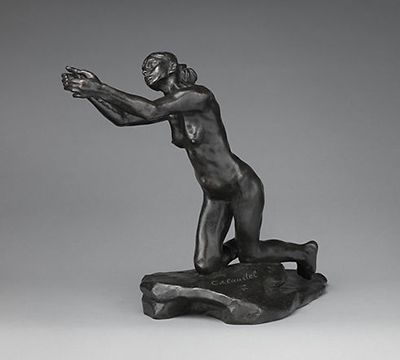
| The Implorer | c. 1894–99 | Sculpture |
| Clotho | 1893 | Sculpture |
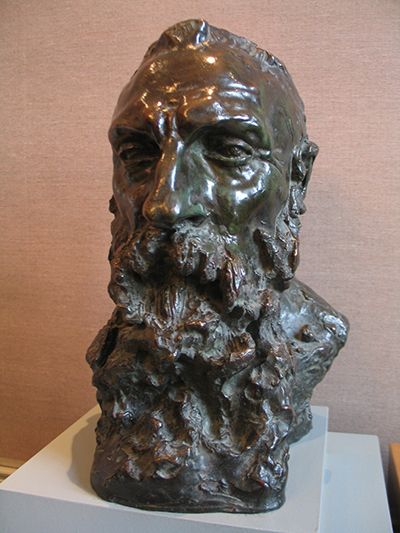
| Bust of Auguste Rodin | c. 1886–89 | Sculpture |
| Paul Claudel at Sixteen Years Old | c. 1882–87 | Sculpture |
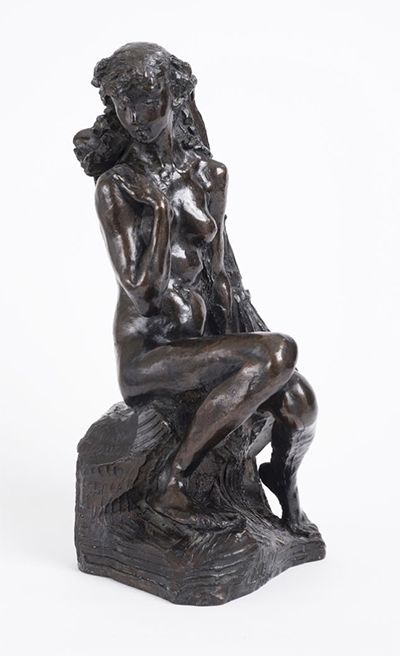
| Young Girl with a Sheaf | c. 1886–87 | Sculpture |
| Giganti | c. 1885 | Sculpture |
| Crouching Woman | c. 1884–85 | Sculpture |
| The Hungry Dog | c. 1893 | Sculpture |
| Old Hélène | c. 1881–82 | Sculpture |
| Fortune | c. 1902–05 | Sculpture |
| The Wounded Niobid | 1906 | Sculpture |
| The Siren, or The Flute Player | c. 1904–05 | Sculpture |
| Deep Thought | c. 1898 | Sculpture |
| Dream by the Fireside | c. 1899 | Sculpture |
| Paul Claudel at Thirty-Seven | 1905 | Sculpture |
| Portrait de Madame Claudel | c. 1883 | Sculpture Musée Camille Claudel. |
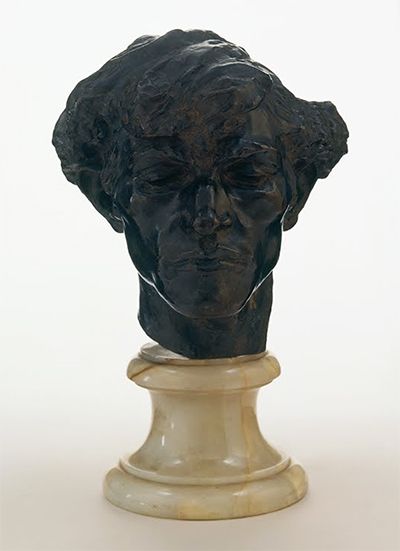
| Jeune Femme aux yeux clos | c. 1885 | Sculpture Musée Camille Claudel. |
| Ferdinande de Massary | 1888 | Sculpture Musée Camille Claudel. |
| Léon Lhermitte | 1889 | Sculpture Musée Camille Claudel. |
| Étude de main gauche | c. 1889 | Sculpture Musée Camille Claudel. |
| Vieil aveugle chantant | c. 1894 | Sculpture Musée Camille Claudel. |
| Tête de vieillard | c. 1890 | Sculpture Musée Camille Claudel. |
| Étude pour la tête d’Hamadryade | c. 1895 | Sculpture Musée Camille Claudel. |
| Aurore | c. 1900 | Sculpture Musée Camille Claudel. |
Discussion
Look again at the images and ideas explored in Clotho. These editorial prompts invite your observations.
Reader Insights
What does the mass of hair do to the figure’s apparent balance?
How does the surface direct your attention from the face to the body?
Join the Conversation
Share a detail, comparison or question about Clotho below.
References
- Musée Rodin, Clotho, collection summary for the standing plaster S.01379 and its exhibition and marble history,. View source.
- Musée Rodin, Clotho, full catalogue entry and photographs of S.01379 by Christian Baraja,. View source.
- Société Nationale des Beaux-Arts, illustrated Champ-de-Mars Salon catalogue, 1893, sculpture section, p. XLII, nos. 37–38, Getty Research Institute facsimile,. View source.
- Musée d’Orsay, Torse de Clotho, catalogue entry and object views of the plaster RF 4216,. View source.
- Musée Camille Claudel, Torse de Clotho chauve, object entry for Valsuani bronze no. 3/8, 2010.4.4,. View source.
- Hesiod, Theogony, lines 901–906, Center for Hellenic Studies translation,. View source.
- Musée Rodin, L’Âge mûr, collection history and photographs of the later composition,. View source.
- Octave Mirbeau, Firmin Javel and Frantz Jourdain, 1893 Salon reviews of 12, 13 and 19 May, transcribed in Sophie Gauthier, Les Images de Camille Claudel dans le discours critique de son époque, annex, pp. 184–187,. View source.
- Musée Rodin, Celle qui fut la belle Heaulmière, collection entry and views for S.01148,. View source.
- Musée Rodin, La Misère, collection entry and views for Jules Desbois’s terracotta S.01150,. View source.
- Anne-Lise Desmas and Emerson Bowyer, editors, Camille Claudel, Getty and Art Institute of Chicago exhibition catalogue, 2023, chronology entries for 1893, 1895 and 1899,. View source.
- Société Nationale des Beaux-Arts, Catalogue illustré du Salon de 1899, sculpture section, Claudel nos. 26–29,. View source.
- Musée Camille Claudel, Les œuvres disparues de Camille Claudel, reproduction of Lémery’s photograph of the marble published in 1913,. View source.
- Société Paul Claudel, Bulletin de la Société Paul Claudel, no. 172, transcription of Claudel’s response to Guillemot’s 1899 criticism,. View source.
- Musée d’Orsay, L’Âge mûr de Camille Claudel, account of the 1988–89 exhibition, the Luxembourg marble and Paul Claudel’s 1951 description,. View source.
- Blanchy & Lacombe, Torse de Clotho chauve, lot 366, catalogue entry and photographs of the posthumous Valsuani bronze marked II/IV,. View source.
- Musée Rodin, Camille Claudel, collection essay documenting the donation from Paul Claudel,. View source.
- Musée d’Orsay, Juan Manuel Castro Prieto, Torse de Clotho, photograph ODO 2007 12 6,. View source.