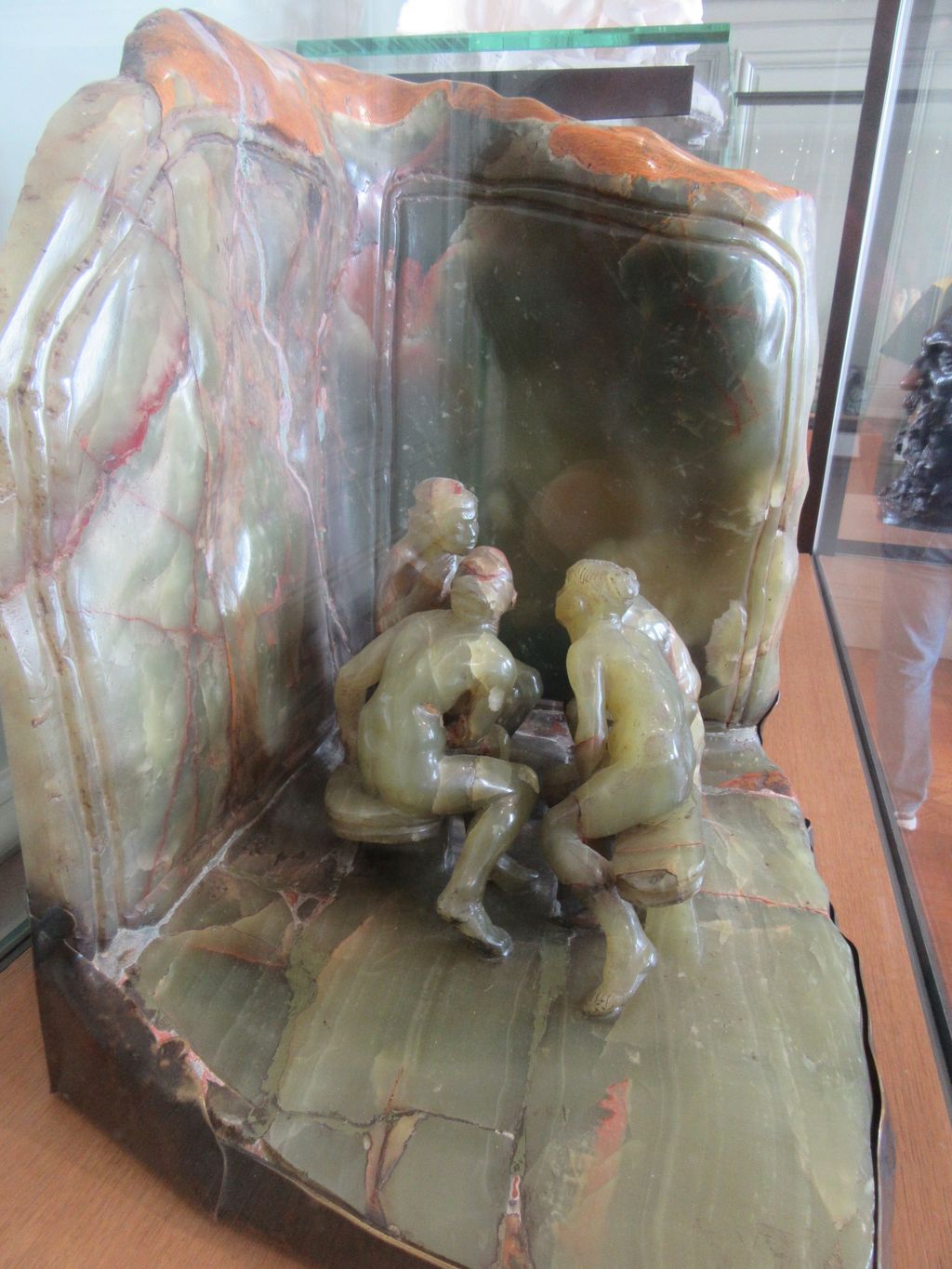
The onyx and bronze group at the Musée Rodin, seen from above the seated figures. Photograph by Draganapopovic. Image source. Public domain. Resized from the original photograph.
 by Tom Gurney
Tom Gurney BSc (Hons) is an art history expert with over 20 years experience
Email: tomgurney1@gmail.com / Phone: +44 7429 011000
The Gossips: Introduction
At the height of the benches in Camille Claudel’s The Gossips, a woman seated in the corner lifts a hand to the side of her mouth. Her face is the highest of the four. Two women on the bench in front of her turn in so far that their shoulders present themselves before their faces. The remaining woman sits a little back, where her profile can still be seen between the others. Across the space between the benches, the forward reach of a chin or the turn of an ear is enough to show who has the floor. The woman at the back appears to be about to speak, or already speaking too quietly for anyone outside the group to hear. [1]
The angle of the screen is easy to miss if you start by looking at the women. Two high surfaces come together behind them. The panel to one side rises above the speaker and throws her outline into shadow in some views, while the opposite side is open enough for us to see the legs and feet beneath the benches. Move around that opening and a face that had been visible drops out behind another woman’s head. The small shifts required to see each face are part of the experience of the work. The women have drawn together to hear, and we have to move to see. [1]
This is the version in onyx marble and bronze made in 1897, now at the Musée Rodin in Paris. The French titles Les Causeuses and Les Bavardes both name women talking, with the latter closer to “the chatterboxes”. La Confidence, another title, draws attention to what passes between them. Versions at the Musée Camille Claudel in Nogent-sur-Seine preserve the same exchange in plaster and in bronze with a tinted stone screen. In a separate white marble, the women sit on their benches in the open. Each version lets us see a different part of how Claudel made the conversation feel private. [1] [2] [3] [4]
At a Glance
- French titlesLes Causeuses and Les Bavardes
- Musée Rodin objectOnyx marble and bronze, S.1006
Camille Claudel in context
Old Hélène
c. 1881–82Sakuntala
Plaster shown in 1888The Waltz
Developed c. 1889–93The Little Châtelaine
First model c. 1892–93The Gossips
Described in 1893, shown in 1895The Mature Age
First and second versions, c. 1894–99The Wave
Plaster shown in 1897, mixed-material object dated 1897–1903 (?)Perseus and the Gorgon
Nogent design and marble, c. 1897–1902The Wounded Niobid
Modelled in 1906Contents
- The scene Claudel described in 1893
- What changes in onyx and bronze
- The Nogent plaster and the Blot edition
- What happens when the screen comes away
- Two kinds of enclosure
- What the critics saw
The scene Claudel described in 1893
In a letter to her brother Paul in late 1893, Claudel described three people listening to another behind a screen. The drawing that accompanies the letter already puts the figures inside an enclosure. That detail is as deliberate as the choice of four figures. With one speaker and three listeners, the subject needs a space that the group can occupy together. The screen makes a corner out of two sides and gives the speaker a place from which she can address the other three at once. What survives from the early idea is a set of relationships as much as a sketch of bodies. [1] [5]
The railway carriage often associated with The Gossips comes from Mathias Morhardt’s 1898 account in the Mercure de France. He wrote that four women facing each other in a narrow compartment seemed to be sharing a secret, and that such a sight suggested the sculpture to Claudel. His article appeared after the work had been exhibited. The letter gives earlier evidence for the design, while the train remains a possible source for the arrangement and the concentrated attention. The sculpture leaves the surroundings open to other readings. The benches are bare, the women are nude, and the screen supplies just enough architecture to make a shelter. [1] [5] [6]
The Société Nationale des Beaux-Arts displayed the group in plaster in 1895 at its Paris Salon. The printed catalogue lists it as no. 23, Croquis d’après nature (groupe), a sketch from life. The word croquis might suggest something caught quickly. Here it also describes a way of taking a familiar event and finding the few details that can carry it in sculpture. Even the most legible sign, the lifted hand, depends on the other figures. It could be a solitary gesture if the listeners were seated upright or turned away. Their bodies give the hand a purpose. [1] [5] [7]
What changes in onyx and bronze
The Musée Rodin’s mixed-material sculpture, S.1006, also catalogued as S.01006, is 44.9 centimetres high, 42.2 wide and 39 deep. The collections portal gives 1897 as its execution date, and the museum records the exhibition of the onyx and bronze version at the Salon that year. The Getty exhibition chronology lists the group as Salon entry no. 25 and gives its material there as jade. Geffroy, reviewing the 1897 Salon, likened its transparency to jade. The Rodin catalogue identifies the stone in the object itself as onyx. Nogent’s collection account names the businessman Joanny Peytel as a buyer of the onyx and bronze version. The Musée Rodin records its own purchase in November 1963. [1] [2] [5] [8] [9]
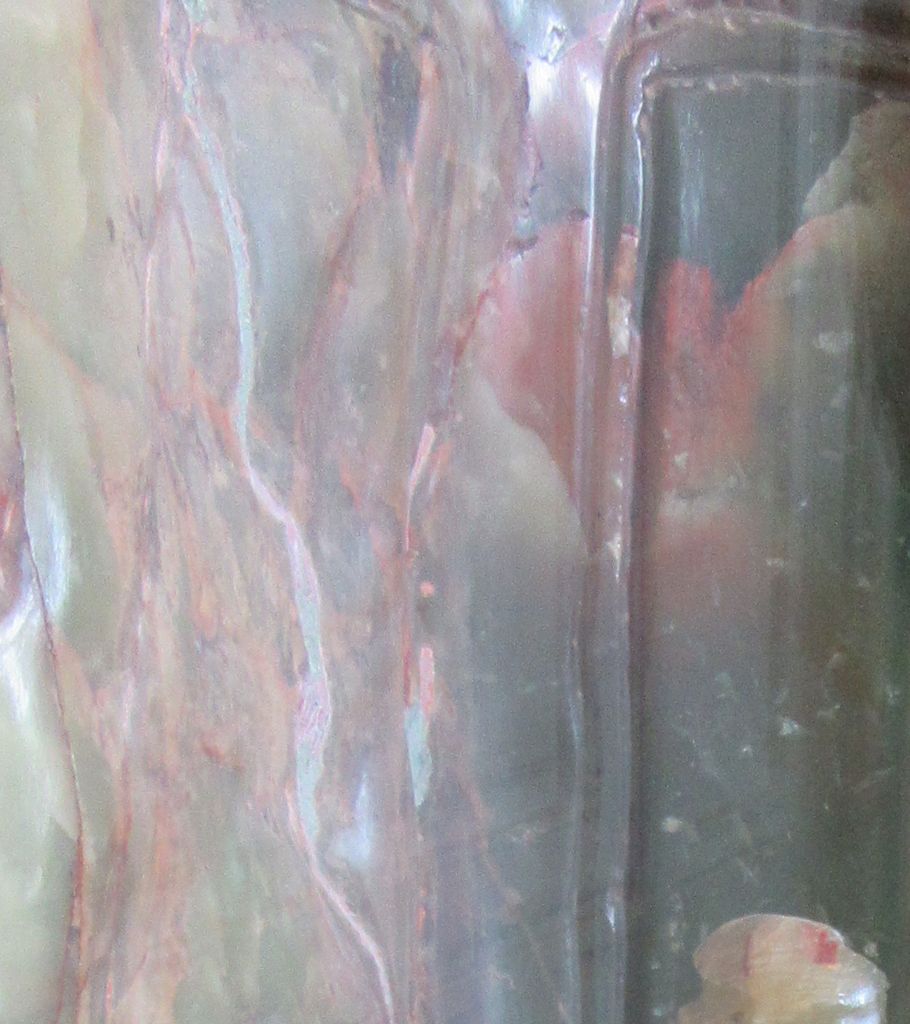
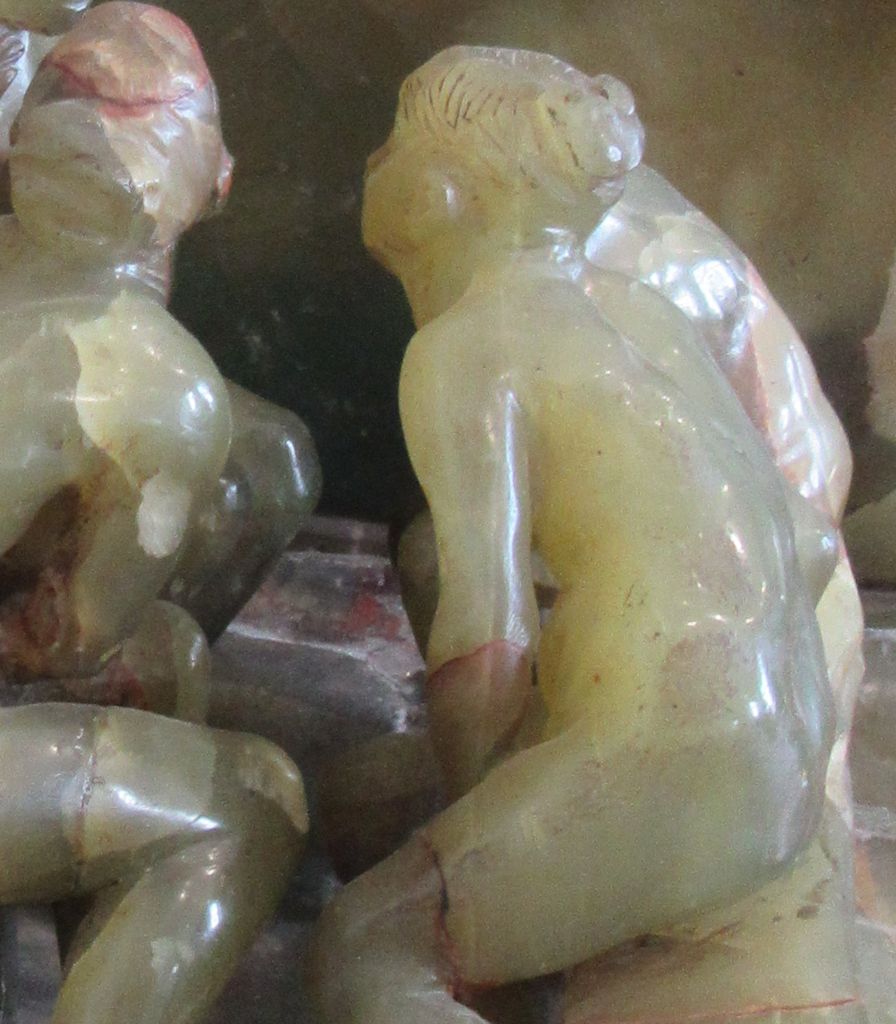
Seen from the open corner, a light band of green runs through the stone behind the heads. Brown, cloudy white and reddish veins cross the enclosure and continue in different patterns on the floor, seat and bodies. In a closer view, the dark hand next to the speaker’s lips stands out against her pale chest. On the foreground women, light that picks out a rounded shoulder also lights the fine parallel grooves of the hair. The colour changes across a single surface, as on the back of the listener who seems almost yellow at the shoulder and darker near the waist. The eye alternates between recognising a body and following the pattern of the stone. [1] [8]
The enclosure can look like fitted panelling. Lines cut into its interior follow the borders of the two sides, while the uneven top and the dense veining keep the material visible as stone. The smooth surfaces on the women throw more concentrated reflections than much of the surrounding wall. There is a different kind of distinction at the face. The lips and jaw project sharply in profile, and the rolls and knots of hair have contours clear enough to pick out even when the faces overlap. The Musée Rodin describes a Japanese-inflected quality in this version. Its combination of a miniature encounter, emphatic contours and coloured materials gives substance to that reading, and the carved border encloses the figures like a frame. [1] [5] [8]
The tension between the elevated speaker and the converging listeners also makes the scale work. A shoulder high above the waist and a hand held near the cheek are big events in this little field of bodies. The bent knees under the benches give those upper-body gestures weight. The listeners seem to have shifted forward from positions they could have held at rest. The speaker keeps enough room around her head for the pose to register even when the others crowd across the foreground. Claudel used onyx and bronze again in The Wave, where the stone curves over the figures. Here the upright enclosure lets the four heads determine where the action is. [1] [10]
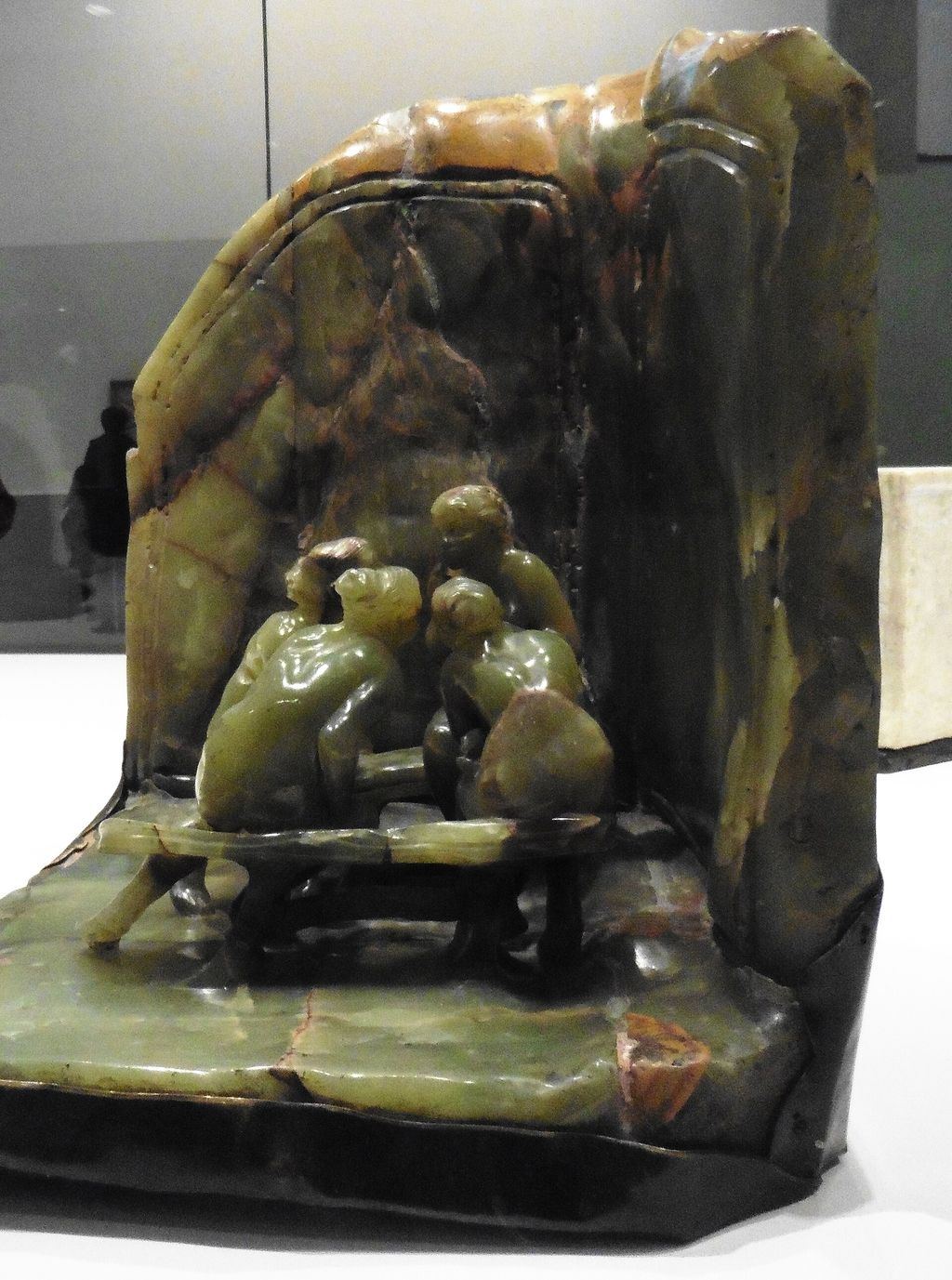
A view of the coloured stone screen and the figures in The Gossips at La Piscine, Roubaix. Photograph by Pierre André Leclercq. Image source. CC BY-SA 4.0. Resized photograph, shared under CC BY-SA 4.0.
The Nogent plaster and the Blot edition
The Musée Camille Claudel’s plaster with a screen, 2010.4.5, measures 40 × 40 × 30 centimetres. Its object record dates it to about 1893, while a photograph caption in the museum’s press dossier dates the same 40-centimetre plaster to about 1896. Both datings place it close to the early development of the composition. The documentation of the 1895 Salon establishes that Claudel showed a plaster there. The surviving Nogent object lets us examine how the screen and gestures work in the single material. [2] [7] [11]
In the Nogent photograph, pale plaster carries the same tone across the skin, hair and wall. Shadows have to do more of the work of separating them. Where the speaker bends her arm up towards her face, the underside of the forearm falls into shade. One listener’s hair gathers into a projecting coil, and the woman beside her has a high, rounded knot. The crest and grooves of the plaster hair catch small patches of light. They tell us which way the head is turned even where the bodies overlap and there is very little face to see. Against the wall, some of the forms are barely more than a raised edge and the shadow it casts. [2] [11]
Nogent’s other example, 2010.1.17, measures 32 × 34 × 24 centimetres. It is Eugène Blot’s bronze cast no. 1 of 1905, signed on the base and backed by a screen the museum identifies as tinted marble or alabaster. The museum acquired the plaster and this mixed-material work in 2008 from Reine-Marie Paris. In the Blot version, a ridge of reflected light can run nearly the length of an arm or across the curve of a back. Darker stretches of bronze deepen the gaps between the women. Against the more even colour of the screen, the women’s silhouettes read more distinctly than they do against the heavily veined Rodin onyx. [2] [3] [11]
The two mixed-material versions reverse an important emphasis. In Paris, bands and patches of colour are conspicuous on bodies as well as on the surfaces around them. In the Blot example, the principal material contrast lies between the bronze bodies and their stone setting. This is a difference you can see before counting figures or following the gestures, and one reason the date of the cast matters. In 1905, the earlier conversation entered the market in a version with its own balance of scale, colour and enclosure. [1] [3] [8] [11]
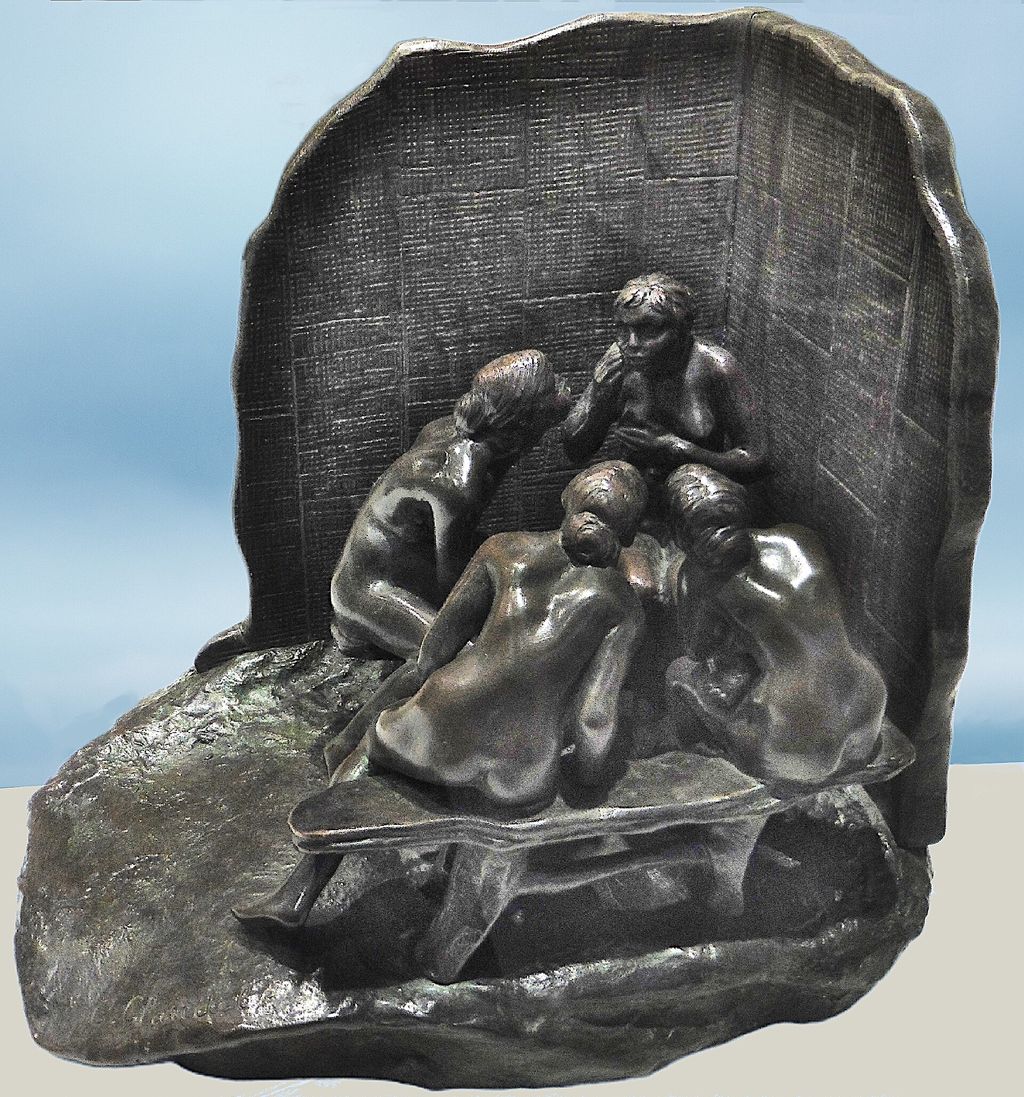
A version of The Gossips shown at La Piscine. The dark screen frames the group from behind. Photograph by Pierre André Leclercq. Image source. CC BY-SA 4.0. Resized photograph, shared under CC BY-SA 4.0.
What happens when the screen comes away
The Musée Rodin’s plaster catalogued as the “second version”, S.06291, has a tall, uneven backing. The museum dates it to 1895 and describes it as a plaster cast of a marble. At 39.9 × 37 × 28.4 centimetres, it is close in height to the Nogent plaster. Its rising edge looks rougher than the panels of the onyx version, and its pale surface sets off the little troughs and ridges in the women’s hair. The backing can read almost like a piece of terrain left around the group. It still rises behind the speaker and interrupts a view through the sculpture from the rear. [8] [12]
A signed white marble catalogued as Les Causeuses sans paravent gives a more decisive contrast. Executed about 1896–98 according to its sale catalogue, this example is 24 centimetres high and 30 centimetres long. The two benches remain, and it is still possible to follow the direction of the conversation from the way the women turn across the gap. Their outlines are open to the space behind the group. In an enclosed version, a shadow can fill the corner and tie the women together. In the screenless marble, the recurring curve of a back, the seats and the narrow interval between the faces make a boundary of their own. Nogent records marble commissions as well as Peytel’s purchase of the onyx and bronze, evidence that the composition could find buyers in more than one form. [2] [4] [12]
Two kinds of enclosure
The range of versions makes it possible to compare the backing as a part of the action. In the Paris stone and bronze group, the coloured surface around the women has a pattern of its own. A vein can continue behind a shoulder and invite the eye to follow the stone farther than it follows the figure. Nogent’s dealer bronze works the other way around. The body is more easily distinguished from the backing as a separate shape, and the screen acts like an architectural surface against which the movement of each head can be measured. In both, the smallest surviving gap between heads does important work. It makes the group appear close enough for a private conversation and still keeps the listener and speaker legible as separate people. [1] [3] [11]
The backing also determines what a viewer encounters on approaching from the side. In the museum’s photographs of the Paris work, the upper edge rises unevenly and the cut sides retain a mass of stone behind the figures. In the Nogent Blot version, the edge of the panel makes a more defined threshold. Looking in from the open end of the seats, you can imagine where a fifth person might fit. Moving around the screen removes that position from view. A photograph taken straight on describes the arrangement of heads, while a photograph taken obliquely gives a better account of how the sculpture manages access to its little room. [1] [3] [11]
The public records preserve two separate kinds of evidence. The Musée Rodin describes S.06291 by reference to a marble from which the plaster was taken. A plaster that records the shape of another object can preserve the uneven outline of a backing while carrying little information about how its stone looked. The Orsay register of polychrome sculpture gives the Paris stone and bronze group and the Nogent Blot group separate entries. A title search may bring all these objects together, but a comparison of surfaces needs the identified object and the material field. The most telling photograph depends on the question. One useful view shows how the women are spaced. Another shows how the room around them is made. [8] [12] [13]
What the critics saw
The Musée Camille Claudel describes the critical reception of the exhibited versions as mixed. One admirer, Gustave Geffroy, saw the 1895 plaster as evidence that Claudel was developing a personal art of direct observation. His account dwelt on the women coming together in the shadow of a corner. In a fuller appraisal he singled out the closeness of the heads and the way light and dark made an atmosphere around the conversation. Roger Marx also noticed how thoroughly the act of listening absorbed the women. Their accounts direct attention to the arrangement of the entire group, including the place the women occupy. [2] [5]
By 1905, Charles Morice could discuss The Gossips and The Wave together in his review of the exhibition at Blot’s gallery. He singled out how much expression Claudel had brought to small silhouettes with only the essential modelling. The position of a torso or the distance between two heads can express several seconds of attention on either side of the moment we see. Someone has brought the others closer and may be about to let them go. That is what gives the still figures a sense of time. Claudel’s other sketches from life used the small group to explore other kinds of everyday action. Here, she gave the act of listening enough weight to hold four people in place. [5] [6] [11]
A closer look at The Gossips
Annotated Details from The Gossips
The onyx and bronze group at the Musée Rodin, seen from above the figures. Photograph by Draganapopovic. Image source. Public domain. Numbers added to the overview and details cropped from the photograph.
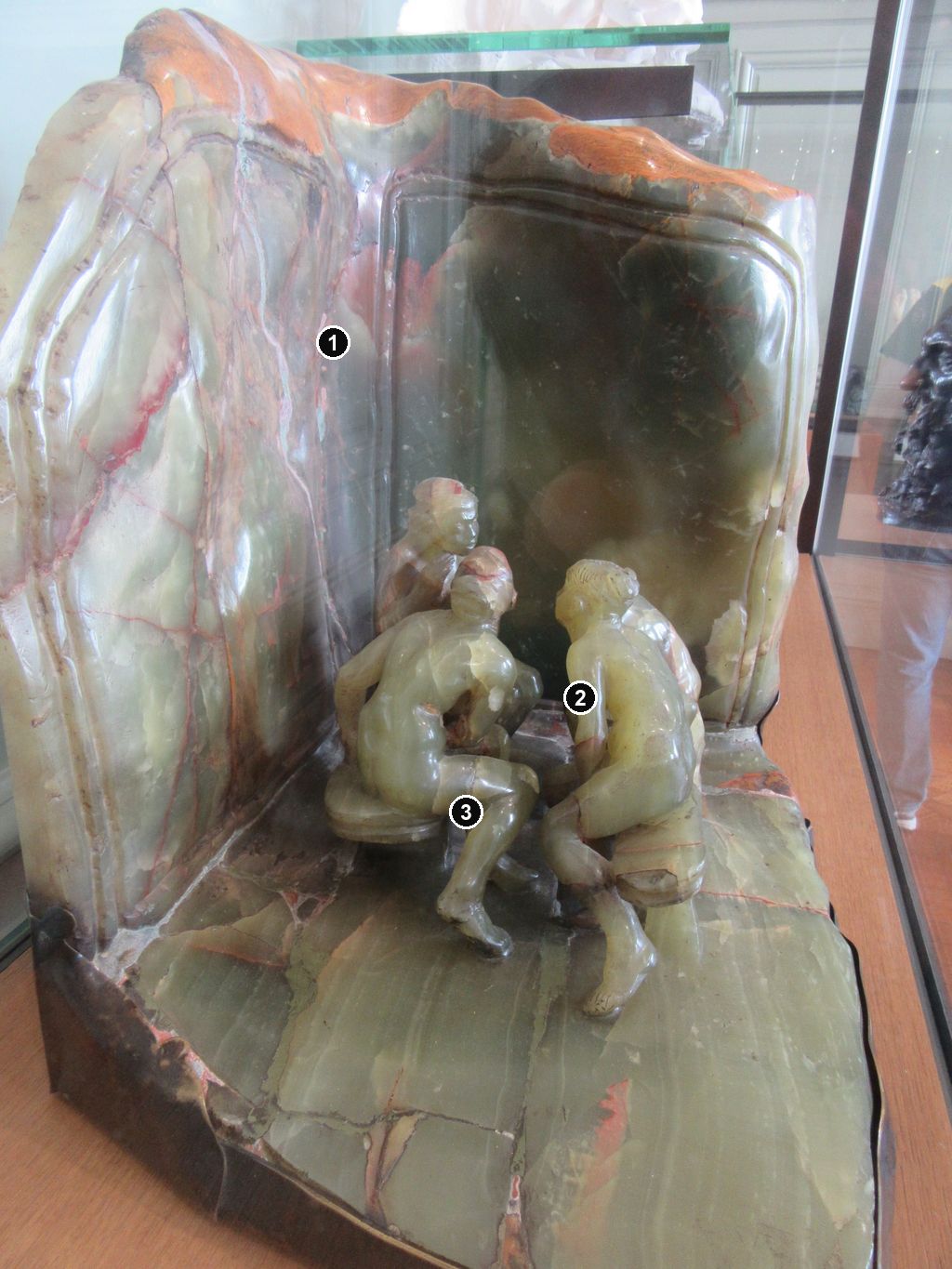
Details from THE GOSSIPS
Look from the hard edges of the screen to the close-set bodies.
The enclosing screen
The tall screen turns a small gathering into an enclosed space. Its curved corner catches the coloured bands in the stone.
The attentive figure
The woman on the right bends into the group. The gap between the heads is just large enough for each person to keep a distinct profile.
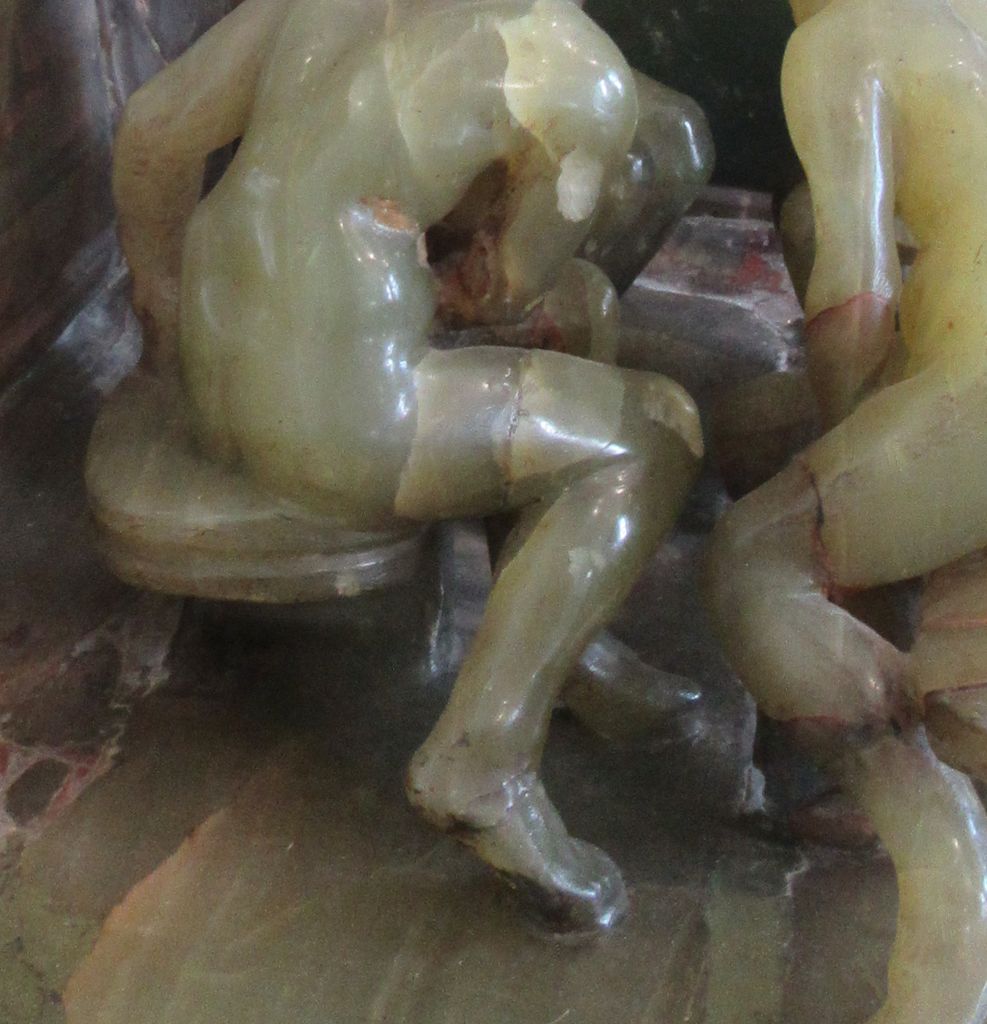
The seated figures
Bent legs and overlapping arms give the figures a rhythm even though all four remain in a small area.
Artworks directory
| Name | Date | Medium |
|---|---|---|
| The Mature Age | 1894–99 | Sculpture |
| The Waltz | c. 1889–93 | Sculpture |
| Sakuntala | 1886–88 | Sculpture |
| The Little Châtelaine | 1892–93 | Sculpture |
| The Gossips | c. 1893 | Sculpture |
| The Wave | 1897–1903 | Sculpture |
| Perseus and the Gorgon | c. 1897–1902 | Sculpture |
| The Implorer | c. 1894–99 | Sculpture |
| Clotho | 1893 | Sculpture |
| Bust of Auguste Rodin | c. 1886–89 | Sculpture |
| Paul Claudel at Sixteen Years Old | c. 1882–87 | Sculpture |
| Young Girl with a Sheaf | c. 1886–87 | Sculpture |
| Giganti | c. 1885 | Sculpture |
| Crouching Woman | c. 1884–85 | Sculpture |
| The Hungry Dog | c. 1893 | Sculpture |
| Old Hélène | c. 1881–82 | Sculpture |
| Fortune | c. 1902–05 | Sculpture |
| The Wounded Niobid | 1906 | Sculpture |
| The Siren, or The Flute Player | c. 1904–05 | Sculpture |
| Deep Thought | c. 1898 | Sculpture |
| Dream by the Fireside | c. 1899 | Sculpture |
| Paul Claudel at Thirty-Seven | 1905 | Sculpture |
| Portrait de Madame Claudel | c. 1883 | Sculpture Musée Camille Claudel. |
| Jeune Femme aux yeux clos | c. 1885 | Sculpture Musée Camille Claudel. |
| Ferdinande de Massary | 1888 | Sculpture Musée Camille Claudel. |
| Léon Lhermitte | 1889 | Sculpture Musée Camille Claudel. |
| Étude de main gauche | c. 1889 | Sculpture Musée Camille Claudel. |
| Vieil aveugle chantant | c. 1894 | Sculpture Musée Camille Claudel. |
| Tête de vieillard | c. 1890 | Sculpture Musée Camille Claudel. |
| Étude pour la tête d’Hamadryade | c. 1895 | Sculpture Musée Camille Claudel. |
| Aurore | c. 1900 | Sculpture Musée Camille Claudel. |
Discussion
Look again at the images and ideas explored in The Gossips. These editorial prompts invite your observations.
Reader Insights
How does the screen affect your position as a viewer?
Which pose or gesture gives the clearest clue to the exchange between the women?
Join the Conversation
Share a detail, comparison or question about The Gossips below.
References
- Musée Rodin, The Gossips or Women Chatting, S.1006, display record and photographs,. View source.
- Musée Camille Claudel, Les Bavardes ou Les Causeuses, plaster 2010.4.5,. View source.
- Musée Camille Claudel, Les Causeuses, Eugène Blot cast no. 1 with stone screen, 2010.1.17,. View source.
- Christie’s, Les Causeuses sans paravent, signed white marble, lot 3908744,. View source.
- Marie Gevart-Dekaeke, La sculpture et l’intime en France (1865–1909), Université Paris Nanterre, 2018, pp. 270–274, including transcriptions of Salon reviews and archival references,. View source.
- Mathias Morhardt, Mademoiselle Camille Claudel, Mercure de France, March 1898, especially pp. 744–745,. View source.
- Société Nationale des Beaux-Arts, illustrated catalogue of the 1895 Salon, sculpture section, no. 23,. View source.
- Musée Rodin, collections portal, Les Causeuses, dites aussi Les Bavardes, S.01006,. View source.
- Anne-Lise Desmas and Emerson Bowyer, editors, Camille Claudel, Getty Publications and the Art Institute of Chicago, 2023, chronology, pp. 15–16,. View source.
- Musée Rodin, The Wave or The Bathers, onyx marble and bronze group,. View source.
- Musée Camille Claudel, 2023 press dossier, especially pp. 61–62, with identified views of the plaster and Blot cast,. View source.
- Musée Rodin, collections portal, Les Causeuses, dites aussi Les Bavardes, 2ème version, plaster S.06291,. View source.
- Musée d’Orsay, Répertoire des sculptures polychromes, entries for S.01006 and 2010.1.17,. View source.