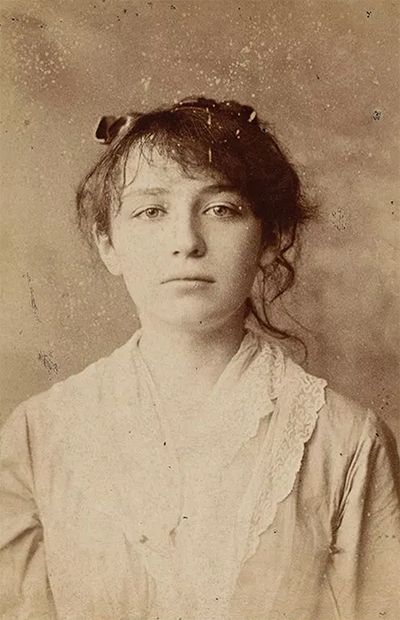
A photograph of Camille Claudel.
 by Tom Gurney
Tom Gurney BSc (Hons) is an art history expert with over 20 years experience
Email: tomgurney1@gmail.com / Phone: +44 7429 011000
Biography: Introduction
Camille Claudel (1864–1943) was a French sculptor who trained in Paris, worked in Auguste Rodin’s studio and built a career of her own at the Salons and through private commissions. At twenty-three she received an honourable mention for the large plaster group Sakuntala. Within a decade she was making groups small enough to bring the viewer close to a whispered conversation, while working on the ambitious three-figure composition now known as The Mature Age. Both kinds of sculpture demanded an eye for what passes between people when a hand reaches, a head turns or a body draws away. [1] [2]
The public career can be traced through exhibition catalogues, surviving sculptures and correspondence about their making. A different set of records documents her confinement from 1913 until her death thirty years later. Letters from the hospitals record what she wanted her relatives and friends to know. In some cases the surviving record also shows why the people she wrote to never read what she had written. [1] [3] [4]
At a Glance
- Born8 December 1864
- Died19 October 1943
Camille Claudel in context
Symbolism in the visual arts
Broad visual span, 1870s–1910sAuguste Rodin
Claudel’s atelier years and later professional contactOld Hélène
c. 1881–82Sakuntala
Plaster shown in 1888The Waltz
Developed c. 1889–93The Little Châtelaine
First model c. 1892–93The Gossips
Described in 1893, shown in 1895The Mature Age
First and second versions, c. 1894–99The Wave
Plaster shown in 1897, mixed-material object dated 1897–1903 (?)Perseus and the Gorgon
Nogent design and marble, c. 1897–1902The Wounded Niobid
Modelled in 1906Contents
- From Fère-en-Tardenois to Nogent-sur-Seine, 1864–1881
- Training and a studio of her own, 1881–1885
- Rodin’s workshop and an early Salon success, 1885–1889
- Exhibiting on her own terms, 1890–1895
- Four entries at the 1895 Salon
- Private patrons and public commissions, 1895–1905
- Blot’s editions and the last years at the Quai de Bourbon, 1905–1913
- Ville-Évrard and Montdevergues, 1913–1943
- The works after her death
- What remained in the family
From Fère-en-Tardenois to Nogent-sur-Seine, 1864–1881
Camille Claudel was born on 8 December 1864 in Fère-en-Tardenois, in the Aisne. Her parents were Louis-Prosper Claudel, a tax official, and Louise-Athanaïse Cerveaux. Her sister Louise was born in 1866 and her brother Paul, later a playwright and diplomat, in 1868. The family moved to Bar-le-Duc in 1870 when her father was transferred there. In autumn 1876 his appointment as registrar of mortgages brought them to Nogent-sur-Seine, where they lived for three years. His next transfer, to Wassy-sur-Blaise, came in 1879. [1] [3]
At Nogent, the children received lessons from a tutor named Colin. The household also became the setting for some of Claudel’s first experiments in clay. The critic Mathias Morhardt, writing in 1898, described a family enlisted in the work of making sculpture. The early clay figures remembered from this period included biblical and historical subjects, among them David and Goliath and Napoleon. Those works are lost. Morhardt’s account, published while Claudel was an established exhibitor, supplies a view of her beginnings from a writer who had become one of her advocates. [1] [3] [5]
The sculptor Alfred Boucher, who had trained in Paris and retained ties to Nogent, recognised Claudel’s aptitude and gave her early lessons. Boucher could assess her modelling as a working sculptor and advise her family on the training available in Paris. He continued to look at her work after the move. He also introduced her to Paul Dubois, the sculptor and director of the École des Beaux-Arts. Salon catalogues named Dubois among her teachers, although the nature of his instruction is less clearly documented than Boucher’s visits to her studio. [1] [3]
Training and a studio of her own, 1881–1885
In April 1881 Claudel’s mother moved with her three children to Paris. Her father retained his provincial posts and joined them on weekends. They lived first on Boulevard du Montparnasse, then at 111 Rue Notre-Dame-des-Champs. Claudel enrolled at the private Académie Colarossi on Rue de la Grande-Chaumière. The state École des Beaux-Arts was still closed to women. A private academy gave her access to training from the model, and a rented studio gave her the space to apply it to work of her own. [1] [3] [6]
In 1882 Claudel and other women sculptors rented a studio at 117 Rue Notre-Dame-des-Champs, a few doors from the family’s new address. Her fellow sculptors included Sigrid af Forselles and Madeleine Jouvray, and later Jessie Lipscomb. Sharing the rent helped make sustained work possible. It also put young sculptors in the same room while they worked through questions about pose, expression and the handling of clay. In an 1887 photograph taken there by William Elborne, Lipscomb and the Claudel sisters sit together over tea. The photograph catches a side of studio life that the bare list of exhibitors in a Salon catalogue leaves out. [1] [3] [6]
Boucher visited the studio to correct the women’s work. When he left for Italy in autumn 1882 he asked Rodin to take over those visits. The first surviving document the 2023 Getty and Art Institute catalogue identifies as evidence of Claudel and Rodin’s acquaintance is a letter from the painter Léon Lhermitte to Rodin dated 9 March 1883. Claudel began working in Rodin’s atelier around 1884. That approximate date refers to regular studio work, which followed her introduction to him as a teacher. [1] [3] [7]
Claudel was also putting work before the public. The Salon des Artistes Français catalogue lists a plaster portrait under her name in 1883, and she exhibited there each year from 1885 to 1889. Her early portraits could differ sharply even when they were close in date. In Old Hélène, the face is modelled with attention to the weight and unevenness of ageing flesh. A young Paul appears in a bust that she exhibited in 1887 as Jeune Romain (Young Roman), its title and form drawing on the authority of antique portraiture. In 1885 she also registered for access to the anatomy collection of the Muséum d’Histoire Naturelle. The range of those activities shows how study from life, anatomy and the example of older sculpture could all feed the work of a young exhibitor. [1] [3] [7]
Rodin’s workshop and an early Salon success, 1885–1889
Rodin had received the commission for The Gates of Hell in 1880 and for The Burghers of Calais in 1885. A studio equipped to handle work on that scale employed assistants at different stages of production. For Claudel, it offered close study of how a sculptor could build an expressive profile from more than one viewpoint and how a fragment could suggest the action of a whole body. The Musée Rodin considers work on hands and feet probable, while the precise assignments remain uncertain. The young sculptor’s own studies show her command of parts of the body whose position can change the meaning of a figure. [1] [2] [7]
Claudel and Rodin also became lovers. The Musée Rodin preserves a letter he wrote to her around 1886 that conveys their intimacy. Her friendship with Lipscomb meanwhile took her to England, where she stayed with the Lipscomb family in Peterborough. She also went to the Isle of Wight in 1886 and drew members of the Jeans family. At Nottingham Castle she exhibited a clay portrait of Lipscomb. The next year Lipscomb exhibited a bust of Claudel there. Each sculptor appears in that exchange as both sitter and exhibitor. [1] [3] [8]
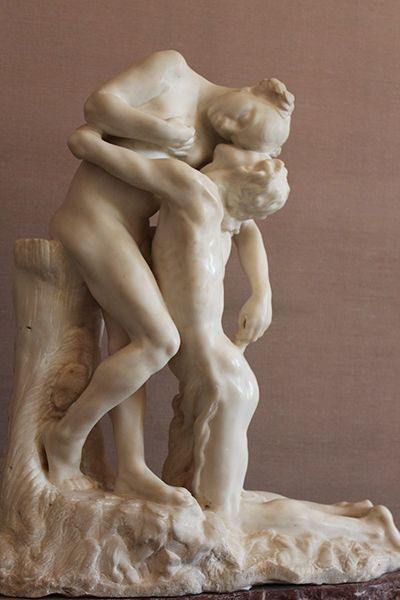
By November 1886 Claudel was working on the two larger-than-life figures of Sakuntala, also known as Sakountala. She described her working day to Florence Jeans, with one model posing in the morning and another in the evening. The time went into coordinating two full bodies at close quarters. Claudel took her subject from Kālidāsa’s play about a king who forgets the woman he loves. She chose the reunion and made the king kneel to meet the woman, so that the movement of forgiveness and recognition passes through the two figures as they come together. [1] [2] [3]
Claudel began the group in the shared studio and finished it after moving to her own space at 113 Boulevard d’Italie in 1888. The plaster was shown as entry 3930 at the Salon des Artistes Français that year and received an honourable mention. The award gave her a distinction under her own name during the years in which she was working with Rodin. She sought a state commission for a marble version without success. The plaster remained a work with a public life of its own. In 1895 she gave it to the city of Châteauroux, whose museum received it that autumn. [1] [2] [3] [9]
Exhibiting on her own terms, 1890–1895
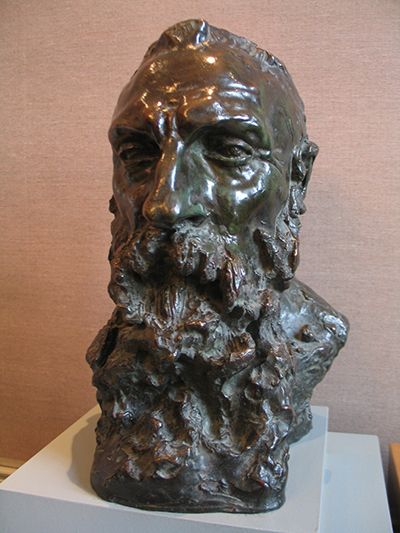
Early in the 1890s Claudel continued to see Rodin and to exhibit independently. A letter she sent him from the Château de l’Islette, dated to the summer of 1890 or 1891 by the Musée Rodin, records their contact in Touraine. At l’Islette Claudel also found the model for a work of her own. She began The Little Châtelaine (La Petite Châtelaine) in 1892, modelling the young Marguerite Boyer, granddaughter of the château’s owner. That year Claudel showed her bust of Rodin at the Société Nationale des Beaux-Arts. The public portrait and the privately addressed letter belong to the same period of their lives, but each tells a different part of it. [1] [2] [10]
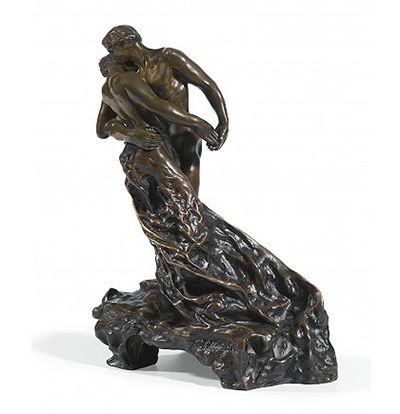
The Société Nationale had begun holding its own Salon in 1890 after a group of artists, including Rodin and Pierre Puvis de Chavannes, split from the Société des Artistes Français. Claudel exhibited The Waltz (La Valse) and Clotho there in 1893. One work put two dancers on a precarious diagonal, the other made the body and hair of an aged woman the subject of an uncompromising figure. Exhibited together, the pair showed the different demands Claudel could make on the same audience. In The Waltz she had already reworked the drapery after the state inspector objected to the nudity of the first composition. The revised plaster attracted attention, although the projected state marble did not follow. [1] [2] [3]
In 1894 the first exhibition of La Libre Esthétique in Brussels listed La Valse in bronze and the portrait now called The Little Châtelaine as Contemplation. Later that year the Paris Salon of the Société Nationale listed the bust as Portrait d’une petite Châtelaine. These exhibitions let Claudel circulate her work across borders and introduce a composition to a second audience under a different title or in another material. The portrait of Marguerite Boyer likewise developed into a series of versions, including marble busts whose differing hair and surface treatments demanded new decisions at the carving stage. [1] [2] [11] [12]
By December 1893 Claudel was writing to Paul about work she regarded as distinct from Rodin’s. She was already developing the small groups that would give her independent practice a new direction. The personal and professional ties loosened over several years. In 1895 Rodin wrote to arrange a visit to her studio by the minister Georges Leygues. In late 1897 Claudel wrote to Rodin about his Balzac, and he replied with advice. In 1898 she asked Morhardt to intervene so that Rodin would stop visiting, and she moved her studio to Rue de Turenne. The Musée Rodin dates the end of the affair to 1892, while the Nogent biography places the definitive break in 1898. The letters and moves give the relationship a more precise sequence than either date alone. [1] [2] [3] [13]
Four entries at the 1895 Salon
The surviving list for the Société Nationale’s 1895 Salon gives a cross-section of what Claudel was making. It places a marble listed as Jeanne as a Child at no. 20, a bronze bust of the painter Léon Lhermitte at no. 21, a plaster Study of a Japanese Figure at no. 22 and the small plaster group later known as The Gossips at no. 23. Four adjacent entries could bring viewers into contact with very different sizes, materials and kinds of subject. A marble portrait and a small scene of women talking belonged to the same period of her working life. Neither activity had to wait for the other to be finished. [14]
The Lhermitte portrait also took a relationship from an earlier stage of Claudel’s life into a public exhibition. The Musée Camille Claudel dates the model of its bronze to 1889 and records a cast by Alexis Rudier. The exhibition record gives the work’s place in the Salon six years after the museum’s model date. The two kinds of date answer different questions. A sculpture might be modelled during one set of encounters and shown to a wider public much later. The museum’s cast gives the portrait a further history of its own. [14] [15]
In the small plaster group the sitter’s identity matters less than the fact of people listening together. Exhibiting it with portrait busts put that experiment beside a form she had been practising since her earliest Salons. This helps place the change often described as Claudel’s independent period. The new groups widened her practice. At the same time she kept using the exhibition system and the genres that had helped establish her as a sculptor. The Salon list lets those two developments be seen at the same point in her career. [1] [14]
Private patrons and public commissions, 1895–1905
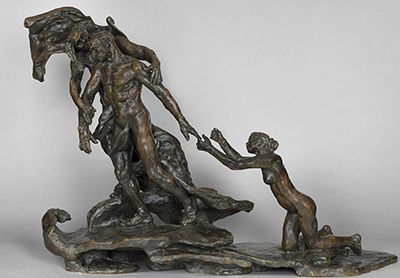
In 1895 Claudel received a commission for a marble Clotho from the committee that had organised a banquet in honour of Puvis de Chavannes. In July the state commissioned The Mature Age (L’Âge mûr). Work on the three-figure group took several years. In December 1898 she complained that she had yet to receive all the money for the plaster. The exhibition catalogue chronology records that the state ultimately paid for the plaster and that the separate order for a bronze was cancelled in June 1899. The later plaster appeared at the Société Nationale’s Salon that year. Captain Louis Tissier financed the bronze cast in 1902, now at the Musée d’Orsay. The work reached bronze through a private patron after the state project had stopped at the model. [1] [2] [16] [17]
The three figures invite comparison with Claudel’s relationship with Rodin, and Paul later identified the kneeling woman with his sister. His reading belongs to the history of how the sculpture was received. Claudel’s revisions also give the group an argument of its own. In the early plaster, the young figure can still hold on to the man. In the later composition, the gap between their hands makes the movement away decisive. That change is visible whether the figures are read as particular people or as youth, maturity and old age. [2] [16]
Claudel had meanwhile been developing smaller compositions based on familiar actions. In The Gossips (Les Causeuses), the women cluster so closely that a listener’s hand and a speaker’s posture draw the eye around the group. In The Wave (La Vague), three small figures face a swell that rises above them. In each case the scale changes where the viewer has to stand and how much can be seen at once. Morhardt’s long profile in the Mercure de France in 1898 singled out Claudel’s way of giving ordinary experience sculptural form. His praise also shows that the small groups were part of her public reputation in her lifetime. [1] [2] [5]
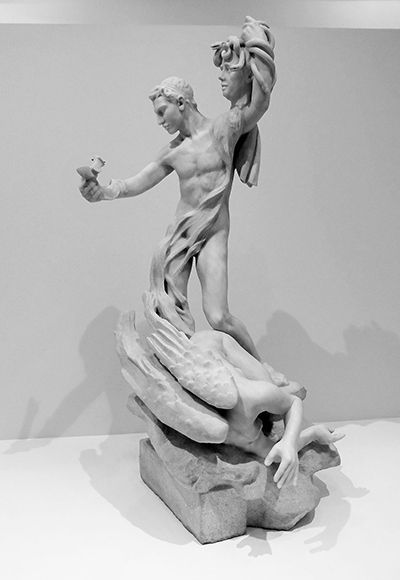
The Countess de Maigret, who became a patron in the later 1890s, supported work at the other end of Claudel’s range. She commissioned the monumental marble Perseus and the Gorgon (Persée et la Gorgone), which François Pompon carved after Claudel’s model. Maigret also commissioned the marble Vertumnus and Pomona, completed in 1905, in which Claudel adapted the embracing pair from Sakuntala to a Roman subject. One commission enabled a new composition at monumental scale. The other gave a group Claudel had developed as a young sculptor a new material and a new public identity. [1] [2] [3] [18]
In January 1899 Claudel moved into two rooms at 19 Quai de Bourbon on the Île Saint-Louis, where she lived and worked until 1913. The studio became her base through a period of uncertain income. On 1 December 1901, Maurice Pottecher wrote to the critic Gustave Geffroy after visiting her and reported that she was exhausted, spoke of giving up sculpture and had broken some moulds. That was one visitor’s report on one occasion. The commissions, editions and exhibition records of the following years document the work that continued. [1] [2]
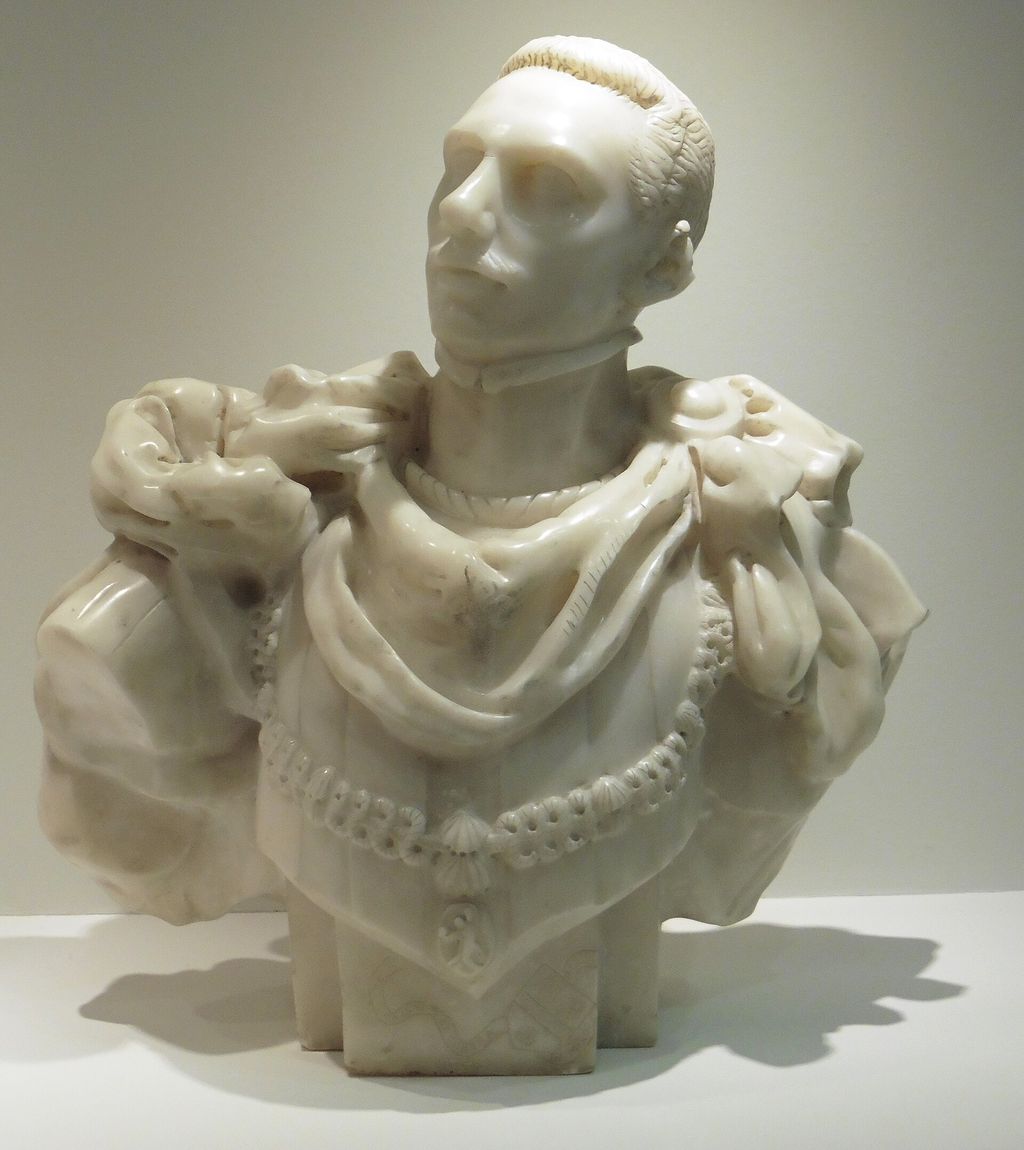
Claudel’s portrait of Christian de Maigret, photographed at the Roubaix exhibition in 2015. Photograph by Pierre André Leclercq. Image source. CC BY-SA 4.0. Resized photograph, shared under CC BY-SA 4.0.
Blot’s editions and the last years at the Quai de Bourbon, 1905–1913
In August 1905 Camille and Paul spent time together in the Pyrenees, where she began the portrait known as Paul Claudel at Thirty-Seven. In the same year he wrote Camille Claudel, statuaire, an appreciation of her sculpture. Their activities overlapped in a new way. The young sitter whose head she had modelled in Paris was now a published writer addressing readers on her work, while she again studied his face as a sculptor. Their relationship as siblings and artists continued across the distances imposed by his diplomatic appointments. [3] [19]
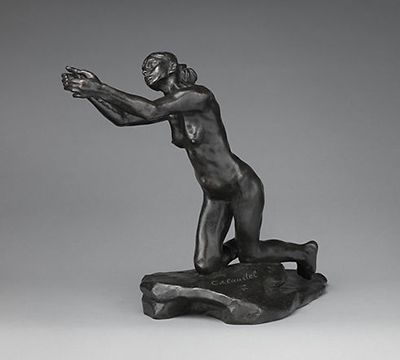
The dealer Eugène Blot provided another means of reaching collectors. In December 1905 he showed Claudel’s bronzes alongside the work of the German sculptor Bernhard Hoetger in his Paris gallery. Among the bronzes were The Waltz and The Implorer. A gallery exhibition could show a body of work together and give collectors a chance to acquire casts. Blot’s bronze edition of the composition that had begun as Sakuntala appeared under the title L’Abandon (The Abandonment). The French state acquired a cast in 1907. Claudel’s career thus included both the unsuccessful request for a state marble after the 1888 Salon and, nearly twenty years later, a state purchase of a bronze edition of the reworked group. [2] [20]
There was new sculpture as well as renewed circulation. Claudel modelled The Wounded Niobid (Niobide blessée) in 1906, and Blot cast it in 1907. The French state’s bronze is on deposit at the Musée Sainte-Croix in Poitiers. The female figure recalls the woman in Sakuntala, but as a single injured figure she gives a different purpose to a pose first worked out in relation to another body. A sculptor could recover an earlier form and change what it did. [2] [3] [21]
Claudel’s world narrowed in the years before her admission to Ville-Évrard. In a letter to her cousin Henriette Thierry, dated about 1912 by the Musée Camille Claudel, she described burning wax figures and smashing sculpture. This is Claudel’s own account of particular acts, written from the studio where she had made and kept her work. It helps explain why a surviving exhibition title or reference to a model may be the only trace of some projects. The scope of the losses remains uncertain. [3]
Ville-Évrard and Montdevergues, 1913–1943
Louis-Prosper Claudel died on 3 March 1913 at Villeneuve-sur-Fère. According to the Musée Camille Claudel, Camille was unaware of his death and did not attend the funeral. Dr Michaux drew up a certificate on 7 March. On 10 March Claudel, aged forty-eight, was admitted to Ville-Évrard, east of Paris, at her mother’s request. The procedure was called placement volontaire. In her case, it was her mother who applied for admission, and Claudel’s letters make clear that she wanted to leave. [3] [4]
Writing to her cousin Charles Thierry on 14 March, Claudel described a car coming to take her from home to the institution. The first letters reached him, but their exchange was soon restricted. Her cousin attempted to visit and was refused. A letter he wrote in May expressing concern about her silence stayed in her hospital file. A letter she wrote to him in August asking why he had neither visited nor written also remained in the file. The two letters document a separation that each experienced as silence from the other. [4]
In September 1914, after the outbreak of the First World War, Claudel was transferred south to Montdevergues at Montfavet, near Avignon. She remained there for the rest of her life. She continued to write, including to Paul and to her mother. In a letter of 2 February 1927 she described the cold at Montdevergues and objected to arrangements being made for her without anyone asking what she needed. In another letter to Paul, dated approximately 1932–33, she described depending on a member of staff to help post her letters. Read alongside the documented restrictions at Ville-Évrard, the letters show how much work it could take to maintain a tie with someone outside. [3] [4] [22]
Claudel did not resume sculpture in the institutions. Her mother and sister did not visit. Paul visited on several occasions, and in 1929 Jessie Lipscomb and her husband came to see her. He photographed Claudel there, more than forty years after he had photographed the women at the shared Paris studio. Paul made his last visit on 21 September 1943. Claudel died at Montdevergues on 19 October, aged seventy-eight. She was buried at Montfavet, and her remains were later moved to a communal ossuary. [1] [3] [22]
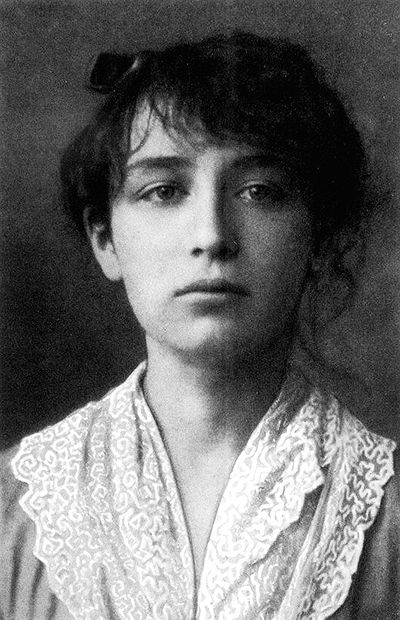
A later photograph of Camille Claudel.
The works after her death
In 1951 the Musée Rodin mounted Claudel’s first retrospective. In 1952 Paul donated four works to the museum, including Vertumnus and Pomona, two versions of The Mature Age and Clotho. A room devoted to her work followed. The two versions of The Mature Age made it possible for the museum to show the distance between an early and a later conception within the same career. The gift helped give the public access to work whose survival had depended on different patrons, foundries and owners. [2] [23]
Books, exhibitions and films brought her to a broader audience in the 1980s. On 26 March 2017 the Musée Camille Claudel opened in Nogent-sur-Seine, incorporating the house where her family had lived. Its history reaches back to the municipal museum founded through Alfred Boucher’s initiative in 1902. The new museum gave the place of her early training a second role in her life’s history, as a place where her work could be seen in the company of sculpture from her own time. The Art Institute of Chicago and the Getty brought together work from public and private collections for their 2023–24 retrospective. [2] [3] [24] [25]
At Nogent, the museum now brings Claudel’s early portraits and the later groups together with work by contemporaries such as Boucher and Dubois. The young sculptor who depended on visits from a teacher in a shared studio eventually employed models, dealt with inspectors, found patrons and worked with a carver of her own. The objects left by those working relationships, from the 1888 Salon plaster to the bronzes Blot issued, make it possible to trace the choices she made across that career. [1] [2] [3]
What remained in the family
Some of Claudel’s smaller works stayed with the heirs of her sister Louise de Massary. When a group of those works came to auction in Paris in 2017, France’s Ministry of Culture reported the use of public pre-emption for twelve lots. The Orsay acquired a terracotta study for Sakuntala and a plaster study of an older woman for The Mature Age. The Département de l’Aube financed the acquisition of the patinated plaster Young Roman, which the Musée Camille Claudel records on deposit. These were objects from the making of sculptures that had become familiar to the public through other examples. Their return to public view added evidence about earlier decisions in Claudel’s working life. [26] [27]
The same acquisition announcement names the pastel portrait of Louise, which went to Nogent. It is a reminder that the family appears in the record in more than one role. Louise was a sitter, while works that came down through her heirs later supplied evidence for sculpture Claudel had made in the 1880s and 1890s. The two facts do not explain the relationship between the sisters. They show why a family collection can change what a later audience is able to study, long after the people who kept the works can answer questions about them. [26]
Follow Camille Claudel’s career through four stages
Making work for her own name
Claudel pursued work of her own alongside her time in Rodin’s studio. Her large plaster Sakuntala received an honourable mention in 1888. At the Salon in 1893, she showed both the entwined dancers of The Waltz and the nearly immobilised figure of Clotho. [2]
Intimate scenes and ambitious groups
The small figures in The Gossips draw attention to a private exchange. In The Mature Age, Claudel lets an empty space between two hands carry the drama across a much larger group. A commission from Captain Louis Tissier led to the 1902 bronze.
Artworks directory
| Name | Date | Medium |
|---|---|---|
| The Mature Age | 1894–99 | Sculpture |
| The Waltz | c. 1889–93 | Sculpture |
| Sakuntala | 1886–88 | Sculpture |
| The Little Châtelaine | 1892–93 | Sculpture |
| The Gossips | c. 1893 | Sculpture |
| The Wave | 1897–1903 | Sculpture |
| Perseus and the Gorgon | c. 1897–1902 | Sculpture |
| The Implorer | c. 1894–99 | Sculpture |
| Clotho | 1893 | Sculpture |
| Bust of Auguste Rodin | c. 1886–89 | Sculpture |
| Paul Claudel at Sixteen Years Old | c. 1882–87 | Sculpture |
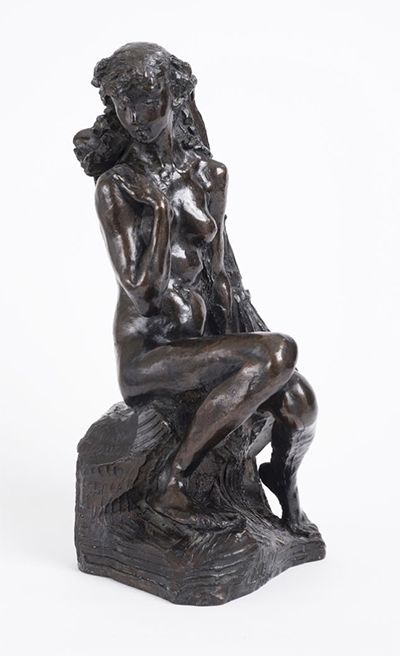
| Young Girl with a Sheaf | c. 1886–87 | Sculpture |
| Giganti | c. 1885 | Sculpture |
| Crouching Woman | c. 1884–85 | Sculpture |
| The Hungry Dog | c. 1893 | Sculpture |
| Old Hélène | c. 1881–82 | Sculpture |
| Fortune | c. 1902–05 | Sculpture |
| The Wounded Niobid | 1906 | Sculpture |
| The Siren, or The Flute Player | c. 1904–05 | Sculpture |
| Deep Thought | c. 1898 | Sculpture |
| Dream by the Fireside | c. 1899 | Sculpture |
| Paul Claudel at Thirty-Seven | 1905 | Sculpture |
| Portrait de Madame Claudel | c. 1883 | Sculpture Musée Camille Claudel. |
| Jeune Femme aux yeux clos | c. 1885 | Sculpture Musée Camille Claudel. |
| Ferdinande de Massary | 1888 | Sculpture Musée Camille Claudel. |
| Léon Lhermitte | 1889 | Sculpture Musée Camille Claudel. |
| Étude de main gauche | c. 1889 | Sculpture Musée Camille Claudel. |
| Vieil aveugle chantant | c. 1894 | Sculpture Musée Camille Claudel. |
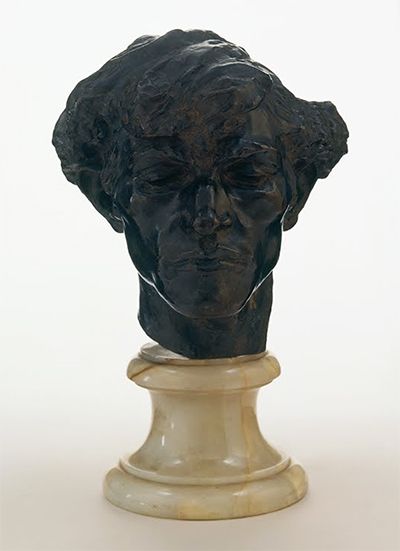
| Tête de vieillard | c. 1890 | Sculpture Musée Camille Claudel. |
| Étude pour la tête d’Hamadryade | c. 1895 | Sculpture Musée Camille Claudel. |
| Aurore | c. 1900 | Sculpture Musée Camille Claudel. |
Discussion
Look again at the images and ideas explored in Biography. These editorial prompts invite your observations.
Reader Insights
What did Paris change about the training Claudel could receive?
How did private patrons and dealer editions affect the work audiences saw?
Join the Conversation
Share a detail, comparison or question about Biography below.
References
- Anne-Lise Desmas and Emerson Bowyer, eds., Camille Claudel, introduction, exhibition notes and chronology, J. Paul Getty Museum and Art Institute of Chicago, 2023. View source.
- J. Paul Getty Museum, Camille Claudel, exhibition guide. View source.
- Musée Camille Claudel, English press kit, “Camille Claudel, biographical details” and museum history. View source.
- Susannah Wilson, “To whom does a Letter Belong? Psychopathology and Epistolography in the Asylum Letters of Antonin Artaud and Camille Claudel”, Modern Languages Open, 2021, especially pp. 4–9. View source.
- Mathias Morhardt, “Mademoiselle Camille Claudel”, Mercure de France, March 1898, pp. 709–755, facsimile. View source.
- Musée de Pont-Aven, In Camille Claudel’s Time, Being a Sculptress in Paris. View source.
- Musée Rodin, “Camille Claudel”, sections on the meeting with Rodin and work in his atelier. View source.
- Musée Rodin, letter from Auguste Rodin to Camille Claudel, about 1886, L.01451. View source.
- Musée Bertrand and French Ministry of Culture, Sakountala, original patinated plaster, inv. 518. View source.
- Musée Rodin, letter from Camille Claudel to Auguste Rodin, summer 1890–91, Ms.00362. View source.
- La Libre Esthétique, catalogue of the first exhibition, Brussels, 1894, entries 94–97. View source.
- Musée Camille Claudel, La Petite Châtelaine, patinated plaster, 2010.1.12. View source.
- Musée Rodin, “Camille Claudel,” collection theme on portraits and the relationship. View source.
- Musée Camille Claudel, Period of solitary creation, the 1895 Société Nationale entries. View source.
- Musée Camille Claudel, Léon Lhermitte, date and bronze object details. View source.
- Musée Rodin, The Age of Maturity, S.01380. View source.
- Musée d’Orsay, L’Âge mûr, bronze commissioned by Louis Tissier, RF 3606. View source.
- Musée Camille Claudel, “Les dernières années de création”, entry on Persée et la Gorgone. View source.
- Musée Camille Claudel, Camille Claudel et Paul Claudel, le rêve et la vie, exhibition dossier, p. 5. View source.
- Alte Nationalgalerie, Camille Claudel und Bernhard Hoetger. Emanzipation von Rodin, section on the 1905 exhibition. View source.
- Centre national des arts plastiques, Modern Collection, p. 11, Niobide blessée, FNAC 2161. View source.
- Centre Hospitalier de Montfavet, “La vie de Camille Claudel”, sections on transfer and visits. View source.
- Musée Rodin, Camille Claudel. Nouveaux regards, nouvelles questions and 2025 documentary dossier, Room 16. View source 1. View source 2.
- Musée Camille Claudel, history of the museum. View source.
- J. Paul Getty Museum, retrospective dates and catalogue. View source.
- French Ministry of Culture, Acquisitions of major works by Camille Claudel, November 2017 family sale and public acquisitions. View source.
- Musée Camille Claudel, Camille Claudel, artist index, Jeune Romain, D2017.14.1. View source.