


 by Tom Gurney
Tom Gurney BSc (Hons) is an art history expert with over 20 years experience
Email: tomgurney1@gmail.com / Phone: +44 7429 011000
Sculptures: Introduction
Camille Claudel's sculptures can ask you to look up, step back or come close enough to follow a whisper. The marble Perseus and the Gorgon rises to almost two metres. The Gossips fits four women and a screen into a group less than half a metre high. Both works reward a walk around them. In Perseus, your eye travels between the severed head held aloft and the body curled at the hero's feet. In The Gossips, a step sideways changes how much of a conversation the screen lets you see. Claudel made the viewer's position part of the experience at both scales. [1] [2]
The best place to start depends on what catches your eye. For faces, put The Little Châtelaine alongside the two portraits of Paul Claudel. For figures in motion, compare the shared tilt of the dancers in The Waltz with the pause before the wave breaks over the bathers. If you want to see Claudel rethink a composition, follow Sakuntala from the tall Salon plaster to the smaller marble and bronze versions. The catalogue below groups the works by these kinds of connections and identifies the particular objects behind the dates. [3] [4] [5] [6]
At a Glance
- ArtistCamille Claudel
- MaterialsTerracotta, plaster, marble, bronze and stoneware
Contents
- Portraits and the direction of a glance
- A dance, a crouch and the moment before an action
- How Claudel brings figures together
- Groups made to be seen up close
- Scale, surface and the label on a bronze
- How to read a material description
- Catalogue of Camille Claudel's sculptures
Portraits and the direction of a glance
Try looking at one portrait at eye level and then in profile. In The Little Châtelaine (La Petite Châtelaine), the young Marguerite Boyer looks upward, her eyes wide and lips parted. Seen straight on, the eyes pull attention immediately to the face. From the side, the lift of the chin and the length of the exposed neck show how much of that alertness depends on the posture. The abrupt lower edge of the bust leaves the head poised above a small body. The effect persists across versions, even as Claudel changes the treatment of the hair. The Getty describes four marble commissions and illustrates a marble with a straight plait from 1895. The patinated plaster at Nogent-sur-Seine belongs to the earlier modelling of about 1892–93. [3] [4]
The two busts of Paul Claudel offer a different comparison because they portray the same person at different ages. For the younger Paul, the titles Jeune Romain and Mon frère suggest two ways into the work. One draws attention to the antique character of the bust, while the other reminds us that this particular face belonged to Claudel's brother. The youthful portrait leaves the neck conspicuously exposed. In the adult bust, the head sits above a broader, clothed expanse of chest. The broader base changes the proportions of the likeness even before you compare the features. There are also two distinct dates to read on the adult bronze at Nogent. Claudel modelled the portrait in 1905 and P. Converset cast the museum's example in 1912–13. The bronze preserves a likeness made years before the metal was poured. [3] [4] [7]
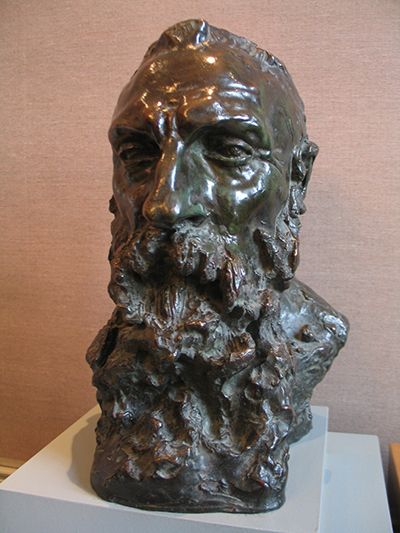
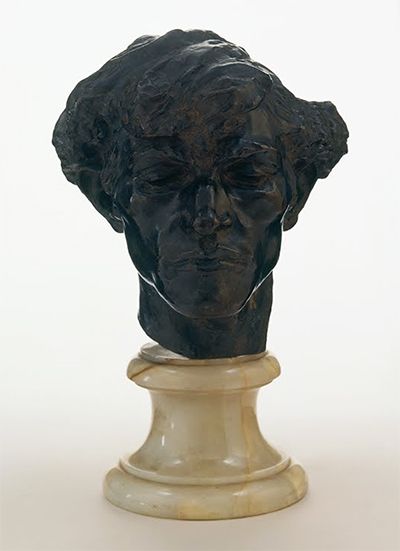
Set the upturned face of Marguerite beside the older face of Old Hélène (La Vieille Hélène), and look for the places where expression gathers. In the terracotta, the folds around the mouth and the modelling around the eyes ask for a slower reading than the child's wide gaze. Giganti makes a different use of uneven surfaces. The strongly marked features emerge from a head and shoulders that are full of changes in contour, especially where the turned head meets the rougher termination of the bust. In the Bust of Auguste Rodin, the long beard gives the face a downward extension. Coming around the sculpture reveals the distance between the projecting brow and beard and the recessed eyes. These works provide three ways to see how much character Claudel could convey within the narrow bounds of a bust. [4] [8] [9]
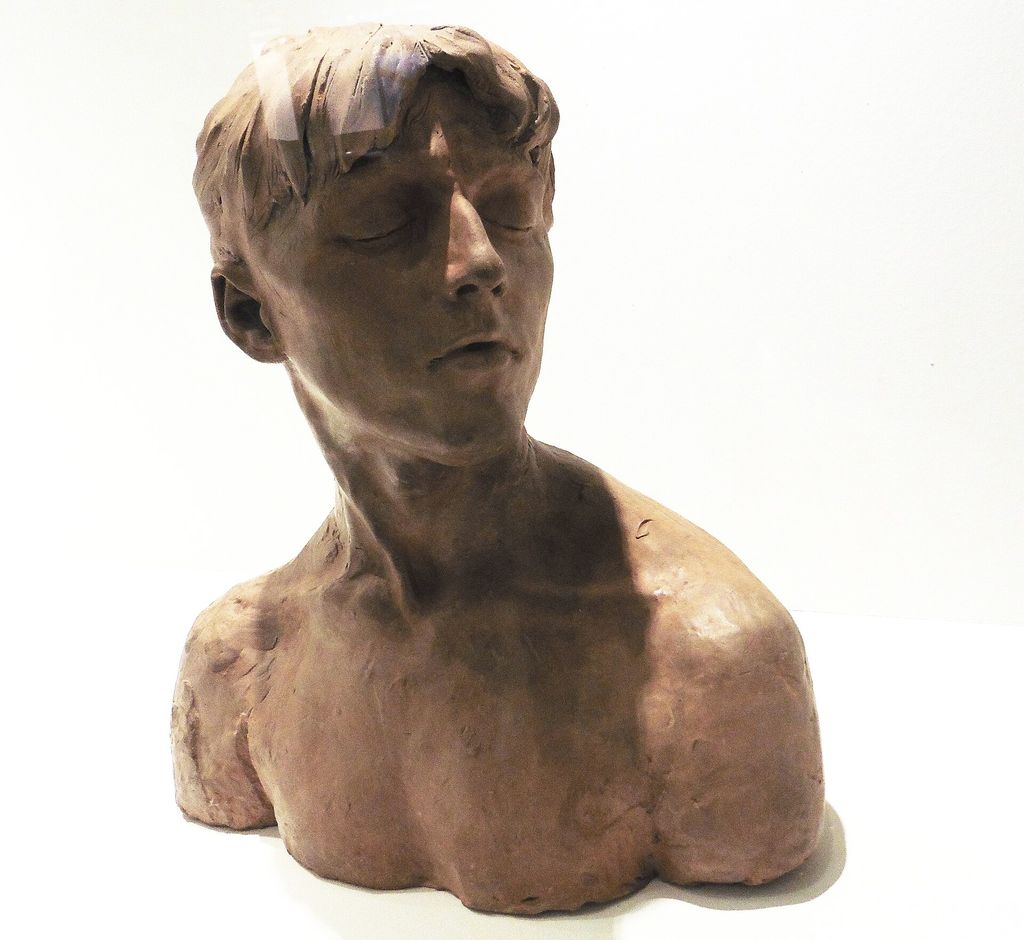
Claudel’s Young Girl with Closed Eyes, photographed at La Piscine, Roubaix. The closed eyelids offer a contrast with the lifted gaze of The Little Châtelaine. Photograph by Pierre André Leclercq. Image source. CC BY-SA 4.0. Resized photograph, shared under CC BY-SA 4.0.
Explore selected sculptures
A dance, a crouch and the moment before an action
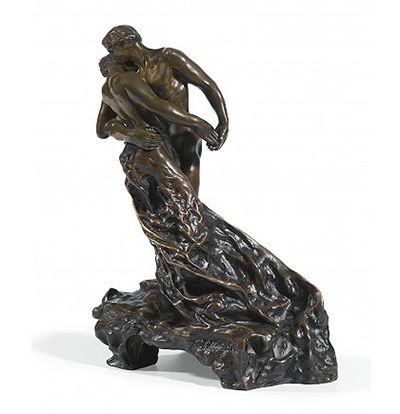
Follow the feet first in The Waltz (La Valse). They give a surprisingly small point of purchase to two bodies leaning together. The clasp and the arm around the partner bring the dancers into one moving unit, while the sweeping fabric extends their turn beyond the point where their bodies meet. From the side, the lean becomes more evident and the drapery can seem to pull the eye in the opposite direction from the feet. Claudel showed a plaster in 1893. The draped sculpture developed during discussions over a proposed state marble, and the related objects at Nogent include reworked plasters, a glazed stoneware example and a later bronze. When comparing two views, check the size of the base and the sweep of the fabric before deciding that the photographs show the same version. [3] [4] [10]
In Fortune (La Fortune), a single figure and a broad curl of drapery carry the movement. Look at how little of the figure's outline is vertical. The raised limb and the turn of the body make the sweep of the cloth legible as part of the action, even though there is no partner to explain the shift in weight. The Siren, or The Flute Player (La Sirène ou La Joueuse de flûte) offers a seated figure with motion concentrated in the arched back, lifted chin and hands. The small space between mouth and flute is enough to suggest that a sound is imminent. The two figures show how much anticipation can come from an extended limb or a gap only a few centimetres across. [11] [12]
A crouch can direct the eye just as forcefully. In the patinated plaster Crouching Woman (Femme accroupie), the knees draw close to the body and the head dips into the space between shoulders and legs. Follow the braid from another angle and the back becomes a point of entry into the pose. In the terracotta Young Girl with a Sheaf (La Jeune Fille à la gerbe), the bent limbs bring the figure into a similarly compact space, but the wheat gives the eye another shape to follow alongside the body. The Musée Rodin compares this sculpture with Rodin's Galatea and argues for Claudel's chronological priority. The related forms make a good visual comparison, while the surviving objects and their dates are the evidence for that separate historical argument. [4] [13] [14]
In The Hungry Dog (Chienne rongeant un os, also Chienne affamée), the action is easiest to read low down. The bone lies between the front paws and gives the head and jaws their direction. Seen from above, the bend into the bone pulls the whole animal into a compact outline. That relation between posture and a small object is also worth following in the figure groups. Once you have found what a figure is looking at, touching or bracing against, the rest of the body often falls into place. [15]
How Claudel brings figures together
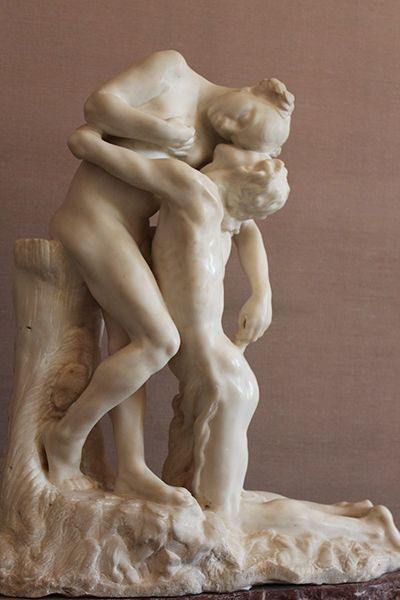
In the 1888 Sakuntala plaster, the central event is an encounter at close quarters. A kneeling man lifts his head towards a woman who bends into his arms. Look at how far she has to incline for their faces to come close, then at how the lower body still carries the pose. The Châteauroux plaster measures 190.5 centimetres high. The 1905 white marble Vertumne et Pomone (Vertumnus and Pomona) is 91 centimetres high including its red marble base. The reduced size changes where the viewer meets the figures, while the new title invites a different story about their meeting. A Blot bronze shown in 1905 as L'Abandon (Abandonment) shifts attention again, towards what one body yields to the other. You can trace the core gesture through all three objects while keeping their different titles, scales and materials in view. [3] [6] [16]
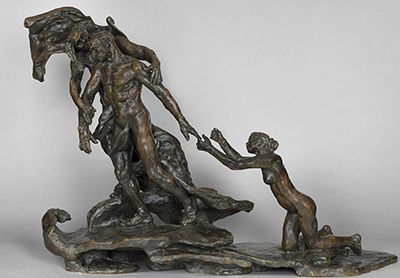
A gap matters as much as contact in The Mature Age (L'Âge mûr). In the first plaster version, the three figures remain more closely tied to one another. In the later composition, the man is drawn forward with the older woman while the kneeling figure's hands reach into space behind him. Viewed from the side, the spread of the group across the base makes the break between their hands particularly clear. Viewed nearer the front, the older woman's body and the folds around it help carry the eye in the direction the man is going. The full bronze at Orsay, made for Captain Louis Tissier about 1902, spans more than a metre and a half. There is time, as you look along that width, for the reach and the departure to register as two distinct actions. [17] [18]
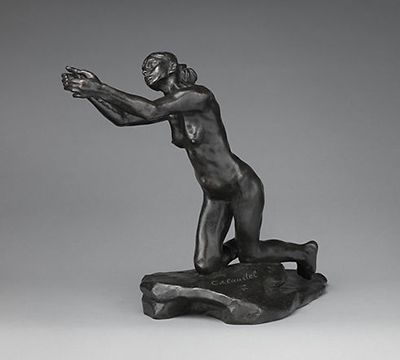
Look next at The Implorer (L'Implorante), where the kneeling posture has a life of its own. On her own, the woman seems to reach past the edge of her base. The raised hands set an imaginary point in the space in front of her, and the knees give that reach a visible anchor. In the group, the other figures and the gap between the hands give the gesture a direction and an immediate consequence. The standalone objects have their own histories, including the patinated plaster L'Implorante ou Le Dieu envolé and the large Blot bronze. Compare the reach across the works before using the title to decide what the figure wants. [17] [19]
Groups made to be seen up close
In The Gossips (Les Causeuses or Les Bavardes), four women huddle beside a screen. The speaker's hand lifts towards a listener, and the other heads tilt in close enough for you to read the conversation through the arrangement of bodies. The screen makes the same few centimetres of space do double duty. It gives the women cover and, seen from the open side, draws you into the scene. Start there, then move towards the back and see how quickly one or more of the women disappear. The Musée Rodin's onyx and bronze version, exhibited in 1897, also turns the screen into a material contrast. The broad sweep of stone throws the smaller bronze figures into relief. [2]
The Wave (La Vague or Les Baigneuses) also places closely grouped figures beside a sheet of stone. Here the onyx bends over three bronze bathers. From the front, three figures repeat the same crouch below the curve. From the side, the depth of the overhang becomes clearer. The bather nearest the advancing stone and the apparent thickness of the crest can look quite different as you move. The Musée Rodin draws a comparison with Hokusai's great wave. In Claudel's sculpture, the crest and bathers occupy the same physical space as the viewer, so a glance from another position can change how imminent the wave feels. [5]
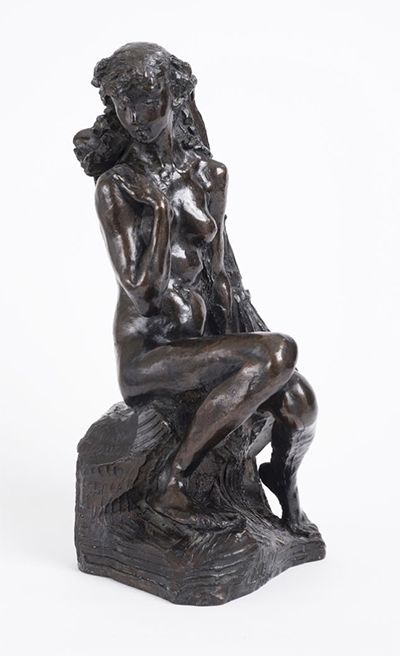
Dream by the Fireside (Rêve au coin du feu) gives a single seated figure and a hearth the intimacy of a room. Look across from the figure towards the opening and notice how low the whole scene sits. A viewer who bends towards it comes closer to the level of the imagined fire. The stone identification depends on the example. The bronze and marble at Nogent is 22 centimetres high and was cast by Blot around 1905. Getty illustrates another example captioned bronze and alabaster. The same habit helps with Deep Thought (Profonde pensée). A viewer can compare the figure's inclined posture in Nogent's all-bronze example with the bronze and marble edition to see where the change in material draws a boundary around the pose. [3] [4] [20]
Scale, surface and the label on a bronze
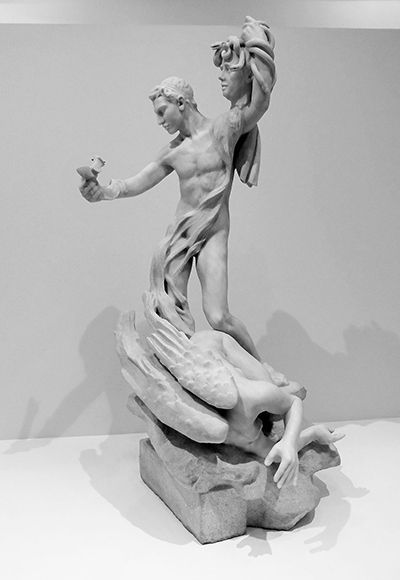
In the marble Perseus and the Gorgon (Persée et la Gorgone) at Nogent, the viewer's eye has a long way to travel between the head held up by Perseus and the body of Medusa below. The almost two-metre height makes those two details difficult to take in at the same distance. Nogent identifies a useful connection with Crouching Woman in the pose of Medusa's folded body. For comparison, the Blot bronze in Tokyo is 51 centimetres high. An entire side of that bronze can be taken in at once, which makes it easier to see the gap between the hero's raised arm and the rest of his body. The two examples also have separate production histories. François Pompon carved the 1902 marble from Claudel's design for the Comtesse de Maigret. The Tokyo museum records its bronze as an unnumbered Blot proof, sand-cast in 1905–06. [1] [21]
A sculpture's survival can shape the comparisons available today. The 1893 plaster of Clotho shows the hair of the aged Fate falling in heavy strands around the body. Follow those strands down from the head and they begin to obscure the outline of the figure. That interplay of hair and silhouette belongs to the full plaster at the Musée Rodin. A marble was commissioned in 1895, completed in 1897 and shown in 1899. Its whereabouts are unknown. The bronze torso at Nogent preserves a different state with a bare head. The museum dates the model for the torso to about 1893 and identifies its example as a post-1990 Valsuani cast. The record of the marble, the surviving plaster and the later torso each tell a different part of the work's history. [22] [23]
The same title can stay in use across several materials, or the same composition can acquire a new name when it changes medium. Begin with the collection and accession number if you are comparing two photographs. Then look for three separate dates where the record gives them. The date of the model places the sculptor's design. A casting or carving date places the example in front of you. An exhibition or acquisition date tells you when that example, or a specifically identified earlier state, entered public view or a collection. For the Rodin bust, the Musée Rodin gives about 1886–88 for the design and 1892 for its Gruet bronze. Nogent gives 1888–89 for its model and 1897–98 for its F. Rudier cast. The museum names matter here because the date pairs describe two different bronzes. [4] [9]
Look for a named maker and a number as well. Nogent's Waltz in glazed stoneware is Émile Muller's no. 14. Its large-model bronze is Eugène Blot's no. 5. Each number makes sense within the history of its own issue. On the Tissier bronze of The Mature Age, Orsay records the foundry name and a first-proof inscription on the reverse of the wave-like form behind the figures. There is a practical reason to look at the back. It can tell you which bronze you are seeing even when the main view closely resembles another cast. [18] The folds of a skirt in glazed stoneware catch light and colour differently from folds in patinated plaster or bronze, even where the outlines in two photographs look alike. The guide to Claudel's technique and materials follows the making of these surfaces. The guide to museum collections is a starting point if you want to compare particular examples in person. [4] [10]
The bronze Wounded Niobid (Niobide blessée) offers a final comparison with Clotho. The Niobid draws one hand to her chest as her head tilts toward the opposite shoulder. A rough upright mass runs alongside her. The relationship of that mass to the body becomes easier to read from a second view, just as the amount of the Fate's body hidden by her hair changes as you walk around the plaster. The two works give quite different shapes to vulnerability. For the Niobid, the Getty dates the model to 1906 and identifies the state-owned bronze deposited at Poitiers as a Blot cast of 1907. Those dates describe the model and cast of the identified example. [3] [22] [24]
How to read a material description
A single work can appear under a short title in a gallery and a much longer description in a collection database. The Musée d’Orsay’s register of polychrome sculpture supplies accession numbers alongside its descriptions. That is particularly helpful for Claudel. It includes two works called Les Causeuses, identified as S.01006 in Paris and 2010.1.17 in Nogent. Keeping the two numbers in view makes it possible to compare a composition that uses coloured stone for the figures with one that casts the figures in bronze. Both combine materials, but light and colour pass through one group and strike the surface of the other. [2] [25] [26]
The same register puts three other Nogent works within reach of that comparison. The entries for the stoneware Waltz, the mixed-material Deep Thought and Fireside Dream place a dancing pair, a compact figure and a figure at a hearth alongside one another. Each offers a different way to introduce colour. In glazed stoneware the colour lies on the surface and can cross from figure to drapery. When bronze meets carved stone, the joint separates elements with different colours and different ways of reflecting light. The combination can describe a physical distinction within the scene, such as the interval between a seated figure and a fireplace. [4] [5] [20] [26]
Read the foundry line separately from the date field. The Orsay Mature Age carries a first-proof inscription and a Tissier foundry mark. The catalogue for the small Tokyo Perseus instead records an unnumbered proof and a Blot stamp. Its inscription contains the number 5 because Blot worked at number 5 on the boulevard de la Madeleine. A number standing alone in an image crop is therefore a poor guide to an edition. The words around it, the position of the mark and the dimensions of the object can establish what kind of number it is. The maker’s signature can be in an entirely different place from the foundry stamp. [18] [21]
A useful sequence when comparing two collection photographs is to look first at the base, then at the outline, then at the surface. A base can contain the signature or help identify a supporting element that changes between versions. The outline will show how much of a model the sculptor or founder retained, such as the projection of Perseus’s shield. The surface can explain why a familiar composition looks different in stoneware, marble or a bronze with a dark patina. Record the accession alongside those observations if you want to find the same sculpture again. It is more durable than a translated title or a filename. [18] [21] [26]
Catalogue of Camille Claudel's sculptures
Each entry names a model, a documented example or both. Some sculptures fit several groups. The Waltz and The Wave, for instance, are equally good starting points for comparing movement and materials.
Portraits and busts
- Old Hélène (La Vieille Hélène). The Musée Camille Claudel's object record dates its terracotta to about 1881–82. [8]
- Paul Claudel at Sixteen Years Old (Jeune Romain, also Mon frère). Nogent lists the patinated plaster on deposit from the Département de l'Aube at about 1884. Getty gives 1882/83–87 for the painted plaster in Chicago. [3] [4]
- Giganti (also known as Tête de brigand). Nogent dates the model to about 1885 and its bronze to before 1892. The museum identifies Gruet as the probable founder. [4] [27] [28]
- Bust of Auguste Rodin (Portrait de Rodin). Musée Rodin S.1021 pairs a design of about 1886–88 with an 1892 Gruet cast. Nogent dates its model 1888–89 and its F. Rudier bronze 1897–98. [4] [9]
- The Little Châtelaine (La Petite Châtelaine). Nogent's patinated plaster is dated about 1892–93. One marble with a straight plait dates to 1895. [3] [4]
- Paul Claudel at Thirty-Seven (Paul Claudel à trente-sept ans). Modelled in 1905. The Nogent example is a P. Converset bronze cast in 1912–13. [7]
Figures, gestures and movement
- Crouching Woman (Femme accroupie). The patinated plaster at Nogent dates to about 1884–85. [4] [13]
- Young Girl with a Sheaf (La Jeune Fille à la gerbe). The Musée Rodin places the design around 1886–87 and dates its terracotta to 1887. [14]
- The Waltz (La Valse). Models dated 1889–93 at Nogent. The museum's Émile Muller stoneware no. 14 is listed in its gallery guide under 1895 and its large-model Blot bronze no. 5 was cast in 1905. [4] [10]
- The Implorer (L'Implorante, also La Suppliante). Nogent holds a patinated plaster titled L'Implorante ou Le Dieu envolé, about 1895. Its separate large-model bronze is dated 1899 for the model in the object record, with a 1905 Blot casting date for no. 5. [19] [29]
- Fortune (La Fortune). Nogent's object record dates the work 1902–05 and its Blot bronze to 1905. It records the work's 1904 Salon d'Automne appearance. [11]
- The Siren, or The Flute Player (La Sirène ou La Joueuse de flûte). Modelled about 1904–05. Nogent holds Blot bronze no. 3 from about 1905. [12] [25]
Encounters, myth and allegory
- Sakuntala (Sakountala). Patinated plaster exhibited in 1888, now at the Musée Bertrand in Châteauroux. The Musée Rodin holds the 1905 marble Vertumne et Pomone. Blot's bronze version appeared in 1905 as L'Abandon. Nogent's small bronze is Blot no. 2, cast that year. [6] [16] [30]
- Clotho (Clotho). Plaster of 1893 at the Musée Rodin. A separately commissioned marble was completed in 1897 and exhibited in 1899. Nogent's bald torso is a separate model from about 1893, cast by Valsuani after 1990. [22] [23]
- The Mature Age (L'Âge mûr). First version in plaster about 1894–95. The later model was shown in 1899. Orsay's Tissier bronze was cast about 1902 and shown at the Salon in 1903. [17] [18]
- Perseus and the Gorgon (Persée et la Gorgone). Nogent dates the design to about 1897 and the Maigret marble to 1902. Tokyo gives 1898–1905 for the model of its bronze and 1905–06 for Blot's sand-casting. [1] [21]
- The Wounded Niobid (Niobide blessée). Model dated 1906 by Getty. The Blot bronze of 1907, FNAC 2161, is deposited at the Musée Sainte-Croix in Poitiers. [3] [24]
Everyday scenes and small groups
- The Hungry Dog (Chienne rongeant un os or Chienne affamée). Model about 1893. Nogent identifies A. Rudier as founder of its bronze without assigning the cast a date in the gallery listing. [4] [15]
- The Gossips (Les Causeuses or Les Bavardes). Described in 1893 and shown in plaster in 1895. The Musée Rodin's onyx and bronze appeared in 1897. Nogent holds a separate Blot bronze with a stone screen from 1905. [2] [4]
- The Wave (La Vague or Les Baigneuses). Shown in plaster in 1897. The Musée Rodin dates its onyx and bronze example to about 1897–1903. [5]
- Deep Thought (Profonde pensée). Model about 1898. Nogent lists a bronze around 1898 and a bronze and marble Blot no. 6 around 1905. [4] [25]
- Dream by the Fireside (Rêve au coin du feu). Model about 1899. Nogent's bronze and marble example was cast by Blot about 1905. [20]
Lost and proposed versions
When a historical version is missing, the remaining material can still show where it belonged in Claudel's work. In Clotho, the full plaster shows the figure and the hair described in accounts of the work. The commissioned marble is known through its production and exhibition history, and its later whereabouts remain unknown. A proposal leaves a different kind of trace. Nogent records that Claudel suggested a green onyx rock and a shiny metal flute for a version of The Siren. The museum treats that combination as unrealised. The documented bronze preserves the pose that prompted the idea. [12] [22]
Explore Camille Claudel’s life and work
- Biography
- Claudel and Rodin
- Technique and materials
- Training and women sculptors in Paris
- Patrons, exhibitions and editions
- Where to see Claudel’s sculptures
- Claudel’s Sketches from Life
- Camille Claudel’s Letters
- Camille and Paul Claudel
- Myth and Allegory in Claudel’s Sculpture
- The Rediscovery of Camille Claudel
Artworks directory
| Name | Date | Medium |
|---|---|---|
| The Mature Age | 1894–99 | Sculpture |
| The Waltz | c. 1889–93 | Sculpture |
| Sakuntala | 1886–88 | Sculpture |
| The Little Châtelaine | 1892–93 | Sculpture |
| The Gossips | c. 1893 | Sculpture |
| The Wave | 1897–1903 | Sculpture |
| Perseus and the Gorgon | c. 1897–1902 | Sculpture |
| The Implorer | c. 1894–99 | Sculpture |
| Clotho | 1893 | Sculpture |
| Bust of Auguste Rodin | c. 1886–89 | Sculpture |
| Paul Claudel at Sixteen Years Old | c. 1882–87 | Sculpture |
| Young Girl with a Sheaf | c. 1886–87 | Sculpture |
| Giganti | c. 1885 | Sculpture |
| Crouching Woman | c. 1884–85 | Sculpture |
| The Hungry Dog | c. 1893 | Sculpture |
| Old Hélène | c. 1881–82 | Sculpture |
| Fortune | c. 1902–05 | Sculpture |
| The Wounded Niobid | 1906 | Sculpture |
| The Siren, or The Flute Player | c. 1904–05 | Sculpture |
| Deep Thought | c. 1898 | Sculpture |
| Dream by the Fireside | c. 1899 | Sculpture |
| Paul Claudel at Thirty-Seven | 1905 | Sculpture |
| Portrait de Madame Claudel | c. 1883 | Sculpture Musée Camille Claudel. |
| Jeune Femme aux yeux clos | c. 1885 | Sculpture Musée Camille Claudel. |
| Ferdinande de Massary | 1888 | Sculpture Musée Camille Claudel. |
| Léon Lhermitte | 1889 | Sculpture Musée Camille Claudel. |
| Étude de main gauche | c. 1889 | Sculpture Musée Camille Claudel. |
| Vieil aveugle chantant | c. 1894 | Sculpture Musée Camille Claudel. |
| Tête de vieillard | c. 1890 | Sculpture Musée Camille Claudel. |
| Étude pour la tête d’Hamadryade | c. 1895 | Sculpture Musée Camille Claudel. |
| Aurore | c. 1900 | Sculpture Musée Camille Claudel. |
Discussion
Look again at the images and ideas explored in Sculptures. These editorial prompts invite your observations.
Reader Insights
What can the material and date on a sculpture label tell you about the example you are seeing?
Which two groups would you compare to study how Claudel used space between figures?
Join the Conversation
Share a detail, comparison or question about Sculptures below.
References
- Musée Camille Claudel, Persée et la Gorgone, marble, 2009.1.1,. View source.
- Musée Rodin, The Gossips or Women Chatting, S.1006,. View source.
- J. Paul Getty Museum, Camille Claudel, exhibition guide and selected object captions,. View source.
- Musée Camille Claudel, collection by gallery,. View source.
- Musée Rodin, The Wave or The Bathers, S.06659,. View source.
- Musée Rodin, Vertumnus and Pomona, S.01293,. View source.
- Musée Camille Claudel, Paul Claudel à trente-sept ans, 2016.1.1,. View source.
- Musée Camille Claudel, La Vieille Hélène, 2010.1.1,. View source.
- Musée Rodin, Portrait of Rodin, S.1021,. View source.
- Musée Camille Claudel, La Valse, Émile Muller stoneware no. 14, 2010.1.11,. View source.
- Musée Camille Claudel, La Fortune, 2010.1.21,. View source.
- Musée Camille Claudel, La Sirène ou La Joueuse de flûte, 2010.1.22,. View source.
- Musée Camille Claudel, Femme accroupie, 2010.1.2,. View source.
- Musée Rodin, Camille Claudel, historical essay and La Jeune Fille à la gerbe caption, S.06738,. View source.
- Musée Camille Claudel, Chienne rongeant un os, 2010.2.3,. View source.
- Musée Bertrand and Ministère de la Culture, Sakountala, Joconde record 02470000239,. View source.
- Musée Rodin, L'Âge mûr, S.01380, with account of the first version,. View source.
- Musée d'Orsay, L'Âge mûr, Tissier bronze, RF 3606,. View source.
- Musée Camille Claudel, artist collection index, entries for L'Implorante (large model) and L'Implorante ou Le Dieu envolé,. View source.
- Musée Camille Claudel, Rêve au coin du feu, bronze and marble, 2010.1.20,. View source.
- National Museum of Western Art, Tokyo, Perseus and the Gorgon, bronze, S.2021-0001,. View source.
- Musée Rodin, Clotho, S.01379,. View source.
- Musée Camille Claudel, Autour de L'Âge mûr, gallery record for Torse de Clotho chauve,. View source.
- Centre national des arts plastiques, collection press dossier, Niobide blessée, FNAC 2161, p. 11,. View source.
- Musée Camille Claudel, collection press dossier, 2018, gallery 15, p. 28,. View source.
- Musée d’Orsay, Répertoire des sculptures polychromes, Camille Claudel holdings,. View source.
- Musée Camille Claudel, Giganti, 2010.5.1,. View source.
- Musées de Reims, Giganti, also Tête de brigand, 901.27.1,. View source.
- Musée Camille Claudel, L'Implorante (grand modèle), 2010.1.15,. View source.
- Musée Camille Claudel, L'Abandon, Blot no. 2, 2010.1.23,. View source.
