by Tom Gurney
Tom Gurney BSc (Hons) is an art history expert with over 20 years experience
Email: tomgurney1@gmail.com / Phone: +44 7429 011000
Camille Claudel’s Letters: Introduction
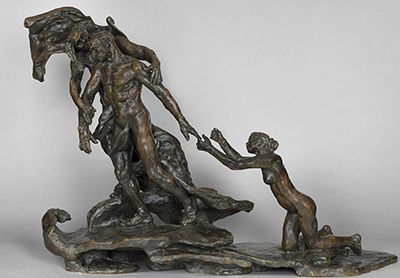
On 12 January 1902, Camille Claudel wrote to Captain Louis Tissier with a price for casting The Mature Age. The bronze founder François Rudier wanted 6,000 francs. On the back of the letter is a note from Rudier himself. A second letter, dated 25 February in the Musée d’Orsay’s archive inventory, concerns handing the plaster over to another founder, Fumière. The plaster already existed. Claudel still had to find someone to cast it, let her client know what the work would cost and arrange for the model to reach the foundry. [1] [2] [3]
In her correspondence, a sculpture changes meaning according to whom she is addressing. A group in a letter to her brother Paul is an idea she is working out. A bust in a letter to Auguste Rodin is an order whose terms need reconsidering. A small figure in a letter to the dealer Eugène Blot is something he might buy and a design she might still change. The letters catch Claudel’s sculptures at stages that a finished bronze or a Salon catalogue can rarely show. [4] [5] [6] [7]
At a Glance
- Correspondents discussedPaul Claudel, Auguste Rodin, Gustave Geffroy, Louis Tissier and Eugène Blot
Contents
- Describing a group before it had a public title
- What ten bronze busts would cost her
- Finding an audience at the Salon
- What Tissier was paying for
- A proposal for Blot and a bronze buyers could order
- Where the letters survive
Describing a group before it had a public title
A letter from Camille to Paul Claudel, assigned to December 1893 and held in the Bibliothèque nationale de France’s Paul Claudel papers, survives under the collection shelfmark NAF 28255. In it she refers to a groupe des trois, a group of three. In its account of The Mature Age, the Musée Rodin uses the letter to place the surviving first plaster version around 1894–95. The description gives Paul the number of figures. The museum’s title gives the viewer a theme. The same museum account notes that Claudel considered adding a leaning tree to give destiny a more visible place in the group. [4] [5]
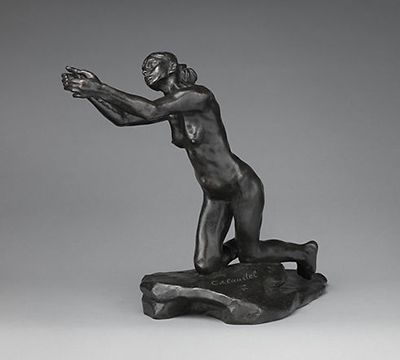
The two sources establish different stages. The letter is evidence that Claudel was thinking about a three-figure composition by the assigned date. The first plaster is the evidence for how she placed the figures in one early arrangement. In the later bronze, the kneeling woman reaches across open space. Claudel dispensed with the tree she had considered. The reach of the woman’s hands and the turn of the man’s body carry the separation. [4] [5]
What ten bronze busts would cost her
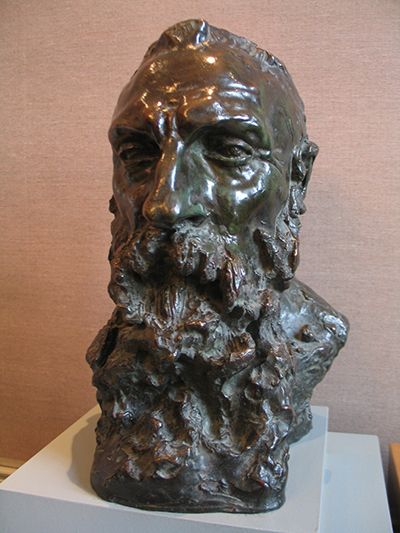
In a letter to Rodin tentatively dated November 1897, Musée Rodin MS.365, Claudel sets out an order brokered by the critic Mathias Morhardt. The Mercure de France wanted ten bronze casts of her Bust of Auguste Rodin and planned to sell them at 300 francs each. Claudel mentions a payment of 280 francs and an obligation to pay the founder. Tears interrupt the paper at the point where she describes those terms. Her account of the work expected of her is clearer. She would have to remove the seams left by casting and engrave a caduceus, the journal’s emblem. Engraving alone would take a day, she reckoned, and cleaning up the seams properly would take five or six. [6]
Both jobs would leave a mark on the bronze. One would erase lines made in production. The other would put a new design on the surface for the journal. The times Claudel gives suggest how much work could be concealed in the sale of a cast from an existing model. The arrangement made the journal responsible for selling the ten busts, while she faced a founder’s bill and the work of finishing the metal. She told Rodin that she could not put up 1,000 francs of her own and asked him to tell Morhardt she could not carry on. The torn passage prevents an exact reconstruction of the deal, and the figures are best read as part of her case for changing it. [6]
The reply of 2 December 1897, preserved as a copy in Rodin’s secretary’s hand under Musée Rodin L.1394, suggests continuing with the busts without the emblem and with the seams left alone. That would change the object the journal received as well as the labour Claudel owed. Taken together, the letters show that the order involved choices about which marks should be visible and who could afford the time to alter them. They give the two sculptors’ positions at that point in the discussion. A Rudier cast at Nogent bears the caduceus beneath her signature. That single bronze establishes that the emblem was used on at least one example and leaves the division of labour and final terms open. [6] [8]
Finding an audience at the Salon
An undated letter to the critic Gustave Geffroy, placed in May–June 1898 by the researcher Marie Gevart-Dekaeke, describes a different obstacle. Claudel congratulates Geffroy on discovering her Hamadryad and her small pensive figure, Deep Thought. In her telling, other visitors had passed by both works because their attention was taken up with Rodin’s Balzac, which was being shown at the same Salon. Gevart-Dekaeke cites and transcribes the passage from the Musée Rodin manuscript Ms 413, also identified as Ma 165. [9]
The Salon had given Claudel a place to exhibit. Her letter asks how much being there counted if visitors walked straight past. It is the report of a participant who wanted her sculpture to be seen, and it addresses someone who had already made the effort to look. Claudel’s thanks also tells us something about a critic’s practical value to a sculptor. A visitor could miss a small work on a first pass through a crowded exhibition. A published description could give another visitor a reason to look for it. Geffroy’s review of the 1898 Salon did discuss Deep Thought, and he would write about Claudel’s work at the 1900 Exposition universelle as well. [9]
Claudel also corresponded with Geffroy in 1905 about a proposed monument to the revolutionary Auguste Blanqui. The Musée Camille Claudel’s 2023–24 correspondence exhibition used letters to follow her hesitation over the commission and eventual decision to withdraw. Geffroy could therefore figure in two very different exchanges. In one, he had seen and written about sculpture she brought to an exhibition. In the other, a public work was still under discussion. The monument was never made. The letters preserve a stage in her dealings with a commission for which there is no finished sculpture to consult. [10] [11]
What Tissier was paying for
The eight pieces of correspondence that came to the Musée d’Orsay through Captain Tissier’s son André document several separate exchanges. One letter assigned to 1899 requests a 150-franc advance on a bronze figure. Another thanks Tissier for 300 francs. One records receipt of 200 francs for a bronze kneeling figure. On 6 August 1899 Claudel told him that the bronze figure was ready. The archive includes letters and envelopes, and its summaries identify which requests concern an advance, which acknowledge money received and which concern the readiness of the work. The difference matters if the figures are to tell us anything about payment. A request and a receipt can be separate records of dealings around the same commission. [1] [12]
The order for a single figure also needs to be kept separate from the later casting of the full group. The kneeling figure could be commissioned on its own, as the archive makes clear. Three years later the proposed price covered casting the entire plaster composition. Rudier’s estimate and the letter concerning Fumière show which founders were involved at two stages of the arrangements. The object record for the surviving bronze, RF 3606, identifies Fumière and Gavignot as the founders. At 163 centimetres wide, the bronze is catalogued as a group in three parts. The dimensions give some sense of the scale of the work being discussed in the two letters. [1] [2] [3] [13]
Tissier’s file also holds a card dated 11 December 1899 in which Claudel invited him to see finished marbles. It is a small counterpart to the longer letters about money and casting. Across the correspondence she could ask for an advance, report a finished bronze figure, arrange a viewing and pass on a founder’s estimate. Her client could encounter the work in person as well as receive word of its progress on paper. In 1982 André Tissier gave the letters when the museum acquired the full bronze. The letters stayed at the Bibliothèque centrale des Musées nationaux until 2016, when they joined the Orsay archive. [1] [14] [13]
A proposal for Blot and a bronze buyers could order
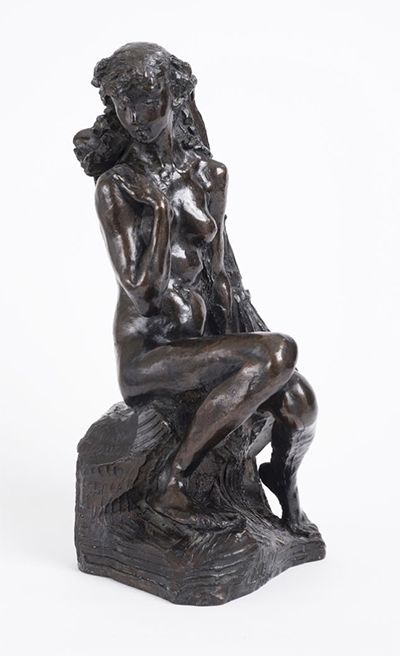
The Musée Camille Claudel quotes two letters to Eugène Blot in its record for The Siren, or The Flute Player. In the first, Claudel offers him a little female faun. In another, she suggests using green onyx for the rock on which the musician sits, to evoke the sea, and bright metal for her flute. The museum records that the mixed-material proposal was never made. In December 1905 Blot’s gallery catalogue listed Sirène as a bronze edition limited to thirty. The museum records six bronzes. Here the dealer’s listing establishes what buyers were offered, while Claudel’s letters show that an offer to sell could open up a discussion about the materials in which a design might be realised. [7] [15]
At Nogent in 2023–24, the correspondence exhibition brought together seventeen letters written between 1895 and 1909, including six newly acquired letters to Blot. The museum placed the letters alongside sculptures they discuss. Some record the steps involved in putting The Flute Player into bronze. Others show Claudel asking Blot for money. A dealer who bought a model and sold casts could also be someone an artist approached for cash when she needed it. The object record gives no dates for the two Siren excerpts. The dated catalogue fixes the moment when the bronze was offered to the gallery’s customers, while the letters disclose the terms on which Claudel was willing to keep discussing the design. [10] [15]
Where the letters survive
The documents reached public collections by different routes. The Musée Rodin’s historical correspondence holdings grew out of Rodin’s donations to the French state in 1916 and consist chiefly of material sent to him. That history helps explain why an inquiry about busts addressed to Rodin belongs there, while the sequence addressed to Tissier follows the bronze into the Musée d’Orsay’s collections. Paul’s papers at the Bibliothèque nationale de France preserve a different stage of Claudel’s work, and the Blot acquisition at Nogent brought another set of papers into a museum that holds the sculptures they discuss. [16] [1] [4] [10]
Anne Rivière and Bruno Gaudichon’s Correspondance, issued in a revised and expanded third edition in 2014, brings letters together in print. The edition is a way to follow Claudel across recipients. To track a particular exchange, the archive can tell the reader which letter retains its envelope, which one carries a note on its reverse and which survives in a secretary’s copy. These distinctions are part of the evidence. The Orsay credits Fumière and Gavignot with executing the bronze. The letter with Rudier’s price records an option Claudel had to weigh while the work was still a plaster. [17] [1] [6] [13]
Other exchanges survive in the recipient’s papers. The Bibliothèque Marguerite Durand holds a signed letter dated 21 October 1906 and catalogued as addressed to Mary Léopold Lacour. The same library holds Lacour’s draft article about Claudel. The letter and the draft have separate catalogue records. Read together, they give the correspondence a setting beyond the studio and the foundry, in the preparations of someone writing about Claudel’s work. [18]
Artworks directory
| Name | Date | Medium |
|---|---|---|
| The Mature Age | 1894–99 | Sculpture |
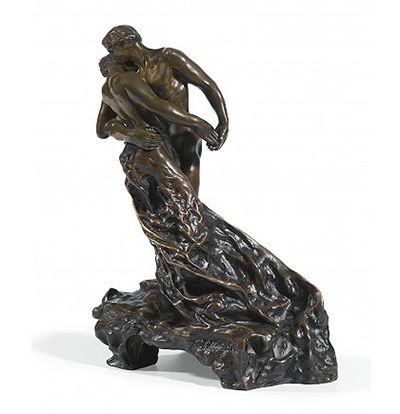
| The Waltz | c. 1889–93 | Sculpture |
| Sakuntala | 1886–88 | Sculpture |
| The Little Châtelaine | 1892–93 | Sculpture |
| The Gossips | c. 1893 | Sculpture |
| The Wave | 1897–1903 | Sculpture |
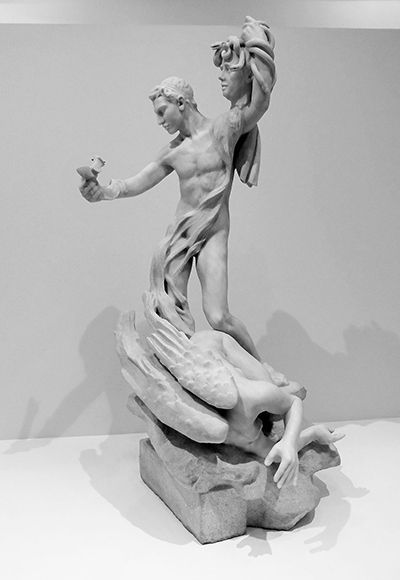
| Perseus and the Gorgon | c. 1897–1902 | Sculpture |
| The Implorer | c. 1894–99 | Sculpture |
| Clotho | 1893 | Sculpture |
| Bust of Auguste Rodin | c. 1886–89 | Sculpture |
| Paul Claudel at Sixteen Years Old | c. 1882–87 | Sculpture |
| Young Girl with a Sheaf | c. 1886–87 | Sculpture |
| Giganti | c. 1885 | Sculpture |
| Crouching Woman | c. 1884–85 | Sculpture |
| The Hungry Dog | c. 1893 | Sculpture |
| Old Hélène | c. 1881–82 | Sculpture |
| Fortune | c. 1902–05 | Sculpture |
| The Wounded Niobid | 1906 | Sculpture |
| The Siren, or The Flute Player | c. 1904–05 | Sculpture |
| Deep Thought | c. 1898 | Sculpture |
| Dream by the Fireside | c. 1899 | Sculpture |
| Paul Claudel at Thirty-Seven | 1905 | Sculpture |
| Portrait de Madame Claudel | c. 1883 | Sculpture Musée Camille Claudel. |
| Jeune Femme aux yeux clos | c. 1885 | Sculpture Musée Camille Claudel. |
| Ferdinande de Massary | 1888 | Sculpture Musée Camille Claudel. |
| Léon Lhermitte | 1889 | Sculpture Musée Camille Claudel. |
| Étude de main gauche | c. 1889 | Sculpture Musée Camille Claudel. |
| Vieil aveugle chantant | c. 1894 | Sculpture Musée Camille Claudel. |
| Tête de vieillard | c. 1890 | Sculpture Musée Camille Claudel. |
| Étude pour la tête d’Hamadryade | c. 1895 | Sculpture Musée Camille Claudel. |
| Aurore | c. 1900 | Sculpture Musée Camille Claudel. |
Discussion
Look again at the images and ideas explored in Camille Claudel’s Letters. These editorial prompts invite your observations.
Reader Insights
Which workshop decisions become easier to follow through a letter?
How does the intended recipient affect what a letter can tell us?
Join the Conversation
Share a detail, comparison or question about Camille Claudel’s Letters below.
References
- Musée d’Orsay, Fonds Camille Claudel, archive inventory, Ms 360,. View source.
- Musée d’Orsay, letter to Captain Tissier reporting F. Rudier’s casting price, Ms 360 8, 9 and 8bis,. View source.
- Musée d’Orsay, letter to Captain Tissier about making the plaster available to Fumière, Ms 360 10, 11 and 10bis,. View source.
- Musée Camille Claudel, Camille Claudel et Paul Claudel. Le rêve et la vie, exhibition dossier, entry 49, Bibliothèque nationale de France, NAF 28255,. View source.
- Musée Rodin, L’Âge mûr, versions and early reference in the letter to Paul Claudel,. View source.
- Château de l’Islette, French transcriptions of manuscripts held at the Musée Rodin, including Claudel to Rodin, MS.365, and Rodin to Claudel, secretary’s copy L.1394,. View source.
- Musée Camille Claudel, La Sirène ou La Joueuse de flûte, object record 2010.1.22 and excerpts of letters to Eugène Blot,. View source.
- Musée Camille Claudel, Auguste Rodin, Rudier cast and caduceus under Claudel’s signature,. View source.
- Marie Gevart-Dekaeke, doctoral dissertation, Université Paris Nanterre, p. 275 and n. 191, transcription and date attribution for Musée Rodin Ms 413 (Ma 165), and references to Geffroy’s Salon criticism,. View source.
- Musée Camille Claudel, De la plume au ciseau. La correspondance de Camille Claudel, 2023–24 exhibition press release,. View source.
- Société Paul Claudel, Bulletin no. 172, discussion of the 1905 letters to Geffroy about the Blanqui monument,. View source.
- Musée d’Orsay, letter to Captain Tissier reporting that the bronze figure was ready, Ms 360 4 and 4bis,. View source.
- Musée d’Orsay, L’Âge mûr, Tissier bronze RF 3606,. View source.
- Musée d’Orsay, card inviting Captain Tissier to see finished marbles, Ms 360 7 and 7bis,. View source.
- Galerie Eugène Blot, Exposition d’œuvres de Camille Claudel et de Bernard Hoetger, December 1905 catalogue, entry 8, facsimile at the Musée Camille Claudel,. View source.
- Musée Rodin, Correspondants de Rodin, historical correspondence holdings,. View source.
- Camille Claudel, Correspondance, edited by Anne Rivière and Bruno Gaudichon, 3rd revised and expanded edition, Gallimard, 2014, Library catalogue. View source.
- Bibliothèque Marguerite Durand, Letter dated 21 October 1906, MS. 091 CLA 131, and Mary Léopold Lacour’s draft article, Ms 70. View source 1. View source 2.