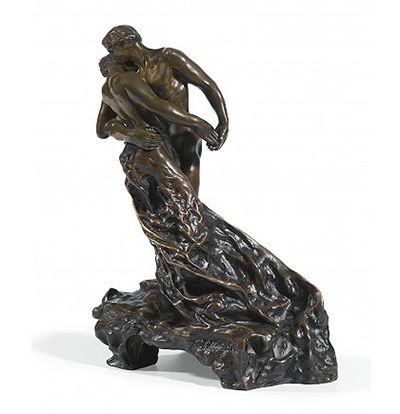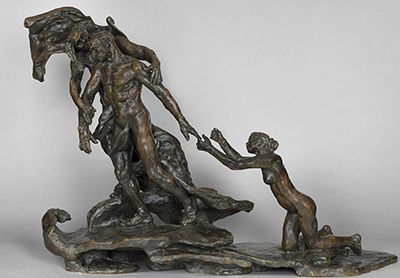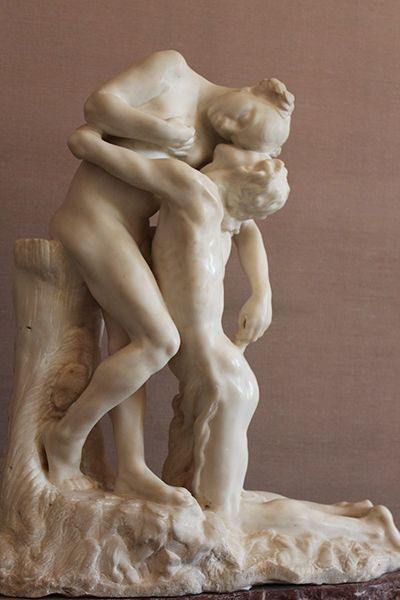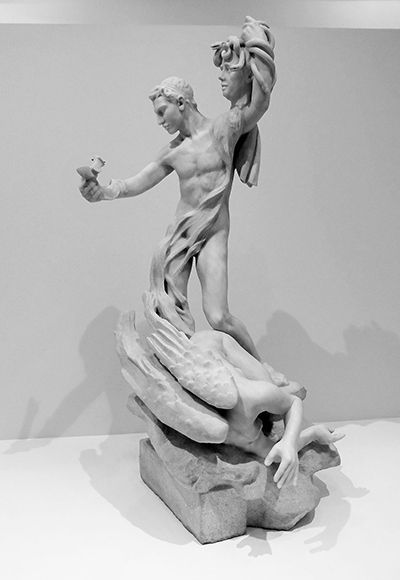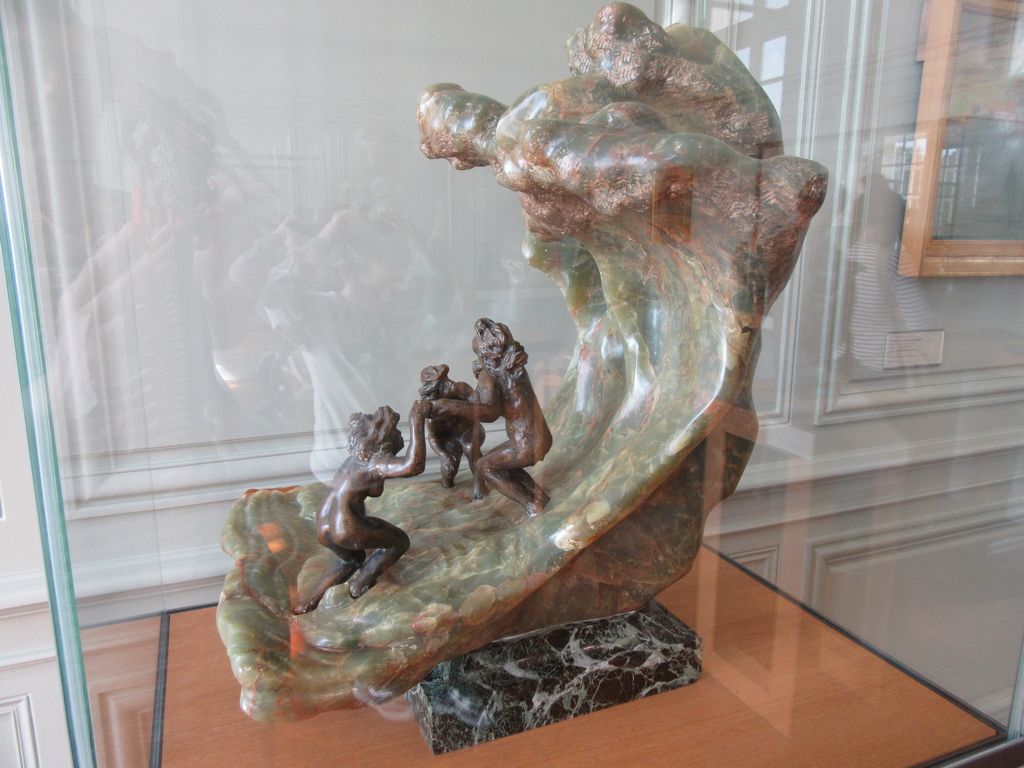
Onyx and bronze figures of The Wave at the Musée Rodin. Photograph by Draganapopovic. Image source. Public domain. Resized from the original photograph.
 by Tom Gurney
Tom Gurney BSc (Hons) is an art history expert with over 20 years experience
Email: tomgurney1@gmail.com / Phone: +44 7429 011000
The Wave: Introduction
Look just below the crest of Camille Claudel’s The Wave (La Vague, also called Les Baigneuses or The Bathers). One woman reaches across to another, and their joined hands make a little arch beneath the much larger one in stone. The woman nearest the eye has her back turned. Beyond her, a face and chest catch the light. Farther to the right, a third body bends so low that its head comes close to the level of those raised hands. What first looks like three different reactions to a wave is, according to the Musée Rodin, one figure repeated three times. [1]
Claudel exhibited a plaster at the Salon in 1897. In the mixed-material sculpture now in Paris, the wave and the shallow sweep beneath the bathers are onyx, the figures are bronze and the group rests on a marble base. The stone rises directly from the surface the women stand on. There is no strip of beach to put them outside the path of the water. Its crest folds over the group and stops in the air, leaving just enough room to see what the bathers are doing. [1] [2] [3]
At a Glance
- French titlesLa Vague and Les Baigneuses
- Musée Rodin objectOnyx marble and bronze, S.06659
Camille Claudel in context
Old Hélène
c. 1881–82Sakuntala
Plaster shown in 1888The Waltz
Developed c. 1889–93The Little Châtelaine
First model c. 1892–93The Gossips
Described in 1893, shown in 1895The Mature Age
First and second versions, c. 1894–99The Wave
Plaster shown in 1897, mixed-material object dated 1897–1903 (?)Perseus and the Gorgon
Nogent design and marble, c. 1897–1902The Wounded Niobid
Modelled in 1906Contents
- Walking around the bathers
- How the stone becomes water
- Colour as part of the construction
- A plaster at the Salon and an onyx wave in the studio
- Claudel and Hokusai
- The bronze reproduction in Shizuoka
Walking around the bathers
In the Musée Rodin’s broad view, the wave rises on the left and the ground curls up at the right. Between those two heights, the stone hollows into a trough. The three bathers occupy its lower part and leave a broad opening between their heads and the crest. From a lower position, the uneven lip of the wave looks thicker and the rise at the right comes up in front of the legs. What appeared to be a reasonably open place to stand becomes a pocket in the stone. The bathers have the same footing in both views, yet their exposure to the wave feels different. [1] [2]
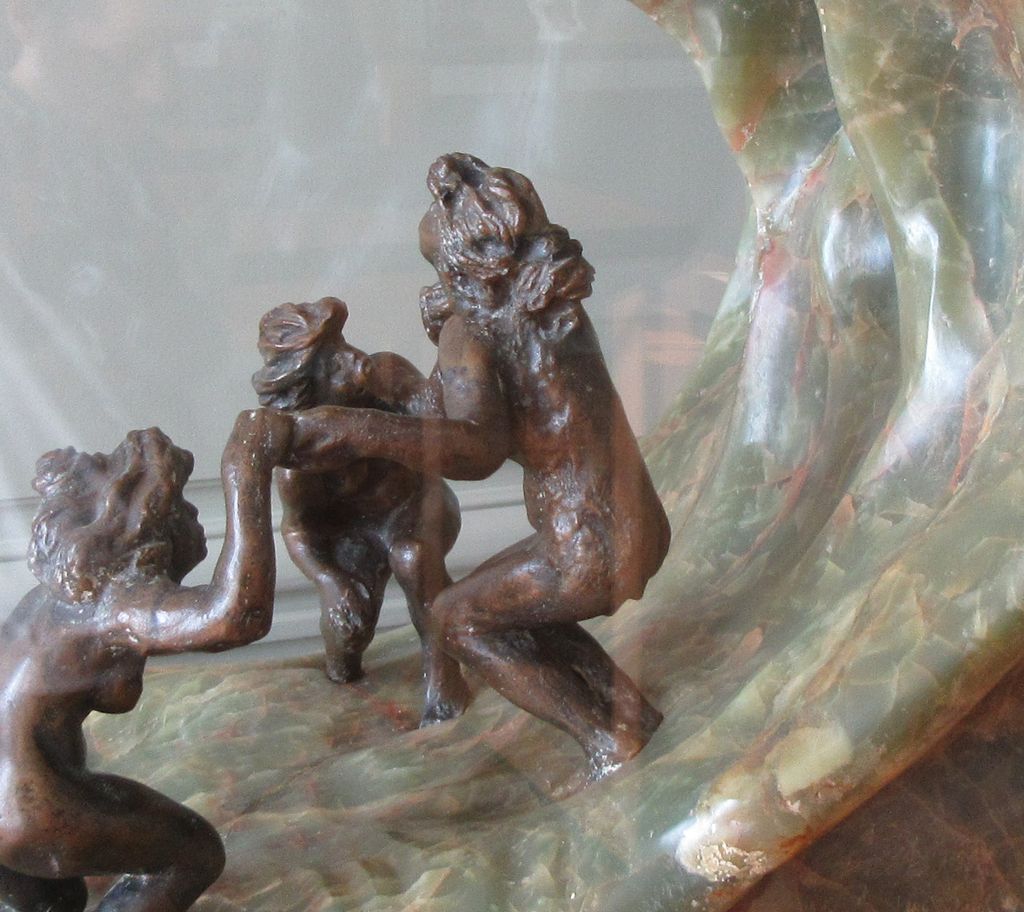
The repetition is easiest to see in the bent knees, the turn of the waist and the gathered hair. Around the circle those features appear in different combinations. The near figure’s back makes the twist easy to see, the farther woman’s lifted chest opens the gesture towards us and the one on the right is more legible in profile. Where two hands meet, their contact gives the eye a way to pass from one body to the next. The figures seem to be taking their cues from each other. A device that gives the group its unity also creates the impression of three people doing something together. [1] [2]
The Musée Rodin suggests that the looming wave can be read as an image of destiny. The critic Gustave Geffroy found a lighter mood in the Salon plaster. In a passage reproduced by the art historian Marie Gevart-Dekaeke, he imagined the women dancing at the shore and anticipating the water with delight. Their bent knees can register as a brace against impact or as the spring in a dance. If they are playing, the wave is still enormous. If they are afraid, the clasp between them still looks deft and poised. Claudel stops the movement at a point where the same gesture can carry either feeling. [1] [3]
Repetition was also a way of building groups for Auguste Rodin. In his Three Shades, conceived before 1886 for The Gates of Hell, three versions of one figure bend their heads and extend their arms towards a common point. Claudel’s bathers have a different relation to the space at their centre. Their movement goes from one person to the next, while the wave comes towards all three from outside the circle. The comparison shows how the placement of a repeated body can determine what an entire group appears to be doing. [1] [4]
The scale makes the episode unusually concentrated. In The Gossips, a stone screen draws the eye inward to a conversation. Here the stone encloses a piece of open air. It even helps define the interval in which the next movement might occur. The wave has curled far enough for us to imagine where it will fall, and the women’s legs are bent far enough for us to imagine them springing up again. The whole event is held between those two possibilities. [1] [5]
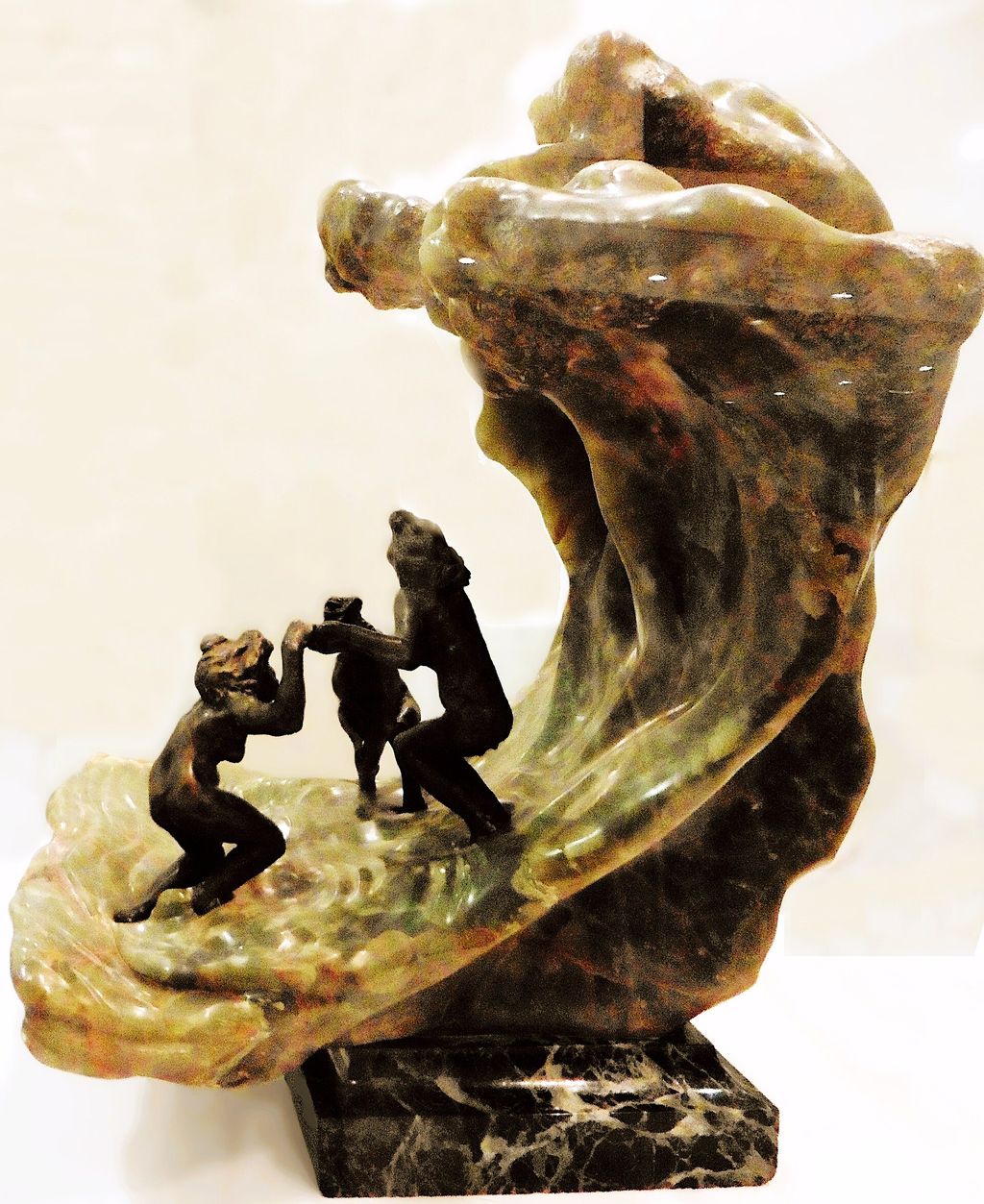
The Wave seen from the side at La Piscine, Roubaix. The crest projects over the line of bathers. Photograph by Pierre André Leclercq. Image source. CC BY-SA 4.0. Resized photograph, shared under CC BY-SA 4.0.
How the stone becomes water
At the foot of the wave, light green swirls are interrupted by reddish lines. Follow them to the upturned edge in front of the bathers, where patches of orange and brown come into view. Higher up, the shaded hollow gives way to the smooth, rounded forms of the crest. Each of those forms catches light on its own surface. The colours belong to the stone, while the direction of the light and the position of the viewer determine which parts of the carving stand out. Claudel gives a material with a recognisable grain the appearance of water turning over itself. [1] [2]
At the junction of stone and metal, the dark bronze feet make precise points of contact with the mottled surface. Some highlights on the figures are as warm as the colour at the rim of the stone, while the shadow under the overhang can be as dark as the metal. The two materials keep their own textures and share a range of light and dark. There is also a reversal in what they represent. The carved stone is the part of the scene we expect to move most quickly. The metal is where Claudel places the bodies that are momentarily holding their positions. [1] [2]
The Musée Rodin places this use of colour alongside that of Charles Cordier, who had combined coloured stone and metal in the preceding generation. In his Woman from the French Colonies of 1861, now at the Metropolitan Museum of Art, the dark bronze head and shoulders meet striated Algerian onyx-marble that suggests fabric. Claudel assigns the materials different roles. Bronze carries the bathers’ weight and gesture, and the patterns of the stone carry the eye around the curve of their surroundings. That distribution of colour and texture helps explain why this particular material combination matters to the scene. [1] [6]
The Musée Rodin connects this experiment with Claudel’s later fireplace groups. In the example of Fireside Dream exhibited by the Getty, a bronze figure sits against an alabaster fireplace. The stone sets the limits of an interior there, just as the curve of the onyx sets the limits of the bathers’ space. One woman rests beside a hearth while three bend before a wave. Claudel could use the same principle of contrasting materials to make the space around a small figure feel still or about to move. [1] [7]
Colour as part of the construction
The Musée Rodin’s comparison with Charles Cordier points to a tradition in which colour could come from the materials themselves. The Musée d’Orsay’s 2018 exhibition on French polychrome sculpture placed Cordier among sculptors who worked with naturally coloured stone and patinated metal. A related example to the Met bust is the Orsay’s own Femme des colonies, RF 2996, acquired at the 1861 Salon. Its sculptural colour combines the metal of the figure with the mineral pattern of the stone and the colour of the stand. The work is an individual bust with a documented nineteenth-century Salon history. It offers a comparison in materials without requiring a claim that Claudel used it as a model. [8] [9]
The comparison also shows why the word onyx needs a little care. The Orsay’s general catalogue describes the material in its Cordier bust as onyx. Its specialist register calls the stone alabaster and gives more precise descriptions of the metal’s treated surfaces. Those catalogues describe one object with different levels of technical specificity. Claudel’s group should be described in the terms used for its own accession. For S.06659, the Musée Rodin distinguishes onyx and bronze from the marble base. The useful point of comparison is visible without choosing one name for all the stones. Cordier gives coloured stone and metal different parts of a bust to play. Claudel gives the dark figures and the varied water very different surfaces and lets the light on the join bring them together. [2] [8] [10]
The photograph taken from the end at the Roubaix exhibition gives a different view of that division. In the broad view the figures are readily read as a row beneath the crest. In the view from the end, the overlap shortens the row and the onyx takes up more of the picture. The light catches at the lip above them, then leaves the inner face of the curl comparatively dark. It is still possible to follow the women by their heads and knees. What disappears at this angle is much of the open interval that makes the three poses easy to count in the frontal view. Both effects belong to the same object and can be understood without treating any one photograph as its definitive view. [1] [11]
A plaster at the Salon and an onyx wave in the studio
Gevart-Dekaeke identifies the plaster as number 24 at the 1897 Salon of the Société Nationale des Beaux-Arts at the Champ-de-Mars. The catalogue describes it as a croquis d’après nature, a sketch from life. That phrase also applies to other small groups in which Claudel brought close observation to familiar activities. She could make the lean of a listening figure or the way a person waited by a fire the central action of a sculpture. Geffroy’s response shows how much life the arrangement already conveyed in plaster. The present whereabouts of the Salon work are unknown, according to the Shizuoka Prefectural Museum of Art. [1] [3] [7] [12]
The collector Maurice Fenaille began to finance The Wave in 1898. A study of Claudel’s correspondence records a further payment of 1,000 francs in 1900. The Musée Rodin’s catalogue names François Pompon as the praticien, a specialist who helped execute the work. Gevart-Dekaeke, citing Anne Rivière’s catalogue research, dates Pompon’s completion of the stone to March 1902 and notes that the finished group is documented at Eugène Blot’s gallery in 1905. In his review of the exhibition with Bernhard Hoetger that December, Charles Morice discussed the Bathers alongside the Gossips, drawing attention to how much expression Claudel found in such small figures. [2] [3] [13] [14]
The Musée Rodin gives 1897 as the date of the design in its collections portal and 1898–1903 as the range for the bronze casting. Its public overview gives the broader date of conception as 1897–1903, with a question mark. The Paris museum purchased the onyx-and-bronze sculpture in January 1995 and records it as S.06659. It stands 62 centimetres high. The year of the plaster’s Salon showing, the work on the stone and the museum’s purchase each describe a different moment in the work’s history. [1] [2]
Claudel and Hokusai
The Musée Rodin relates The Wave to Japonisme, the enthusiasm for Japanese art in late nineteenth-century France, and singles out Katsushika Hokusai’s Under the Wave off Kanagawa, also called The Great Wave. Gevart-Dekaeke identifies the Japanese section of the 1889 Paris Universal Exposition as a possible occasion for Claudel to have seen the design and cites Mathias Morhardt’s account of her studying at the Musée Guimet. The comparison can be made directly with the Metropolitan Museum of Art’s impression JP1847, a colour woodblock print dated about 1830–32 from the series Thirty-six Views of Mount Fuji. [1] [3] [15]
In Hokusai’s print, the largest wave rises at the left, curves over the boats and breaks into narrow white fingers at the crest. It surrounds a hollow in which Mount Fuji appears tiny. The long boats and the men pressed low inside them give the rise of water its scale. Claudel’s broad view also lets the eye travel from a sweeping flank into the opening under the crest and down to people whose size makes the wave look huge. Hokusai sends smaller splashes out into the sky. Claudel keeps the lip in a succession of rounded projections, with the weight of the overhang apparent from below. Her crest has a shadow deep enough to be part of the space the figures inhabit. [1] [2] [15]
Hokusai’s blue contours, white foam and distant mountain hold those near and far elements in one view. Claudel’s greens and browns move in and out of sight as the onyx turns away from the light. The distant mountain in the print also gives the eye somewhere to rest beyond the immediate peril. In the sculpture, the closest thing to that point of rest is the bathers’ clasp. Move around them and the hands overlap, separate into distinct silhouettes or disappear behind a shoulder. The resemblance between the two works is strongest in the relation of the curl to what lies underneath. The sculpture changes that relation each time the viewer moves. [1] [2] [15]
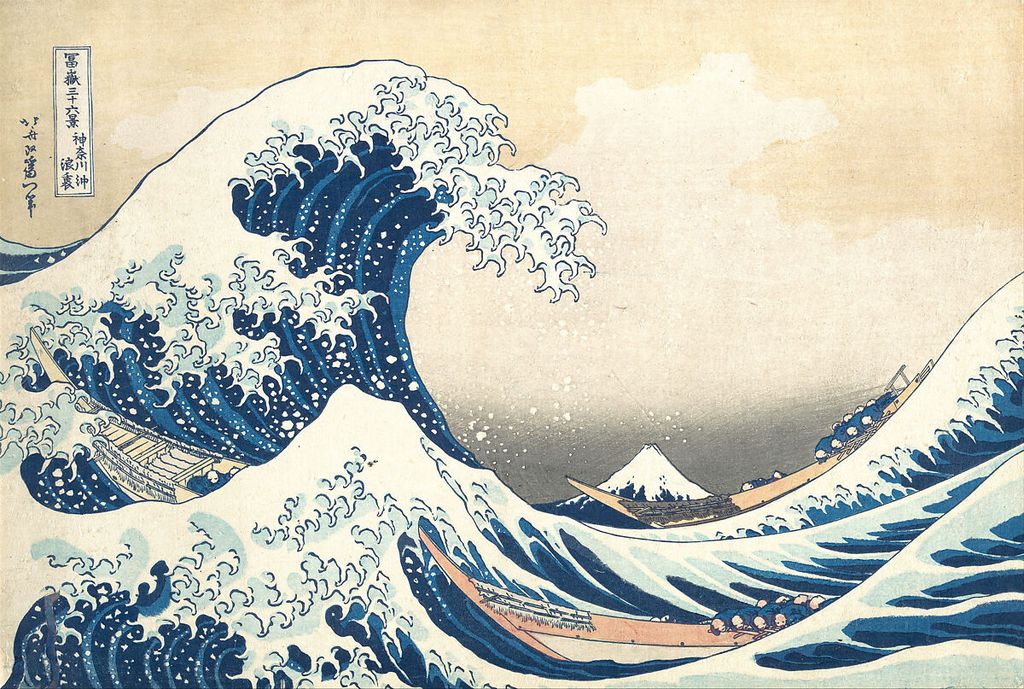
Katsushika Hokusai, Under the Wave off Kanagawa, about 1830–32. Metropolitan Museum of Art, JP1847. The Metropolitan Museum of Art, Open Access. Image source. CC0 / Public domain. Resized from the museum image.
The bronze reproduction in Shizuoka
The Shizuoka Prefectural Museum of Art bought its Wave in 1992. The museum identifies it as an all-bronze reproduction made after Claudel’s death from a mould taken from the finished sculpture now at the Musée Rodin. The Shizuoka example is accession 978, classified S-054 and marked 1/8. Its catalogue keeps the date of the composition, 1897–1903, alongside the separate history of the object it acquired. [12]
The Shizuoka museum also sees a resemblance to the Three Graces in the bathers’ linked hands. That reading draws attention to a form that survives the change of material. A group of three women can close into a ring without facing a viewer in unison. Claudel places that familiar arrangement on sloping ground and gives the ring an edge exposed to the water. [1] [12]
The difference became particularly important after litigation in France over another all-bronze example, marked 3/8. In 2016 the Cour de cassation upheld the distinction between the authorised manufacture and sale of those reproductions and their presentation as originals. Shizuoka cites that decision in explaining its own catalogue label. The museum has used the reproduction to show visitors how Claudel’s work relates to Rodin and to younger sculptors in his orbit. The repeated bodies, their clasp and the sweep above them are all part of what a bronze reproduction can convey. To follow a coloured band in the stone from the feet of the bathers up into the turn of the wave, the object to look for is the one in Paris. [2] [12] [16]
A closer look at The Wave
Annotated Details from The Wave
The Musée Rodin’s onyx-and-bronze sculpture, photographed through its display case. Photograph by Draganapopovic. Image source. Public domain. Numbers added to the overview and details cropped from the photograph.
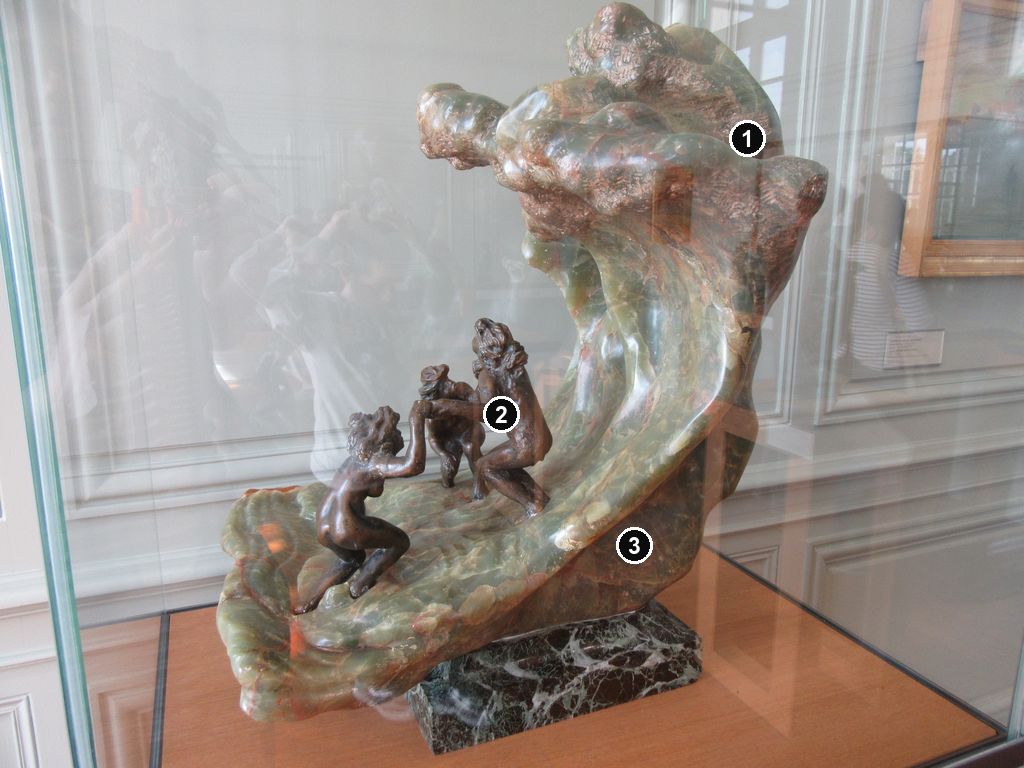
Details from THE WAVE
Compare the repeated bodies with the curving surfaces above and below them.
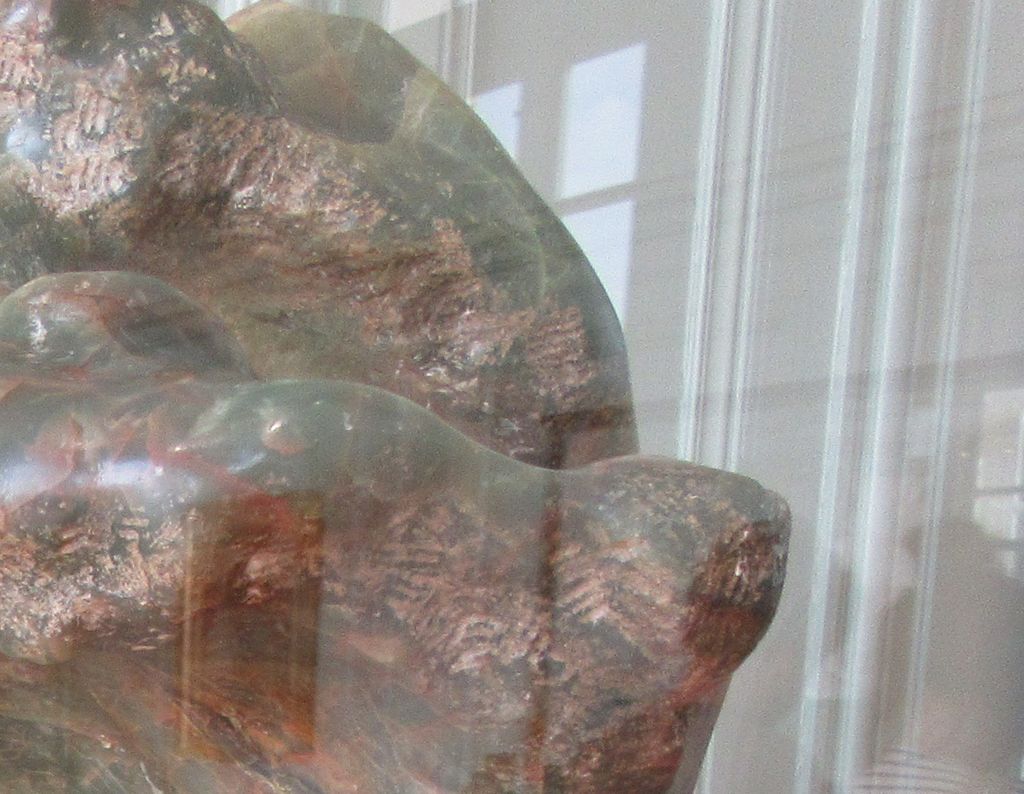
The projecting crest
The crest projects over the small figures. Patches of pale and reddish stone help its outline stand away from the background.
The repeated bathers
The staggered positions make the repeated pose look like a succession of reactions. Compare how much of each figure can be seen from this angle.
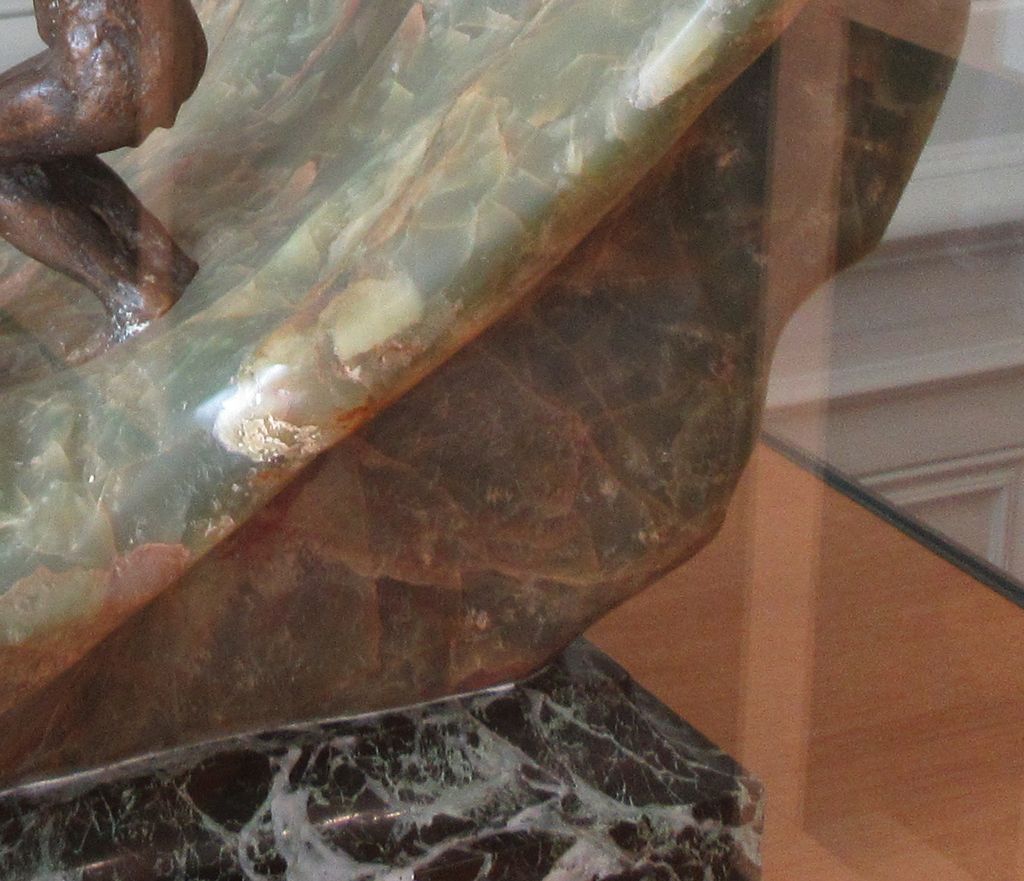
The curl beneath the figures
The stone curves up from under the bathers to the right, linking the footing beneath them to the overhanging wave.
Artworks directory
| Name | Date | Medium |
|---|---|---|
| The Mature Age | 1894–99 | Sculpture |
| The Waltz | c. 1889–93 | Sculpture |
| Sakuntala | 1886–88 | Sculpture |
| The Little Châtelaine | 1892–93 | Sculpture |
| The Gossips | c. 1893 | Sculpture |
| The Wave | 1897–1903 | Sculpture |
| Perseus and the Gorgon | c. 1897–1902 | Sculpture |
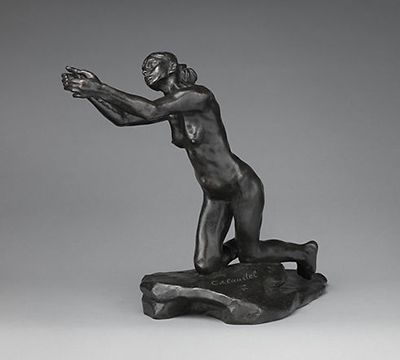
| The Implorer | c. 1894–99 | Sculpture |
| Clotho | 1893 | Sculpture |
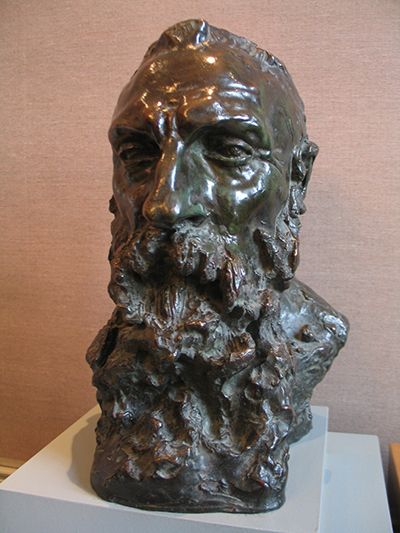
| Bust of Auguste Rodin | c. 1886–89 | Sculpture |
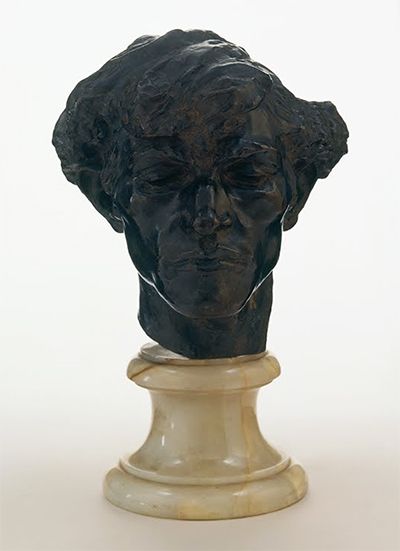
| Paul Claudel at Sixteen Years Old | c. 1882–87 | Sculpture |
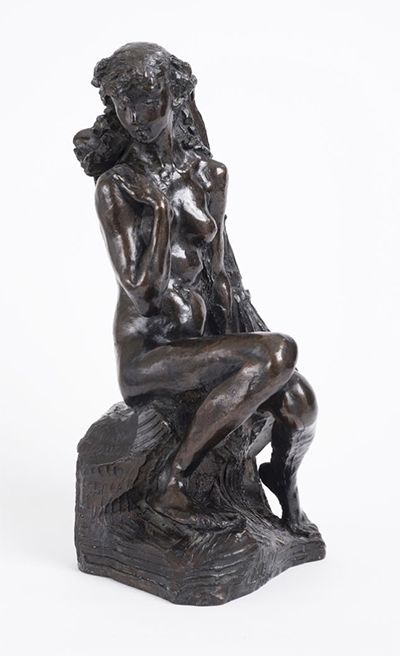
| Young Girl with a Sheaf | c. 1886–87 | Sculpture |
| Giganti | c. 1885 | Sculpture |
| Crouching Woman | c. 1884–85 | Sculpture |
| The Hungry Dog | c. 1893 | Sculpture |
| Old Hélène | c. 1881–82 | Sculpture |
| Fortune | c. 1902–05 | Sculpture |
| The Wounded Niobid | 1906 | Sculpture |
| The Siren, or The Flute Player | c. 1904–05 | Sculpture |
| Deep Thought | c. 1898 | Sculpture |
| Dream by the Fireside | c. 1899 | Sculpture |
| Paul Claudel at Thirty-Seven | 1905 | Sculpture |
| Portrait de Madame Claudel | c. 1883 | Sculpture Musée Camille Claudel. |
| Jeune Femme aux yeux clos | c. 1885 | Sculpture Musée Camille Claudel. |
| Ferdinande de Massary | 1888 | Sculpture Musée Camille Claudel. |
| Léon Lhermitte | 1889 | Sculpture Musée Camille Claudel. |
| Étude de main gauche | c. 1889 | Sculpture Musée Camille Claudel. |
| Vieil aveugle chantant | c. 1894 | Sculpture Musée Camille Claudel. |
| Tête de vieillard | c. 1890 | Sculpture Musée Camille Claudel. |
| Étude pour la tête d’Hamadryade | c. 1895 | Sculpture Musée Camille Claudel. |
| Aurore | c. 1900 | Sculpture Musée Camille Claudel. |
Discussion
Look again at the images and ideas explored in The Wave. These editorial prompts invite your observations.
Reader Insights
How do the repeated figures change as you move round the onyx?
What differs between the curve in Claudel’s sculpture and Hokusai’s print?
Join the Conversation
Share a detail, comparison or question about The Wave below.
References
- Musée Rodin, The Wave or The Bathers, collection overview and photographs of S.06659,. View source.
- Musée Rodin, La Vague, full collections portal record for S.06659,. View source.
- Marie Gevart-Dekaeke, La sculpture et l’intime en France (1865–1909), doctoral dissertation, Université Paris Nanterre and École du Louvre, 2018, pp. 273–275,. View source.
- Musée Rodin, Auguste Rodin, The Three Shades, bronze S.01191 and conception history,. View source.
- Musée Rodin, The Gossips or The Women Chatting,. View source.
- Metropolitan Museum of Art, Charles Cordier, Woman from the French Colonies, 1861,. View source.
- J. Paul Getty Museum, Camille Claudel, exhibition guide, “Sketches from Life”,. View source.
- Musée d’Orsay, In Colour: Polychrome Sculpture in France 1850–1910, exhibition account of Cordier,. View source.
- Musée d’Orsay, Charles Cordier, Femme des colonies, RF 2996, Salon and acquisition records,. View source.
- Musée d’Orsay, Polychrome Sculpture Register, Femme des colonies, RF 2996, materials,. View source.
- Pierre André Leclercq, side photograph of La Vague at La Piscine, Roubaix,. View source.
- Shizuoka Prefectural Museum of Art, Wave (reproduction) / La Vague (reproduction), accession 978,. View source.
- Société Paul Claudel, Bulletin no. 172, discussion of the correspondence and Fenaille’s payments,. View source.
- Musée Camille Claudel, 1905 : l’exposition Claudel & Hoetger, exhibition history and catalogue facsimiles,. View source.
- Metropolitan Museum of Art, Katsushika Hokusai, Under the Wave off Kanagawa, impression JP1847,. View source.
- Cour de cassation, First Civil Chamber, 25 February 2016, nos. 14-18.639 and 14-29.142,. View source.