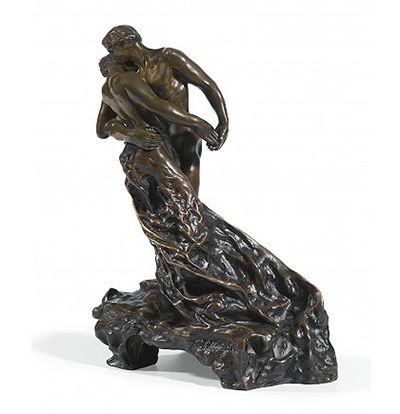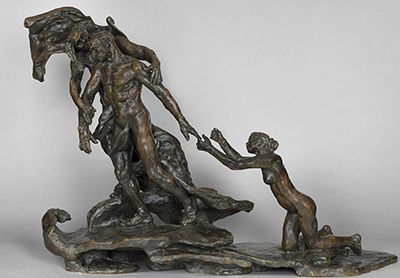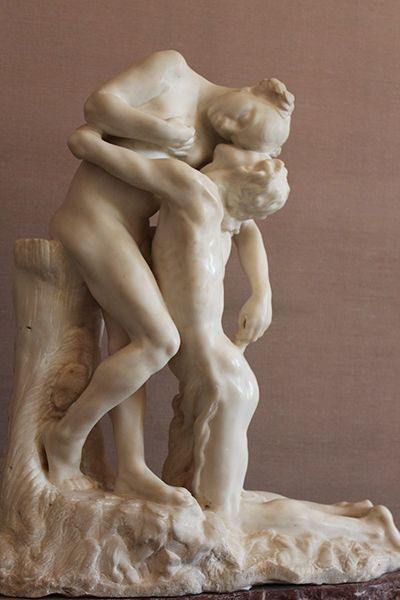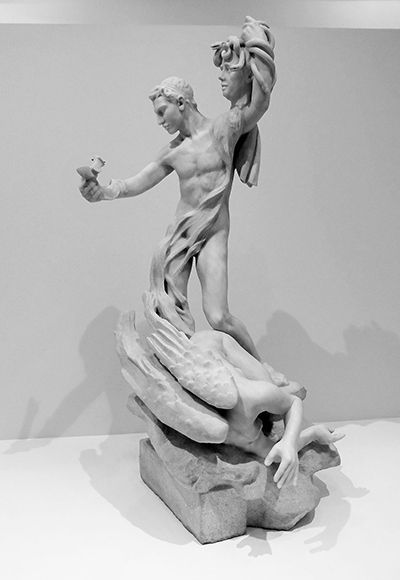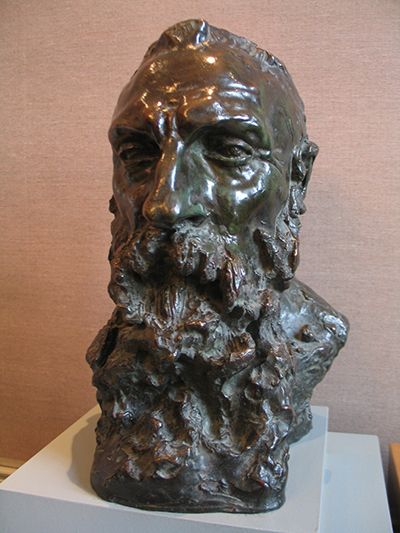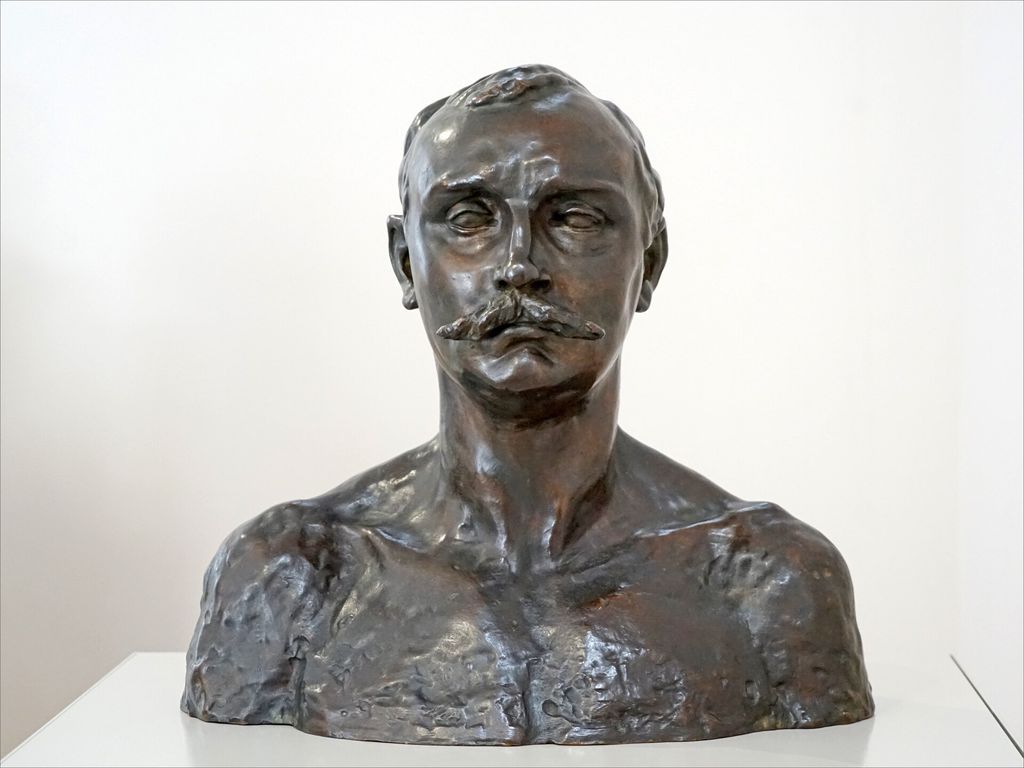
The Converset bronze that belonged to Paul Claudel, now in the Musée Camille Claudel, Nogent-sur-Seine. Photograph by Jean-Pierre Dalbéra. Image source. CC BY 2.0. Resized from the original photograph.
 by Tom Gurney
Tom Gurney BSc (Hons) is an art history expert with over 20 years experience
Email: tomgurney1@gmail.com / Phone: +44 7429 011000
Paul Claudel at Thirty-Seven: Introduction
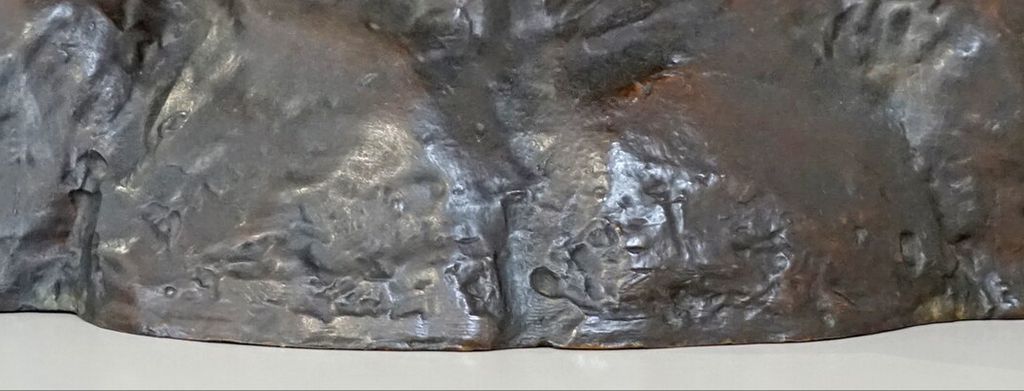
Camille Claudel began this bust of her brother in 1905. His head rises from bare shoulders, the eyes beneath a heavy brow and a thick moustache spreading across the upper lip. The bronze in the Musée Camille Claudel at Nogent-sur-Seine was cast by P. Converset in 1912–13. In the museum’s frontal photograph, the forehead and cheeks catch the light in broad patches, while the surface breaks into ridges and hollows toward the lower edge. The head has the poise of a formal portrait, but much of the work of holding it upright happens in the long neck and the wide sweep of the chest. [1]
At a Glance
- SitterPaul Claudel
Camille Claudel in context
Old Hélène
c. 1881–82Sakuntala
Plaster shown in 1888The Waltz
Developed c. 1889–93The Little Châtelaine
First model c. 1892–93The Gossips
Described in 1893, shown in 1895The Mature Age
First and second versions, c. 1894–99The Wave
Plaster shown in 1897, mixed-material object dated 1897–1903 (?)Perseus and the Gorgon
Nogent design and marble, c. 1897–1902The Wounded Niobid
Modelled in 1906Contents
- Looking at the Nogent bronze
- A study begun in the Pyrenees
- From plaster study to bronze
- The bronzes at Nogent and Paris
- The same sitter at two ages
Looking at the Nogent bronze
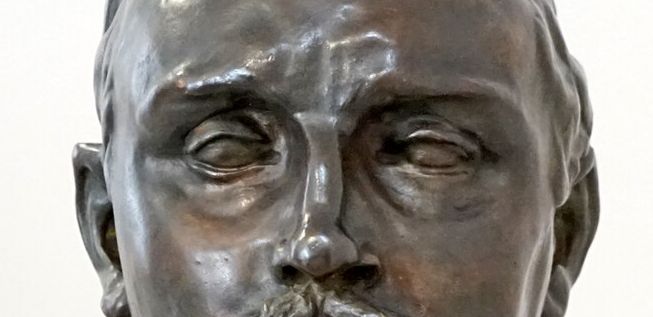
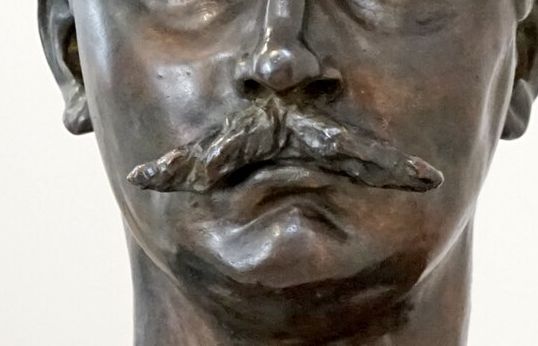
Start with the eyes. Claudel gives the lids enough definition to cast narrow shadows across their rounded surfaces. The smooth bronze within those outlines leaves the direction of the gaze open. The nose projects between the eyes, and the moustache spreads out below it in two uneven wings. Follow its lower edge and a thin, closed line emerges where the lips meet. The chin catches the light again beneath it. A few closely spaced changes in depth give the lower part of the face much of its character. [1]
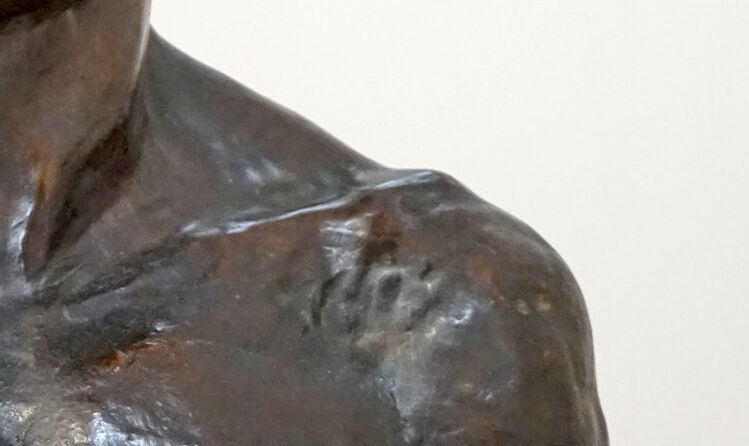
The neck looks nearly columnar in the frontal view. At its foot, the collarbones spread outward from a shallow hollow and meet the rounded shoulders. The light picks up one shoulder differently from the other, and the ripples across the chest break up the broad silhouette. The bottom edge is shallowly curved. It cuts across the torso close to where the modelling grows roughest, so that the relatively clear outline of the bust and the uneven surface inside it register at the same time. The cut lets the shoulders serve as the support for the likeness. [1]
A study begun in the Pyrenees
Paul had returned from China in 1905 after serving as vice-consul in Fou-Tchéou, now Fuzhou. In August the siblings spent several weeks together in the Pyrenees, where, according to the Musée Camille Claudel, Camille began a study of his head. The work appears to have continued beyond the summer. In a letter to Gabriel Frizeau on 23 October, Paul wrote that his sister was working on his bust and that he expected it to be superb. The letter catches the sculpture in progress, well before the foundry produced the bronze now at Nogent. [2] [3]
Paul also wrote about his sister’s work that year. “Camille Claudel, statuaire” appeared under the initials P. C. in the August 1905 issue of L’Occident. In a passage preserved in a later collected edition, he asks readers to consider what happens to daylight in an inhabited room. Furniture and mirrors interrupt and reflect it, changing the appearance of an interior as the day passes. He uses this setting to explain what he calls Camille’s sculpture intérieure. The adult bust and the essay give two views of their work in 1905. One places the sculptor in a history of her art, while the other studies the face and bearing of the person making that argument. The essay appeared again in an illustrated issue of L’Art décoratif in July 1913. [4] [5] [6]
From plaster study to bronze
The Musée Sainte-Croix in Poitiers acquired the 1905 plaster study in 2017. In the photograph published for Nogent’s 2018 exhibition Le rêve et la vie, the forehead, eyes and moustache already stand out above a rough mass that barely suggests a chest. In the completed bust, the neck has a distinct outline all the way down to the collarbones, and the shoulders extend well beyond the width of the head. The plaster makes it possible to see how much of the face was already worked out before the portrait took on the proportions of the finished bust. [6] [7]
The study also helps explain a reference in Paul’s correspondence. The painter Henry Lerolle proposed having the portrait cast in 1911. In an October reply quoted by Anne Rivière, Paul wrote that the proposal had come to nothing and that an earlier state, consisting essentially of the head, was with his sister Louise. His distinction between the head and the bust matters here. The change from the narrow, loosely worked support to the broad chest is a change in the composition, quite apart from the different appearance of plaster and bronze. The known Converset bronzes date from the following two years. [1] [3] [8]
The bronzes at Nogent and Paris
The Musée Camille Claudel bought its bronze from Paul’s descendants in 2016 with support from France’s Fonds national du patrimoine. Its accession number is 2016.1.1. The 2018 exhibition dossier identifies it as the sitter’s own example and records its display alongside the Poitiers study. The two works therefore reached public collections by separate routes, even though they could be brought together to show how the portrait developed. [1] [6] [7]
The Musée Rodin bought its own bronze, S.01218, in 1983. It dates the model and casting to the same years as Nogent and records Camille Claudel’s signature on the right shoulder along with Converset’s Paris foundry mark. The Musée Rodin’s angled photographs show how far the nose and moustache project from the face, a depth that is hard to judge from Nogent’s frontal view. They also show the side of the neck running from behind the ear down to the shoulder, where it meets the much less even surface of the upper arm. The Paris photographs belong to S.01218, and the acquisition from Paul’s descendants belongs to the Nogent cast. [1] [8]
The completed bust also circulated in print. Rivière identifies a reproduction of the bronze in the July 1913 issue of L’Art décoratif. The illustration puts the bronze form on record by that date. A much later document, a 2017 Ministry of Culture announcement, records another example, a bronze from the Musée Jean de La Fontaine in Château-Thierry deposited at the Maison Camille et Paul Claudel in Villeneuve-sur-Fère. That is a deposit from one institution to another, distinct from the purchases that brought the bronzes into the Nogent and Paris collections. [3] [7]
The same sitter at two ages
A photograph taken by Ying Cheong in 1906, reproduced in the Nogent exhibition dossier, gives a view of Paul close in date to the modelling of the adult bust. It shows him dressed for the camera, with a high collar framing his face and the moustache prominent beneath his nose. The sculpted portrait keeps that immediately recognisable feature. Its bare shoulders change the way the head meets the body, however, since the eye can follow the contours of the neck all the way down to the chest. [1] [6]
The Nogent museum describes the adult portrait as an Italian-style bust. Claudel had already used an Italian Renaissance format for Paul Claudel at Sixteen Years Old, also called Jeune Romain. In the museum’s photograph of the teenage portrait in patinated plaster, the drapery bunches at the throat and crosses the chest in overlapping folds. It leaves a triangular opening at the neck and draws the eye down from the boy’s face to the lower corner of the bust. The adult portrait takes away the drapery and gives the collarbones a comparable role, leading the eye outward from the base of the throat. [2] [9]
Both portraits give the head a firm vertical position above the shoulders. In the younger one, the exposed lips and the narrower chin stand out against the large folds below. In the adult one, the moustache widens the middle of the face and the bare chest leaves the eye free to follow the full descent from chin to sternum. The contrast between the busts has as much to do with that arrangement as it does with the features that changed as Paul aged. An inherited portrait form gives Claudel room to alter the relation of face, neck and shoulders when she returns to the same sitter. [1] [9]
A closer look at Paul Claudel at Thirty-Seven
Annotated Details from Paul Claudel at Thirty-Seven
The Converset bronze that belonged to Paul Claudel, now in the Musée Camille Claudel, Nogent-sur-Seine. Photograph by Jean-Pierre Dalbéra. Image source. CC BY 2.0. Overview numbered and details cropped.
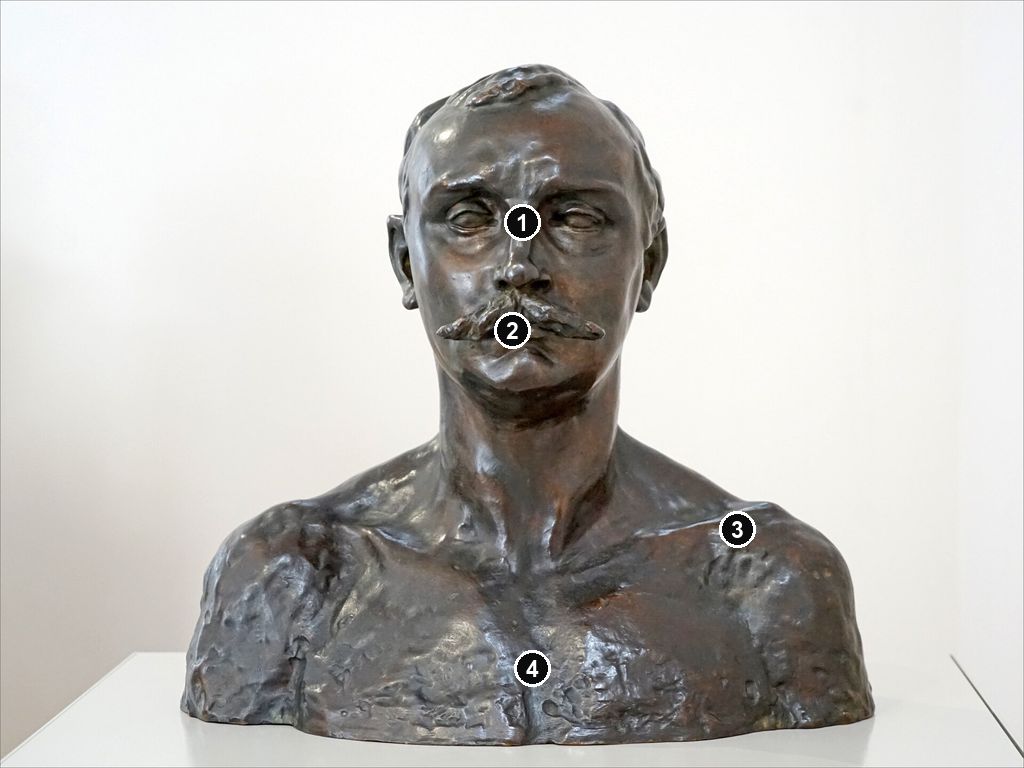
Details from PAUL CLAUDEL AT THIRTY-SEVEN
Follow the numbered details, then return to the complete view.
The eyes and brow
A narrow rise in the forehead separates the two heavy brows. The lids catch light around the recessed eyes.
The moustache and lips
The tips of the moustache spread beyond the comparatively short line of the mouth.
The shoulders
The long slope away from the neck gives the frontal view a wide base.
The lower edge
Irregular tool-like marks break up the surface above the relatively even lower edge.
Artworks directory
| Name | Date | Medium |
|---|---|---|
| The Mature Age | 1894–99 | Sculpture |
| The Waltz | c. 1889–93 | Sculpture |
| Sakuntala | 1886–88 | Sculpture |
| The Little Châtelaine | 1892–93 | Sculpture |
| The Gossips | c. 1893 | Sculpture |
| The Wave | 1897–1903 | Sculpture |
| Perseus and the Gorgon | c. 1897–1902 | Sculpture |
| The Implorer | c. 1894–99 | Sculpture |
| Clotho | 1893 | Sculpture |
| Bust of Auguste Rodin | c. 1886–89 | Sculpture |
| Paul Claudel at Sixteen Years Old | c. 1882–87 | Sculpture |
| Young Girl with a Sheaf | c. 1886–87 | Sculpture |
| Giganti | c. 1885 | Sculpture |
| Crouching Woman | c. 1884–85 | Sculpture |
| The Hungry Dog | c. 1893 | Sculpture |
| Old Hélène | c. 1881–82 | Sculpture |
| Fortune | c. 1902–05 | Sculpture |
| The Wounded Niobid | 1906 | Sculpture |
| The Siren, or The Flute Player | c. 1904–05 | Sculpture |
| Deep Thought | c. 1898 | Sculpture |
| Dream by the Fireside | c. 1899 | Sculpture |
| Paul Claudel at Thirty-Seven | 1905 | Sculpture |
| Portrait de Madame Claudel | c. 1883 | Sculpture Musée Camille Claudel. |
| Jeune Femme aux yeux clos | c. 1885 | Sculpture Musée Camille Claudel. |
| Ferdinande de Massary | 1888 | Sculpture Musée Camille Claudel. |
| Léon Lhermitte | 1889 | Sculpture Musée Camille Claudel. |
| Étude de main gauche | c. 1889 | Sculpture Musée Camille Claudel. |
| Vieil aveugle chantant | c. 1894 | Sculpture Musée Camille Claudel. |
| Tête de vieillard | c. 1890 | Sculpture Musée Camille Claudel. |
| Étude pour la tête d’Hamadryade | c. 1895 | Sculpture Musée Camille Claudel. |
| Aurore | c. 1900 | Sculpture Musée Camille Claudel. |
Discussion
Look again at the images and ideas explored in Paul Claudel at Thirty-Seven. These editorial prompts invite your observations.
Reader Insights
Which features seem clearest in profile?
What changes when you compare the bust with the earlier portrait of Paul?
Join the Conversation
Share a detail, comparison or question about Paul Claudel at Thirty-Seven below.
References
- Musée Camille Claudel, Paul Claudel à trente-sept ans, Nogent bronze 2016.1.1 and Marco Illuminati photograph,. View source.
- Musée Camille Claudel, acquisition notice for the adult bust,. View source.
- Anne Rivière, discussion of the adult bust in the Bulletin de la Société Paul Claudel, no. 191, especially notes 30 and 33–34,. View source.
- Institut national d’histoire de l’art, repertoire of French-language art journals, entry for L’Occident, no. 45, August 1905, pp. 81–85,. View source.
- Paul Claudel, “Camille Claudel statuaire,” excerpt from the collected prose, p. 274, reproduced by the Société Paul Claudel,. View source.
- Musée Camille Claudel, Camille Claudel, Paul Claudel. Le rêve et la vie, 2018 exhibition dossier, pp. 9–10 and 16–18,. View source.
- Ministère de la Culture, 2017 announcement on the acquisition of works by Camille Claudel, Poitiers study and Château-Thierry bronze,. View source.
- Musée Rodin, Buste de Paul Claudel à trente-sept ans, Paris bronze S.01218 and Christian Baraja photographs,. View source.
- Musée Camille Claudel, Jeune Romain, collection record and photograph for patinated plaster D2017.14.1,. View source.