by Tom Gurney
Tom Gurney BSc (Hons) is an art history expert with over 20 years experience
Email: tomgurney1@gmail.com / Phone: +44 7429 011000
Where to see Claudel’s sculptures: Introduction
In Nogent-sur-Seine, Camille Claudel’s Perseus and the Gorgon rises nearly two metres in marble. At the National Museum of Western Art in Tokyo, the hero and the severed head occupy a bronze just 51 centimetres high. Both are works by Claudel, and each preserves a different way of encountering the subject. A museum guide to her sculpture is most useful when it identifies the version, the material and the place that holds it. A room listing adds another piece of information, since an object can travel while its collection record continues to point to its usual home. [1] [2]
The Musée Camille Claudel has the broadest public collection for following her career across subjects and materials. The Musée Rodin holds the two compositions of The Mature Age, while the Musée d’Orsay holds the first bronze of the later composition. The original Salon plaster of Sakuntala belongs to Châteauroux. The display information below reflects museum and collection records checked on 10 November 2026. [3] [4] [5] [6]
At a Glance
- French collectionsNogent-sur-Seine, Paris and Châteauroux
- Tokyo examplePerseus and the Gorgon, S.2021-0001
Contents
- Nogent-sur-Seine | Musée Camille Claudel
- Paris | Musée Rodin and Musée d’Orsay
- Châteauroux | Musée Bertrand
- Tokyo | National Museum of Western Art
- Poitiers, Chicago, New York and Los Angeles
Nogent-sur-Seine | Musée Camille Claudel
The museum opened in 2017 in a building that incorporates the Claudel family’s former home. In Nogent, the young Claudel met Alfred Boucher, who encouraged her and gave her early instruction. Boucher also helped establish the town’s first museum in 1902. More than a century later, the town acquired the collections assembled by Reine-Marie Paris and Philippe Cressent in 2008. The museum’s object record dates the acquisition of the monumental marble Perseus and the Gorgon to 2009. Those acquisitions explain why the museum can trace Claudel’s development in depth within a broader collection of sculpture from her period. [1] [3] [7] [8]
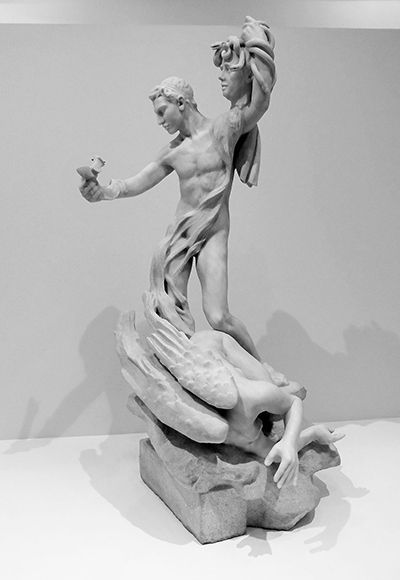
The scale of Perseus and the Gorgon makes it a natural starting point. The Comtesse de Maigret commissioned this marble, which François Pompon carved from Claudel’s model and completed in 1902. At 196 centimetres high, the work makes the distance between the lifted head and the fallen body part of the encounter. Follow the hero’s gaze towards the place where a shield once acted as a mirror. The shield is absent from the marble today, and the turn of the head leaves a question that the Tokyo bronze helps answer. [1] [2] [9]
The smaller pieces reward a closer look. In the museum’s gallery guide, a plaster Gossips with a screen and Eugène Blot’s 1905 bronze edition cast no. 1 share a room with versions of Deep Thought and Dream by the Fireside. Compare the way the screen cuts off the huddle in Gossips with the way a fireplace encloses the figure in Dream by the Fireside. The setting gives a very small figure or group a place of its own. The materials can change that sense of enclosure. In the plaster, the screen and bodies can be read together as one pale arrangement. In the Blot version, the museum identifies the figures as bronze and gives marble or tinted alabaster for the screen, so the division between the figures and their surroundings comes through in colour as well as shape. [3]
Nogent’s collection guide also lists a patinated plaster of The Little Châtelaine and a bronze of Paul Claudel at Thirty-Seven, cast by P. Converset in 1912–13. One way into the portrait collection is to compare how Claudel ends each bust. The child’s head rises from a compact sweep of shoulders, while the adult portrait gives the chest and shoulders more room to carry the weight of the head. A collection label can also distinguish what the museum bought from what another public body placed with it. The patinated plaster Young Roman, for example, is a deposit from the Département de l’Aube. The museum’s gallery guide describes the regular arrangement, and its visitor and exhibition pages give separate information about access and temporary shows. [3] [8] [10] [11]
Paris | Musée Rodin and Musée d’Orsay
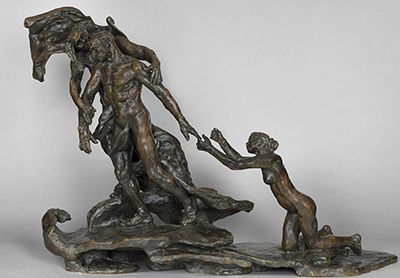
At the Musée Rodin, the Paris visitor map places Claudel on the first floor of the Hôtel Biron in room 16. The collection grew around Paul Claudel’s 1952 gift of four works, including the two versions of The Mature Age, Clotho and Vertumnus and Pomona. The museum’s early plaster of The Mature Age (S.01378) keeps the young woman in close contact with the man. In its bronze of the later composition (S.01380), cast in 1913 by Frédéric Carvillani, her arms extend across a gap. The plaster and the bronze make it possible to follow a revision in three dimensions. Where the figures touch in the earlier arrangement, the viewer sees a solid connection. In the bronze, the space between their hands has to carry that part of the action. Both catalogue entries list the objects in the permanent exhibition, and the museum advises that works can be away on loan. [4] [12] [13] [14]
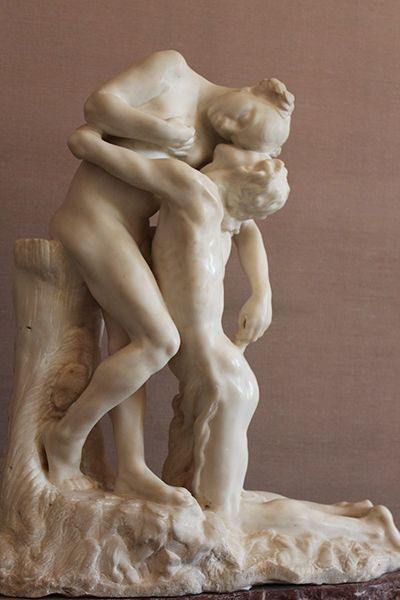
Room 16 also appears on the object pages for The Wave and Vertumnus and Pomona. The two works use stone for very different effects. In The Wave, the rounded backs and bent knees of three bronze bathers sit beneath the curling edge of the onyx marble. In Vertumnus and Pomona, the smooth white marble of the embracing figures sits above a contrasting red marble plinth. The latter is the 1905 marble related to Sakuntala, under the title Claudel used for that version. The Wave’s Musée Rodin inventory number, S.06659, also appears on Nogent’s page for the temporary Claudel and Bernhard Hoetger exhibition, dated 12 September 2026 to 10 January 2027. During that period, use the exhibition listing alongside the Paris room assignment when checking where to see this particular work. [8] [15] [16]
The Musée d’Orsay holds the Tissier bronze of The Mature Age (RF 3606). Captain Louis Tissier commissioned it, and the museum bought it from his son André in 1982. Its foundry inscription names Thiébaut Frères and Fumière et Gavignot and identifies it as a first proof. Its usual gallery location is the middle-level sculpture terrace for 1880–1910. Orsay’s record also cites the catalogue for the touring Claudel and Hoetger exhibition, including its Nogent dates, but lists Berlin in 2025 under the object’s exhibition history. The catalogue citation alone leaves the bronze’s availability during the Nogent run unconfirmed. [5] [8]
Orsay’s plaster Torso of Clotho (RF 4216), acquired in 1988, is also listed on the middle-level sculpture terrace. At 44.5 centimetres high, this concentrated study invites a different kind of looking from The Mature Age. The bending of the upper body and the changes across the ribcage are easy to follow because the plaster ends at the torso. The Musée Rodin’s full plaster Clotho (S.01379) gives the figure a head and the heavy masses of hair through which the full work is often recognised. The two museum records make clear which object a visitor should ask for. Orsay’s official visitor page gives access information during its reception-area works, while the Rodin visitor page covers the Paris building and sculpture garden. [12] [17] [18] [19] [20]
Châteauroux | Musée Bertrand
The original Sakuntala plaster belongs to the city of Châteauroux and is catalogued as Musée Bertrand 518. Claudel gave it to the city in 1895, after the work had appeared at the Salon in 1888. At 190.5 centimetres high, this patinated plaster has a physical presence that smaller versions of the embrace can only suggest. The kneeling man rises to meet the standing woman as she folds towards him. Seen at the size of the Salon group, that action plays out across nearly the height of a person, with the weight of the two bodies gathered around the contact between them. [6] [16] [21]
Three different labels can accompany this composition. Sakountala is the title used in the Châteauroux record. Vertumnus and Pomona identifies the Musée Rodin marble, and L’Abandon identifies the bronze edition published by Blot. Nogent’s 2024 gallery checklist also records a unique preservation bronze that reproduces the state of the original plaster in 1987. Châteauroux lent the plaster to Nogent for a temporary exhibition in 2024–25, so a label or photograph from Nogent can refer to either a visiting original or the preservation cast. The local tourist office features the original plaster among Musée Bertrand’s highlights. The ownership record and the municipal notice about the 2024 loan give stronger evidence for the object’s identity and movements than for its availability on any given day. [6] [16] [22] [23] [24]
Tokyo | National Museum of Western Art
Tokyo’s Perseus and the Gorgon (S.2021-0001) is an unnumbered bronze proof with a brown-green patina. The museum separates the modelling range, 1898–1905, from Eugène Blot’s sand cast of 1905–06. Claudel’s signature sits on the side of the base below the shield, and Blot’s foundry mark is behind Perseus. The museum purchased the bronze in 2021. Its object record, updated 14 July 2026, marks it on display in the permanent collection, and the museum’s online gallery list also includes it. [2] [25]
The shield gives Perseus a way to look at the Gorgon’s head by reflection. In the Tokyo bronze, you can follow the line from the hero’s eyes to the shield and back across the composition to the head he holds. The marble in Nogent, with its missing shield, lets the eye follow a different course through the same encounter. The difference in scale changes the viewer’s relationship to both objects. The bronze keeps the raised head, shield and fallen body within a compact field of vision. At the scale of the Nogent marble, looking from the head to the body requires a longer sweep. Tokyo’s visitor page gives opening times for the collection galleries. [1] [2] [9] [26]
Poitiers, Chicago, New York and Los Angeles
In Poitiers, Musée Sainte-Croix is the host institution for The Wounded Niobid, FNAC 2161, a bronze cast by Blot in 1907. The work belongs to the French national collection administered by the Centre national des arts plastiques and is on long-term deposit in Poitiers. Claudel makes the raised arm and the body leaning against the rough support central to the impression of injury. A checklist can name the national collection and Poitiers on the same line because one identifies the holding collection and the other identifies the museum responsible for the deposit. The deposit record establishes that relationship. Availability in a gallery depends on the host museum’s display. [21] [27]
The Art Institute of Chicago owns the painted plaster Young Roman (2022.1438), a portrait of Claudel’s brother Paul. Its red-brown and green colouring invites comparison with the patinated plaster deposited in Nogent. The two are individually catalogued, so the finish of one should be read on its own terms. In Los Angeles, the Getty owns Torso of a Crouching Woman (2018.32), a bronze in which the curve of the back and the angles of the legs keep the crouching posture legible even in fragmentary form. Both museums also borrowed Claudel sculptures for their joint retrospective in 2023–24. An exhibition caption gives the lender separately, which makes it possible to tell the works the museums kept from those that returned to other collections. [10] [21] [28]
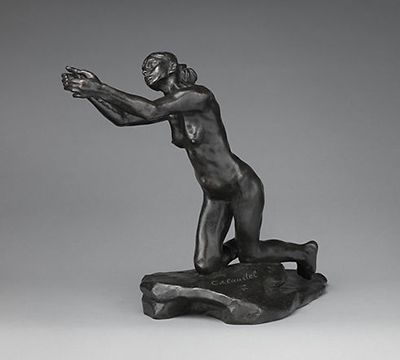
At The Met in New York, The Implorer (1990.171) concentrates the gesture of the kneeling figure from The Mature Age into a bronze 27.9 centimetres high. The extended arms now reach into the viewer’s space without the other two figures present. The Met identifies this example as cast by Eugène Blot around 1905 and lists it on view in Gallery 800 at Fifth Avenue. Its inventory number distinguishes it from other casts of the figure, and the gallery listing gives a place to look for this one. [29]
Artworks directory
| Name | Date | Medium |
|---|---|---|
| The Mature Age | 1894–99 | Sculpture |
| The Waltz | c. 1889–93 | Sculpture |
| Sakuntala | 1886–88 | Sculpture |
| The Little Châtelaine | 1892–93 | Sculpture |
| The Gossips | c. 1893 | Sculpture |
| The Wave | 1897–1903 | Sculpture |
| Perseus and the Gorgon | c. 1897–1902 | Sculpture |
| The Implorer | c. 1894–99 | Sculpture |
| Clotho | 1893 | Sculpture |
| Bust of Auguste Rodin | c. 1886–89 | Sculpture |
| Paul Claudel at Sixteen Years Old | c. 1882–87 | Sculpture |
| Young Girl with a Sheaf | c. 1886–87 | Sculpture |
| Giganti | c. 1885 | Sculpture |
| Crouching Woman | c. 1884–85 | Sculpture |
| The Hungry Dog | c. 1893 | Sculpture |
| Old Hélène | c. 1881–82 | Sculpture |
| Fortune | c. 1902–05 | Sculpture |
| The Wounded Niobid | 1906 | Sculpture |
| The Siren, or The Flute Player | c. 1904–05 | Sculpture |
| Deep Thought | c. 1898 | Sculpture |
| Dream by the Fireside | c. 1899 | Sculpture |
| Paul Claudel at Thirty-Seven | 1905 | Sculpture |
| Portrait de Madame Claudel | c. 1883 | Sculpture Musée Camille Claudel. |
| Jeune Femme aux yeux clos | c. 1885 | Sculpture Musée Camille Claudel. |
| Ferdinande de Massary | 1888 | Sculpture Musée Camille Claudel. |
| Léon Lhermitte | 1889 | Sculpture Musée Camille Claudel. |
| Étude de main gauche | c. 1889 | Sculpture Musée Camille Claudel. |
| Vieil aveugle chantant | c. 1894 | Sculpture Musée Camille Claudel. |
| Tête de vieillard | c. 1890 | Sculpture Musée Camille Claudel. |
| Étude pour la tête d’Hamadryade | c. 1895 | Sculpture Musée Camille Claudel. |
| Aurore | c. 1900 | Sculpture Musée Camille Claudel. |
Discussion
Look again at the images and ideas explored in Where to see Claudel’s sculptures. These editorial prompts invite your observations.
Reader Insights
Which collection would you visit to compare a single design in several materials?
What can an accession number tell you when two museums display the same title?
Join the Conversation
Share a detail, comparison or question about Where to see Claudel’s sculptures below.
References
- Musée Camille Claudel, Persée et la Gorgone, marble 2009.1.1, collection entry on the marble index,. View source.
- National Museum of Western Art, Perseus and the Gorgon, S.2021-0001, bilingual object record,. View source.
- Musée Camille Claudel, La plus grande collection d’œuvres de Camille Claudel, permanent gallery guide,. View source.
- Musée Rodin, Camille Claudel, collection history and the 1952 gift,. View source.
- Musée d’Orsay, L’Âge mûr, RF 3606, provenance, inscriptions, gallery assignment and exhibition catalogue references,. View source.
- Musée Bertrand and Ministère de la Culture, Sakountala, inv. 518, Joconde record 02470000239,. View source.
- Musée Camille Claudel, Histoire du musée, the Dubois-Boucher collection and the museum project,. View source.
- Musée Camille Claudel, Camille Claudel & Bernhard Hoetger : l’exposition de 1905, exhibition dates and the caption for La Vague,. View source.
- Musée Camille Claudel, La mythologie au musée, Persée et la Gorgone, Pompon, the Salon model and missing shield,. View source.
- Musée Camille Claudel, Jeune Romain, D2017.14.1, object record and deposit credit,. View source.
- Musée Camille Claudel, Horaires et tarifs, practical information,. View source.
- Musée Rodin, Paris visitor map, first floor, room 16,. View source.
- Musée Rodin, L’Âge mûr, première version, plaster S.01378, catalogue and display field,. View source.
- Musée Rodin, L’Âge mûr, bronze S.01380, the two versions and gallery listing,. View source.
- Musée Rodin, La Vague ou les Baigneuses, S.06659, materials and gallery listing,. View source.
- Musée Rodin, Vertumne et Pomone, S.01293, the plaster, marble and bronze titles and gallery listing,. View source.
- Musée d’Orsay, Torse de Clotho, RF 4216, plaster torso and gallery assignment,. View source.
- Musée d’Orsay, Visit, visitor information and reception-area works,. View source.
- Musée Rodin, Informations pratiques, Paris access and temporary loan advice,. View source.
- Musée Rodin, Clotho, full plaster S.01379 and gallery listing,. View source.
- J. Paul Getty Museum, Camille Claudel, selected works and lender or collection credits,. View source.
- Musée Camille Claudel, March 2024 press dossier, permanent gallery checklist, entrance hall and the Sakountala preservation bronze,. View source.
- Châteauroux Métropole, CHTX Métropole, no. 53, September–October 2024, notice on the loan of the plaster to Nogent,. View source.
- Châteauroux tourist office, Le musée Bertrand et son jardin à la française, collection highlights,. View source.
- National Museum of Western Art, Permanent collection gallery checklist, listing for Perseus and the Gorgon,. View source.
- National Museum of Western Art, General Information, permanent collection hours and access,. View source.
- Centre national des arts plastiques, Modern collection presentation, p. 11, fig. 16, FNAC 2161 and the Poitiers deposit,. View source.
- J. Paul Getty Museum, Torso of a Crouching Woman, technical examination atlas, fig. 75, bronze 2018.32,. View source.
- The Metropolitan Museum of Art, The Implorer, 1990.171, object and gallery record,. View source.