 by Tom Gurney
Tom Gurney BSc (Hons) is an art history expert with over 20 years experience
Published on June 19, 2020 / Updated on October 14, 2023
Email: tomgurney1@gmail.com / Phone: +44 7429 011000
The Implorer: Introduction
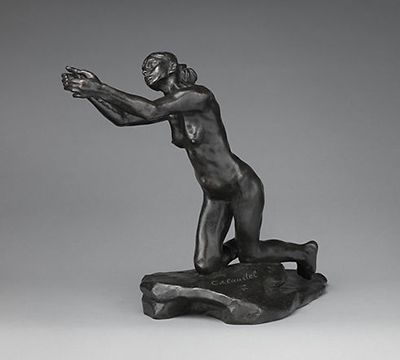
The hands of Camille Claudel’s The Implorer nearly face each other. One rises a little above the other, and the fingers bend around a space they never close. The young woman’s face follows the reach, chin raised and lips apart. Below, both knees remain on a patch of uneven ground. In the small bronze at the Musée d’Orsay, you can follow the whole effort from one side. The feet trail behind the hips, the chest rises in front of them and the forearms carry the movement beyond the face. The distance from the rear foot to the forward hand is long enough that the figure looks as if she has travelled across the base without getting up. [1]
From nearer the front, the forearms overlap and the hands seem to draw together. From the back, the stretch runs through the shoulder blades and down a narrow channel in the spine, with the legs folding back beneath the pelvis. The forward reach feels less like an action performed by the arms alone. Claudel has given the body a low point of support and made the rest of it strain away from there. The receiving end of the gesture lies somewhere outside the bronze. Seen from the front again, the small interval between the hands has all the attention the pose can give it. [1]
The Implorer Camille Claudel
At a Glance
- French titleL’Implorante
- Nogent patinated plasterLe Dieu envolé, 2021.1.1
Camille Claudel in context
Old Hélène
c. 1881–82Sakuntala
Plaster shown in 1888The Waltz
Developed c. 1889–93The Little Châtelaine
First model c. 1892–93The Gossips
Described in 1893, shown in 1895The Mature Age
First and second versions, c. 1894–99The Wave
Plaster shown in 1897, mixed-material object dated 1897–1903 (?)Perseus and the Gorgon
Nogent design and marble, c. 1897–1902The Wounded Niobid
Modelled in 1906Contents
- A plea before the bronze
- From holding on to reaching out
- A figure sold on its own
- What the hands are asking for
A plea before the bronze
A kneeling woman was already visible to the Paris public in 1894. Writing about that year’s Champ-de-Mars Salon, Gustave Geffroy described a woman with twisted hands, her torso thrown back and her face raised. He called the work Le Dieu envolé, which can be translated as The God Has Flown Away. The Musée Camille Claudel treats the work attested in 1894 as lost. In the absence of the object, Geffroy’s account preserves something of the direction of the body. The title, meanwhile, gives his description a possible story. It asks the viewer to imagine a departure before considering what the woman is trying to do with her hands. [2] [3]
The patinated plaster at Nogent-sur-Seine bears the double title L’Implorante ou Le Dieu envolé. The museum dates this object to about 1895 and places it between the lost work attested in 1894 and the kneeling figure in the group shown in 1899. At 72 centimetres high, the plaster gives the lifted gesture considerable room. The right knee leads and the head tilts with the twist of the body, features that carry over into the later figure. Here the trunk is still upright and the arms go almost straight up. The line through the body could continue towards something overhead. In the later group that line inclines towards the departing man. [3] [4]
The plaster lets you see how much of the pose was worked out below the raised arms. The forward knee sets the lower body at a slight turn, and the rounded abdomen gives way to the firmer edges of bone and tendon as the torso twists. The museum also draws attention to the surviving traces of hair winding round an arm. Damage before the plaster’s rediscovery in 1986 left those strands incomplete. Even in their partial state, they recall the way hair takes on a life of its own in Clotho. Here the surviving traces draw the eye towards the arm and the upward movement of the figure. In the museum’s profile photograph, the toes extend behind the small support beneath the knees. The rocky base of the later bronze runs underneath the feet and out in front of the figure. Where the plaster’s compact base makes the body seem lifted above it, the longer bronze base makes the reach look like a movement along the ground. The plaster entered the Nogent collection by purchase in 2021. The museum records that conservator Véronique Picur reattached a lock of hair, secured the join of the right arm and stabilised the patina. [1] [3] [5]
From holding on to reaching out
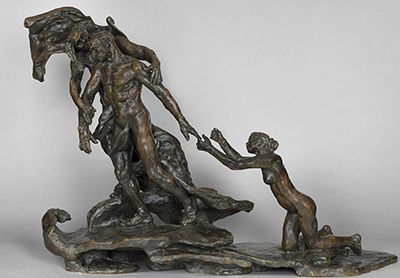
In the first plaster of The Mature Age at the Musée Rodin, the kneeling woman is still in contact with the man. Her elbows are bent and her hands keep his close to her chest. That gives her a different task from the woman with her arms raised in the Nogent plaster. She has something to hold, and the man’s arm gives a viewer a line to follow between the bodies. The upright figure at Nogent and the first group plaster at the Musée Rodin preserve different experiments with a kneeling body, made around the same period. [3] [4] [6]
By the time Claudel exhibited the second version of the group in 1899, the young woman’s hands had lost their hold. The man’s arm trails behind him as he moves away with the older woman. The kneeling figure leans forward and upward from a lower stretch of the base, and the group supplies a particular destination for her effort, just beyond the fingertips. The Musée Rodin describes its own small Blot bronze as a figure extracted from The Mature Age. The kinship is clearest in the extended arms and the tilt of the trunk. In the stand-alone version the gesture takes place with nobody at the other end. A viewer can look from the hands to the face and back again, waiting for some clue as to what she sees. [1] [4] [7]
A figure sold on its own
Captain Louis Tissier commissioned a bronze of the kneeling figure in 1899. Claudel’s letters at the Musée d’Orsay show a sculptor managing the work in instalments. She asked for an advance of 150 francs on a bronze figure and acknowledged receipt of 200 francs for the kneeling figure in another letter. The museum’s archive dates the letter announcing that the bronze was ready to 6 August 1899. The Musée Camille Claudel identifies Gruet as the founder. These records give the figure a history as a sculpture in its own right before Tissier had the three-figure group cast around 1902. The edition history compiled by Galerie Malaquais, drawing on the catalogue raisonné, points to a difference in the position of the arms between Tissier’s figure and the figure Blot later issued. [4] [8] [9] [10]
Eugène Blot subsequently issued bronzes for a wider audience. The Musée Rodin dates the start of his edition to 1904, and L’Implorante appeared in the December 1905 exhibition of Claudel and Bernhard Hoetger at Blot’s Paris gallery. The printed catalogue lists two sizes under the title Imploration and advertises limits of 20 for the original size and 100 for the reduction. Decades later, Blot recalled setting the limit for the larger size at ten. The Alte Nationalgalerie records 59 casts of the small version through 1937. The printed limits tell us what buyers were offered in 1905, while the foundry history gives a better idea of how many bronzes were made. Blot’s own account also recalls an intermediate format. The Pushkin State Museum of Fine Arts preserves a 33-centimetre-high example, which its collection catalogue relates to the second group composition. It came to the Pushkin in 1948 from the State Museum of New Western Art. [7] [11] [12] [10] [13] [14]
The large Nogent bronze is Blot’s no. 5, cast in 1905 and purchased from Reine-Marie Paris in 2008. It measures 67 centimetres high and 72 across. Nogent’s object record gives 1899 alongside the separate casting date, while its gallery materials use about 1894 for the model. At the Metropolitan Museum of Art, the small Blot bronze given by Iris and B. Gerald Cantor in 1990 is 27.9 centimetres high. The Met dates the model to 1898 and the cast to around 1905. These labels attach to particular records and different moments in making and circulating the figure. In a room, the difference in scale changes the first encounter. The statuette lets the eye take in knees, face and hands almost together. The museum’s near-frontal view of the large bronze picks out the knee that comes forward and the turn of the face between the hands. The other knee falls into shadow behind it. That unevenness gives the woman a sense of movement even from an angle where the forward reach of her arms is harder to see. [15] [16] [17]
The smaller bronzes have individual histories too. At the Musée Rodin, Claudel’s signature lies near the left knee, and Blot’s name appears with the number 14. The museum bought that cast in 1968. On the Orsay bronze the signature is at the front of the base and Blot’s mark and the number 57 are at the back. The Orsay bought it in 2025 and gives the banker Louis Bernard as its probable early owner. The numbers help follow each bronze as a separate object. No. 57 came to the Orsay through Bernard’s descendants, while the Tissier family supplied the museum with the full group and the correspondence that records the first commission for a kneeling bronze. [1] [4] [7] [8]
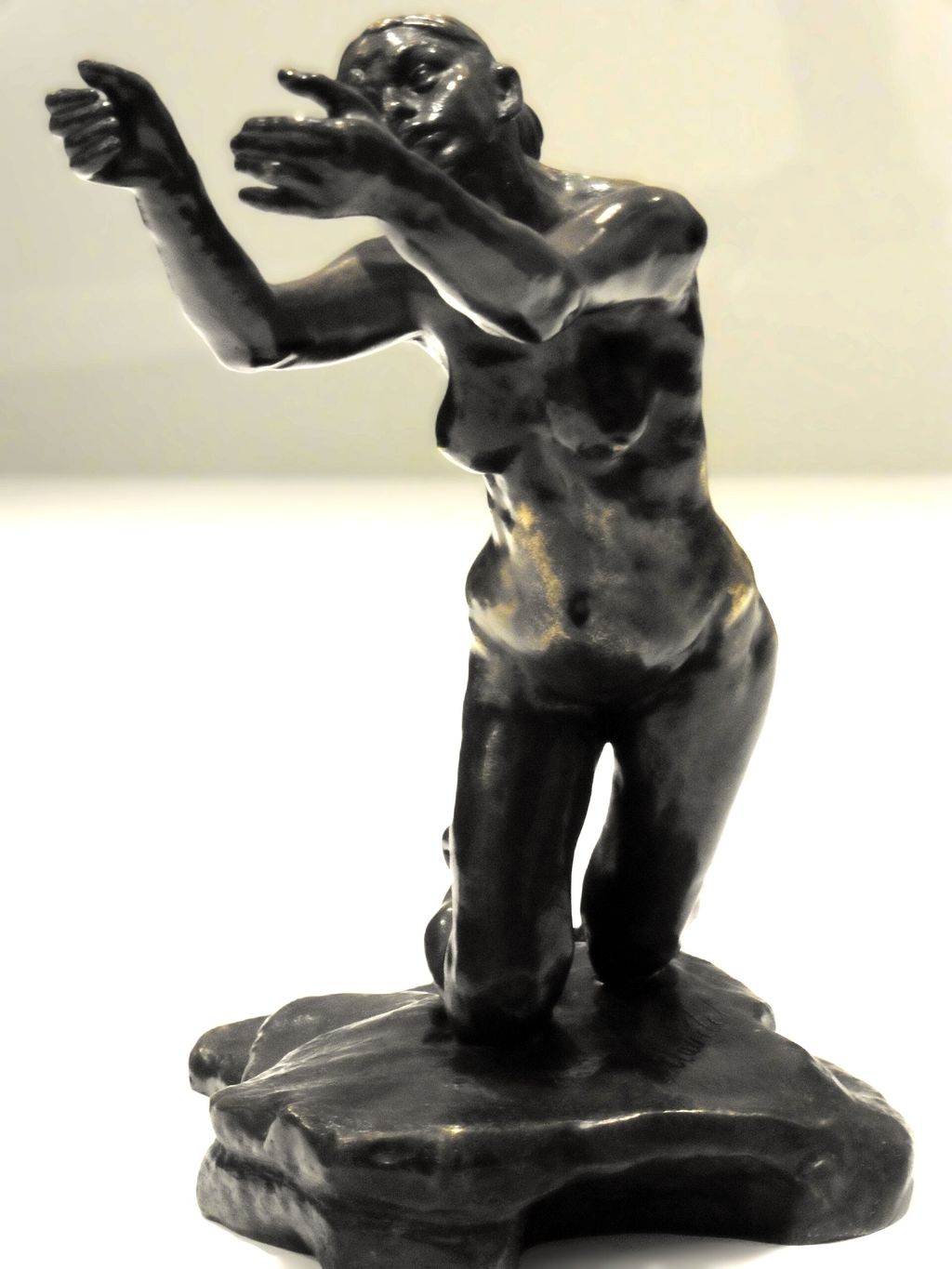
An example of The Implorer shown independently at La Piscine, Roubaix. Photograph by Pierre André Leclercq. Image source. CC BY-SA 4.0. Resized photograph, shared under CC BY-SA 4.0.
What the hands are asking for
The different titles direct attention to different things. La Suppliante, the alternate title at the Musée Rodin, names a woman making a plea. Imploration, also used in connection with Blot’s edition, names the action itself. Le Dieu envolé directs attention beyond the figure by naming a being who has gone. The Musée Camille Claudel connects the title to Psyche losing Cupid after she lights a lamp to see him. The lifted hands in the Nogent plaster suit the idea of someone leaving through the air. The myth depends on what the title supplies, since the figure carries no lamp and Cupid is absent. In the catalogue for Blot’s 1905 exhibition, Louis Vauxcelles dwelt on the tension in her face, upper body and hands and wondered what she wanted. The question is an early response to the figure as an independent sculpture. A viewer could recognise a plea before deciding whether its object was a person, a god or something harder to name. [3] [7] [12] [16]
Paul Claudel later recognised his sister in the young woman of The Mature Age, and the Met’s reading of its small bronze also connects the gesture to the sculptor’s relationship with Auguste Rodin. The life gives the plea one possible object. The group gives it another in its allegory of youth losing its hold on maturity. Both readings meet at the difficulty visible in the single figure. Her balance would let her stay on her knees, yet the lift of her chest and the uncertain grip of her fingers make the pose feel hard to sustain. The bronze can hold that effort for as long as someone stands before it. The woman seems to have only another moment in which to reach. [1] [4] [6] [17]
Artworks directory
| Name | Date | Medium |
|---|---|---|
| The Mature Age | 1894–99 | Sculpture |
| The Waltz | c. 1889–93 | Sculpture |
| Sakuntala | 1886–88 | Sculpture |
| The Little Châtelaine | 1892–93 | Sculpture |
| The Gossips | c. 1893 | Sculpture |
| The Wave | 1897–1903 | Sculpture |
| Perseus and the Gorgon | c. 1897–1902 | Sculpture |
| The Implorer | c. 1894–99 | Sculpture |
| Clotho | 1893 | Sculpture |
| Bust of Auguste Rodin | c. 1886–89 | Sculpture |
| Paul Claudel at Sixteen Years Old | c. 1882–87 | Sculpture |
| Young Girl with a Sheaf | c. 1886–87 | Sculpture |
| Giganti | c. 1885 | Sculpture |
| Crouching Woman | c. 1884–85 | Sculpture |
| The Hungry Dog | c. 1893 | Sculpture |
| Old Hélène | c. 1881–82 | Sculpture |
| Fortune | c. 1902–05 | Sculpture |
| The Wounded Niobid | 1906 | Sculpture |
| The Siren, or The Flute Player | c. 1904–05 | Sculpture |
| Deep Thought | c. 1898 | Sculpture |
| Dream by the Fireside | c. 1899 | Sculpture |
| Paul Claudel at Thirty-Seven | 1905 | Sculpture |
| Portrait de Madame Claudel | c. 1883 | Sculpture Musée Camille Claudel. |
| Jeune Femme aux yeux clos | c. 1885 | Sculpture Musée Camille Claudel. |
| Ferdinande de Massary | 1888 | Sculpture Musée Camille Claudel. |
| Léon Lhermitte | 1889 | Sculpture Musée Camille Claudel. |
| Étude de main gauche | c. 1889 | Sculpture Musée Camille Claudel. |
| Vieil aveugle chantant | c. 1894 | Sculpture Musée Camille Claudel. |
| Tête de vieillard | c. 1890 | Sculpture Musée Camille Claudel. |
| Étude pour la tête d’Hamadryade | c. 1895 | Sculpture Musée Camille Claudel. |
| Aurore | c. 1900 | Sculpture Musée Camille Claudel. |
Discussion
Look again at the images and ideas explored in The Implorer. These editorial prompts invite your observations.
Reader Insights
How much of the action can you read from the arms and knees?
What changes when the kneeling woman stands apart from the group?
Join the Conversation
Share a detail, comparison or question about The Implorer below.
References
- Musée d’Orsay, L’Implorante, Blot no. 57, RF MO S 2025 1, collection record and photographs. View source.
- Gustave Geffroy, account of the 1894 Champ-de-Mars Salon, La Vie artistique, fourth series, 1895, pp. 147–148, excerpt reproduced in Véronique Gauthier’s Les images de Camille Claudel. View source.
- Musée Camille Claudel, L’Implorante ou Le Dieu envolé, patinated plaster 2021.1.1, collection record and photograph. View source.
- Musée d’Orsay, L’Âge mûr, Tissier group bronze RF 3606, collection record and photographs. View source.
- Musée Camille Claudel, Acquisition et restauration : Le Dieu envolé, record of Véronique Picur’s treatment. View source.
- Musée Rodin, L’Âge mûr, account of the two group versions. View source.
- Musée Rodin, L’Implorante, dit aussi La Suppliante, Blot no. 14, S.01377. View source.
- Nadège Horner, Musée d’Orsay, Fonds Camille Claudel, archive inventory of the Tissier correspondence, Ms 360.1–11. View source.
- Musée Camille Claudel, 1893–1908: Period of Solitary Creation, museum chronology. View source.
- Eugène Blot, letter to Barbedienne, 17 December 1936, Archives nationales, 368 AP 3, excerpt on the intermediate bronze reproduced in Galerie Malaquais’s The Implorer dossier, pp. 4–5 and note 8. View source.
- Musée Camille Claudel, 1905 : l’exposition Claudel & Hoetger, exhibition history. View source.
- Yvette Deseyve, Alte Nationalgalerie, L’Implorante, NG 2/24, with excerpts from Blot’s account and Vauxcelles’s 1905 catalogue essay. View source.
- Pushkin State Museum of Fine Arts, Мольба (Imploration), bronze Ск-238. View source.
- Galerie Eugène Blot, December 1905 exhibition catalogue, Claudel entries 1–2, Musée Camille Claudel facsimile. View source.
- Musée Camille Claudel, L’Implorante (grand modèle), Blot no. 5, 2010.1.15, collection record and photograph. View source.
- Musée Camille Claudel, museum press dossier, March 2024, Salle 14 checklist and plaster acquisition, p. 50. View source.
- Metropolitan Museum of Art, The Implorer (L’Implorante), small Blot bronze 1990.171. View source.