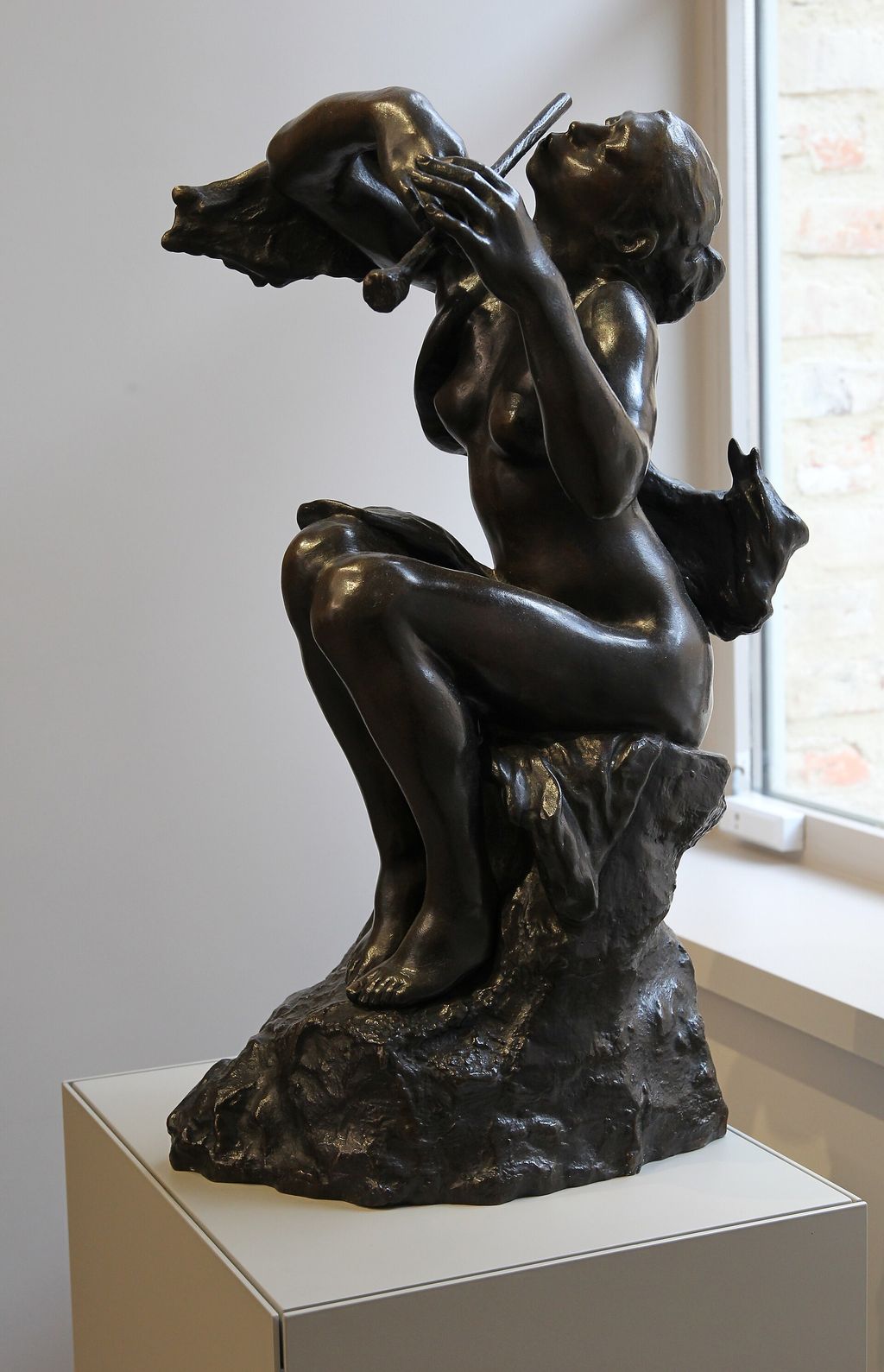
The Siren, or The Flute Player, bronze in the Musée Camille Claudel, Nogent-sur-Seine, 2010.1.22. Photograph by Vassil. Image source. CC0 / Public domain. Resized from the original photograph.
 by Tom Gurney
Tom Gurney BSc (Hons) is an art history expert with over 20 years experience
Email: tomgurney1@gmail.com / Phone: +44 7429 011000
The Siren, or The Flute Player: Introduction
In Camille Claudel’s The Siren, or The Flute Player (La Sirène ou La Joueuse de flûte), the flute passes close to a woman’s lifted mouth. She sits with her feet close together on a rock, her knees bent and her back arched. The space between the instrument and her lips is small, but it sets the action of the whole figure. The viewer has to imagine the breath passing across it. The Musée Camille Claudel in Nogent-sur-Seine dates the modelling to around 1904–05 and lists its bronze, inventory 2010.1.22, as an Eugène Blot cast of 1905. The museum’s collection guide identifies it as cast no. 3. [1] [2]
At a Glance
- French titlesLa Sirène and La Joueuse de flûte
- Nogent bronzeEugène Blot, 2010.1.22
Camille Claudel in context
Old Hélène
c. 1881–82Sakuntala
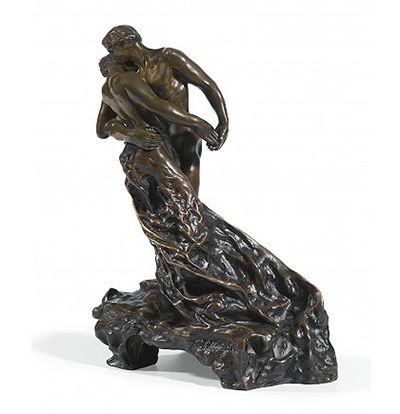
Plaster shown in 1888The Waltz
Developed c. 1889–93The Little Châtelaine
First model c. 1892–93The Gossips
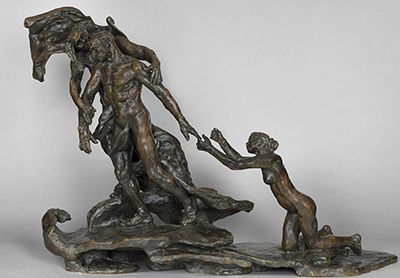
Described in 1893, shown in 1895The Mature Age
First and second versions, c. 1894–99The Wave
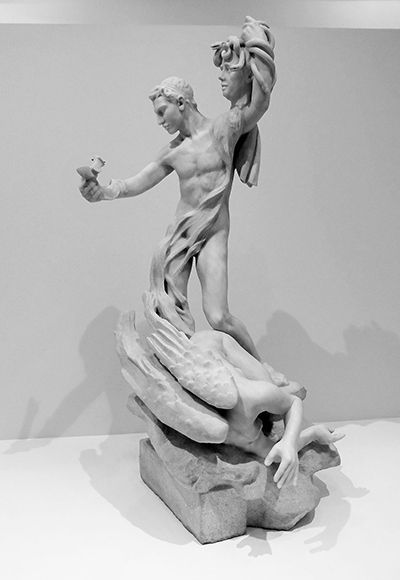
Plaster shown in 1897, mixed-material object dated 1897–1903 (?)Perseus and the Gorgon
Nogent design and marble, c. 1897–1902The Wounded Niobid
Modelled in 1906Contents
- From the rock to the flute
- What the two titles ask us to see
- A green onyx rock
- Blot’s edition and its surviving bronzes
From the rock to the flute
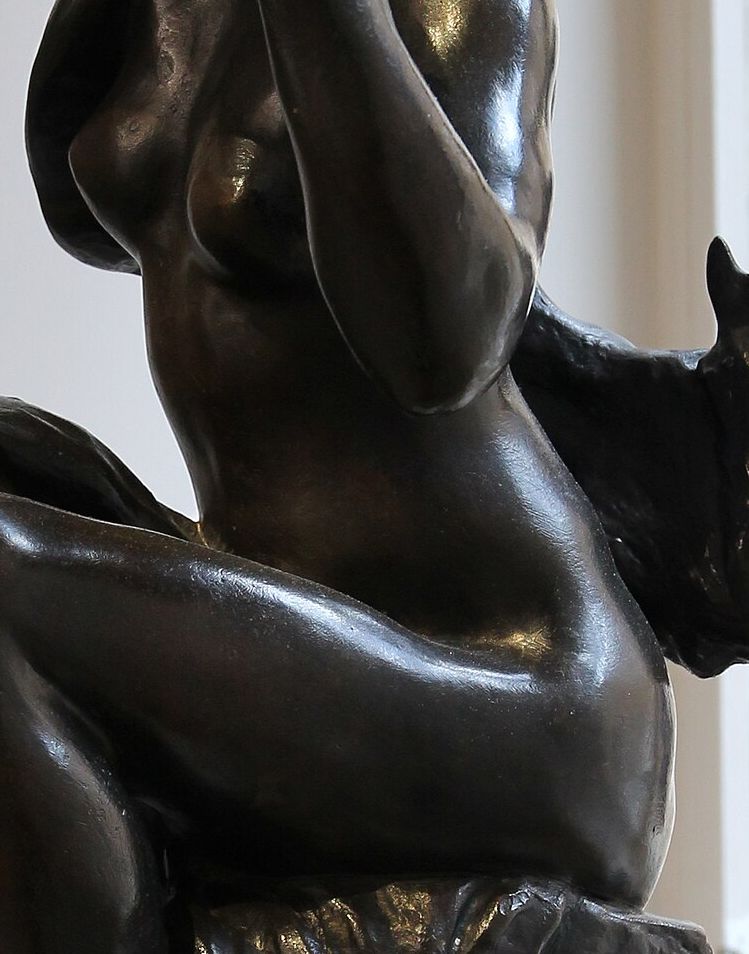
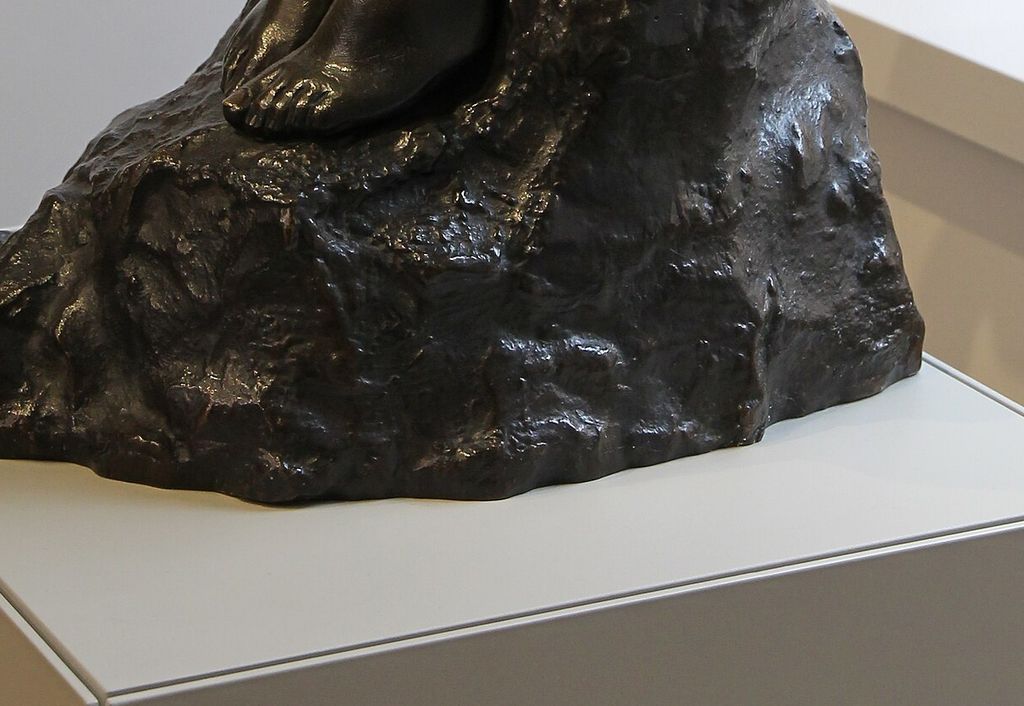
Start at the bottom, where the rock widens into a rough, irregular base. The seat is higher at the back and the rock comes forward under the feet, almost like a step. From the front and side, both feet can be seen against that slope. The bent legs rise in parallel, and the knees are so close that the near one largely hides the other when you look across the figure. Above the thighs, the waist draws back and the chest opens as the woman raises her head. That change of direction makes the upper body look mobile even though the feet and hips remain firmly settled on the rock. [1]
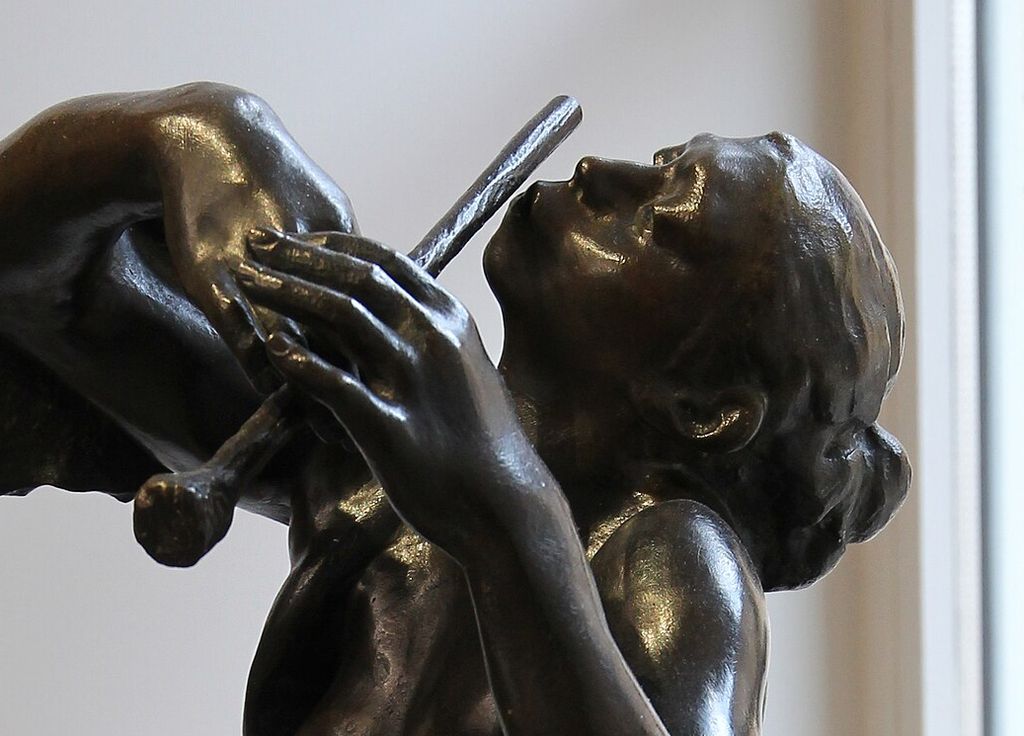
The arms give that movement a destination. One elbow rises high and the forearm curves down towards the instrument. The other elbow stays near the body, with the forearm coming up to meet the first hand. Seen together, the hands nearly overlap, but the long fingers are still easy to follow. The near hand stretches its fingers along the line of the flute while the far hand approaches from above. The instrument itself cuts across the curved lines of the wrists and arms. Its exposed end brings the eye past the fingers to the lifted chin, the open lips and the gap the museum’s description singles out. [1]
The cloth has a different job at each height. Beneath the thigh it hangs against the side of the rock and picks up some of the base’s roughness. Higher up, it projects behind the waist and again near the raised elbow. In silhouette these edges give the upper body room to expand beyond the narrow line of the joined legs. They also break up the light. A highlight can run uninterrupted along the thigh or forearm, while short glints catch on the ridges of the cloth and the uneven rock. The museum relates the drapery to Art Nouveau. Here the folds extend the curves set by the body, carrying the motion of a wrist or an elbow out into the space around the figure. [1]
What the two titles ask us to see
The Nogent museum quotes a letter in which Claudel offered Blot une petite faunesse, a little female faun. The names attached to the work in 1905 draw attention to different aspects of the same figure. The chronology in the Getty and Art Institute of Chicago exhibition catalogue records a bronze Flute Player in the Salon des Artistes Français, listed as no. 2981 and belonging to Blot. In December the catalogue for Blot’s joint exhibition of Claudel and Bernhard Hoetger lists Sirène as item 8. The published descriptions give each title a public setting in 1905, while Claudel’s offer shows that she was already thinking of the player as a mythological creature. [1] [3] [4]
The Flute Player directs attention to how she holds the instrument and shapes her mouth. With The Siren in mind, the same details draw attention to what the music might do to someone listening. Claudel leaves any listener outside the composition. There is no ship or second figure to supply a story, and the woman’s joined legs end in recognisably human feet. The rock is enough to suggest a perch and the flute gives the figure her means of drawing someone closer. From the side, the line of her face is turned up into the space above the instrument, as though she were listening to the sound herself. [1] [4]
A green onyx rock
In a separate letter to Blot, Claudel proposed a rock in green onyx to evoke the sea and a flute in shiny metal. The Musée Camille Claudel reproduces the passage in its collection record and says the version was never made. The proposal concerned how the sculpture would be experienced at a glance. In the surviving bronze, a viewer discovers the flute by following the fingers and can distinguish rock from flesh by the way the metal catches light. Green stone would have made the base immediately distinct from the figure, while the contrasting flute could have caught the eye even from across a room. The museum’s 2023–24 correspondence exhibition placed letters alongside the works they discuss, tracing the stages of the bronze edition and bringing such decisions about materials into view. [1] [5]
Claudel had already used stone to give the sea a physical presence in The Wave. In the Musée Rodin’s onyx-marble and bronze group, the arched stone hangs above the bathers and makes their scale and movement legible. The proposed rock for The Siren would put the colour below the body, where the eye first registers her footing. The polished instrument would carry attention in the opposite direction, up towards her face. The letter gives the green stone a precise association with the sea. It leaves the arrangement of the bronze figure, with the legs gathered below and the hands raised above, as the means of leading the eye between those materials. [1] [6]
Blot’s edition and its surviving bronzes
Blot acquired Claudel’s plaster for an edition in bronze. The booklet for his exhibition, held at 5 boulevard de la Madeleine in Paris from 4 to 16 December 1905, offered Sirène in an edition limited to thirty. The Musée Camille Claudel records six bronzes. The difference matters when reading an individual cast’s number. The no. 3 in the museum’s guide identifies the bronze that it bought from Reine-Marie Paris de La Chapelle in 2008. The 8 in the Blot booklet tells visitors where to find the work on the list, and the 30 beside it sets a ceiling on production. The booklet offers La Valse two entries farther down. The gallery gave visitors a chance to see the isolated player and the turning couple within the same presentation of Claudel’s work. Nogent’s collection guide also groups the two designs, listing the Siren bronze alongside several versions of the dance. In the dance the figures lean together and the fabric follows their turn. In the seated player, the fabric is free to turn out behind the arms, while the feet stay planted. [1] [2] [4] [7]
The Nogent bronze measures 53 centimetres high, 27 wide and 34 deep. Christie’s documents two separate bronzes by their marks. Its record for cast no. 1 gives a height of 53.6 centimetres and describes a brown and green patina, with Claudel’s name, the number and Blot’s Paris mark on the left side of the base. Its record for cast no. 4 gives 53 centimetres and describes a reddish brown patina, also with the identifying marks on the side of the base. The green noted on no. 1 is part of the finish of a bronze, distinct from the green stone Claudel discussed with Blot. In each example the base carries information that can identify the object, even as the rocky surface above it makes the setting for the player. [1] [8] [9]
A closer look at The Siren
Annotated Details from The Siren
The Siren, or The Flute Player, bronze in the Musée Camille Claudel, Nogent-sur-Seine, 2010.1.22. Photograph by Vassil. Image source. CC0. Overview numbered and details cropped.
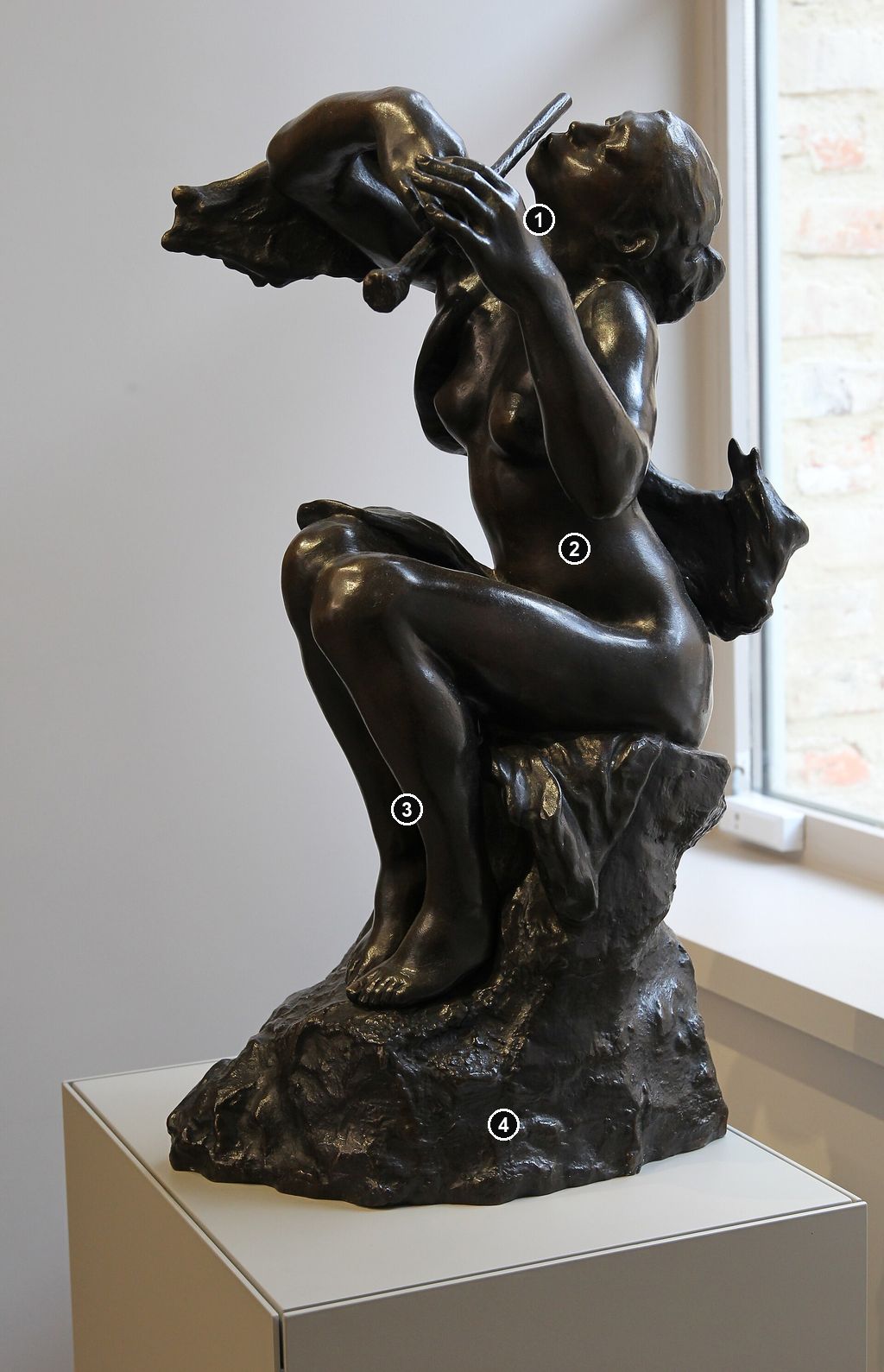
Details from THE SIREN
Follow the numbered details, then return to the complete view.
The mouth and the flute
The figure lifts her face toward the flute. The instrument and the raised fingers are distinct from the profile.
The curve of the torso
The torso curves back above the bent legs, following the upward turn of the head.
The knees and feet
The adjoining legs form a continuous shape from the raised knees down toward the feet.
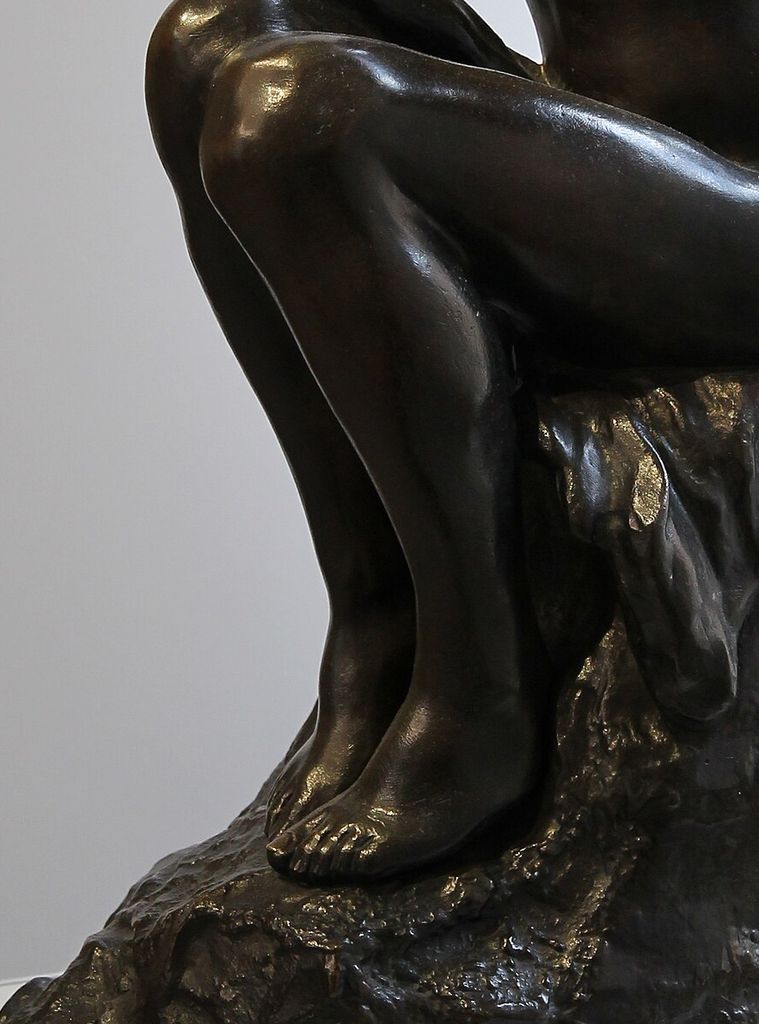
The rock beneath the figure
Ridges in the support break up the light beneath the smoother surface of the figure.
Artworks directory
| Name | Date | Medium |
|---|---|---|
| The Mature Age | 1894–99 | Sculpture |
| The Waltz | c. 1889–93 | Sculpture |
| Sakuntala | 1886–88 | Sculpture |
| The Little Châtelaine | 1892–93 | Sculpture |
| The Gossips | c. 1893 | Sculpture |
| The Wave | 1897–1903 | Sculpture |
| Perseus and the Gorgon | c. 1897–1902 | Sculpture |
| The Implorer | c. 1894–99 | Sculpture |
| Clotho | 1893 | Sculpture |
| Bust of Auguste Rodin | c. 1886–89 | Sculpture |
| Paul Claudel at Sixteen Years Old | c. 1882–87 | Sculpture |
| Young Girl with a Sheaf | c. 1886–87 | Sculpture |
| Giganti | c. 1885 | Sculpture |
| Crouching Woman | c. 1884–85 | Sculpture |
| The Hungry Dog | c. 1893 | Sculpture |
| Old Hélène | c. 1881–82 | Sculpture |
| Fortune | c. 1902–05 | Sculpture |
| The Wounded Niobid | 1906 | Sculpture |
| The Siren, or The Flute Player | c. 1904–05 | Sculpture |
| Deep Thought | c. 1898 | Sculpture |
| Dream by the Fireside | c. 1899 | Sculpture |
| Paul Claudel at Thirty-Seven | 1905 | Sculpture |
| Portrait de Madame Claudel | c. 1883 | Sculpture Musée Camille Claudel. |
| Jeune Femme aux yeux clos | c. 1885 | Sculpture Musée Camille Claudel. |
| Ferdinande de Massary | 1888 | Sculpture Musée Camille Claudel. |
| Léon Lhermitte | 1889 | Sculpture Musée Camille Claudel. |
| Étude de main gauche | c. 1889 | Sculpture Musée Camille Claudel. |
| Vieil aveugle chantant | c. 1894 | Sculpture Musée Camille Claudel. |
| Tête de vieillard | c. 1890 | Sculpture Musée Camille Claudel. |
| Étude pour la tête d’Hamadryade | c. 1895 | Sculpture Musée Camille Claudel. |
| Aurore | c. 1900 | Sculpture Musée Camille Claudel. |
Discussion
Look again at the images and ideas explored in The Siren, or The Flute Player. These editorial prompts invite your observations.
Reader Insights
How does the gap between the face and the flute affect the scene?
Where does the curved pose begin to feel stable?
Join the Conversation
Share a detail, comparison or question about The Siren, or The Flute Player below.
References
- Musée Camille Claudel, La Sirène ou La Joueuse de flûte, object record for 2010.1.22, collection photograph and excerpts of Claudel’s letters to Eugène Blot,. View source.
- Musée Camille Claudel, March 2024 press dossier, collection checklist for Room 13,. View source.
- Art Institute of Chicago and J. Paul Getty Museum, Camille Claudel, chronology for 1905, Salon des Artistes Français entry 2981,. View source.
- Galerie Eugène Blot, Exposition d’œuvres de Camille Claudel et de Bernard Hoetger, December 1905, entry 8, facsimile at the Musée Camille Claudel,. View source.
- Musée Camille Claudel, De la plume au ciseau. La correspondance de Camille Claudel, 2023–24 exhibition press release,. View source.
- Musée Rodin, The Wave or The Bathers, collection record and photographs,. View source.
- Musée Camille Claudel, 1905 : l’exposition Claudel & Hoetger, venue, dates and installation evidence,. View source.
- Christie’s, La joueuse de flûte, lot 1478337, object details for Blot cast no. 1,. View source.
- Christie’s, La sirène ou La joueuse de flûte, lot 5766372, object details for Blot cast no. 4,. View source.